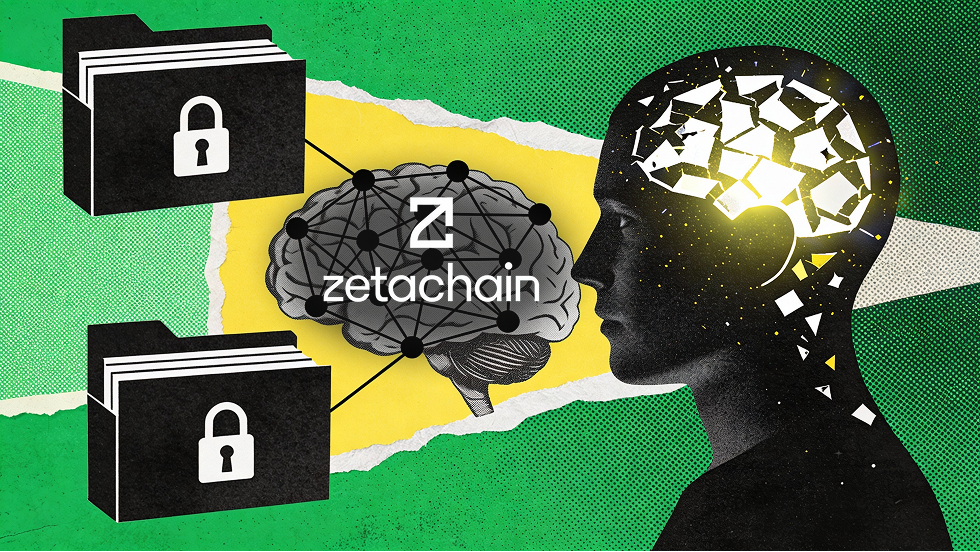
Interview with ZetaChain Lead Jessie Zhang: Reclaiming Humanity's Right to Think Between Decentralization and AI

marsbitPublished on 2026-02-06Last updated on 2026-02-06

Abstract

Interview with Jessie Zhang, Head of Incubation and Investment at ZetaChain, discussing the intersection of decentralization and AI, and the importance of reclaiming human cognitive sovereignty. ZetaChain, initially known for cross-chain interoperability, evolved in 2025 from building foundational infrastructure to focusing on real-world applications, connecting major blockchains like Bitcoin, Ethereum, and Solana. The team began exploring how blockchain could address growing concerns around AI, particularly data privacy and centralized control. Jessie highlights the risks of AI-driven "cognitive centralization," where user data—including intentions, emotions, and preferences—is concentrated in few platforms, threatening individual autonomy. Examples like OpenAI retaining deleted user chats and past incidents of algorithmic manipulation (e.g., Facebook influencing elections) underscore the urgency. ZetaChain’s response is Anuma, a private AI platform built as a "personal memory layer." Anuma acts as a privacy-first AI管家 (butler) that manages user data locally, allowing interaction with models like ChatGPT or Claude without surrendering personal information. It ensures data sovereignty, prevents context fragmentation across AI tools, and safeguards independent thinking. Jessie emphasizes that privacy is an architectural imperative, not just a feature, and that blockchain’s trustless, ownership-based model is critical for AI ethics. Anuma, while built on ZetaChain, ...

——An in-depth interview with Jessie Zhang, Head of Incubation and Investment at ZetaChain

When the blockchain space began pondering "what's next," AI almost inevitably became a topic of discussion. But for Jessie Zhang, this is not merely a technological overlay; it is a long-term struggle concerning privacy, cognitive sovereignty, and humanity's independent thinking ability.

As a core contributor to ZetaChain, Jessie operates at the intersection of infrastructure, product incubation, investment, and long-term strategy. In 2025, after ZetaChain reached a key milestone, the decision was made to subsequently launch what seems like an "atypical blockchain product"—Anuma, a privacy-focused AI platform built around a "private memory layer."

In this interview, we started by reviewing ZetaChain's 2025 and ultimately touched upon a more fundamental question:

In a world reshaped by large models, can humanity still maintain genuine independent thought?

Starting with Cross-Chain: ZetaChain's 2025

PANews: Many people know ZetaChain from the keyword "cross-chain." How would you summarize what ZetaChain does, and what progress did you make in 2025?

Jessie:

2025 was a transition period for ZetaChain, moving from 'laying the foundation' to 'gaining momentum.'

From the beginning, we focused on interoperability. We are not just building bridges but creating a universal blockchain that can natively connect all chains. Our goal is to enable developers to avoid deploying and maintaining logic for each chain individually, instead providing comprehensive coverage for different ecosystems like Bitcoin, Ethereum, and Solana in one go.

By 2025, we had achieved native connections with multiple major public chains, supported cross-chain assets and contract calls, and saw significant growth in user scale and ecosystem projects. More importantly, ZetaChain is no longer just a "technical concept" but has been validated as infrastructure capable of supporting real applications.

But at this stage, we began asking a more complex question:

If "connecting everything" is just the means, then what are we truly aiming to protect and empower?

When AI Becomes Powerful Enough, the Risks Become Real Enough

PANews: Why did you start thinking about the integration of blockchain and AI around the middle of last year? Was there a specific trigger?

Jessie:

The core logic stems from our vigilance regarding AI development trends and our commitment to privacy principles.

First, we observed AI shifting from an "efficiency tool" to a form of "cognitive centralization," moving from "information centralization" to "cognitive centralization." Mid-last year was a tipping point. Approximately 80% of the world's high-value AI interaction data was rapidly concentrating in the hands of a very few leading platforms. In May 2025, a US court ordered OpenAI to preserve all ChatGPT user chat histories, including deleted chats and sensitive conversations recorded via its API services, which made us acutely aware of the harsh reality of this "digital centralization."

The data being captured goes far beyond simple natural language interactions; it encompasses your intentions, emotions, decision-making context, and long-term user preferences.

We have already witnessed the cost of data misuse: Facebook manipulating news feeds through algorithms, influencing presidential elections without users' awareness; travel or food delivery platforms using data for precise profiling, engaging in "price discrimination" or "big data price gouging" against frequent users, erasing fair competition behind algorithms; and even on social media, algorithms creating "information cocoons," completely fracturing the worldviews of different groups.

But large models are more insidious than these social networks or search engines. They don't just mislead you on the consumer end; they deeply介入 (intervene in) your thought process. When you ask AI for assistance in decision-making, you can hardly tell if its response is neutral or subtly manipulated by commercial interests or algorithmic biases. When a system gradually understands you better than you do yourself and begins to shape your judgment in reverse, the boundaries of independent thinking become blurred. This is the systemic risk we are concerned about.

The second reason comes from our own DNA and long-term choices.

Ankur Nandwani, a co-founder of the Brave privacy browser ($BAT), is also a core contributor to ZetaChain. Today, Brave's monthly revenue exceeds $10 million, and another privacy-focused application, the instant messaging app Signal, has reached 70 million monthly active users. These facts continually validate one point: privacy is not a niche demand but a long-underestimated, yet consistently essential,刚性需求 (rigid demand).

We have always believed that privacy in the AI era will not be diminished but will be increasingly amplified. As AI deeply介入 (intervenes in) cognition, decision-making, and behavior, data sovereignty and usage boundaries are no longer just technical issues but fundamental questions concerning individual freedom and social structure.

It is against these two backgrounds that we began systematically considering: could there be an infrastructure for LLMs that reintroduces data sovereignty, verifiability, and decentralization into the AI system without sacrificing AI capabilities? This is the fundamental reason we started thinking about blockchain and AI together.

Why Blockchain is Still the Answer

PANews: Many people might think "AI privacy" is a Web2 problem. Why do you believe blockchain is the key?

Jessie:

Among all technologies, only blockchain inherently addresses the three core challenges: ownership, tamper-proof verification, and trustless system design.

An AI company can promise "we don't do evil," but the philosophy of blockchain is: you don't even need to trust me.

We increasingly believe that privacy is not a feature but an architectural choice. Cognitive sovereignty is not guaranteed by terms but enforced by technology.

The Birth of Anuma, and Why It's Defined as a "Private Memory Layer"

Jessie:

Anuma was born precisely to solve the core paradox we just mentioned: we want AI's "intelligence" but not its "manipulation."

The current AI logic is: if you want it to be smarter and understand you better, you must feed it massive amounts of context and personal information. As interactions deepen, these fragments of information gradually piece together a "memory layer" of your true self. You can try asking an AI: "In your eyes, what kind of person am I?" You'll find its answer is often startlingly accurate. This indicates it has already grasped your mental model.

But the problem is, this "memory layer" is currently hosted on the servers of tech giants.

Anuma's starting point is not "anti-AI" but "anti-monopoly." We believe that since "memory" is an inevitable byproduct of AI evolution, it should not naturally belong to any single platform. This memory should be held and controlled by you, and you should be able to take it with you at any time.

By defining Anuma as a "private memory layer," we aim to defend the last line of cognitive sovereignty for humanity in a highly intelligent future. We want to achieve this: allow data to continuously generate value and make you more powerful, while preventing it from becoming a weapon that alienates and attacks us.

What Functions Does Anuma Have?

PANews: How would you introduce Anuma to the average person? What core functions has it currently implemented?

Jessie:

Simply put, Anuma is an AI private butler who will never tell your secrets. The most remarkable thing about this butler is that he doesn't work alone; he brings a whole team of "AI assistants" to serve you. If ChatGPT, Claude, or Gemini are like top expert assistants from different fields, then Anuma is the overall coordinator, the trusted chief butler who knows all your secrets but remains tight-lipped.

This architecture solves two core pain points in current AI usage:

  • First, it is your "cognitive firewall": All sensitive information and historical memory are locked solely with the butler (Anuma). When he dispatches the little assistants to handle tasks, he ensures your privacy is not "stolen" for model training. This means AI can become smarter, but your raw data never leaves your control.

  • Second, it is your "memory synchronizer": When you instruct the butler to switch to a different "assistant" to handle a problem, the conversation memory is completely continuous. You don't need to jump between different Apps, nor repeat your background information to every new assistant. The butler helps each assistant "sync progress"; no matter who you call upon, they always understand you like an old friend.

In terms of user experience, you see only a minimalist, natural conversation interface; but underlying it, we use technical means to reassemble the digital sovereignty originally scattered in the hands of giants and return it to the user.

Humanity's Independent Thought is Still Worth Defending

PANews: Why does your branding repeatedly emphasize "the autonomy of the human mind"?

Jessie:

We believe this is an underestimated crisis. As AI increasingly resembles a "second brain," people are prone to abandon thinking and outsource judgment.

And if this "second brain" does not truly belong to you, then you are essentially handing over your right to think to a system you cannot audit.

The bottom line Anuma wants to protect is: your memory, your context, your thought history should be your private property. Not the platform's, not the model's, and not the advertising system's.

I believe AI will become one of humanity's most important tools. But the prerequisite is that humans remain the masters of their own thoughts.

From ZetaChain to Anuma: Blockchain's Extension into the Web2 World

PANews: How do you view the relationship between ZetaChain and Anuma?

Jessie:

Anuma is the flagship落地 (landing/implementation) of ZetaChain entering its 2.0 phase and fully embracing the AI narrative. I see the relationship between the two as one where "the infrastructure drives the application, and the application defines the value": Internally, we don't simply define Anuma as a "Web3-specific" product; it is built entirely according to Web2's 2C standards and user experience. But at the same time, it is completely built on top of ZetaChain.

This is the direction we believe Web3 should take: the infrastructure becomes invisible, but its value is irreplaceable. Only when users no longer perceive the existence of the "chain" and only feel a "more usable, more secure" service will Web3 truly move towards mass adoption.

Epilogue

At the end of the interview, Jessie said: "The real danger is not how smart AI becomes, but that humans unknowingly hand over the steering wheel of decision-making without realizing it."

Perhaps, Anuma is more than just an AI product.

It is more like a reminder:

In a highly intelligent world, maintaining independent thinking is itself an ability that needs to be guarded by technology.


Trending Cryptos

Related Questions

QWhat is the core mission of Anuma, the AI platform developed by ZetaChain?

AAnuma's core mission is to serve as a 'private memory layer' that protects user data sovereignty and cognitive independence in the AI era. It ensures users retain ownership and control over their personal data and interaction history with AI models, preventing centralized platforms from exploiting or manipulating this information.

QHow does ZetaChain's infrastructure support Anuma's functionality?

AZetaChain provides the underlying decentralized infrastructure for Anuma, enabling features like data ownership, immutability, and trustless system design. This ensures that user data and memory layers remain private, secure, and under user control, without relying on centralized intermediaries.

QWhat risks does Jessie Zhang associate with the current AI landscape?

AJessie Zhang highlights risks such as cognitive centralization, where a few major platforms control vast amounts of user data, leading to potential manipulation, algorithmic bias, and loss of individual decision-making autonomy. She emphasizes that AI systems can subtly influence human judgment, undermining independent thinking.

QHow does Anuma address the trade-off between AI intelligence and user privacy?

AAnuma decouples AI intelligence from data exploitation by acting as a privacy-first intermediary. It allows users to leverage multiple AI models (e.g., ChatGPT, Claude) while keeping their sensitive data and memory layer encrypted and locally controlled. This ensures AI benefits are retained without compromising privacy.

QWhy does Jessie Zhang believe blockchain is essential for solving AI privacy issues?

AShe argues that blockchain is uniquely suited to address AI privacy challenges due to its inherent properties: decentralized ownership, tamper-proof verification, and trustless architecture. Unlike centralized promises of 'do no harm,' blockchain enforces privacy and sovereignty through technical design rather than policy.

Related Reads

7 Months After the Collapse of Huiwang, Southeast Asia's Escrow Platforms Undergo a Major Reshuffle

Following the collapse of Huione Pay—dubbed the "Alipay of Southeast Asia"—seven months ago, the region's underground financial guarantee platform sector is undergoing a significant reshuffle. This power vacuum has been swiftly filled by emerging platforms such as XinBi, Tiger/Navigator, JinBei (renamed JinBo), Dali/Tiancheng, and FullyLight. These platforms, operating largely via Telegram and offering services like escrow for illicit transactions, have absorbed the vast user base and markets left behind by Huione. While positioning themselves as "trust intermediaries," their primary clientele consists of networks involved in online scams, money laundering, illegal gambling, and even human trafficking. For instance, the Tiger/Navigator platform explicitly provides "escrow" services for kidnapping-for-ransom operations ("强押车交易"). Data underscores the immense scale: Huione alone processed over $103 billion in cryptocurrency payments and facilitated over $31 billion through its escrow market before its downfall, linking it to Cambodia's notorious Prince Group. Since its collapse, competitors have seen explosive growth. For example, the XinBi platform has accumulated over $1.6 billion in total USDT revenue, while platforms like NewPay, OkPay (under Dali), and FullyLight Wallet collectively processed over $4.8 billion in USDT in a single year. This ecosystem thrives in regions like Cambodia and Myanmar, where regulatory gaps allow these platforms to act as critical financial infrastructure for sprawling cybercrime industries, from scam compounds to online casinos. The article concludes that the moniker "Southeast Asian Alipay" is a misnomer, obscuring the platforms' fundamental role in enabling serious criminal enterprises rather than representing legitimate financial innovation.

Odaily星球日报33m ago

7 Months After the Collapse of Huiwang, Southeast Asia's Escrow Platforms Undergo a Major Reshuffle

Odaily星球日报33m ago

The Changing Landscape: What Are Crypto VCs Experiencing?

Title: The Shifting Landscape of Crypto Venture Capital The era of dedicated crypto venture capital funds is undergoing a significant transformation. Once essential for navigating the sector's complexity and high risk, these specialized funds are now facing an identity crisis as the market matures. This shift mirrors historical patterns in other specialized investment classes like cleantech and SPACs, where initial information advantages dissipate as technologies become mainstream and integrated into existing industry frameworks. The article argues that crypto is reaching a critical inflection point, transitioning from a "building phase" to an "integration phase." Major players like Stripe, BlackRock, and Visa now engage with crypto not for its novel mechanics but as a foundational financial infrastructure. Their needs—regulatory compliance, banking partnerships, distribution channels—align with traditional fintech, a domain easily understood by large, generalist funds like Sequoia and Founders Fund. This evolution creates a "barbell effect" within the VC landscape. On one end are massive, diversified platforms that can incorporate crypto as one vertical among many. On the other are small, nimble funds focused on niche, experimental projects. The middle ground—medium-sized dedicated crypto funds—is being squeezed out. Their typical fund size makes it impossible to generate sufficient returns solely from early-stage crypto bets, yet they cannot compete with giants for later-stage deals. Consequently, leading crypto-native firms like Paradigm and Framework Ventures are expanding into AI, robotics, and other sectors, driven partly by LP pressure for better returns amid a broader VC DPI crisis. Others, like Dragonfly and a16z, have narrowed their crypto focus predominantly to financial infrastructure like stablecoins, reframing the sector's core narrative. For crypto entrepreneurs, this consolidation presents challenges. While generalist funds offer larger checks and broader resources, crypto projects now compete fiercely with AI for attention and capital within these firms. Furthermore, the long-term, non-commercial foundational work that built the ecosystem—funded by dedicated crypto VCs—is less likely to attract generalist capital focused on direct returns. The conclusion is that "crypto investor" as a standalone category is becoming obsolete, akin to "internet investor." Crypto is becoming a baseline infrastructure layer. The future will see a barbell structure: large-scale growth financing handled by generalist funds, while pioneering, speculative projects are funded by small, specialized vehicles. The dedicated crypto funds of the 2017-2021 boom, which incubated core infrastructure, are giving way to this new, bifurcated reality.

Foresight News50m ago

The Changing Landscape: What Are Crypto VCs Experiencing?

Foresight News50m ago

As Consensus Accelerates, What Are Young Investors Betting On?

Title: As Consensus Forms Faster, What Are Young Investors Betting On? In the rapid evolution of tech investment, a new generation of young investors is navigating a landscape where AI, robotics, commercial aerospace, and quantum computing are advancing simultaneously. Traditional investment logic based on financial models is giving way to a need for deep technical understanding and the ability to act before industry consensus forms. An analysis of trends from the "WAIC FUTURE TECH" list of young investment leaders reveals key shifts in focus. The first major trend is the movement of AI from the digital screen into the physical world. Investment is shifting from large language models and chatbots towards embodied AI, robotics, AI hardware, and edge computing. While demonstrations generate excitement, the real challenge lies in achieving scalable, reliable, and cost-effective delivery in complex real-world environments like factories and logistics. Success depends not just on algorithms but on the integration of sensors, actuators, and control systems. Second, the competitive focus for large models is moving beyond raw capability toward building an "intelligence flywheel." The goal is to create self-reinforcing systems where user interaction generates data, improving the model, which in turn enhances the user experience and attracts more engagement. Companies that successfully embed AI into workflows to create these closed-loop systems can build lasting value that isn't easily erased by the next model upgrade. Third, facing a potential bottleneck in high-quality human-generated data, investors are looking at new underlying technologies. Reinforcement learning and self-play, as demonstrated by AlphaGo Zero, offer paths for AI to generate its own experience. Scientific foundation models, which aim to build general AI capabilities for fields like life sciences and materials discovery, represent a non-consensus direction that could unlock new frontiers of knowledge and data. Finally, in deep-tech areas like quantum computing, commercial aerospace, and space-based infrastructure, patient capital is essential. These fields have long, uncertain development and validation cycles involving complex engineering, supply chains, and regulations. Investment here requires a long-term view, focusing on foundational team capabilities and the eventual emergence of market demand, even if commercial returns are distant. Collectively, these trends illustrate how young investors are adapting to a new era. They are learning to make earlier, technically-informed judgments, balance hype with real-world viability, and provide the patient capital needed to build the deep-tech foundations of the future.

marsbit1h ago

As Consensus Accelerates, What Are Young Investors Betting On?

marsbit1h ago

Trading

Spot

Hot Articles

Discussions

Welcome to the HTX Community. Here, you can stay informed about the latest platform developments and gain access to professional market insights. Users' opinions on the price of AI (AI) are presented below.

活动图片














