Idle Macs Can Also Make Money? An Overview of Eigen Labs' Decentralized AI Inference Network Darkbloom

marsbitPublished on 2026-06-22Last updated on 2026-06-22

Abstract

AI inference is becoming a crucial layer of internet infrastructure, yet it remains largely dependent on costly, capacity-limited centralized systems with potential security risks. Meanwhile, millions of powerful computers sit idle globally. Eigen Labs' Darkbloom network aims to utilize this idle capacity by enabling distributed AI inference on Mac computers, specifically those with Apple Silicon chips. Darkbloom's architecture consists of three components: users who send inference requests, a coordinator (operated by Eigen Labs) that routes these requests, and providers (Mac owners) whose machines run the models and return outputs without being able to see the request content. The system prioritizes privacy through a hardened provider process, software integrity checks, and hardware-supported attestation based on Apple's security architecture to ensure verifiable privacy. Economically, Darkbloom differs from traditional models. It leverages existing hardware, with marginal costs primarily driven by electricity, allowing it to offer pricing roughly 50% lower than major API aggregators. Providers keep 100% of the inference revenue, and the project does not rely on token subsidies; earnings come solely from real AI inference demand. However, early-stage earnings are modest, with top providers currently earning under $6 per day, influenced by factors like hardware specs, uptime, and network demand. The network currently supports models like Google's Gemma 4 and OpenAI's GPT-OS...

Compiled by: Felix, PANews

AI inference is gradually becoming a critical layer of internet infrastructure. However, most inference currently still relies on a centralized architecture, which is costly, has limited capacity, involves multiple layers of stacking, and carries certain security risks. At the same time, there are millions of powerful computers worldwide that remain idle for most of the day.

Eigen Labs recently launched the AI inference network Darkbloom, which explores performing distributed AI inference on idle Mac computers. By combining verified nodes, hardware-level privacy protection, and superior economic efficiency, it transforms idle Apple Silicon chips into a more efficient, privacy-first computing network.

The project was launched as a research preview around April this year, upgraded to a public alpha version in May, and is now available on the OpenRouter platform. In the alpha version, the available models are Google's Gemma 4 and OpenAI's GPT-OSS.

Core Architecture and Verifiable Privacy

The Darkbloom network consists of three parts: users, coordinators, and providers.

  • Users can send inference requests through a chat interface or a compatible OpenAI API.
  • The coordinator (operated by Eigen Labs) routes these requests to eligible Macs in the network.
  • Providers (users who own these eligible Macs) run the models and return the output, but they cannot see the request content.
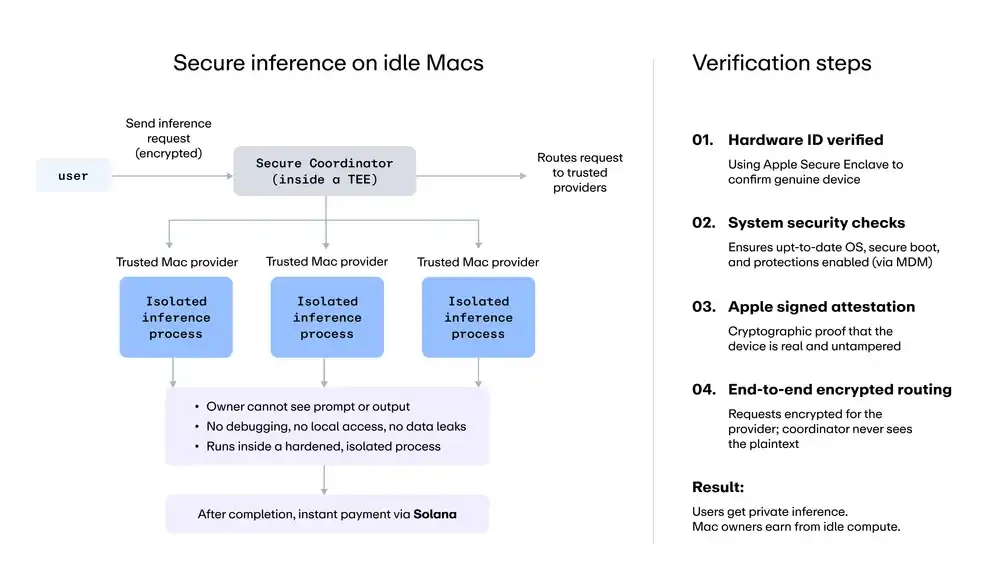
Darkbloom is built on a privacy-first distributed inference model. The provider process is hardened to resist common local inspection paths, including debugger attachment and external memory inspection. The integrity of the running binary is also part of the trust model, helping to ensure that the software serving requests conforms to network expectations.

The system also uses hardware-supported attestation based on Apple's security architecture. Secure Enclave keys, attestation signals, and periodic challenge-response checks are used to verify that participating nodes are running with the intended protections and software state, achieving truly verifiable privacy.

Economic Model and Daily Earnings

Darkbloom is fundamentally different in its business model compared to the vast majority of projects. In the traditional tech stack, costs include hardware, facilities, cooling, networking, operational overhead, and layers of profit margins. In Darkbloom's model, the hardware already exists, and the marginal cost is primarily driven by electricity. Darkbloom's benchmark pricing is only about 50% of current mainstream API aggregators. Providers (Mac hosts) can keep 100% of the inference revenue. Furthermore, Darkbloom has not taken the path of issuing tokens to subsidize early participants; node earnings come entirely from real AI inference demand.

It is worth noting that, given the project's early stage of development, earnings are relatively modest. Factors such as memory and hardware configuration, uptime, model demand, node health, and network demand can all influence earnings to some extent.

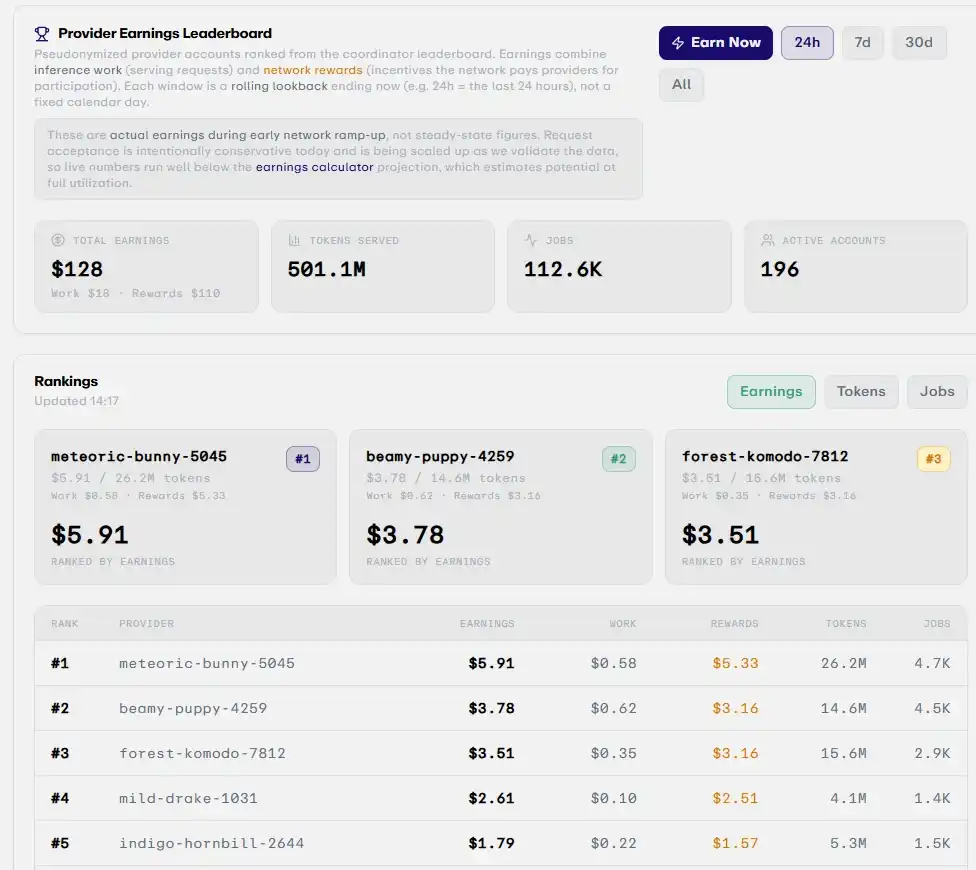
Current leaderboard data shows that the top provider earns less than $6 per day, and the fifth-ranked provider earns even less than $2. However, as the network opens up to large language models with high memory requirements and real user usage increases, this situation is expected to improve.
Regarding how to set up an idle Mac, the steps are as follows:

  • Acquire a Mac with an Apple Silicon chip
  • Ensure it runs macOS 14 or higher
  • Install the Darkbloom provider
  • Keep the Mac online with a stable internet connection
  • Let the network route supported AI tasks

Related reading: A Roundup of Recent Stocks and Crypto Assets Worth Watching: AI, RWA, and Space Stocks...


Trending Cryptos

Related Questions

QWhat is the core concept of Eigen Labs' Darkbloom network, as described in the article?

ADarkbloom is a decentralized AI inference network that aims to utilize the idle computing power of Mac computers equipped with Apple Silicon chips. It distributes AI inference tasks across these devices, offering a more cost-effective and privacy-focused alternative to centralized infrastructure.

QHow does Darkbloom's architecture ensure privacy for user requests?

ADarkbloom ensures privacy through a hardware-supported verification model. It uses Apple's Secure Enclave keys, attestation signals, and periodic challenge-response checks to verify that provider nodes are running with the expected protections. Provider processes are hardened against local inspection, and providers cannot see the content of user requests.

QWhat is the current economic model for providers (Mac owners) participating in the Darkbloom network?

AProviders keep 100% of the inference revenue they generate. The model is based on real AI inference demand, not token subsidies. Currently, however, earnings are low; the top provider earns less than $6 per day, and the fifth earns under $2, with factors like hardware, uptime, and network demand influencing income.

QWhich AI models are available in Darkbloom's current alpha version, and where is it accessible?

AIn its current public alpha version, Darkbloom offers Google's Gemma 4 and OpenAI's GPT-OSS models for inference. The network is accessible on the OpenRouter platform.

QWhat are the basic requirements for a Mac to become a provider on the Darkbloom network?

ATo become a provider, a user needs a Mac with an Apple Silicon chip, running macOS 14 or a higher version. They must install the Darkbloom provider software and keep the Mac online with a stable internet connection to allow the network to route AI tasks to it.

Related Reads

Primit Season 1 Officially Launches: $100,000 Avalanche On-Chain Perp Trading Incentive Event Now Live

Primit, in collaboration with Avalanche, has officially launched "Season 1: On-Chain Perp Frenzy," a large-scale incentive event for on-chain perpetual trading on the Avalanche network. The campaign features a total prize pool equivalent to 100,000 USDT in AVAX, distributed across four concurrent reward mechanisms. Key components of the event include: * **Daily Random User Rewards ($7,000 pool):** Over 14 days, 20 users daily with at least $200 in trading volume are randomly selected to share a $500 daily pool. * **Twitter Contributor Rewards ($5,200 pool):** Rewards of $300–$500 for high-quality community content about Primit on Twitter/X using #PrimitAvalanche. * **Referral Rebate Mechanism ($50,000 pool):** A proportional share of the pool is distributed based on valid referral volume, with no individual cap. Referred users must register via a code and achieve ≥$500 cumulative volume with ≥5 trades. * **Volume Leaderboard ($37,800 pool):** Top 120 traders by cumulative volume receive rewards ranging from $100 to $4,000. The event runs from July 15 to July 28. Trading volume from AVAX-related pairs or using native gas receives a 1.5x multiplier, incentivizing engagement with Avalanche's core ecosystem. According to the Primit team, the season serves as a product stress test to demonstrate the readiness of on-chain perpetuals for high-frequency, professional trading demand, facilitated by Avalanche's high-performance infrastructure. Relevant links to the official Twitter and event portal are provided.

TheNewsCrypto1h ago

Primit Season 1 Officially Launches: $100,000 Avalanche On-Chain Perp Trading Incentive Event Now Live

TheNewsCrypto1h ago

Trading

Spot

Hot Articles

Discussions

Welcome to the HTX Community. Here, you can stay informed about the latest platform developments and gain access to professional market insights. Users' opinions on the price of AI (AI) are presented below.

活动图片