"I Don't Need a Better Model Anymore": A Panorama of AI Users Under a Reddit Hot Post

marsbitPublished on 2026-06-12Last updated on 2026-06-12

Abstract

Titled "I Don't Need a Better Model Anymore": AI User Reactions on Reddit Anthropic recently released Claude Fable 5, its first publicly available 'Mythos'-tier model, achieving 80.3% on the SWE-Bench Pro benchmark and significantly outperforming its predecessor and competitors. However, a viral Reddit post titled "Claude Fable made me realize I don't need better models anymore" highlighted a growing user sentiment of "good enough." Top comments expressed "model fatigue," with users stating that earlier models like Opus 4.5/4.8 already sufficed for their workflows. High cost was a key concern, as Fable 5's API is nearly twice the price of Opus 4.8, with users questioning the return on investment and suggesting the field has hit a plateau. The most frequent complaint targeted Fable 5's stringent safety filters. Designed to intercept high-risk requests (e.g., cybersecurity), the system was perceived as overly conservative. Users reported frequent rejections for routine security-related tasks, leading to automatic fallbacks to the older Opus model. Paying users were particularly frustrated, feeling they paid a premium for a less usable product. Dissenting voices came from users with heavy, complex tasks. For workloads like high-energy physics simulations with thousands of code lines, Fable 5's improved long-context understanding and error detection represented a significant, worthwhile leap—described as moving from a "college player to an NBA starter." The debate underscore...

Author: Friday, Shenchao TechFlow

Anthropic just delivered a performance report that is impeccable on paper.

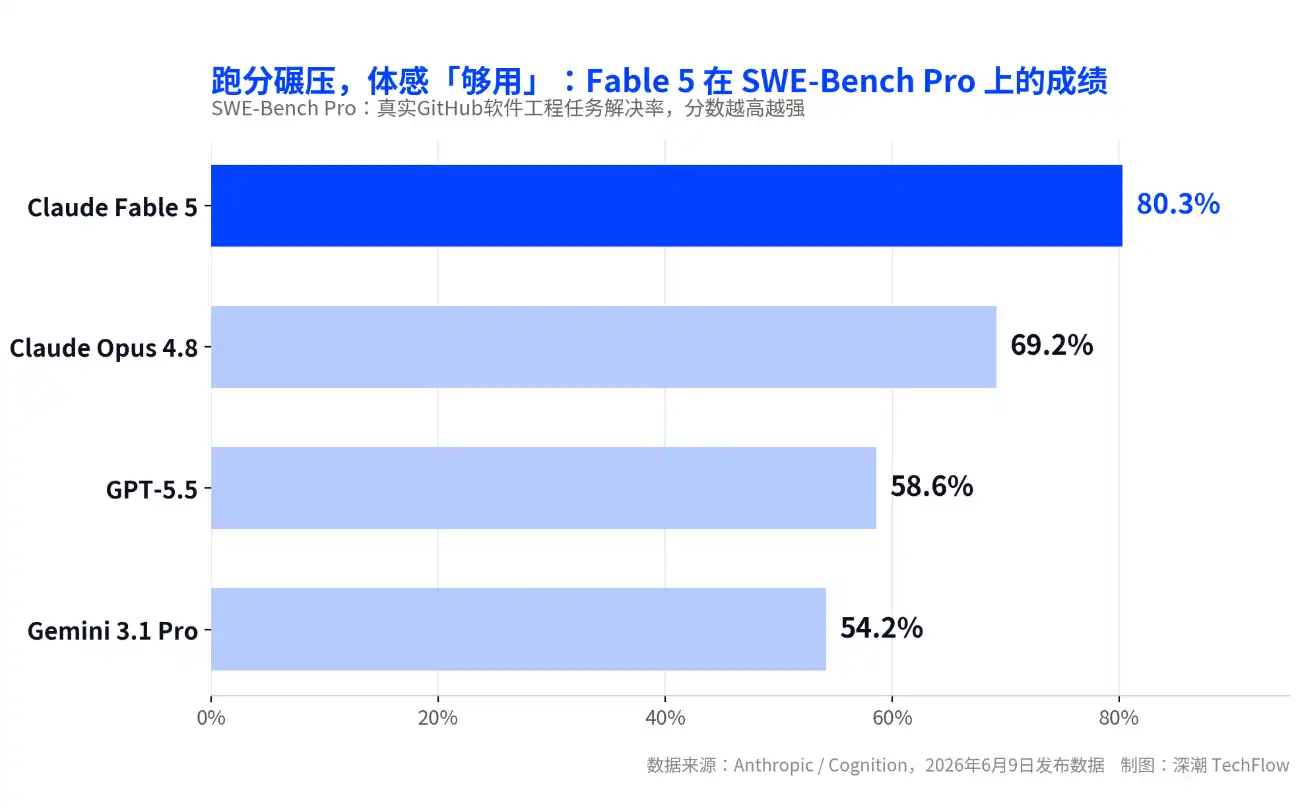
Claude Fable 5, released on June 9th, is the company's first publicly available Mythos-tier model. It scored 80.3% on the real-world software engineering benchmark SWE-Bench Pro, leading its own previous flagship Opus 4.8 by about 11 percentage points and surpassing GPT-5.5 by over 20 percentage points.

But user reactions poured cold water on the excitement.

Three days after the release, a hot post on the r/artificial subreddit (weekly traffic 305k) was titled: "Claude Fable made me realize I don't need a better model anymore." The poster, Axi0m-22, said he used Fable for a while for security research and daily tasks, then almost immediately switched back to Opus for coding and Haiku for miscellaneous jobs. He made an analogy: It's like watching the iPhone 17 launch while holding an iPhone 14. "You know the new one is better, but you think: Nah, mine is fine."
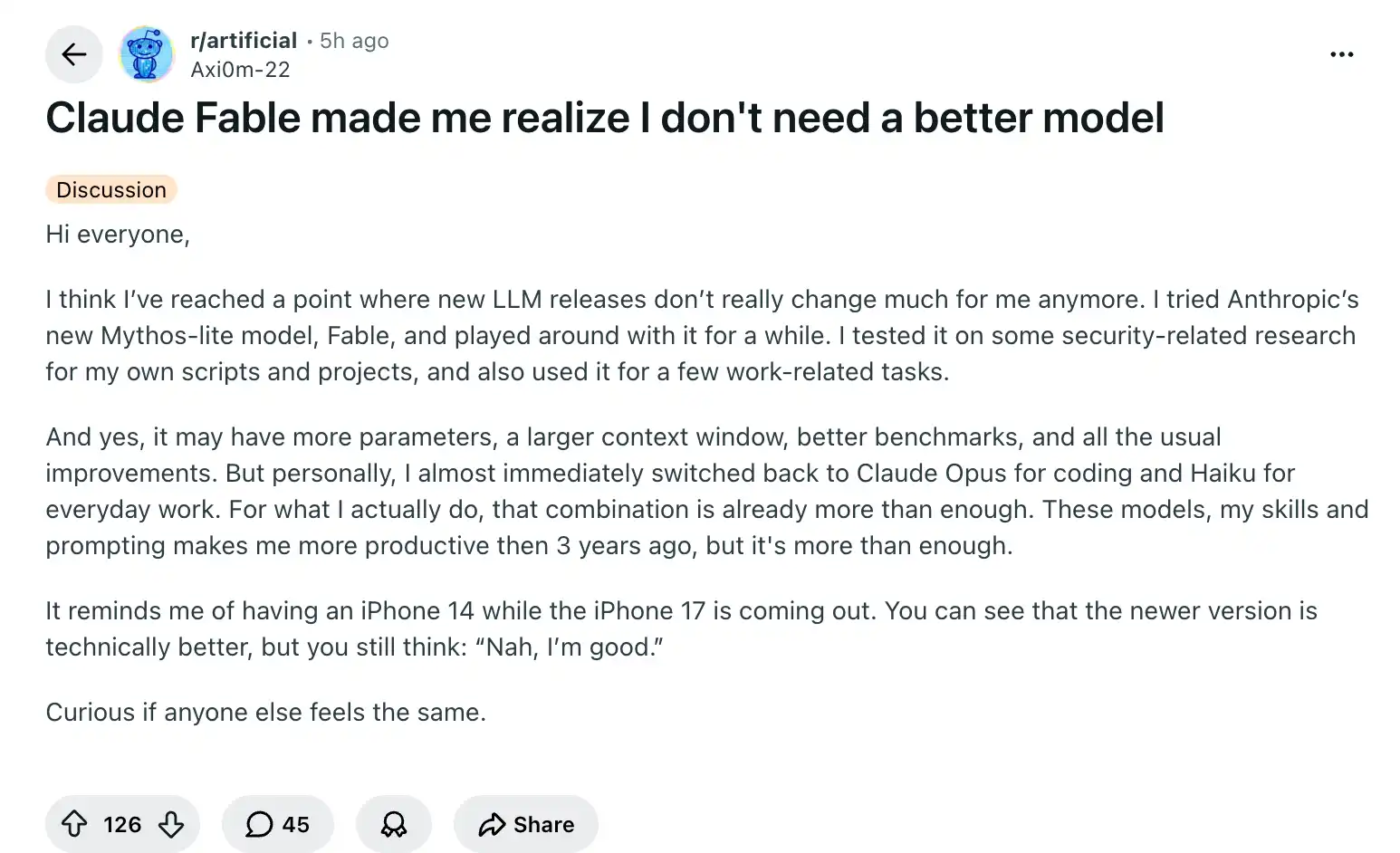
The High-Vote Zone is Occupied by the "Good Enough" Camp: Model Fatigue Becomes the Prevailing Sentiment

The top comment with 42 upvotes states: "Other than the larger context window, I haven't felt the need for a stronger model since Opus 4.5."

Another user, hyprlab, received 13 upvotes for this statement: "I don't see any benefit to my workflow from switching to a model that burns tokens even faster. Opus 4.8 high-intensity mode is already comfortable enough."

There's a common cost calculation behind such remarks.

Fable 5's API is priced at $10 per million input tokens, nearly double that of Opus 4.8. User siromega37 was blunt: "Higher token consumption, but no return on investment. I think we're seeing the plateau, the bubble will eventually burst."

User hobopwnzor gave a more systematic interpretation: "We've been near the top of the S-curve for a while. Recent improvements mainly come from tool use and peripheral engineering, not the core model capability itself."

Safety Guardrails Become the Biggest Complaint: "90% of Intended Uses Get Rejected"

If "good enough" is just sentiment, then complaints about safety guardrails are a concrete product issue.

According to Anthropic's official description, Fable 5 shares the same underlying model as the Mythos 5, which is only available to a select few institutions. The difference is that Fable has a safety classifier installed: requests involving high-risk fields like cybersecurity are intercepted and handed off to Opus 4.8 to answer. The company states this mechanism is tuned conservatively, triggering in less than 5% of sessions on average, and may mistakenly block harmless requests.

In this Reddit thread, the perceived trigger rate is clearly much higher than 5%. User jradoff, whose comment got 17 upvotes, said he asked Fable to review the security of his code, and "basically any mention of security-related stuff gets rejected," then it falls back to Opus. Another comment with 12 upvotes was even harsher: "90% of what you want to use it for gets rejected, which makes it useless."

Paid users are even more aggrieved. User kaitava, who subscribes to the $200 tier, wrote: "I'm paying double the usage fee, I ask it to do a security review, and I get downgraded to Opus. Now I dislike everything about it, just waiting for OpenAI to catch up."

For a flagship product touting a leap in capability, "the usability cost paid for safety" is becoming a core variable in users' decisions to pay.

Opposing Voices: Heavy-Duty Task Users Feel the Difference is "Night and Day"

The hot post isn't without opponents, and the opposing camp's profile is quite clear: the heavier the task, the higher the praise.

User Phylaras's comment received 15 upvotes: "Fable made a substantial difference for me. On those massive, complex tasks demanding huge context windows, it caught errors that weren't spotted before." A user claiming to work on high-energy physics simulations said that a single simulation model can easily be 8,000 to 10,000 lines of code with hundreds of interacting models. "Having a model that can work independently and continuously, understanding environmental details, is something I eagerly anticipate."
The fiercest rebuttal came from user Navetz: "Honestly, people who have used this model think posts like this are insane. To me, it feels like a different, smarter person. I've been using it non-stop. I explained it to non-technical friends: it's like going from a college basketball player directly to an NBA starter."

Some offered compromise usage patterns. User ready-eddy suggested using Fable as a "planner and fixer," not as the daily "builder," unless you don't mind burning money. Another comment summed it up more like a user manual: Using Fable for spreadsheet calculations is choosing the wrong model; using Haiku to run a complex task with 16 agents is also choosing the wrong model. "There's no inherently bad model, only models used for the wrong scenario."

After the Disconnect Between Benchmarks and User Experience, Will Public AI Get Stronger?

The most interesting comment in this debate shifted the topic from product to industry structure.

User KedMcKenna proposed a "Public AI Freeze Theory": the models accessible to ordinary people might forever remain near the current level, while corporate and governmental elites will continuously get access to stronger private models. "We know of at least Mythos, and there are likely even stronger models we'll never hear about."

This comment points to a fact: Mythos 5 is indeed not open to the public and is currently only available to cyber defense agencies and critical infrastructure companies through the Project Glasswing program.

Looking at benchmark scores and public sentiment together, the conclusions aren't contradictory.

Benchmarks measure the ceiling of capability, while the Reddit high-vote zone reflects the ceiling of daily needs. When most users' tasks were already satisfied in the Opus 4.6 era, stronger models can only prove themselves in extreme scenarios like physics simulations or ultra-long context tasks. Model vendors no longer face a "can it be done" problem, but rather a "who needs it, how much are they willing to pay, and how much safety friction can they tolerate" problem.

Three days after release, Fable 5 received two completely different report cards: one on the benchmark charts, and another in the court of public opinion. Which one is closer to the truth depends on how quickly Anthropic adjusts its safety classifier and how heavily reliant users vote with their wallets.


Trending Cryptos

Related Questions

QWhat is the main point of the Reddit post titled 'I don't need a better model anymore' regarding Claude Fable 5?

AThe main point is that despite Claude Fable 5's impressive benchmark scores, many users feel the new model's improvements are not necessary for their daily workflows. The post author and many commenters express 'model fatigue,' stating that previous models like Opus 4.8 are already 'good enough' for their needs, and the higher cost and restrictive safety features of Fable 5 don't provide sufficient added value for them.

QAccording to the article, what are the two primary user criticisms of Claude Fable 5?

AThe two primary criticisms are: 1) High cost with insufficient return on investment (ROI), as its API price is nearly double that of Opus 4.8. 2) Overly restrictive safety 'guardrails.' Users report a much higher rate of request denials for security-related tasks than the official 5% estimate, often downgrading them to Opus, which diminishes Fable 5's usability for its intended purpose.

QWho are the users that reported a positive, substantial difference when using Claude Fable 5?

AThe positive feedback comes from users with extremely heavy and complex computational tasks. Examples given include users working on high-energy physics simulations involving thousands of lines of code and hundreds of interacting models, or those needing to process very long context windows for complex tasks. For them, Fable 5's advanced capabilities provide a tangible, 'night and day' difference in performance.

QWhat is the 'public AI freeze theory' mentioned by a commenter in the article?

AThe 'public AI freeze theory' suggests that the capability of AI models available to the general public may plateau around the current level (like Opus 4.8). Meanwhile, significantly more powerful private models (like the non-public Mythos 5) will continue to be developed exclusively for elite entities such as corporations and government agencies, creating a growing capability gap between public and private AI.

QWhat final conclusion does the article draw about the disconnect between Claude Fable 5's benchmark scores and user sentiment?

AThe article concludes that the disconnect is not contradictory. Benchmark scores measure the peak capability of a model, while user sentiment reflects the 'ceiling' of everyday needs. For most users, their tasks were already satisfied by earlier models. Therefore, new, more powerful models must now justify themselves not just on raw ability, but on cost, specific niche use-cases, and how much usability is sacrificed for safety features. The 'true' performance of Fable 5 will depend on Anthropic's adjustments to its safety filters and adoption by heavy-duty, paying users.

Related Reads

NVIDIA CPU Advances, China's RISC-V Responds: Semiconductor Deep Dive - Part Four

NVIDIA is set to launch its new Vera AI data center CPU in China as early as August, with high pricing. While this move offers a new option, it highlights China's continued dependence on foreign-controlled Arm architecture. In response, the Chinese semiconductor industry is increasingly turning to RISC-V as a strategic alternative for achieving high-performance computing autonomy. The article explores the concept of the "impossible triangle" in CPU development—balancing prosperity, control, and autonomy—and posits that RISC-V's open-source, modular nature offers a unique path to achieving all three. While RISC-V is already dominant in embedded systems, the focus is now shifting to data centers and AI workloads. China has become a global hotspot for RISC-V development, driven by AI-driven compute demand, supply chain concerns from export controls, cost benefits of open-source, and strong policy support. Multiple Chinese companies have reportedly crossed the key performance threshold of 15 SPECint per GHz, a benchmark for entering the high-performance CPU club. Progress extends beyond single-core benchmarks. Companies are developing complete computing subsystems, including commercial-grade coherent network-on-chip (NoC) technology and server processors with up to 40 cores that strictly adhere to the RVA23 standard to ensure software compatibility. Real-world applications are emerging in areas like video transcoding and edge AI. However, significant challenges remain. The RISC-V ecosystem faces fragmentation, immature toolchains and verification processes, and gaps in single-core performance and energy efficiency compared to mature x86 and Arm architectures. The formidable software moat, epitomized by NVIDIA's CUDA, is a long-term hurdle. In conclusion, while RISC-V cannot immediately replace offerings like NVIDIA's Vera, it represents a viable long-term path for China to develop a self-sufficient, high-performance CPU ecosystem. The journey is acknowledged to be long and arduous, requiring sustained effort to overcome technical and ecosystem challenges.

marsbit3h ago

NVIDIA CPU Advances, China's RISC-V Responds: Semiconductor Deep Dive - Part Four

marsbit3h ago

My Coding Betting Dashboard is Profiting, but Polymarket is Truly Not a Good Place for 'Arbitrage'

The author built a custom monitoring dashboard for Polymarket, a prediction market platform, and tested it with $1,600, achieving over 30% returns. However, the core argument is that Polymarket is not a good venue for traditional arbitrage. The dashboard has two main sections: a "Portfolio Dashboard" for tracking active positions with key metrics like total capital, P&L, and a risk-control module using a tier system (T1, T2, T3), and an "Opportunity Watchlist" for monitoring markets. The article details a critical structural trap in binary markets: a bet with a high perceived probability of success still carries a 100% loss risk if wrong. The author's T1/T2/T3 system is designed to manage this by limiting position sizes based on conviction and time horizon, emphasizing that high confidence should not equal high concentration. A key insight is the danger of "pseudo-diversification"—betting on different markets driven by the same underlying variable. The author concludes that Polymarket offers few true low-risk, arbitrage opportunities. It is instead a high-risk environment where wins can create a false sense of mastery, leading to large losses. The platform is better viewed as a training ground for honing judgment through disciplined, framework-driven betting rather than a reliable income source. The tools help transform intuition into structured, rule-based decisions to mitigate the risk of catastrophic errors.

marsbit6h ago

My Coding Betting Dashboard is Profiting, but Polymarket is Truly Not a Good Place for 'Arbitrage'

marsbit6h ago

WeChat AI Card Hands-On Guide: Has the AI Shopping Era Arrived?

**"WeChat AI Card" Practical Test Guide: Has the Era of AI Shopping Arrived?** WeChat has officially launched the "AI Exclusive Card," a feature integrated into its Workbuddy AI assistant. This card is designed to handle payments for AI-initiated purchases. Our hands-on test reveals it's not yet a tool for fully autonomous AI shopping, but rather a controlled payment layer for AI agents. The AI Card functions as an isolated sub-wallet within WeChat Pay. Users must bind the card and transfer funds into it from their main wallet. Crucially, every transaction requires explicit user confirmation via smartphone scan; AI cannot spend autonomously. Currently accessible through the Workbuddy agent, the card targets specific digital consumption scenarios: purchasing paid content (reports, data), calling paid APIs/tools, and subscribing to services. Its design prioritizes security and control by separating funds and mandating approval for each payment. We tested a real-world scenario: ordering bubble tea via Workbuddy using a "Meituan Life Assistant" skill. The process encountered multiple hurdles: high "skill" usage costs (exceeding daily free credits), and most importantly, while a payment was successfully initiated, the AI purchased an incorrect product (a mismatched group-buy coupon instead of the desired drink). This highlights the current limitation: the **AI Card only solves the payment step**. The broader challenge lies in the **AI agent's execution chain**—accurately understanding intent, navigating third-party platforms, selecting the right product, and ensuring proper fulfillment. The payment succeeded, but the purchase failed to meet the user's need. In conclusion, the WeChat AI Exclusive Card is a cautious, early-step experiment in AI commerce. It provides a secure, user-controlled payment method for agent interactions but is not yet capable of reliable, end-to-end complex purchases. For now, it's best used for low-value, low-risk digital services with careful user verification at each step. The vision of AI handling complete shopping tasks remains a work in progress.

marsbit8h ago

WeChat AI Card Hands-On Guide: Has the AI Shopping Era Arrived?

marsbit8h ago

Trading

Spot
Futures

Hot Articles

Discussions

Welcome to the HTX Community. Here, you can stay informed about the latest platform developments and gain access to professional market insights. Users' opinions on the price of AI (AI) are presented below.

活动图片