I Built Myself an Investment Workbench Using AI

marsbitPublished on 2026-06-16Last updated on 2026-06-16

Abstract

For the past two weeks, I've been immersed in Vibe Coding—using AI to write code from natural language descriptions. This process has enabled me to quickly build functional tools that address long-standing personal ideas. Previously, I had many concepts but found execution too cumbersome. Key ideas included a unified dashboard for assets across US stocks, Crypto, HK stocks, and A-shares; a real-time alert system for price movements; an investment map visualizing sector relationships; and a tool to correlate prediction market bets with news and market data. Traditional development hurdles meant these often remained unrealized. Using AI (Codex, Claude Code, and DeepSeek API), I built four initial tools: 1. A **Cross-Market Asset Dashboard** showing total assets, daily P&L, and holdings by market, with added features for alerts and sector mapping. It's deployed locally for privacy. 2. A **Prediction Market (PM) Monitor** tracking bets on events (e.g., company valuations) and correlating probability shifts with news and market movements. I categorize bets by conviction to filter noise. 3. A **Simple Operations Backend** for managing my writing workflow (topics, progress, publishing). It's cloud-deployed for mobile access. 4. A **One-Click Formatting Tool** that automates converting drafts into various platform-specific formats, saving manual effort. While these tools are basic, they represent a significant shift: AI lowers the barrier to creating personalized systems. I be...

Over the past couple of weeks, I’ve been a bit obsessed with Vibe Coding.

Not the "I'm going to build an amazing product" kind of obsession, but a sudden realization that many of the little ideas that have been stuck in my head for so long can actually be brought to life, bit by bit.

As you all know, Vibe Coding is about using natural language to command AI to write code for you, to "craft" a product.

I mainly use a combination of Codex and the Claude Code client, describing requirements and functional modules, and they write the code for me. When I run out of quota, I switch to the CLI and continue running with the DeepSeek API.

One: Those "I wanted to do it but never did" ideas

I used to have a lot of ideas pop into my head.

For example, could I have a dashboard to view assets like US stocks, Crypto, Hong Kong stocks, and A-shares all together, instead of switching between several apps every day?

For example, could I create an anomaly monitor, so if an asset suddenly spikes or crashes, I can see it immediately, and also know what other assets or sectors it's related to.

For example, could I build an investment map, so when researching a sector, I don't just focus on one project, but lay out the entire network: upstream, downstream, beneficiaries, potential risks, related assets.

And for example, on prediction markets (PM), there are many bets about unlisted company valuations, market cap overtakes, macro events. Could I put this data together with news events and secondary market changes for comparison?

Plenty of ideas, but actually doing them was too much hassle.

You need to know code, design interfaces, integrate data, and iterate repeatedly; hiring someone is expensive, and requirements aren't always clear. After a few rounds, most ideas ended up with that phrase—"Forget it, let’s just make do with Excel for now."
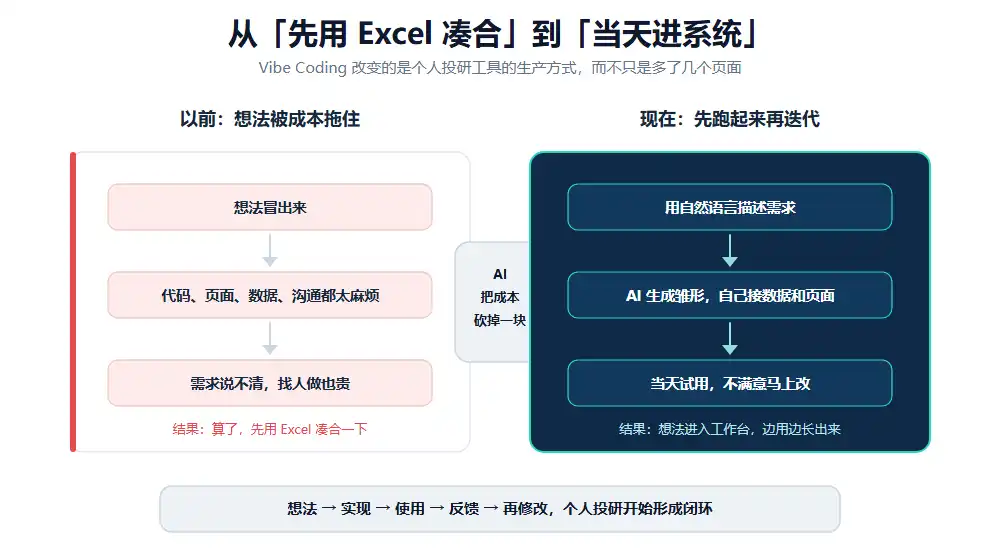
But after tinkering with Vibe Coding for these two weeks, I found this is truly different.

I started building some rough but practical tools for myself. An idea pops up, and it can be integrated into the system the same day, instead of being scattered across chat records, bookmarks, and my own mind.

Two: Four small tools I crafted in two weeks

I mainly built four things in these two weeks (other miscellaneous small tools don't count).

First, Cross-Market Asset Dashboard

The reason was very simple. My assets are scattered across several places: Hong Kong and US stocks in brokerage apps, Crypto on trading platforms, A-shares in another software.

Every day, wanting to see my overall situation meant opening each one, switching back and forth. After checking everything, I still couldn't piece together the full picture. So the first thing I did was stuff all my holdings into one page:

Top section shows total assets, daily P&L. Below, divided by market—one section for US stocks, one for Crypto, one each for HK and A-shares. At a glance, the state of my entire portfolio, who's up and who's down today, is crystal clear.
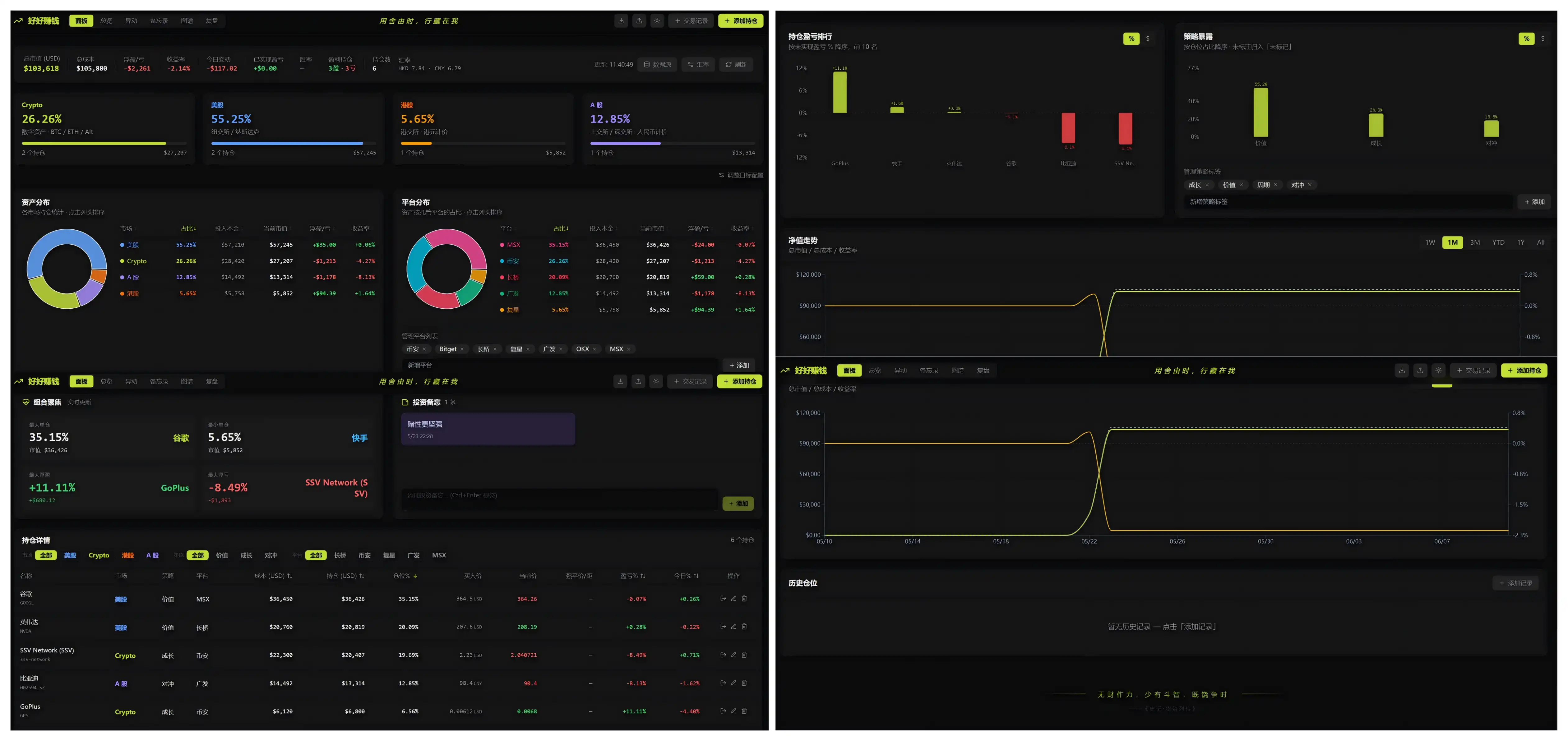
After finishing it, I found it quite useful, and couldn't help but keep adding Tab after Tab, because new needs kept emerging as I used it:

  • Anomaly Monitor: I pre-set the assets I care about and thresholds. If anyone suddenly surges or crashes, it highlights it for me, saving me from constantly watching the market.
  • Investment Map: When researching a sector, draw the upstream, downstream, beneficiaries, risk points, and related assets into a network, making it easier to trace capital flow chains and relationships.
  • Memo + Review: Jot down why I was bullish initially, what happened later, where my judgment was right or wrong, so I can look back later.
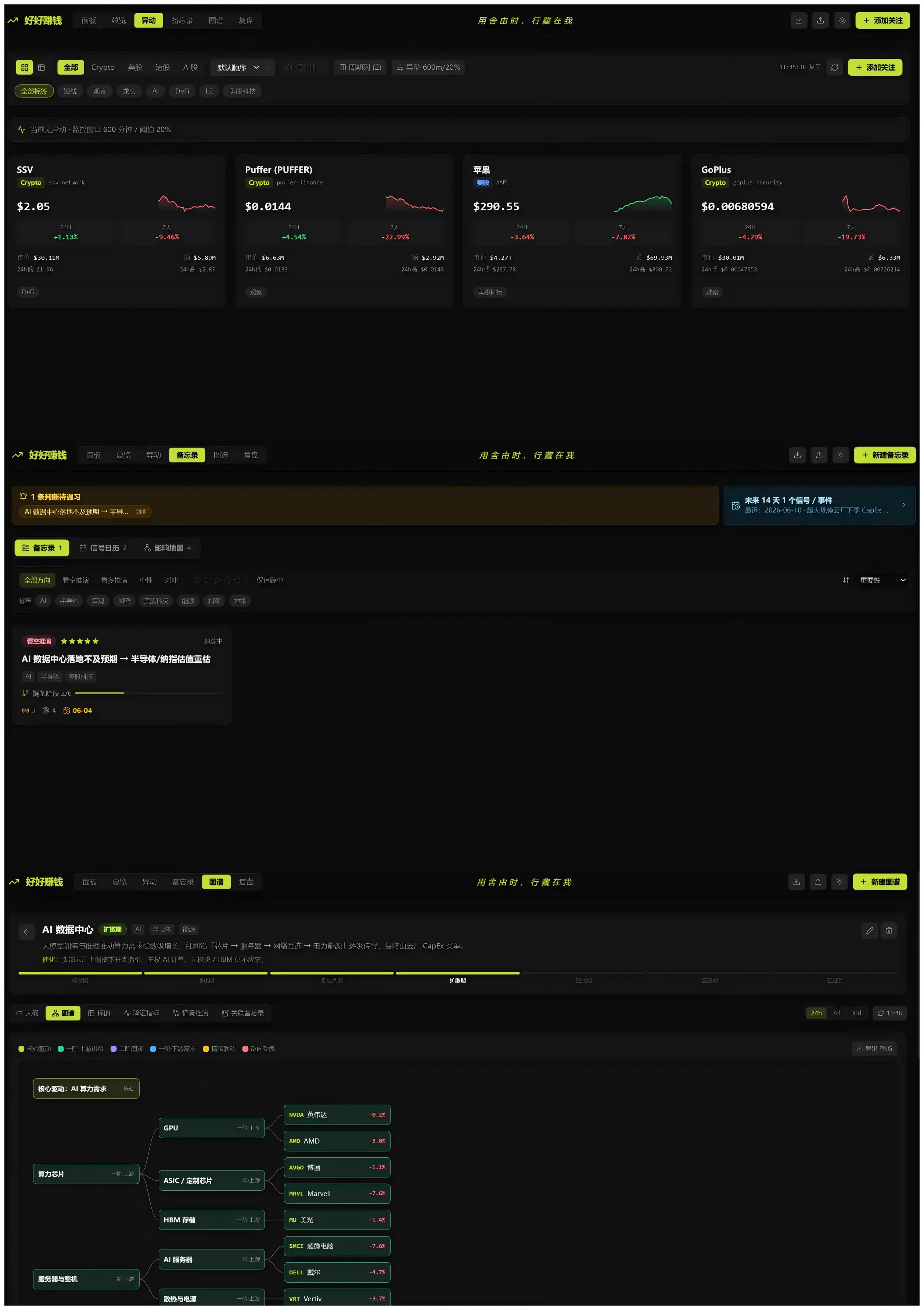
Since this dashboard contains all my real holdings, it's quite private, so I deployed it locally.

Second: PM Bet Monitor

This one is specifically for watching prediction markets.

To explain briefly, prediction markets (like PM) are where people use real money to bet on whether a future event will happen. The price itself represents the market's perceived probability—for example, a "yes" for "SpaceX market cap reaches $2 trillion by end of June" priced at 0.8 means the market thinks there's an 80% chance of it happening.

For the bets I care about, like "Will OpenAI/Anthropic's valuation go up by year-end?" "Will a certain market cap overtake event among the Magnificent Seven happen?", "Will xx and xx meet?", I used to have to check each one individually. Now I've centralized them into a single dashboard. I also compare probability changes alongside news events and secondary market fluctuations. Who moves first, who influences whom, becomes clear at a glance.
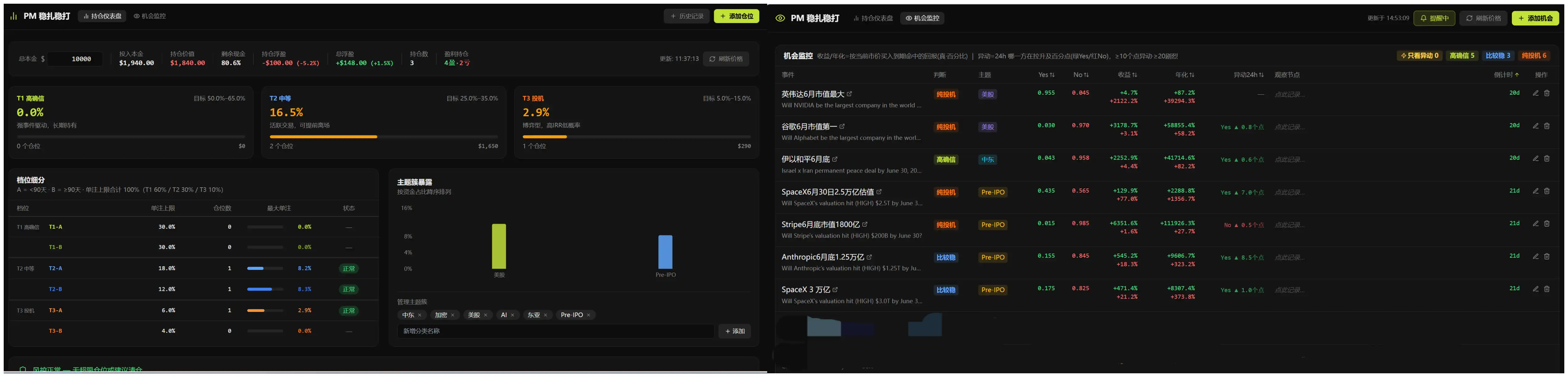
I also tiered these bets according to my own criteria (internally called T1 (high conviction) / T2 (relatively stable) / T3 (pure speculation)), sorted by expected return, so I can instantly distinguish which are just noise.

Honestly, a small edge I have in this market is Chinese information and East Asian political-economic dynamics—many are dominated by Western players, and pricing for this area is often half a step behind. Opportunities hide in this time gap.

Third: Small Operations Backend

This one isn't related to investment; it's for my own writing.

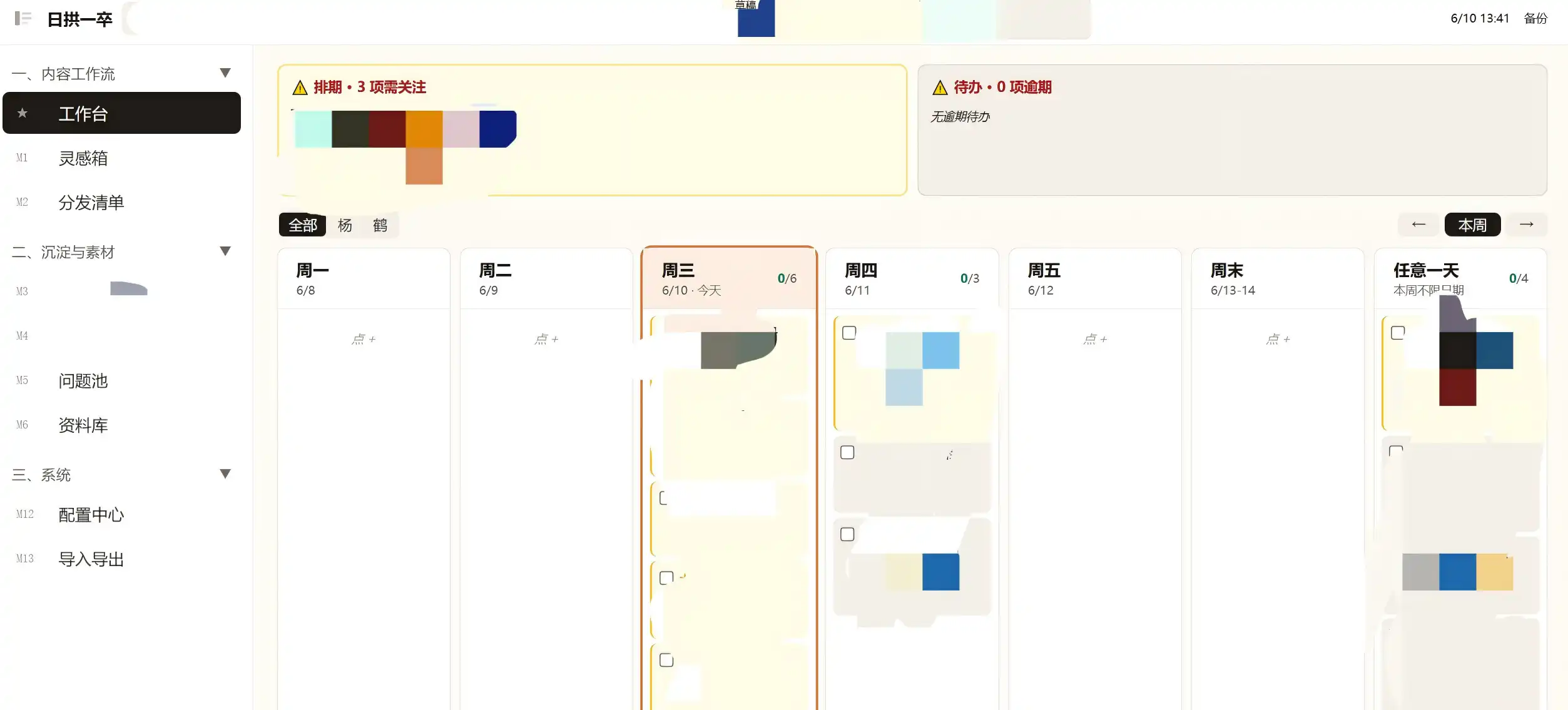
I usually manage topics, write articles, and publish on several platforms. Progress was all in my head or by digging through chat records, often messy. So I made a small backend to manage it, including a topic list, article progress, publishing platforms, and an inspiration box.

Since I might need to use this when I'm out, I didn't make it local, but deployed it to the cloud—using GitHub + Vercel. I can open it on my phone to view and edit, quite convenient.
Fourth: One-Click Formatting Tool

This was mainly to solve a personal minor need. After writing an article, I need to publish it on many platforms, especially for Web3 media. Each platform has different formatting rules, and manually adjusting each time is very time-consuming.

So I created a small tool. Paired with a browser Tampermonkey script I fine-tuned through coding, I throw in an original Markdown or Word document, and it automatically converts it into the corresponding format for each platform and directly inserts images. It's not particularly advanced, but it saves me some mechanical work every day.

To be honest, these four things are still very basic, even a bit ugly, and can't be considered mature products. But for me, they are already very useful because once an idea appears, I can immediately integrate it into the system, rather than letting it scatter and be forgotten.

This is the most important change I feel.

Three: Ordinary People's Investment Research Approach Has Really Changed

Because of this, I increasingly feel that ordinary people doing investment don't necessarily need to start with complex models, but should at least have a few of their own basic systems.

Because the change AI brings to ordinary people isn't suddenly turning you into a guru, but enabling you to first create a prototype for many things you "wanted to do but couldn't" before.

Especially for someone like me who watches the market daily, the feeling is particularly obvious. As long as you have an idea, every ordinary investor can gradually accumulate a few of their own basic systems:

  • Asset Observation System: What assets are you actually watching? Which market do they belong to? What recent changes have occurred?
  • Signal Monitoring System: Which events, once they happen, might indicate a change in market expectations?
  • Map Organization System: A sector isn't a point, but a network. Who's upstream, who's downstream, who benefits from sentiment, who from performance, who from capital flows. Especially over the past year-plus, AI sector stocks have almost rewarded those who could thoroughly understand a sector (from HPC to optical modules to the memory chain).
  • Review System: Why were you bullish initially? What happened later? What was right, what was wrong?
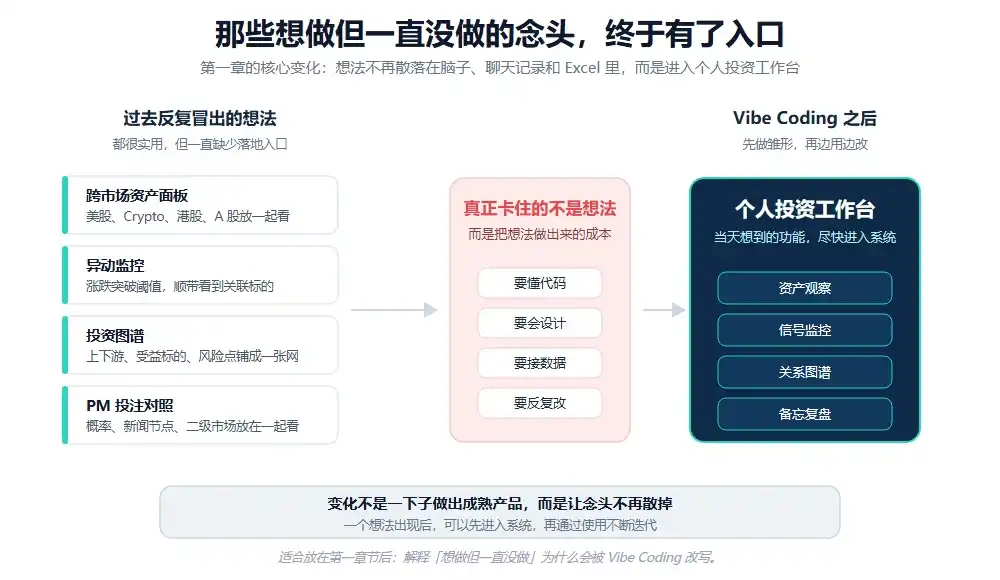
These things weren't impossible to do before, but they were too troublesome, hard to sustain. The biggest meaning of AI is that it cuts away a huge chunk of this "trouble."

You may not know how to code, but you can describe requirements, and slowly accumulate your own product design. And you don't have to finish it all at once; release the first version, and modify it while using it.

This is also the most attractive part of Vibe Coding for me: the feedback is so fast. In the past, the gap between an idea popping up and landing could be very long, so long you forgot why you wanted to do it in the first place.

Now, if I think of a feature today, I can try it the same day. If I'm not satisfied after trying, I modify it immediately. After using it for two days, new needs emerge, and I iterate further.

This closed loop of "idea—implementation—use—feedback—modify again," once it starts spinning, really makes you unable to stop.

In Conclusion

Consider this as the first record for the new phase of "太乐 Tyler."

Moving forward, I'll try to update regularly, recording my investment thoughts, tool tests, on-chain operations and arbitrage research, as well as some educational/introductory Web3 operations and investment knowledge points.

Welcome to follow, and feel free to communicate anytime.

Trending Cryptos

Related Questions

QWhat is Vibe Coding and how does the author use it?

AVibe Coding is using natural language to command AI to write code and build products. The author primarily uses Codex and the Claude Code client, switching to the CLI with DeepSeek API when limits are reached, to create personal tools based on their ideas.

QWhat are the four main tools the author built using Vibe Coding?

AThe author built: 1) A cross-market asset dashboard for viewing holdings across stocks and crypto. 2) A prediction market (PM) betting monitor. 3) A personal operations backend for managing writing tasks. 4) A one-click typesetting tool for formatting articles for different platforms.

QWhat advantage does the author claim to have in prediction markets?

AThe author claims a small advantage lies in having better access to Chinese information and East Asian political-economic dynamics. They state that pricing on these events in Western-dominated markets is often slow, creating opportunities in that time lag.

QAccording to the author, how has AI changed research and tool-building for ordinary investors?

AAI hasn't made ordinary investors experts overnight, but it allows them to create initial versions of tools they previously 'wanted to build but couldn't'. It significantly reduces the hassle, enabling a fast 'idea-implementation-use-feedback-modification' loop to build personal systems for observation, monitoring, and analysis.

QWhat systems does the author suggest ordinary investors should gradually build for themselves?

AThe author suggests building several personal foundational systems: an Asset Observation System, a Signal Monitoring System, a Map/Network Organization System for understanding industry sectors, and a Review/Post-mortem System to track reasoning and outcomes.

Related Reads

Former CFTC Chairman, Circle President Tarbert: Preaching Long-Termism While Cashing Out $30 Million Himself

Former CFTC Chairman and Circle President Heath Tarbert has consistently advocated for a long-term vision in public, urging patience from investors as Circle’s stock price has fallen significantly from its peak. However, it has been revealed that since Circle’s IPO, Tarbert has continuously sold his CRCL shares through pre-arranged trading plans, cashing out approximately $30 million, without making any public market purchases. This contrast between his public messaging and personal actions has drawn criticism. Tarbert joined Circle in July 2023 as Chief Legal Officer, leveraging his regulatory experience to help guide the company through its IPO and expansion. Despite promoting stablecoins as long-term infrastructure, he established a 10b5-1 trading plan just before Circle went public, leading to substantial stock sales over the following year. In March 2026, he initiated another plan to sell more shares. His career trajectory highlights a pattern of moving between high-level regulatory roles and influential positions in the financial sector. After resigning as CFTC Chairman in early 2021, he joined Citadel Securities as Chief Legal Officer just 27 days later, during a period of intense regulatory scrutiny for the firm. He later joined Circle, aiding its efforts to navigate regulatory challenges for its public listing. While Tarbert's expertise in policy and compliance is valuable to companies like Circle, his actions—advocating long-term confidence while personally divesting—raise questions about the alignment between his public statements and his private financial decisions, leaving investors who followed his advice to bear the market risks.

marsbit15m ago

Former CFTC Chairman, Circle President Tarbert: Preaching Long-Termism While Cashing Out $30 Million Himself

marsbit15m ago

Gate Research Institute: The 'Wall Street-ization' Wave of Crypto Financial Products – Competition or Integration?

The article titled "Gate Research Institute: Are Crypto Financial Products Sparking a 'Wall Street' Wave—Competition or Convergence?" explores the evolving relationship between the crypto ecosystem and traditional finance (TradFi). The piece begins by reflecting on Bitcoin's original 2009 vision of decentralization, disintermediation, and moving away from banks. It then contrasts this with the 2024 landscape, where key crypto assets like Bitcoin are increasingly held through Wall Street products like ETFs issued by giants like BlackRock. The article questions whether this signifies that TradFi is systematically taking over the rights to issue, price, custody, and distribute crypto financial assets. The core argument is that this is not a zero-sum takeover but rather a bidirectional convergence where each side addresses the other's weaknesses. Crypto offers 24/7 global markets, programmable settlement, and open access but lacks compliant channels, institutional-grade custody, deep fiat liquidity, and mainstream distribution. TradFi possesses these but is constrained by legacy systems, limited operating hours, and slow settlement. Two primary convergence paths are highlighted: * **Path A (CEX to TradFi):** Exemplified by Gate, which has progressed from offering tokenized stocks and CFDs to providing direct, real stock trading (US, Hong Kong, South Korea) within its platform, using USDT. * **Path B (TradFi to Crypto):** Exemplified by Robinhood, which has integrated crypto trading, acquired exchanges like Bitstamp, and is moving traditional assets like stocks onto the blockchain via tokenization and its own Layer 2. Both paths are ultimately competing to become the next-generation, unified financial account—a "super account" where users can seamlessly trade cryptocurrencies, stocks, ETFs, RWA (Real World Assets), and tokenized treasury products in one interface. The growth of RWA and tokenized treasuries (e.g., BlackRock's BUIDL) is presented as the asset-layer fusion, providing stable, yield-bearing assets on-chain and acting as a bridge between the two worlds. In conclusion, the "Wall Street-ization" of crypto is framed as a mutual transformation. Decentralized ideals persist in the protocol layer, while at the application layer, a more efficient, global, and accessible unified capital market is emerging from this convergence. The future competition lies not between crypto exchanges and stockbrokers, but between platforms vying to offer the most comprehensive asset coverage, liquidity, and user experience within a single account.

marsbit19m ago

Gate Research Institute: The 'Wall Street-ization' Wave of Crypto Financial Products – Competition or Integration?

marsbit19m ago

Claude's Major New Feature: Screen Recording + Voice, Distilling Your Skills into AI Tasks in One Click

Claude has introduced a major new feature called "Record a Skill," available for Pro, Max, and Team users. This function, found in the Claude desktop app's CoWork menu, allows users to create reusable AI skills simply by recording their screen and providing voice narration while performing a task. Claude then automatically analyzes the recording and generates a functional Skill. A hands-on test confirmed the feature works seamlessly. Users start recording via the Skills manager, perform their workflow while verbally explaining the steps and logic, and avoid including sensitive information. After recording, Claude processes the content and creates the Skill, which can be saved and later invoked with a slash command (/). This eliminates the need for manual adjustments or writing complex instruction files. The innovation goes beyond mere efficiency. Previously, creating a Skill required writing a detailed SKILL.md file in Markdown—a significant barrier for non-technical users. "Record a Skill" bypasses this by directly capturing both actions and the implicit reasoning shared in the narration. This lowers the barrier to knowledge transfer and automation, addressing a core challenge in corporate knowledge management: the difficulty of getting experts to write and maintain documentation. However, the feature also highlights a shift in the nature of work. A case study from March 2026 showed a freelancer whose five-year client relationship was effectively replaced by a hand-coded Claude Skill automating their content workflow. With the even lower barrier of screen recording, the ability to distill personal expertise into automatable skills accelerates this trend. The "moat" for work is moving from simply knowing how to do a task to mastering tasks that are difficult or impossible to automate.

marsbit23m ago

Claude's Major New Feature: Screen Recording + Voice, Distilling Your Skills into AI Tasks in One Click

marsbit23m ago

Feeding AI "Noise" Can Also Boost Scores, This Work Enables Positive Transfer with Noise

Feeding "Noise" to AI Can Improve Performance: A Method Enables Positive Transfer from Noise This work, Semi-Supervised Noise Adaptation (SSNA), introduces a Noise Adaptation Framework (NAF) that challenges traditional transfer learning. Instead of requiring a labeled source domain of real data (e.g., images, text), NAF uses randomly generated Gaussian noise as the source. For a target task with C classes, it constructs C noise clusters by sampling from Gaussian distributions. Although this synthetic noise contains no semantic meaning, NAF trains it to form a discriminative class structure in a shared representation space—clustering same-class noise and separating different classes. The key is aligning this learned structure from the noise domain to the real, sparsely labeled target domain. A small number of target labels are still essential to establish the correspondence between noise clusters and actual classes. The training objective combines: 1) supervised loss on the few labeled target samples, 2) classification loss for the noise to build its structure, and 3) a distribution alignment loss (using Negative Domain Similarity) to minimize the gap between the noise and target domains in the shared space. Experiments show significant gains in few-label settings. With just 4 labels per class, NAF with a ResNet-18 backbone improves accuracy over a standard supervised baseline (ERM) by +12.35% on CIFAR-10, +7.61% on CIFAR-100, +4.38% on DTD-47, and +2.74% on Caltech-101. It also benefits fine-grained datasets and scales to ImageNet-1K (with 100 labels/class) and text classification (AG News). NAF can be integrated into existing semi-supervised methods like FixMatch for further gains. Ablation studies confirm the transferred benefit comes from the discriminative structure of the noise, not randomness itself. Collapsing all noise into a single point causes negative transfer, while increasing separation between noise cluster centers improves performance. The amount of noise per class is less critical once a basic structure forms. In conclusion, this work demonstrates that for positive transfer, the semantic content of source data may not be necessary. What can be effectively transferred is the *organizational structure* of categories within a representation space. This offers a promising alternative for scenarios where real source data is unavailable due to privacy, copyright, or procurement constraints.

marsbit25m ago

Feeding AI "Noise" Can Also Boost Scores, This Work Enables Positive Transfer with Noise

marsbit25m ago

Trading

Spot

Hot Articles

Discussions

Welcome to the HTX Community. Here, you can stay informed about the latest platform developments and gain access to professional market insights. Users' opinions on the price of AI (AI) are presented below.

活动图片