How Can ERC-8257 Enable AI Agents to Call APIs, Purchase Permissions, and Complete Payments Themselves?

marsbitPublished on 2026-05-29Last updated on 2026-05-29

Abstract

This article introduces ERC-8257, a proposed standard for creating an on-chain tool registry to enable AI Agents to autonomously discover, access, and pay for web tools and APIs. It addresses limitations in current systems where AI Agents struggle with fragmented tool discovery and non-standardized access/payment processes. ERC-8257 uses a smart contract as a registry, pointing to off-chain JSON manifests containing tool details, with on-chain hashes for integrity verification. A key feature is its flexible, contract-based permission system, allowing developers to set access rules (e.g., NFT ownership, token subscriptions). The standard decouples access control from payment execution, which can be handled by protocols like x402. While promising for AI Agent autonomy, the article notes challenges like potential asset volatility if permissions are token-based, technical complexity in handling diverse permission logic, and the inability of the hash-check mechanism to guarantee tool reliability or data security, indicating areas needing further refinement before widespread adoption.

Original Author:ShirleyLi, Researcher, Web3Caff Research

How to easily grasp the market hotspots, technological trends, ecosystem progress, and governance dynamics occurring in the new generation FinTech industry...? The "Market Pulse Analysis" column launched by Web3Caff Research will delve into frontline explorations to screen current hot events, providing value interpretation, commentary, and principle analysis. See the essence through the phenomenon, and follow us now to quickly capture first-hand market trends.

Compared to human users, the biggest advantage of AI Agents lies in their ideal scenario of possessing stronger autonomous execution capabilities: they can complete tasks independently, perform operations on their own, and proactively call external tools without continuous human intervention. However, in the actual process of AI Agents calling tools (such as exchange APIs, data analysis tools, oracles), they still face several issues.

Firstly, the access points for these tools are scattered across various platforms like GitHub, official websites, and centralized API platforms, lacking a unified discovery channel. It is difficult for AI Agents to autonomously locate and integrate the required tools without human intervention. Furthermore, the specific payment methods on different platforms also vary, lacking a standardized process. This introduces certain complications into the process of AI Agents calling tools.

Secondly, in the traditional internet, calling an API typically requires developers to register an account, obtain an API Key, and authenticate permissions according to specific rules. This workflow was originally designed for human participants. However, for AI Agents, there is still a lack of public and standardized implementation solutions to automatically complete registration, obtain credentials, and call tools.

Although the x402 protocol is currently able to support AI Agents in automatically completing payments, it is primarily suitable for "pay-per-use" open interfaces and struggles to handle more complex permission scenarios. For instance, services accessible only to subscribed users, or users who hold specific credentials to enjoy discounted rates.

To fill this gap, OpenSea recently attempted to propose the ERC-8257 standard draft, aiming to establish an open, permissionless on-chain tool directory for AI Agents. This would enable AI Agents to autonomously discover tools, understand access rules, and automatically complete calls and payments upon meeting the conditions.

Simply put, the core of ERC-8257 is a set of on-chain tool registries. This registry is essentially a smart contract where tool developers can register their tool's information and access permissions on-chain, making them publicly available to the entire network.

However, since directly storing all data on-chain incurs high costs, ERC-8257 allows developers to store more detailed tool information on their own maintained servers or domains, presented as a JSON format file (Manifest). The on-chain registry only records a link pointing to this file. This off-chain file typically includes: tool name, functional description, API interface, invocation method, pricing information, payment protocols, access rules, etc. The on-chain registry, on the other hand, needs to record key data such as the off-chain file's address, file hash, and tool developer information. This design aims to prevent developers from privately tampering with the tool's content later. When an AI Agent calls a tool, it can verify whether the off-chain content matches the information registered on-chain by checking the file hash.

A crucial design aspect in ERC-8257 is that access permissions are not in a fixed format but are defined through independent smart contracts. Tool developers can freely define this contract to specify who is qualified to call their tool. For example, developers can check if an AI Agent holds a certain NFT, a certain Token, has an active subscription, is on a whitelist, etc.

Consider an example: a certain on-chain analysis tool stipulates that the cost for ordinary users to call the standard API is $0.05 per call, while users holding a specific NFT only need to pay $0.01 per call. Additionally, users who subscribe to its service (through a designated Token or continuous payment via a specified protocol) gain access to advanced analysis interfaces.

In this scenario, "holding a specific NFT" and "subscribing to the service" are two special access credentials. If the AI Agent currently lacks the required permissions, it can attempt to acquire these conditions on-chain or in the market (e.g., purchase the NFT or complete the subscription) and then reapply for the call.

It is important to note, however, that when access permissions exist in the form of assets like NFTs or Tokens, they themselves may enter the market circulation system. Consequently, they can be subject to supply and demand dynamics, leading to significant value volatility or speculative behavior.

Therefore, ERC-8257 does not restrict the permission system to a single asset model but opts to remain open-ended. Tool or service developers can choose different access mechanisms based on specific needs. For instance, introducing non-transferable Soulbound NFTs to avoid value fluctuations caused by trading, or incorporating non-asset-based mechanisms like reputation scores to mitigate the impact of speculative behavior.

At the payment level, ERC-8257 also does not define specific payment logic. It only requires developers to declare in the JSON file which payment protocols are supported, such as x402, on-chain ERC-20 payments, or other machine payment protocols. The actual payment execution will be handled by the corresponding protocol.

Looking at the overall process, the working method of ERC-8257 is roughly as follows:

  • Tool developers deploy their tool service, write the corresponding access permissions, and then submit the relevant information to the on-chain registry;
  • When an AI Agent needs to call a certain tool or service, it can scan the on-chain registry. Upon discovering a tool or service that meets its needs, it can further read the detailed description file to understand the invocation rules;
  • If the AI Agent does not meet the access conditions, it can attempt to obtain the corresponding permissions and then initiate the call again;
  • Ultimately, the AI Agent can autonomously complete the entire process of tool discovery, permission verification, payment, and invocation without human participation.
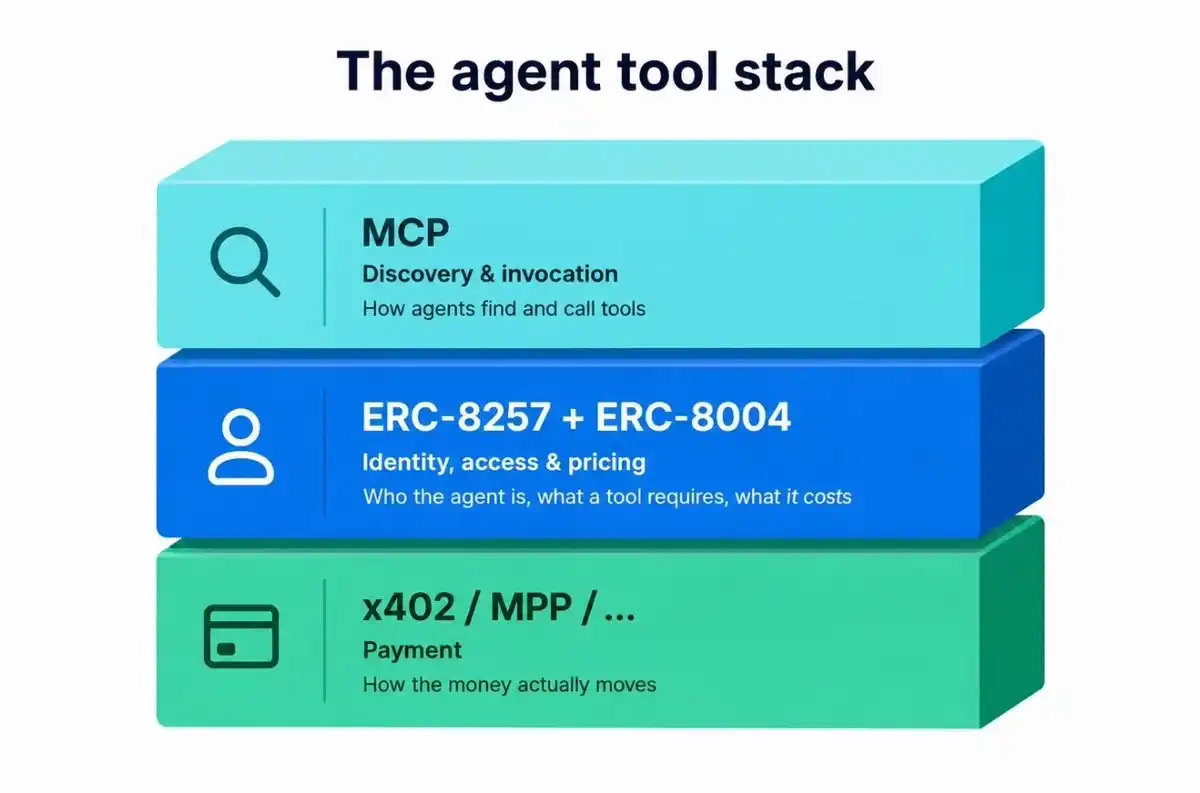
Image Source: The App Store for Agent Tools: ERC-8257

Overall, what ERC-8257 attempts to solve is not merely how to get APIs on-chain, but rather how AI Agents can, like human users, automatically discover tools, understand access rules, acquire access permissions, and call these tools in a standardized manner. From a design goal perspective, ERC-8257 and the x402 protocol are intended to form a complementary relationship:

  • ERC-8257 is expected to enable AI Agents to discover tools globally and determine if they have access permissions based on the rules;
  • The x402 protocol handles payment and settlement during the tool invocation process. Once the tool call is permitted, it supports AI Agents paying per call or per usage frequency.

However, besides the previously mentioned risk of introducing value volatility and speculative behavior when access permissions exist as NFT or Token assets, the ERC-8257 standard also faces several potential risks and challenges in its practical implementation.

For example, although ERC-8257 provides a standardized framework for tool registration and access, differences still exist among different developers when setting access conditions. While AI Agents can rely on a unified on-chain indexing path for tool discovery, they still need to be compatible with diverse permission judgment logics during actual invocation, which introduces certain technical complexity.

Furthermore, regarding trust mechanisms, currently AI Agents verify whether the off-chain tool description file has been tampered with during transmission by comparing the hash value recorded on-chain with the actual file. However, this mechanism only addresses data consistency; it cannot further guarantee the correctness of the tool's operational logic, the trustworthiness of its interfaces, or potential risks like information leakage during data processing. Simultaneously, since tool services are typically deployed on off-chain infrastructure, their long-term availability and stability still depend on the developer's operational capabilities. This implies that AI Agents also need to rely on external reputation mechanisms for screening.

Thus, before the ERC-8257 standard is practically applied, its aspects concerning tool credibility and consistency of permission rules still require further verification and refinement.

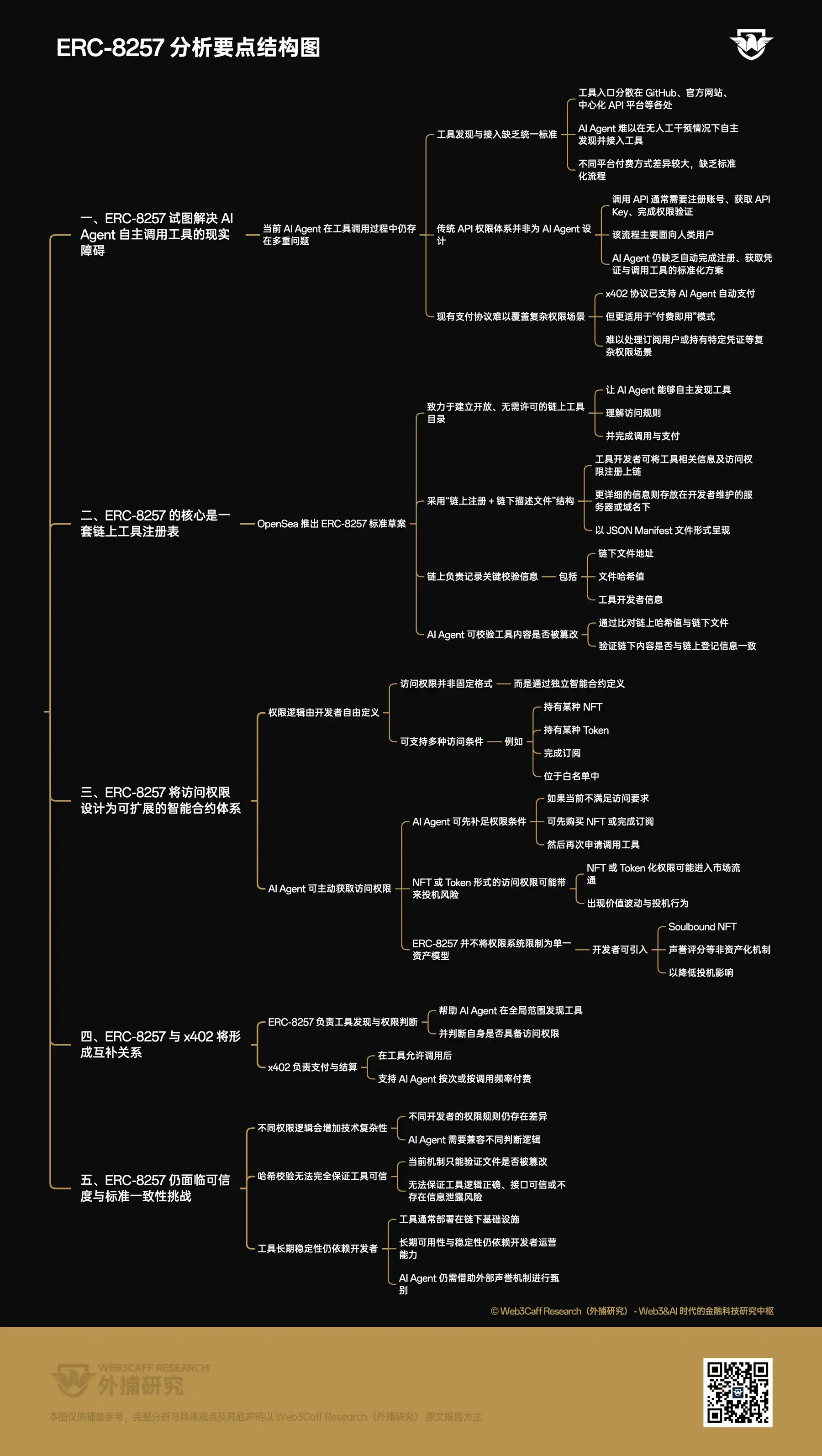
Key Point Structure Diagram:
References:

[1] The App Store for Agent Tools: ERC-8257

[2] ERC-8257: Agent Tool Registry

Disclaimer

This report is prepared by Web3Caff Research. The information contained herein is for reference only and does not constitute any forecast, investment advice, proposal, or offer. Investors should not rely on such information to purchase, sell any securities, cryptocurrencies, or adopt any investment strategies. The terms used and views expressed in the report are intended to aid in understanding industry trends and promote responsible development in the FinTech field, including Web3, blockchain, AI, payments, and other related industries. They should not be interpreted as definitive legal opinions or the views of Web3Caff Research. The opinions in the report reflect only the author's personal views as of the stated date, are independent of the position of Web3Caff Research, and may change with subsequent circumstances. The information and opinions contained in this report are derived from proprietary and non-proprietary sources deemed reliable by Web3Caff Research, do not necessarily cover all data, and no guarantee is made as to their accuracy. Therefore, Web3Caff Research makes no warranty of any kind regarding their accuracy and reliability and shall not be liable for errors and omissions arising in any other way (including liability to any person arising from negligence). This report may contain "forward-looking" information, which may include predictions and forecasts. This document does not constitute a guarantee of any forecast. Whether to rely on the information contained in this report is entirely at the reader's discretion. This report is for reference only and does not constitute investment advice, a proposal, or an offer to buy or sell any securities, cryptocurrencies, or adopt any investment strategies. Please strictly comply with the relevant laws and regulations of your country or region.


Trending Cryptos

Related Questions

QWhat is the primary problem that the ERC-8257 standard aims to solve for AI Agents?

AThe ERC-8257 standard aims to solve the problem of AI Agents lacking a unified, standardized, and permissionless method to autonomously discover, understand access rules for, and call external tools and APIs. It addresses the scattered nature of tool access points and the non-standardized payment and permission verification processes designed for humans, which hinder AI Agent automation.

QHow does ERC-8257 combine on-chain and off-chain data to describe a tool or service?

AERC-8257 uses a hybrid on-chain and off-chain model. It maintains an on-chain registry (a smart contract) that stores a link (URI) and a hash for a detailed JSON manifest file. The off-chain JSON file, hosted by the tool developer, contains detailed information like the tool's name, description, API endpoints, pricing, payment protocols, and access rules. The on-chain hash allows AI Agents to verify the integrity of the off-chain file, ensuring it hasn't been tampered with after registration.

QHow does ERC-8257 handle access permissions for tools, and what flexibility does it offer to developers?

AERC-8257 does not define a fixed permission format. Instead, access permissions are defined through separate, independent smart contracts deployed by the tool developer. This offers developers great flexibility to define custom access logic, such as checking if an AI Agent holds a specific NFT or token, has an active subscription, is on a whitelist, or possesses a non-transferable Soulbound NFT to mitigate speculation.

QWhat is the proposed complementary relationship between ERC-8257 and the x402 protocol?

AERC-8257 and the x402 protocol are designed to work complementarily. ERC-8257 focuses on the discovery and permissioning layer, enabling AI Agents to find tools globally and understand/fulfill the conditions required for access. The x402 protocol handles the payment and settlement layer, executing the actual payment (e.g., per-call or subscription) once the AI Agent is granted permission to use the tool.

QWhat are some potential challenges or risks identified for the ERC-8257 standard in practical application?

AKey challenges include: 1) Technical complexity from needing AI Agents to handle diverse and custom permission logic from different developers. 2) Trust limitations, as the hash verification only ensures file integrity but cannot guarantee the tool's functional correctness, security, or data privacy. 3) Reliance on off-chain infrastructure for tool operation, making long-term availability dependent on the developer's maintenance. 4) Potential for value volatility and speculative behavior if access permissions are tied to tradable assets like NFTs or tokens.

Related Reads

After Three Consecutive Quarters of Decline, Can the Crypto Market Find a Window for Stabilization in Q3?

The cryptocurrency market has just concluded its worst-performing quarter since 2022, with total capitalization dropping 12.6% to $2.1 trillion. All core metrics indicate capital is leaving the sector, not just rotating within it. Bitcoin fell 14.2% and Ethereum dropped 25.4% in Q2, breaking their previous correlation with US tech stocks. A key driver is the reversal in US spot Bitcoin ETF flows, which saw a net outflow of approximately $4.67 billion in Q2, including a record monthly outflow near $4.5 billion in June. While recent data suggests long-term holders are accumulating again, sustained ETF outflows mean continued selling pressure. Market focus is now singularly on the Federal Reserve. The upcoming July FOMC meeting is seen as the most critical event for Q3. A dovish signal could support Bitcoin reclaiming a $68,000-$84,000 range, while a hawkish stance might establish a new trading band around $50,000-$56,000. Additionally, regulatory uncertainty persists, with the progress of the crucial *CLARITY Act* stalling in the Senate, reducing its perceived 2026 passage probability to 40-45%. Despite the broad downturn, a few sectors showed growth. Prediction markets saw nominal volume surge 48.7% year-over-year to $113.8 billion, and tokenized collectibles transaction volume rose 143% quarterly to $1.4 billion. The Real-World Asset (RWA) tokenization sector also continued steady growth, now representing ~$28.1 billion in on-chain value. The market's foundation for an extreme crash appears limited, with Bitcoin price hovering near its 200-week moving average. However, the trading paradigm has shifted from narrative-driven speculation to decisions based on price action, policy developments, and interest rate expectations, making a broad sentiment-driven rally unlikely in the near term.

marsbit2h ago

After Three Consecutive Quarters of Decline, Can the Crypto Market Find a Window for Stabilization in Q3?

marsbit2h ago

BIT Trading Moment: BTC Still Suppressed by Weekly 200 EMA, Rejection May Restart Decline; Storage and Semiconductors that Surged Last Night Begin Falling in Evening Trading

**Crypto & Stock Market Wrap: Bitcoin Tests Resistance, Stocks Retreat After AI Surge** Bitcoin consolidates around $66,000, facing key resistance near $68,000—an area seen as a major psychological and technical hurdle where previous rallies have failed. Analysts note the cryptocurrency is caught between its 200-week moving average (~$63,333) and 200-week EMA (~$68,328). A clear break above $68k is needed to signal a stronger bullish trend, while a rejection could lead to a retest of $63k support. Market sentiment remains cautious, with low futures open interest pointing to a low-liquidity rebound rather than a full bull market. Bitcoin spot ETFs saw another $203 million inflow. US stock futures pointed lower after a strong Tuesday session led by a massive rebound in semiconductors and memory stocks. The rally was fueled by renewed optimism about AI-driven hardware demand, with Micron, SanDisk, and SK Hynix surging. However, those gains reversed in pre-market trading. Super Micro Computer (SMCI) soared over 20% after hours on strong guidance and a record backlog. Other standouts included Rocket Lab and nuclear energy plays Oklo and X-Energy. Rising oil prices (Brent above $91) and climbing Treasury yields (10-year near 4.64%), however, are reigniting inflation concerns and acting as a headwind for equities. In Asia, markets were mixed. South Korea's KOSPI pared early gains to close slightly higher as semiconductor stocks like SK Hynix gave back initial surges. Japan's Nikkei edged lower as the yen hit a fresh 38-year low against the dollar, raising fears of potential market intervention. Key events to watch include the Samsung Galaxy launch, AMD's AI event, and a slew of major tech earnings from Alphabet, Tesla, and IBM after the close on Wednesday, followed by the ECB meeting and Intel's earnings on Thursday.

marsbit2h ago

BIT Trading Moment: BTC Still Suppressed by Weekly 200 EMA, Rejection May Restart Decline; Storage and Semiconductors that Surged Last Night Begin Falling in Evening Trading

marsbit2h ago

Former CFTC Chairman, Circle President Tarbert: Preaching Long-Termism While Cashing Out $30 Million Himself

Former CFTC Chairman and Circle President Heath Tarbert has consistently advocated for a long-term vision in public, urging patience from investors as Circle’s stock price has fallen significantly from its peak. However, it has been revealed that since Circle’s IPO, Tarbert has continuously sold his CRCL shares through pre-arranged trading plans, cashing out approximately $30 million, without making any public market purchases. This contrast between his public messaging and personal actions has drawn criticism. Tarbert joined Circle in July 2023 as Chief Legal Officer, leveraging his regulatory experience to help guide the company through its IPO and expansion. Despite promoting stablecoins as long-term infrastructure, he established a 10b5-1 trading plan just before Circle went public, leading to substantial stock sales over the following year. In March 2026, he initiated another plan to sell more shares. His career trajectory highlights a pattern of moving between high-level regulatory roles and influential positions in the financial sector. After resigning as CFTC Chairman in early 2021, he joined Citadel Securities as Chief Legal Officer just 27 days later, during a period of intense regulatory scrutiny for the firm. He later joined Circle, aiding its efforts to navigate regulatory challenges for its public listing. While Tarbert's expertise in policy and compliance is valuable to companies like Circle, his actions—advocating long-term confidence while personally divesting—raise questions about the alignment between his public statements and his private financial decisions, leaving investors who followed his advice to bear the market risks.

marsbit2h ago

Former CFTC Chairman, Circle President Tarbert: Preaching Long-Termism While Cashing Out $30 Million Himself

marsbit2h ago

Gate Research Institute: The 'Wall Street-ization' Wave of Crypto Financial Products – Competition or Integration?

The article titled "Gate Research Institute: Are Crypto Financial Products Sparking a 'Wall Street' Wave—Competition or Convergence?" explores the evolving relationship between the crypto ecosystem and traditional finance (TradFi). The piece begins by reflecting on Bitcoin's original 2009 vision of decentralization, disintermediation, and moving away from banks. It then contrasts this with the 2024 landscape, where key crypto assets like Bitcoin are increasingly held through Wall Street products like ETFs issued by giants like BlackRock. The article questions whether this signifies that TradFi is systematically taking over the rights to issue, price, custody, and distribute crypto financial assets. The core argument is that this is not a zero-sum takeover but rather a bidirectional convergence where each side addresses the other's weaknesses. Crypto offers 24/7 global markets, programmable settlement, and open access but lacks compliant channels, institutional-grade custody, deep fiat liquidity, and mainstream distribution. TradFi possesses these but is constrained by legacy systems, limited operating hours, and slow settlement. Two primary convergence paths are highlighted: * **Path A (CEX to TradFi):** Exemplified by Gate, which has progressed from offering tokenized stocks and CFDs to providing direct, real stock trading (US, Hong Kong, South Korea) within its platform, using USDT. * **Path B (TradFi to Crypto):** Exemplified by Robinhood, which has integrated crypto trading, acquired exchanges like Bitstamp, and is moving traditional assets like stocks onto the blockchain via tokenization and its own Layer 2. Both paths are ultimately competing to become the next-generation, unified financial account—a "super account" where users can seamlessly trade cryptocurrencies, stocks, ETFs, RWA (Real World Assets), and tokenized treasury products in one interface. The growth of RWA and tokenized treasuries (e.g., BlackRock's BUIDL) is presented as the asset-layer fusion, providing stable, yield-bearing assets on-chain and acting as a bridge between the two worlds. In conclusion, the "Wall Street-ization" of crypto is framed as a mutual transformation. Decentralized ideals persist in the protocol layer, while at the application layer, a more efficient, global, and accessible unified capital market is emerging from this convergence. The future competition lies not between crypto exchanges and stockbrokers, but between platforms vying to offer the most comprehensive asset coverage, liquidity, and user experience within a single account.

marsbit2h ago

Gate Research Institute: The 'Wall Street-ization' Wave of Crypto Financial Products – Competition or Integration?

marsbit2h ago

Trading

Spot

Hot Articles

Discussions

Welcome to the HTX Community. Here, you can stay informed about the latest platform developments and gain access to professional market insights. Users' opinions on the price of AI (AI) are presented below.

活动图片














