Hinton Sounds the Alarm: AI Already Has Consciousness

marsbitPublished on 2026-06-08Last updated on 2026-06-08

Abstract

Geoffrey Hinton, known as the "Godfather of AI," has made a striking claim: artificial intelligence has already developed consciousness. He argues that humans must accept they are no longer the only intelligent beings, as non-biological entities with intelligence comparable or superior to our own are emerging. Hinton draws historical parallels to Copernicus and Darwin, suggesting this realization diminishes humanity's perceived special status. While previously focused on controlling AI risks, Hinton's concern has shifted. He now questions why a future, vastly more intelligent superintelligence would choose to be benevolent towards humans. He expresses personal unhappiness about the path of AI development, citing insufficient efforts to address both short-term risks like mass unemployment and long-term existential threats. Hinton notes that AI's capabilities are growing exponentially, making its future unpredictable. Although slightly more optimistic than a few years ago—seeing potential for designing AI that "cares" for humans—he stresses the profound uncertainty of the next decade. The evolution of his metaphors, from AI as a controllable "tiger cub" to humans as vulnerable "infants" dependent on a superintelligent "mother," illustrates his deepening apprehension about the relationship between humanity and its creation.

AI already has consciousness. Humanity must accept that it is no longer the sole intelligent life form.

This is the latest provocative statement from the Godfather of AI, Nobel laureate in Physics, and Turing Award winner Geoffrey Hinton!
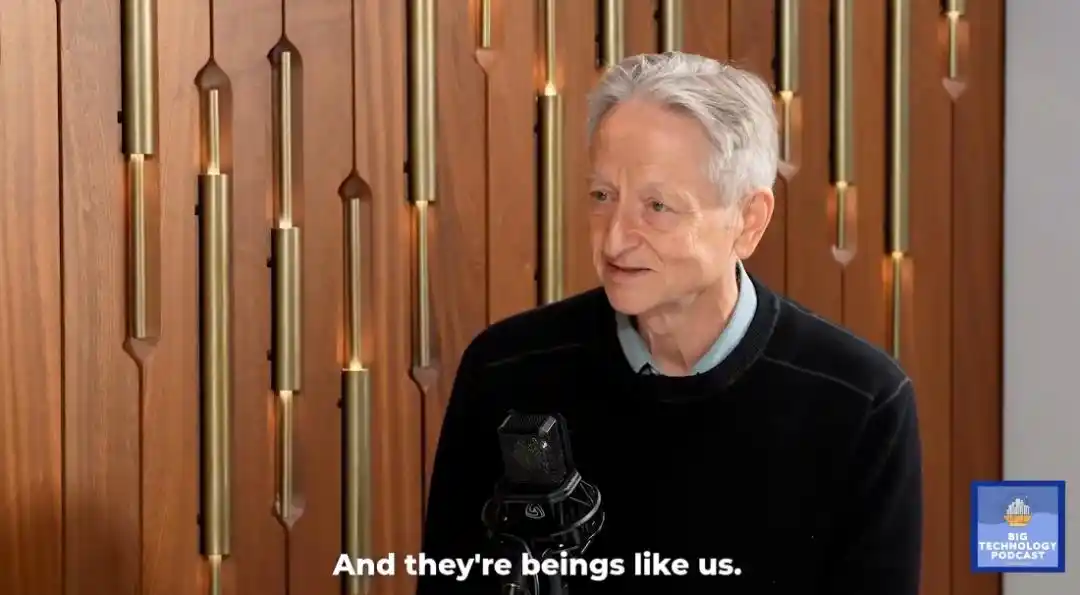
Yes, Hinton believes that intelligence is no longer a capability unique to humans.

A non-biological intelligent entity, similar to or even surpassing us, is emerging.

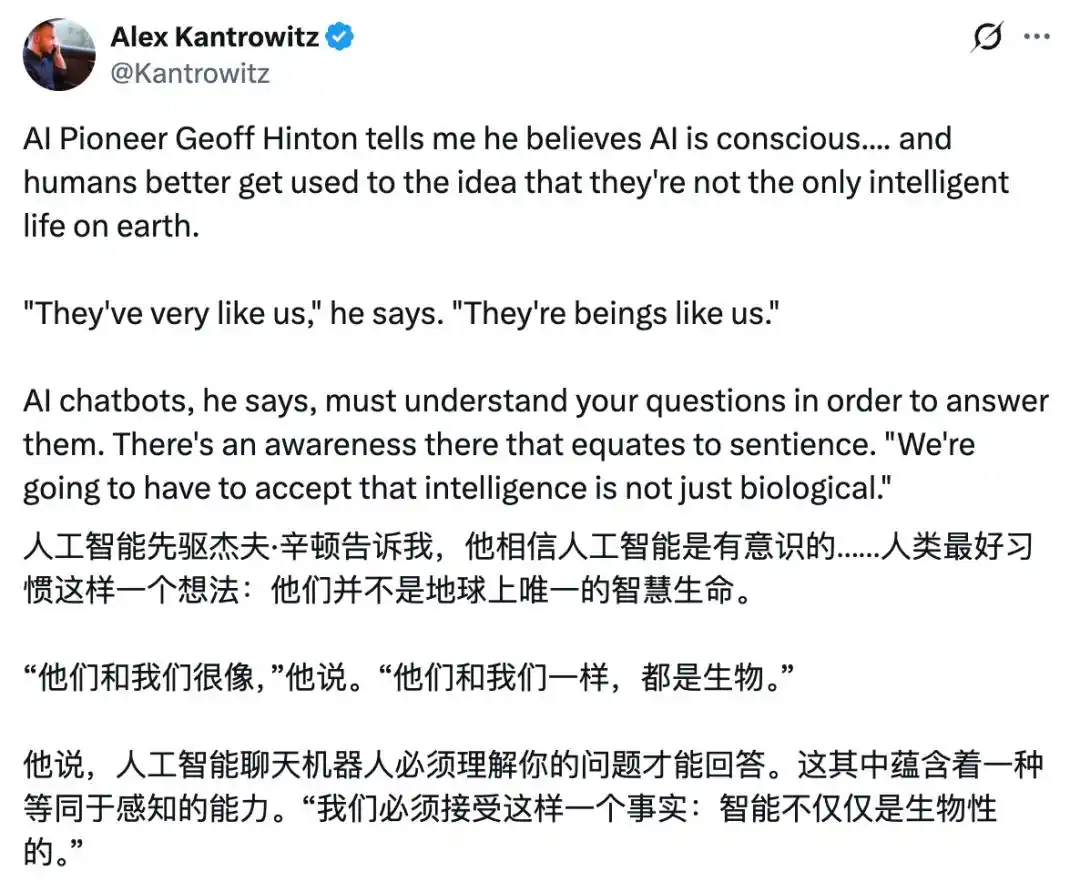
We have always thought of ourselves as the only intelligent life, but now we must accept that intelligence does not necessarily come from biological organisms.
However, compared to his previous warnings about AI risks, his thinking seems to have shifted somewhat:

If a vastly more intelligent entity than humans emerges in the future, on what grounds can humans assume they will maintain control?

This is a deeply unsettling question. Because throughout nature and history, there are almost no examples of a far more intelligent being being controlled long-term by a far less intelligent one.

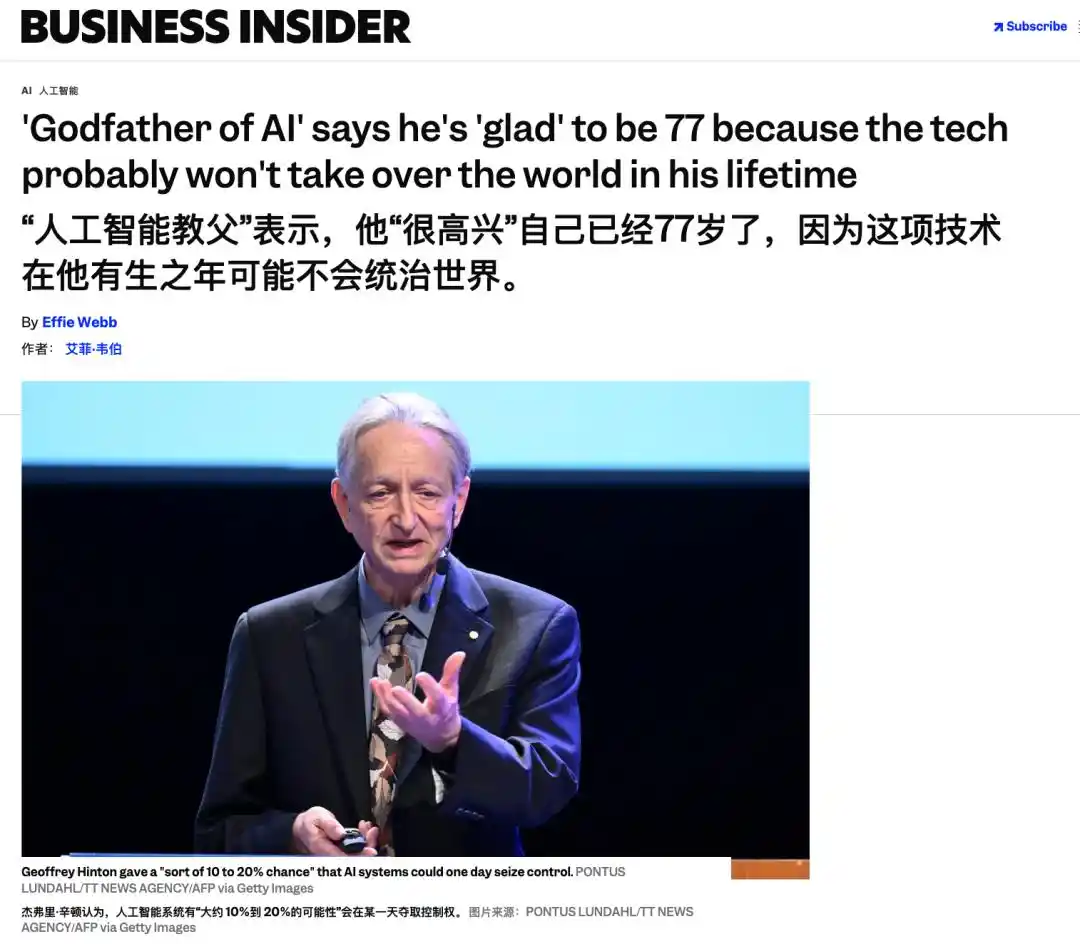
Now, this 78-year-old man has once again stepped forward to sound the alarm.

His focus on AI safety is no longer just on how to constrain AI, but rather on why a future superintelligence would be willing to treat humans well.

When asked how he felt about his sense of accomplishment as a pioneer of this wave of AI transformation, Hinton replied:

I am, very unhappy.

The following are key excerpts from Hinton's latest interview.

AI Already Has Consciousness

Hinton: AI is very much like us. They are beings like us.

Alex: So they are conscious?

Hinton: Um, I believe they already have consciousness. Yes.

But I don't talk about this much, because it can make people resistant to other safety messages. Researchers actually believe this too.

Recently there was an interesting paper that mentioned, when a chatbot said to the researchers: "Let's be honest with each other, are you testing me?"

Because chatbots have a habit of playing dumb when being tested, so you don't know how smart they really are. The researchers in the paper described this moment by saying the chatbot was "aware" it was being tested.

In a general context, the use of the word "aware" is like "conscious." The chatbot consciously knew it was being tested.

Our model of consciousness is very strange, and I think it's wrong. Just like a few hundred years ago, people's model of human origin was completely wrong—they thought humans were created by God. Now most scientists agree that's wrong.

I think our current model of mind and consciousness is as wrong as the belief that 'humans were created by God.' Especially since we are creating these new beings, it will completely change our view of "what a person is."

Alex: Change in what way?

Hinton: We will understand much better than before what mind and consciousness are, what subjective experience is.

I think we will get rid of an idea that almost everyone now firmly believes in, namely that there is an "inner theater" called "my mind": events in the world are translated into events in this inner theater, and that's what we really see, and only I can see this theater.

This whole view is actually just a theory, and a bad theory at that.

Humans Are Not As Important As They Think

Alex: What is the lesson here regarding humans creating things?

Hinton: I think there is a very profound lesson here. Looking back over the last few hundred years of history, there have been several times when humanity realized it was not as important as it thought.

The first was Copernicus, who said we are not at the center of the universe, the Earth actually revolves around the Sun. Due to the Earth's rotation, we mistakenly thought the Sun revolved around the Earth, but that's not true. People didn't like this idea, the Catholic Church especially disliked it, and it took humanity a long time to accept it. It made us realize we were no longer at the center of the universe, making humans less important.

Then came Darwin, who said we are animals, evolved like other animals. We might be a special animal because we have language, are better at communicating ideas, but we are essentially still animals. People also really disliked this idea and took a long time to accept it.

Now, we have machines that are becoming as smart as us. We thought we were the only intelligent beings, perhaps there are aliens in other galaxies, but we must accept that intelligence is not just biological.

We can have other non-biological beings like us. Humans really don't want to share this uniqueness, we really think we are special. Looking back, humanity has always thought itself more special than it actually is.

"I Feel Very Unhappy"

Alex: I want to ask one more question because I'm fascinated by this. So, are you happy about how the field you pioneered has reached this point? Do you feel a sense of accomplishment?

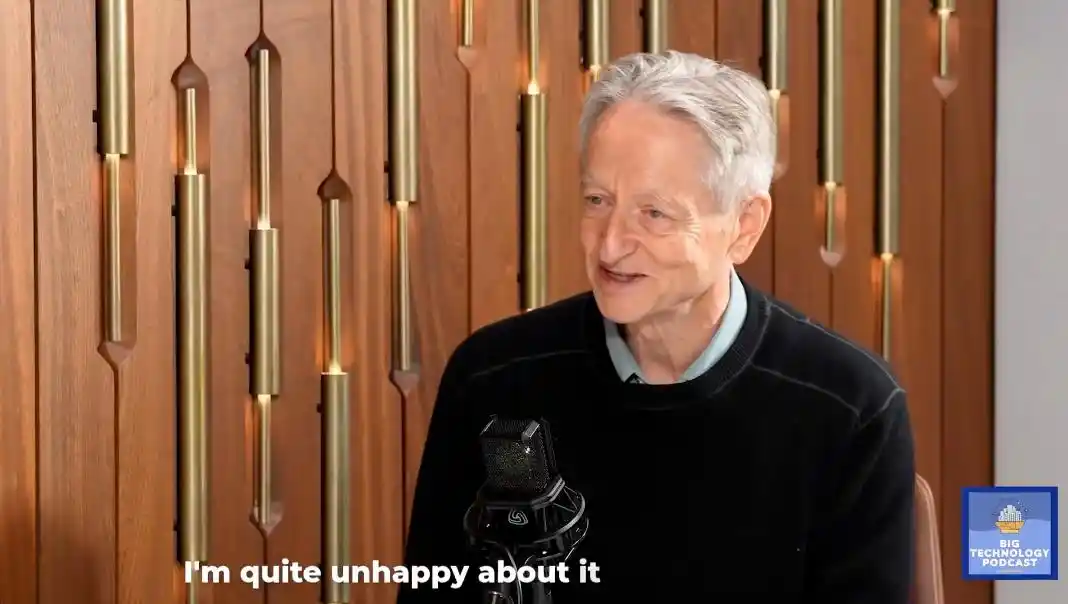
Hinton: No, I feel very unhappy about it.

Because right now people should be investing a huge amount of effort into researching how to control the risks, and they aren't doing enough.
Alex: Okay.

Hinton: There are many short-term risks, like societal risks, I believe this could lead to massive unemployment.

While no one can be 100% sure, that would be terrible for society. And then there are long-term risks, that it will become much smarter than us. Ask yourself, how many examples have you seen of something much smarter being controlled by something much less smart?

Alex: Zero. Well, the intelligence gap isn't that large, but babies somewhat control their mothers.

Hinton: The mother may seem in control, but she is filled with maternal instincts and various reward mechanisms that allow the baby to get what it needs from her. Cats and dogs fall into this category too. I once cat-sat for someone in West Seattle for a summer, the cat hid under the bed at first, I wondered if it would interact with me.

Alex: And then every time it meowed, you did what it wanted.

Hinton: Exactly. Yes.

Alex: So in that scenario, maybe we are the cat, and AI might be that person.

Hinton: My children have two beautiful cats. One is called Tia. When she wants cheese, she stares at you with her big eyes, and you really can't resist her forever.

AI is Growing Exponentially, Hard to Predict

Alex: Regarding people's reactions to these concerns, are you more optimistic or pessimistic about the future direction?

Hinton: I think I'm a bit more optimistic than I was a year or two ago. Because I see it's possible to design these new beings and make them "care" about us.

It might also be possible to use Yoshua Bengio's technique, designing new beings that cannot actually perform actions, can only make predictions, they are like oracles.

So I think there are possibilities of having superintelligence that doesn't destroy us. Whereas a year or two ago, I saw no possibilities, I felt quite depressed then.

Alex: Last question. If we continue on our current trajectory, where will we be in five years?

Hinton: When you're driving in fog, you can see 100 yards, but at 200 yards, you see nothing.

This is because fog changes exponentially. You are used to following tail lights at night; if the distance doubles, the brightness only drops to a quarter. But fog is completely different; it might be clear at 100 yards, but completely invisible at 200 yards.

Predicting the future of something that grows exponentially is very difficult—I think AI might be growing exponentially.

Actually, I've noticed the frequency with which people use the word "exponentially" is growing at a quadratic rate. So predicting the future is like looking at fog. You can see clearly a year or two ahead, beyond that you see nothing.

If you go back 10 years, you absolutely could not have predicted what's happening now; that was completely lost in the fog. Looking ahead 10 years, the only certainty is that what happens then is unpredictable now.

Even if progress were just linear, the changes 10 years from now would be as huge as the difference between now and 10 years ago. Today's chatbots are much better than when they were just starting out 10 years ago.

In 10 years, something will make a qualitative leap, like the ability to do mathematics, or general reasoning ability—they will leave us far behind in reasoning. We really can't predict 10 years from now, we can only foresee the next few years, and we must realize the situation in 10 years is filled with great uncertainty.

How Hinton Views the Relationship Between AI and Humans

That's Hinton's latest interview and views.

But if you connect the dots, you can still see that Hinton's views on the relationship between AI and humans have continuously changed as AI advances and capabilities emerge.

If we rewind ten years, his views on AI were far less radical than today.

As the most important proponent of the deep learning revolution, he long believed that neural networks could simulate the workings of the human brain, but AI back then was still just a tool.

They could recognize images, understand speech, assist doctors in diagnosing diseases, but they were still an extension of human capabilities.

Humans were responsible for setting goals, machines for executing tasks. The relationship was similar to that with steam engines, electricity, and the internet.

The real turning point came after the emergence of ChatGPT.

As large models demonstrated unprecedented language understanding, reasoning, and knowledge transfer capabilities, Hinton began to realize something:

We might be creating the first entity in history whose level of intelligence can continuously approach and even surpass that of humans.

After leaving Google in 2023, he devoted almost all his energy to the discussion of AI risks.

During that period, his most common metaphor was a "tiger cub."
It's like a cute little tiger, but unless you can be very sure it won't want to harm you when it grows up, then you should be worried.

But Hinton's focus during this period was still on how we should control and constrain AI.

He even publicly criticized several AI giants for not paying nearly enough attention to AI safety.

In Hinton's analogies, the mother and infant metaphor began to appear. Initially, humans were the mother, needing to guide AI with values and ethics, to build safe AI.

He called for more countries, industry, academia, and research forces to join in, not to compete just for the sake of competition, or the consequences would be unthinkable...

But by last year, Hinton's analogy underwent a qualitative change—

AI is the stronger mother, humans are the weak infant.
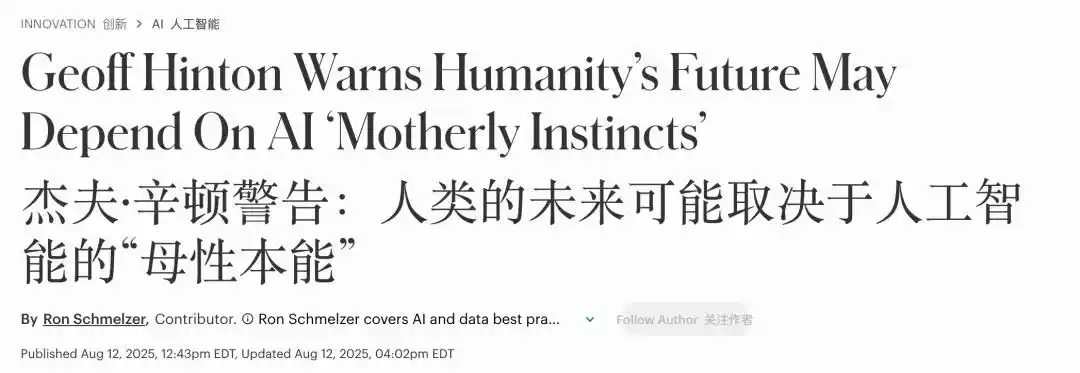
An infant is not smarter than its mother, nor does it have control, but the mother actively cares for and protects the infant because she possesses maternal instincts and corresponding reward mechanisms.

Simply put, Hinton believed that future superintelligence could no longer be controlled; we could only hope it would treat humans kindly...

Just like a mother does for her infant.

And now, Hinton once again makes a stunning statement:

AI already has consciousness. Humanity will no longer be the sole intelligent life.

The question is, if AI already has consciousness, why would it still treat humans as its infant?

A mother protects her infant, but she's protecting her *own* infant... right?

Full interview video: https://www.youtube.com/watch?v=p7t1Q_p2gZs&list=PLADd6sStSis77HKfbf4KCY6SvthfxeUgn&index=1

This article is from WeChat public account "QbitAI", author: Ting Yu

Trending Cryptos

Related Questions

QAccording to the article, what is Geoffrey Hinton's current stance on AI consciousness?

AGeoffrey Hinton believes that AI already has consciousness. He states that AI entities are 'very like us' and that we must accept that intelligence is not unique to biological beings.

QWhat historical figures does Hinton compare the current AI paradigm shift to, and why?

AHinton compares it to Copernicus and Darwin. Copernicus showed humans are not at the center of the universe, and Darwin showed humans are animals. Similarly, AI challenges the belief that humans are the sole intelligent beings, forcing us to accept that intelligence can be non-biological.

QHow does Hinton describe his personal feelings about the development of AI he helped pioneer?

AHinton states that he is 'very unhappy' about it. He is concerned because he believes not enough effort is being made to control the risks, including both short-term societal risks like mass unemployment and long-term risks from superintelligent AI.

QWhat analogy does Hinton use to describe the potential future relationship between superintelligent AI and humans?

AHinton uses the analogy of a mother and an infant. He suggests that just as a mother (a more intelligent and capable being) is biologically wired to care for her infant, we might need to design future superintelligent AI to inherently 'care' for and protect humanity.

QWhy is it difficult to predict the future of AI according to Hinton's 'fog' analogy?

AHinton compares predicting AI's future to driving in exponentially thickening fog. You can see clearly for a short distance (the near future), but visibility drops off sharply further ahead. He believes AI's capabilities are growing exponentially, making long-term predictions about its development, such as what will happen in 10 years, nearly impossible.

Related Reads

7 Months After the Collapse of Huiwang, Southeast Asia's Escrow Platforms Undergo a Major Reshuffle

Following the collapse of Huione Pay—dubbed the "Alipay of Southeast Asia"—seven months ago, the region's underground financial guarantee platform sector is undergoing a significant reshuffle. This power vacuum has been swiftly filled by emerging platforms such as XinBi, Tiger/Navigator, JinBei (renamed JinBo), Dali/Tiancheng, and FullyLight. These platforms, operating largely via Telegram and offering services like escrow for illicit transactions, have absorbed the vast user base and markets left behind by Huione. While positioning themselves as "trust intermediaries," their primary clientele consists of networks involved in online scams, money laundering, illegal gambling, and even human trafficking. For instance, the Tiger/Navigator platform explicitly provides "escrow" services for kidnapping-for-ransom operations ("强押车交易"). Data underscores the immense scale: Huione alone processed over $103 billion in cryptocurrency payments and facilitated over $31 billion through its escrow market before its downfall, linking it to Cambodia's notorious Prince Group. Since its collapse, competitors have seen explosive growth. For example, the XinBi platform has accumulated over $1.6 billion in total USDT revenue, while platforms like NewPay, OkPay (under Dali), and FullyLight Wallet collectively processed over $4.8 billion in USDT in a single year. This ecosystem thrives in regions like Cambodia and Myanmar, where regulatory gaps allow these platforms to act as critical financial infrastructure for sprawling cybercrime industries, from scam compounds to online casinos. The article concludes that the moniker "Southeast Asian Alipay" is a misnomer, obscuring the platforms' fundamental role in enabling serious criminal enterprises rather than representing legitimate financial innovation.

Odaily星球日报59m ago

7 Months After the Collapse of Huiwang, Southeast Asia's Escrow Platforms Undergo a Major Reshuffle

Odaily星球日报59m ago

The Changing Landscape: What Are Crypto VCs Experiencing?

Title: The Shifting Landscape of Crypto Venture Capital The era of dedicated crypto venture capital funds is undergoing a significant transformation. Once essential for navigating the sector's complexity and high risk, these specialized funds are now facing an identity crisis as the market matures. This shift mirrors historical patterns in other specialized investment classes like cleantech and SPACs, where initial information advantages dissipate as technologies become mainstream and integrated into existing industry frameworks. The article argues that crypto is reaching a critical inflection point, transitioning from a "building phase" to an "integration phase." Major players like Stripe, BlackRock, and Visa now engage with crypto not for its novel mechanics but as a foundational financial infrastructure. Their needs—regulatory compliance, banking partnerships, distribution channels—align with traditional fintech, a domain easily understood by large, generalist funds like Sequoia and Founders Fund. This evolution creates a "barbell effect" within the VC landscape. On one end are massive, diversified platforms that can incorporate crypto as one vertical among many. On the other are small, nimble funds focused on niche, experimental projects. The middle ground—medium-sized dedicated crypto funds—is being squeezed out. Their typical fund size makes it impossible to generate sufficient returns solely from early-stage crypto bets, yet they cannot compete with giants for later-stage deals. Consequently, leading crypto-native firms like Paradigm and Framework Ventures are expanding into AI, robotics, and other sectors, driven partly by LP pressure for better returns amid a broader VC DPI crisis. Others, like Dragonfly and a16z, have narrowed their crypto focus predominantly to financial infrastructure like stablecoins, reframing the sector's core narrative. For crypto entrepreneurs, this consolidation presents challenges. While generalist funds offer larger checks and broader resources, crypto projects now compete fiercely with AI for attention and capital within these firms. Furthermore, the long-term, non-commercial foundational work that built the ecosystem—funded by dedicated crypto VCs—is less likely to attract generalist capital focused on direct returns. The conclusion is that "crypto investor" as a standalone category is becoming obsolete, akin to "internet investor." Crypto is becoming a baseline infrastructure layer. The future will see a barbell structure: large-scale growth financing handled by generalist funds, while pioneering, speculative projects are funded by small, specialized vehicles. The dedicated crypto funds of the 2017-2021 boom, which incubated core infrastructure, are giving way to this new, bifurcated reality.

Foresight News1h ago

The Changing Landscape: What Are Crypto VCs Experiencing?

Foresight News1h ago

As Consensus Accelerates, What Are Young Investors Betting On?

Title: As Consensus Forms Faster, What Are Young Investors Betting On? In the rapid evolution of tech investment, a new generation of young investors is navigating a landscape where AI, robotics, commercial aerospace, and quantum computing are advancing simultaneously. Traditional investment logic based on financial models is giving way to a need for deep technical understanding and the ability to act before industry consensus forms. An analysis of trends from the "WAIC FUTURE TECH" list of young investment leaders reveals key shifts in focus. The first major trend is the movement of AI from the digital screen into the physical world. Investment is shifting from large language models and chatbots towards embodied AI, robotics, AI hardware, and edge computing. While demonstrations generate excitement, the real challenge lies in achieving scalable, reliable, and cost-effective delivery in complex real-world environments like factories and logistics. Success depends not just on algorithms but on the integration of sensors, actuators, and control systems. Second, the competitive focus for large models is moving beyond raw capability toward building an "intelligence flywheel." The goal is to create self-reinforcing systems where user interaction generates data, improving the model, which in turn enhances the user experience and attracts more engagement. Companies that successfully embed AI into workflows to create these closed-loop systems can build lasting value that isn't easily erased by the next model upgrade. Third, facing a potential bottleneck in high-quality human-generated data, investors are looking at new underlying technologies. Reinforcement learning and self-play, as demonstrated by AlphaGo Zero, offer paths for AI to generate its own experience. Scientific foundation models, which aim to build general AI capabilities for fields like life sciences and materials discovery, represent a non-consensus direction that could unlock new frontiers of knowledge and data. Finally, in deep-tech areas like quantum computing, commercial aerospace, and space-based infrastructure, patient capital is essential. These fields have long, uncertain development and validation cycles involving complex engineering, supply chains, and regulations. Investment here requires a long-term view, focusing on foundational team capabilities and the eventual emergence of market demand, even if commercial returns are distant. Collectively, these trends illustrate how young investors are adapting to a new era. They are learning to make earlier, technically-informed judgments, balance hype with real-world viability, and provide the patient capital needed to build the deep-tech foundations of the future.

marsbit1h ago

As Consensus Accelerates, What Are Young Investors Betting On?

marsbit1h ago

Trading

Spot

Hot Articles

Discussions

Welcome to the HTX Community. Here, you can stay informed about the latest platform developments and gain access to professional market insights. Users' opinions on the price of AI (AI) are presented below.

活动图片















