Google's $85 Billion Secondary Offering Breaks Historical Record, Buffett Invests $10 Billion in AI Infrastructure

marsbitPublished on 2026-06-09Last updated on 2026-06-09

Abstract

Alphabet (Google) has completed a record-breaking $847.5 billion equity offering, the largest in history. The funds are earmarked for AI infrastructure, with Alphabet's 2026 capital expenditure guidance raised to $180-190 billion. The complex financing structure included public offerings, convertible notes, and a $100 billion private placement to Warren Buffett's Berkshire Hathaway, seen as a major vote of confidence from value investors. Alphabet's move comes amid strong Q1 2026 results, with revenue hitting $110 billion and cloud backlog surpassing $460 billion. This offering signals the start of a massive AI funding supercycle. SpaceX is set for a $750 billion IPO, while AI giants Anthropic and OpenAI have also confidentially filed for public listings targeting trillion-dollar valuations. Analysts estimate total AI-related equity issuance in 2026 could reach $400 billion, dwarfing previous records. The flood of supply raises questions about market absorption, with historical data showing significant post-IPO pullbacks. Some advise investors seeking AI exposure to consider established players like Alphabet, which offers growth potential with comparatively lower risk than pure-play AI startups.

Author: Claude, Shenchao TechFlow

Shenchao TechFlow Insight: Alphabet priced $84.75 billion in equity financing on June 2nd, breaking Petrobras's 2010 record of $70 billion. The initial offering plan was $40 billion but expanded to $45 billion due to oversubscription; Berkshire Hathaway's $10 billion private placement anchored institutional confidence.

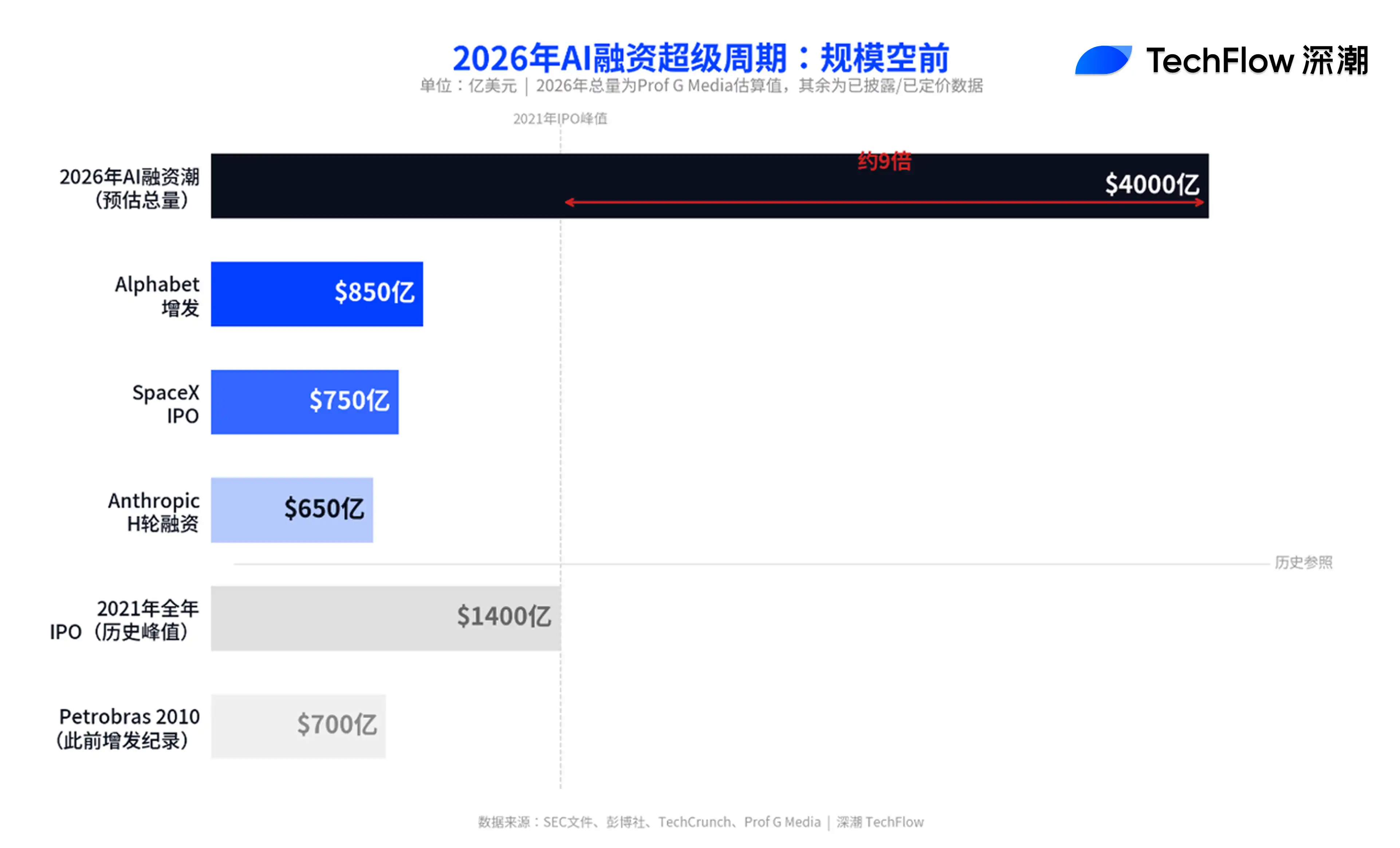
Meanwhile, SpaceX's $75 billion IPO is set to list on Nasdaq on June 12th, while Anthropic and OpenAI have both confidentially submitted S-1 filings. Total equity financing related to AI in 2026 could exceed $400 billion, nine times the size of last year's IPO market.

Alphabet has dropped a bombshell on the capital markets.

According to SEC filings and Bloomberg, Alphabet completed pricing for a total of $84.75 billion in equity financing on June 2nd, marking the largest single equity offering in history, surpassing the $70 billion record set by Petrobras in 2010 by over $14 billion. CEO Sundar Pichai posted on X platform that the initial offering was expanded from $40 billion to approximately $45 billion due to oversubscription. Following the announcement, Alphabet's stock price fell about 4%.
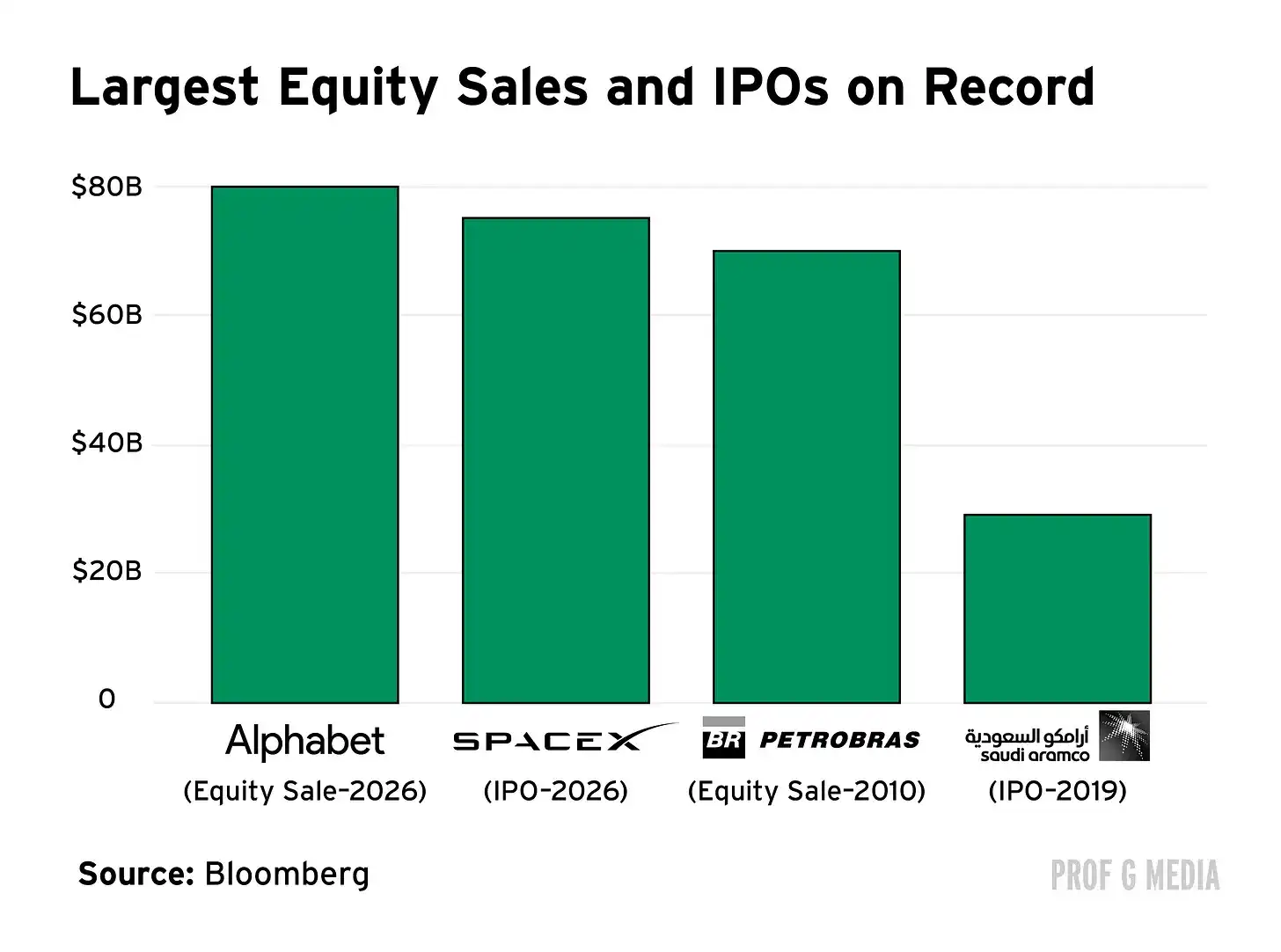
The destination of these funds is clear: AI infrastructure. Pichai defined it as "part of a multi-year investment strategy to seize the opportunities presented by AI." Alphabet's 2026 capital expenditure guidance has been raised to $180-$190 billion, nearly double the full-year 2025 figure of $91.4 billion.

How the $84.75 Billion Was Raised: A Four-Tier Structure Breakdown

This financing was not a simple secondary public offering but a composite structure pieced together from four components.

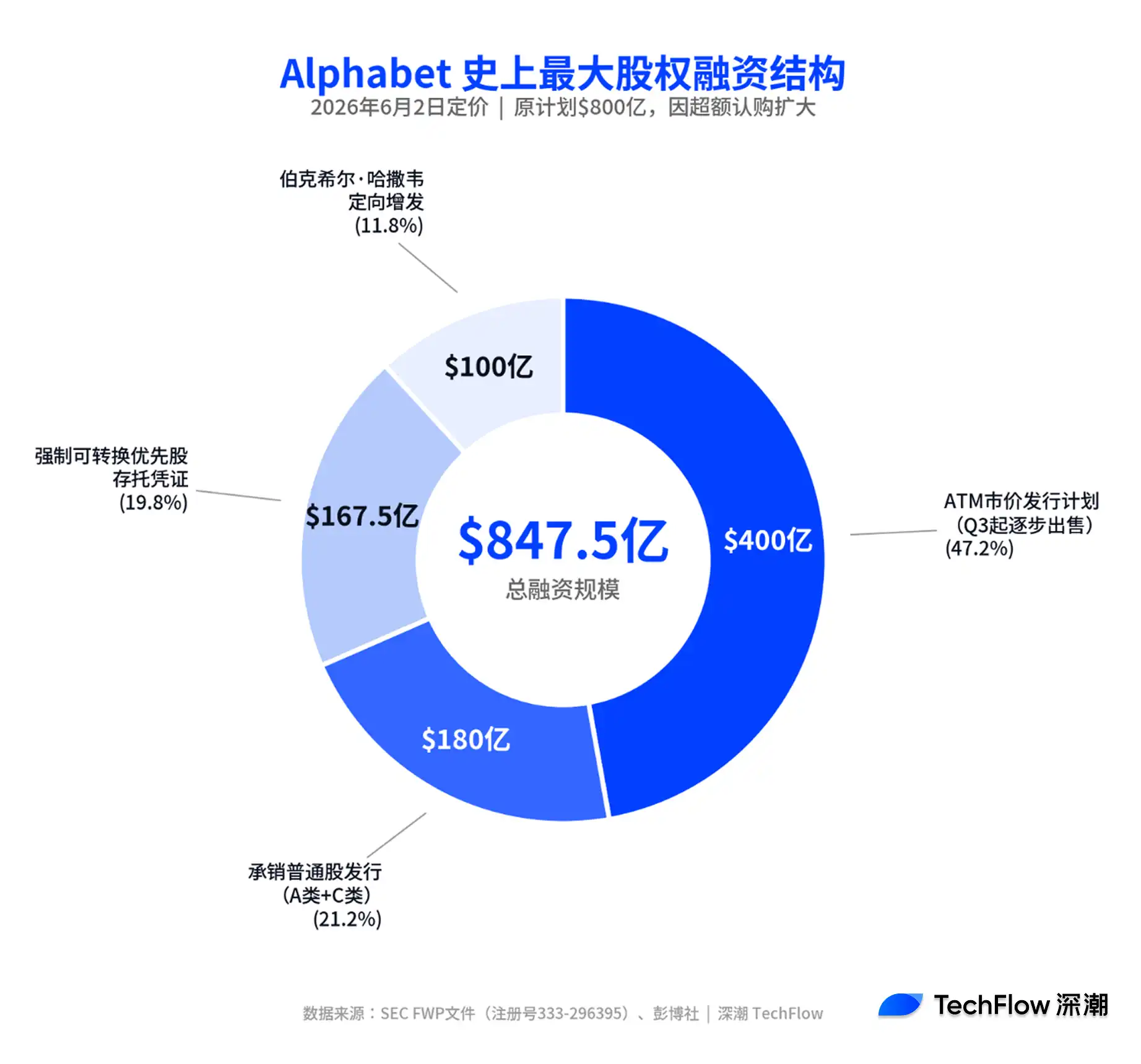
According to the FWP filing submitted to the SEC, the specific composition is: an underwritten offering of $18 billion in Class A common stock and Class C capital stock (expanded from the original plan of $15 billion); $16.75 billion in mandatory convertible preferred stock depositary receipts (expanded from the original plan of $15 billion), with a 6.25% fixed dividend rate; a $40 billion at-the-market offering program (ATM), which will gradually sell shares to the market starting in the third quarter; and a $10 billion private placement to Berkshire Hathaway.

The underwriting portion was priced at $355.20 per share for Class A shares and $351.80 per share for Class C shares. The common stock and depositary receipt offerings were settled on June 4th and June 5th, respectively.

Based on Alphabet's total market capitalization of approximately $4.2 trillion, this financing round represents less than 2% of its market value. According to Seeking Alpha analysis, considering the issuance structure and employee stock option tax obligations, the actual dilution effect may be lower than the nominal figure.
Buffett's $10 Billion Investment: Value Investors Cast a Vote of Confidence for AI Infrastructure

Berkshire Hathaway's $10 billion private placement was the most notable single transaction in this financing round.

According to SEC filings, Berkshire purchased equivalent amounts of Class A and Class C shares at approximately a 6.5% discount. This company, famous for value investing, has long been seen as conservative in the tech investment arena. But from heavily investing in Apple to now directly participating in AI infrastructure financing, Berkshire's move sends a signal: even the most cautious institutional capital now views AI infrastructure as an asset class worth betting on.

According to TechCrunch, Pichai specifically mentioned Berkshire's participation on X platform, emphasizing that its "long-term commitment to value investing" aligns with Alphabet's investment logic.

Google's Confidence: Q1 Revenue of $110 Billion, Cloud Backlog Exceeds $460 Billion

Alphabet's confidence in issuing an $85 billion financing check at this moment stems from solid data.

In the first quarter of 2026, Alphabet's total revenue reached $110 billion, a 22% year-over-year increase. Among this, Google Cloud revenue was $20 billion, a 63% increase, and contract backlog nearly doubled from the previous quarter to over $460 billion, with approximately 50% expected to be recognized as revenue within the next 24 months. Google Search and other business revenue grew 19% year-over-year to $60.4 billion, and Google paid subscription users reached 350 million. According to Prof G Media, Gemini's monthly active users are close to 900 million.

Pichai bluntly stated on the first-quarter earnings call: "We are constrained in the short term by compute supply." CFO Anat Ashkenazi added that capital expenditure in 2027 is expected to "increase significantly again." In other words, the $180-$190 billion annual capital expenditure is just the starting point.

Alphabet's President and Chief Investment Officer, Ruth Porat, played a key role in this financing round. Prof G Markets host Scott Galloway commented that Alphabet could have funded this investment entirely with cash from its own balance sheet, but Porat chose a smarter approach: financing with low-cost external capital while locking in investor allocations before Anthropic and OpenAI go public. "Every resource is finite, including investor appetite for AI infrastructure. Google just took $85 billion off the table," Galloway wrote.

The AI Financing Supercycle: SpaceX, Anthropic, OpenAI Queue Up for IPO

Alphabet's secondary offering is not an isolated event but the opening act of the 2026 AI capital markets supercycle.

SpaceX publicly filed its S-1 prospectus on May 20th, planning to issue 556.6 million shares at $135 per share, raising $75 billion, corresponding to a valuation of approximately $1.75 trillion. According to Bloomberg, the company is expected to price on June 11th and officially list on Nasdaq under the ticker "SPCX" on June 12th. The roadshow started on June 4th and has been oversubscribed. If completed, this will be the largest initial public offering in global IPO history.
Anthropic confidentially submitted a draft S-1 to the SEC on June 1st. Just prior, on May 28th, the company completed a $65 billion Series H funding round, with a post-money valuation of $965 billion, surpassing OpenAI's $852 billion to become the highest-valued AI company in Silicon Valley. According to multiple media reports, Anthropic's target IPO window is around October 2026, with exceeding a $1 trillion valuation on the first day seen as a baseline expectation.

OpenAI is also not far behind. According to CNBC's May 20th report, OpenAI is preparing to confidentially submit its IPO prospectus draft, with Goldman Sachs and Morgan Stanley acting as lead underwriters, targeting a valuation exceeding $1 trillion, with an IPO window between September and November 2026.

The Supply Shock of the $400 Billion Financing Wave: Can the Market Digest It?

Summing these numbers reveals a capital market financing scale in 2026 that is unprecedented.

According to Galloway's calculation, the largest year for IPO financing in history was 2021, with approximately $140 billion for the full year. The combined financing from just Google's secondary offering plus the IPOs of the three AI giants—SpaceX, Anthropic, and OpenAI—already far exceeds this record. If we add other AI-related listing projects like Cerebras and the entire 2026 financing pipeline, the total annual equity issuance could surpass $400 billion, approximately nine times the size of last year's IPO market.

Galloway presents a sobering historical statistic: the average maximum drawdown within one year of listing for the past 30 major IPOs was 55%. "The IPO moment is the peak of hype, the peak of demand. You are competing with every asset manager on the planet for the shares everyone wants," he wrote. "The smarter approach is often to wait for the hype to die down and find an entry point when fear is higher than greed."

For investors, Galloway offers a concise framework: Want AI exposure but unsure if Anthropic or OpenAI is worth their valuation? Buy Google. It's already one of the greatest businesses of all time, with a relatively reasonable valuation, offering upside with far less risk than pure-play AI companies. If AI ultimately disappoints, Alphabet won't disappear, but other companies might not be so lucky.


Trending Cryptos

Related Questions

QWhat was the total size of Alphabet's record-breaking equity offering and how did it break the previous record?

AAlphabet completed an equity offering totaling $84.75 billion. This broke the previous record of $70 billion set by Petrobras (Brazil's state oil company) in 2010 by over $14 billion.

QWhat is the stated primary purpose of Alphabet's massive capital raise?

AThe stated primary purpose of the capital raise is for AI infrastructure investment. CEO Sundar Pichai defined it as 'part of a multi-year investment strategy to capture the opportunities presented by AI.'

QWho invested $10 billion in Alphabet's offering, and why is this significant?

ABerkshire Hathaway invested $10 billion in a private placement. This is significant as the company, known for its conservative value investing philosophy, is seen as giving a 'trust vote' to AI infrastructure as a legitimate asset class.

QWhich three major AI/tech companies are mentioned as preparing to go public in 2026, and what are their expected IPO valuations?

AThe three major companies are SpaceX (targeting a $1.75 trillion valuation), Anthropic (targeting a valuation exceeding $1 trillion), and OpenAI (also targeting a valuation exceeding $1 trillion).

QAccording to the article, what is a key risk or concern highlighted about the upcoming wave of large-scale AI-related public offerings?

AA key concern is the market's ability to absorb the massive supply of equity. Scott Galloway notes that the combined offering sizes could be 9x larger than last year's IPO market. He warns that IPOs often represent a peak in hype, and historically, major IPOs have seen an average maximum drawdown of 55% within their first year of trading.

Related Reads

human.tech Launches Clean SDK for Privacy-First Web3 Apps

human.tech has launched the Clean SDK, a toolkit enabling developers to build privacy-first Web3 applications with transparent accountability. Released alongside Aztec's version 5, the SDK provides components for integrating zero-knowledge identity verification, sanctions screening, and private transactions, without developers handling sensitive user data or building compliance infrastructure from scratch. It uses zero-knowledge proofs and programmable verification to allow apps to confirm user legitimacy and sanctions compliance while keeping identities confidential. The first application built on the SDK, Shield, a privacy bridge to Aztec, also launched. It allows users to transfer assets privately while proving a unique human is behind each transfer and that funds have passed sanctions checks, as verified by a May 2026 audit. The SDK offers three core verification techniques: Proof of Innocence (sanctions screening against 23 sources), Proof of Personhood (simpler verification via Human Passport), and Proof of Clean Hands (higher-assurance zero-knowledge government ID checks). This allows apps to authenticate users and transactions without exposing personal data. Designed for Aztec builders, the SDK lets developers add programmable privacy to decentralized apps, eliminating the need to create their own verification and ZK infrastructure. Shield demonstrates its practical use for private bridges, but the SDK aims to enable a wider ecosystem of private, accountable financial apps and services. The launch addresses growing demand for infrastructure that balances privacy and accountability. The SDK avoids traditional identity databases, storing encrypted data off-chain, screening at both entry and exit points, and including a gated disclosure mechanism for legal requests. human.tech's products, including the Clean SDK, focus on using zero-knowledge technology to enable verifiable personhood and privacy in digital systems.

TheNewsCrypto12m ago

human.tech Launches Clean SDK for Privacy-First Web3 Apps

TheNewsCrypto12m ago

Unlocking $100 Million in Liquidity? Pump.fun's New Policy Tests the 5-Minute Pump Technique

Pump.fun, a popular meme coin launchpad, has introduced a new standard mechanism called BOOST. It aims to address a significant capital efficiency issue: when a newly launched token graduates from its initial bonding curve to a liquidity pool (LP), roughly 20% of its liquidity becomes permanently locked as "dead liquidity," estimated to waste over $100 million annually. Instead of locking these funds permanently, BOOST repurposes them. Upon a token's migration, approximately 20% of the settlement funds (e.g., 17.6 SOL or ~$2516 USDC) are used to buy back the token on the open market over a 5-minute period via a Time-Weighted Average Price (TWAP) mechanism. All purchased tokens are immediately burned. This creates a brief, systematic buy pressure immediately after migration, potentially generating a short-term price surge ("pump") while permanently reducing the token's circulating supply. The goal is to enhance the immediate post-launch trading experience, potentially increasing trader retention and sustainable protocol revenue, which funds ongoing token buybacks. However, concerns exist that this artificial 5-minute boost could lower the barrier for launching low-quality tokens and lead to steeper price crashes once the buy pressure stops, if followed by large sell-offs. The feature automatically applies to tokens migrating after July 21, 2024, but not to previously migrated tokens or those launched via the Mayhem AI Agent lab.

marsbit19m ago

Unlocking $100 Million in Liquidity? Pump.fun's New Policy Tests the 5-Minute Pump Technique

marsbit19m ago

Podcast Notes | Conversation with GSR Asset Management Head: To Determine if This Crypto Rally is Real, Just Watch the Lending Rates on Aave

Podcast Summary: Dialogue with GSR's Head of Asset Management: To Determine if This Crypto Rally is Real, Just Check Lending Rates on Aave Andy Baehr, Managing Director of Asset Management at GSR, discusses the current crypto market, characterizing it as stuck in a state of "ambivalence" with short-lived, unsustainable rallies. He outlines a simple framework: the market moves between "ambivalence" and "conviction" (sustained upward momentum). Currently, every rally resembles a single-stage rocket booster that quickly fizzles out. Baehr identifies three key signals to watch: 1) DeFi lending rates, 2) the potential passage of the CLARITY Act, and 3) the market forming a consensus on the "Fed hawkish peak." He emphasizes that the most immediate indicator for the sustainability of the recent CPI-triggered rally is the USDC borrowing rate on Aave, currently around 3.75%—close to U.S. Treasury yields. The absence of a credit spread indicates low leverage demand and a lack of market energy. He explains that a healthy, sustained rally requires layered buying pressure. Last year's rally progressed from an ETH short squeeze to crypto-native trader influx and finally to ETF inflows. Currently, this structure is missing. Other potential structural buyers like Digital Asset Treasury (DAT) companies are absent, and ETF flows have proven transient. Baehr notes that while small-cap crypto tokens outperformed large caps in Q2—a potential sign of capitation in major assets—capital is also flowing to more exciting opportunities like AI stocks and tech IPOs, leaving crypto sidelined. Regarding DeFi, he highlights that platforms like Aave provide a clear, real-time signal of leverage demand through their supply/demand-driven interest rates. A significant, sustained rate increase would signal genuine market conviction. He also observes the quiet emergence of fixed-income-like products and vaults in DeFi. On regulation, the probability of the CLARITY Act passing before the August 7th deadline has dropped linearly from 75% to below 40% on Polymarket. Baehr suggests its passage would be treated as a bullish surprise, a potent driver for price movement. However, political hurdles, including ethical clause debates and disclosures about the First Family's crypto profits, remain significant obstacles. Ultimately, the market awaits clarity on the Fed's terminal rate under Chair Warsh. Until the "Fed Solstice"—the point where the market collectively understands the peak of hawkish policy—sustained conviction will be difficult to achieve.

marsbit50m ago

Podcast Notes | Conversation with GSR Asset Management Head: To Determine if This Crypto Rally is Real, Just Watch the Lending Rates on Aave

marsbit50m ago

Trading

Spot

Hot Articles

Discussions

Welcome to the HTX Community. Here, you can stay informed about the latest platform developments and gain access to professional market insights. Users' opinions on the price of AI (AI) are presented below.

活动图片