From Speculation to Utility: Why AI and Stablecoins Remain Unfazed by the Bear Market?

marsbitPublished on 2026-03-27Last updated on 2026-03-27

Abstract

Despite the overall downturn in the cryptocurrency market in 2026, the AI and stablecoin sectors have outperformed, showing resilience and continued adoption. While Bitcoin price dropped by 18.5% and the total crypto market cap fell to $2.42 trillion, these two areas recorded significant growth in usage and market activity. Key data highlights include: - The AI token sector declined by only 14% in Q1 2026, the smallest drop among major categories. - Stablecoin total market cap reached a record $3.2 trillion, with monthly trading volume hitting $1.8 trillion in February 2026, also a historic high. USDC supply grew by 220% since November 2023, reaching $78 billion, while ChatGPT’s weekly active users increased tenfold to 900 million during the same period. Tether’s USDT remains the leading stablecoin with a $184 billion market cap. The convergence of AI and stablecoins is driven by structural trends: AI requires fast, low-cost payment systems, and stablecoins serve as ideal “internet money.” Both sectors benefit from real-world utility beyond speculation—AI enhances productivity and security, while stablecoins provide efficient global dollar distribution and settlement infrastructure. This shift reflects a broader market transition from speculation to practical, infrastructure-focused applications, positioning AI and stablecoins for sustained growth.

Written by: Cointelegraph

Compiled by: AididiaoJP, Foresight News

Despite the overall downturn in the cryptocurrency market in 2026, the performance of the artificial intelligence (AI) and stablecoin sectors has outperformed the broader market. Relevant data shows that while the prices of other assets continue to fall, usage in these two sectors continues to grow.

Key Takeaways

  • The AI sector recorded the smallest decline in Q1 2026, at just 14%.
  • The total market capitalization of stablecoins reached a new all-time high of $3.2 trillion, with monthly trading volume hitting $1.8 trillion, also a record high.

AI and Stablecoin Sectors Defy the Downtrend

In 2026, Bitcoin's price fell by 18.5%, and the total cryptocurrency market capitalization dropped to $2.42 trillion, with most altcoins underperforming. The market was affected by concerns and uncertainties related to the US and Israel-Iran conflict, while the Federal Reserve maintained a hawkish stance, leading to a generally cautious sentiment.

In contrast, businesses related to AI and stablecoins continued to grow against the trend, showing strong fundamentals and significant expansion, reflecting a market shift in focus from speculative behavior to infrastructure construction.

Taking USDC, issued by Circle, as an example, data from Token Terminal shows its supply has reached $78 billion, a 220% increase since November 2023.

Meanwhile, the number of weekly active users of ChatGPT grew from 85 million in November 2023 to 900 million in March 2026, an approximately 10-fold increase during the same period.
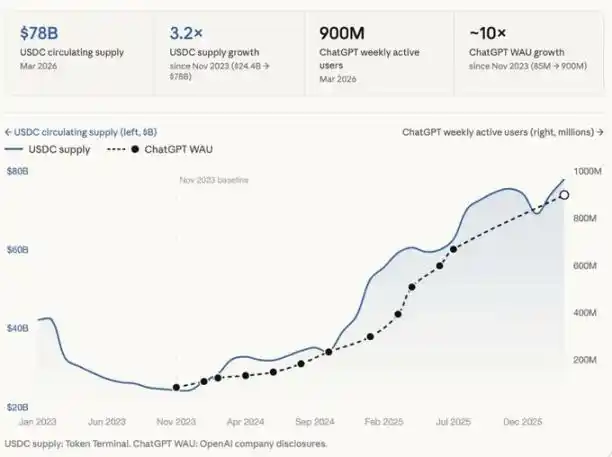
(Chart: USDC Supply vs. ChatGPT Weekly Active Users; Source: Token Terminal)

A Q1 2026 report from Grayscale also confirmed this trend. The report pointed out that the AI sector had the smallest decline in the first quarter, at 14%, while the Consumer & Culture sector fell 31%, the Smart Contract Platforms sector fell 21%, and the Currency sector fell 21% during the same period.

The digital asset management company stated that this indicates "investor preference has shifted away from momentum-driven, more speculative sectors." The report further stated:

"Although overall market sentiment remains low, capital has begun to concentrate in projects with stronger fundamentals that align with key themes such as AI and tokenization."
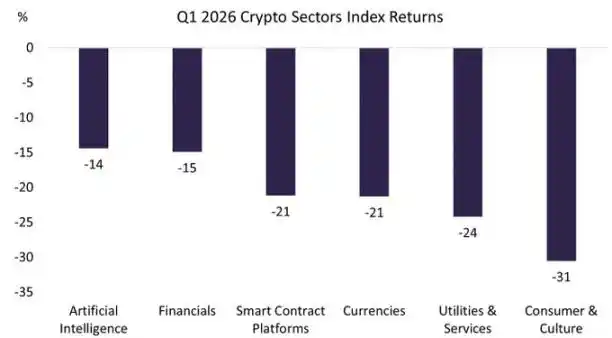
(Chart: Negative Returns Across All Sectors in Q1 2026; Source: Grayscale)

Currently, the total market capitalization of AI tokens is approximately $17.4 billion, up 30% in the past 30 days. Among them, Bittensor and NEAR Protocol (NEAR) led the gains, with prices rising 75% and 30% respectively during the same period.
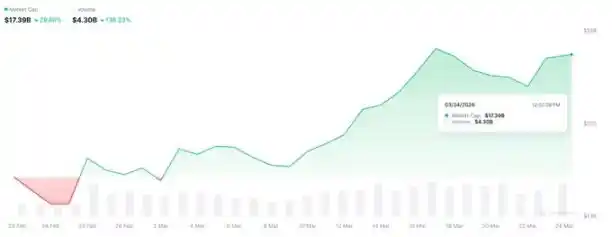
(Chart: Market Capitalization of Major AI & Big Data Tokens; Source: CoinMarketCap)

Regarding stablecoins, their market size continues to expand. As of March 23rd, the total market capitalization of stablecoins reached a record $3.2 trillion. USDt, issued by Tether, continues to dominate with a market capitalization of approximately $1.84 trillion, accounting for 57% of the total stablecoin supply.

In February 2026, the monthly trading volume of stablecoins reached $1.8 trillion, a historical high, now comparable to traditional payment systems. USDC stood out in terms of supply growth, increasing 80% month-on-month, with last month's trading volume reaching a historical high of $1.26 trillion.
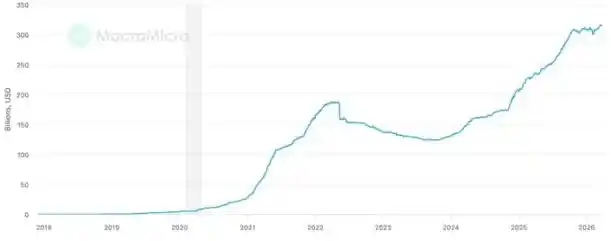
(Chart: Total Stablecoin Market Capitalization; Source: MacroMicro.me)

Stablecoins are a type of cryptocurrency designed to maintain a stable value, typically pegged to fiat currencies like the US dollar, and can operate on multiple blockchains.

In a bear market environment, stablecoins serve as a store of purchasing power and a settlement channel, widely used in trading pairs, tokenized real-world assets, and yield-generating products. The transfer volume of stablecoins on Ethereum and other blockchains remains high, and institutional-grade products launched by banks and fintech companies are gradually integrating stablecoins for yield management and fund operations. Even as speculative assets perform poorly, the role of stablecoins as infrastructure remains solid.

"Structural Tailwinds" Drive Convergent Growth in Both Sectors

The reason the AI and stablecoin sectors can thrive is that they continue to provide tangible value even after the speculative frenzy subsides.

Token Terminal pointed out: "AI labs and stablecoin issuers are among the companies with the strongest structural tailwinds in the 2020s."

The crypto data service provider further stated that these two fields are at the "convergence of technological, financial, and geopolitical forces," and each force independently brings demand to these two sectors. The report added:

"AI drives improvements in productivity and defense capabilities, while stablecoins provide the financial infrastructure for the global distribution of the US dollar."

Cryptocurrency trader Mando CT stated in a post on platform X on March 24th that AI and stablecoins are two of the four dominant sectors in 2026.

Explaining the convergence trend of the two sectors, the trader noted that AI requires instant, low-fee payment systems to support its operation, and stablecoins are the "internet money" that achieves this.

Mando CT said: "These trends are interconnected," adding:

"2026 is not just another cycle rotation, but a transformative year moving from speculation to infrastructure."

As reported by Cointelegraph, stablecoins are expected to benefit from AI-driven payment scenarios, facilitating convenient, automated, rule-based transactions between entities, further driving the long-term growth of both fields.


Trending Cryptos

Related Questions

QWhy did the AI and stablecoin sectors outperform the broader cryptocurrency market in 2026 despite the bear market?

AThe AI and stablecoin sectors showed strong fundamentals and significant expansion, reflecting a market shift from speculation to infrastructure. AI tokens had the smallest decline (14%) in Q1 2026, while stablecoin market cap hit a record $3.2 trillion with monthly trading volume reaching $1.8 trillion.

QWhat was the USDC supply growth and ChatGPT user growth from November 2023 to March 2026?

AUSDC supply grew by 220% from November 2023, reaching $78 billion. ChatGPT's weekly active users grew approximately 10 times, from 85 million in November 2023 to 900 million in March 2026.

QWhich AI tokens performed well in the 30 days leading up to the article, and what were their gains?

ABittensor and NEAR Protocol (NEAR) were top performers. Bittensor's price increased by 75%, and NEAR's price increased by 30% in the past 30 days.

QWhat role do stablecoins play in a bear market environment according to the article?

AIn a bear market, stablecoins act as a store of purchasing power and a settlement channel. They are widely used in trading pairs, tokenized real-world assets, and yield-bearing products, maintaining their role as infrastructure even when speculative assets perform poorly.

QHow are the growth trends of AI and stablecoin sectors interconnected, as explained by trader Mando CT?

AMando CT stated that AI requires instant, low-fee payment systems to support its operations, and stablecoins serve as 'internet money' to achieve this. These trends are interconnected, representing a transition from speculation to infrastructure in 2026.

Related Reads

Annual Salary of Millions Competing for Electricians, Meta Rushes to Open Its Own Technical School

The AI boom is facing an unexpected bottleneck: a severe shortage of skilled construction workers and electricians. As tech giants like Meta, OpenAI, and Alphabet race to build massive data centers—such as OpenAI's $16 billion "Stargate" project—they are hitting a critical labor wall. The U.S. needs an estimated 130,000 more electricians, 240,000 construction workers, and 150,000 supervisors by 2030 for AI infrastructure alone, but tens of thousands of electrician jobs go unfilled each year. While AI companies offer high premiums, with electricians earning up to $280,000 annually, worker scarcity still causes massive losses—delays on a single project can cost $14.2 million per month. The complexity of building AI data centers, which require immense power (equivalent to powering hundreds of thousands of homes), sophisticated electrical systems, and advanced liquid cooling solutions, demands highly skilled technicians who are in short supply. To combat this, companies are investing heavily in training. Meta has committed $115 million to a free training school offering tuition, housing, and stipends, targeting 5,000 new workers. OpenAI is partnering with unions to secure skilled labor. These efforts are paying off, with a significant rise in Gen Z interest in trade schools over college. However, the power demands are staggering. AI data centers are driving a rapid surge in electricity consumption, projected to account for up to 12% of U.S. power use by 2028 and raising costs for consumers. Furthermore, the construction boom is project-based, leading to a potential future glut of trained workers once building peaks, which could depress wages industry-wide. The race for AI supremacy now depends as much on skilled hands as on advanced chips.

marsbit1h ago

Annual Salary of Millions Competing for Electricians, Meta Rushes to Open Its Own Technical School

marsbit1h ago

OpenAI No Longer Sells Its Most Expensive Model for Profit

OpenAI is shifting its business strategy away from promoting its most expensive, flagship models for every task. Recent price cuts—80% for GPT-5.6 Luna and 20% for Terra—signal a deeper change: the company now actively advises users that many tasks don't require the most powerful model. Instead, OpenAI recommends a tiered approach: use the high-end GPT-5.6 Sol for complex planning and analysis, then delegate execution to cheaper models like Luna. This mirrors moves by Anthropic, which recently launched Claude Opus 5 at half the price of its top model, Fable 5. Both companies are de-emphasizing flagship models as primary revenue drivers, using them instead for brand prestige and technological showcases. The industry is entering a "mass-market" phase, similar to automotive, where high-volume, cost-effective models handle daily operations and drive scale. OpenAI's price reductions are partly enabled by AI models themselves optimizing underlying code and infrastructure, creating a self-reinforcing cycle of efficiency gains and cost reduction. Competition is shifting from "who is smartest" to "who offers the best value." The goal is no longer selling individual models but fostering widespread API adoption and ecosystem lock-in. By making AI calls cheap and ubiquitous, companies like OpenAI aim to become the indispensable, utility-like infrastructure powering automated workflows—the "water and electricity" of software, quietly embedded everywhere.

marsbit1h ago

OpenAI No Longer Sells Its Most Expensive Model for Profit

marsbit1h ago

Trading

Spot

Hot Articles

Discussions

Welcome to the HTX Community. Here, you can stay informed about the latest platform developments and gain access to professional market insights. Users' opinions on the price of AI (AI) are presented below.

活动图片