From Speculation to Risk Management: Predictive Markets Are Filling the Gap in Commercial Insurance

marsbitPublished on 2026-08-17Last updated on 2026-08-17

Abstract

From Speculation to Risk Management: Predictive Markets Filling the Commercial Insurance Gap The emergence of AI risk management tools like Blanket is exploring the potential of predictive markets as a genuine insurance tool for businesses. These markets, with their simple contract structure—paying $1 if an event occurs, $0 if not—allow the real-time market price to reflect collective probability assessments. Businesses can use them to hedge against operational risks (e.g., abnormal weather, energy price fluctuations) that are often not covered by traditional business interruption insurance, which typically requires physical damage. A key question is whether these markets are genuinely used for hedging or remain primarily speculative. Analysis of Kalshi markets from August 2025 to August 2026 compared weather contracts (a potential hedge instrument) against sports contracts (largely speculative) and traditional CME grain futures. Three behavioral metrics were examined: 1. **Daily Turnover Rate:** Weather contracts showed the lowest rate (0.210), lower than corn futures (0.266) and significantly lower than sports contracts (0.315), suggesting longer holding periods. 2. **Hold-to-Expiry Ratio:** Weather contracts had a much higher ratio (over 0.5) compared to near-zero ratios for sports contracts, indicating a stronger tendency to hold positions until settlement, consistent with hedging behavior. 3. **Position Buildup Timing:** Weather market positions reached 50% of their...

Written by: G_Gyeomm

Compiled by: AIdidiaoJP, Foresight News

I. A New Type of Insurance Directly Priced by the Market

The recently launched AI risk management tool Blanket is attempting to turn predictive markets into a genuine insurance tool usable by businesses. The logic is straightforward: a business inputs its operational information, the system automatically diagnoses its main risk exposures, and then recommends corresponding Kalshi event contracts to help the business hedge against these risks.

The hedging mechanism itself is not complex. The contract structure of a predictive market is extremely clear — it pays $1 if an event occurs and $0 if it doesn't. The contract's real-time price represents the market's collective judgment on the probability of that event occurring.

It is precisely this simple structure that gives predictive markets the potential to become real hedging tools. Businesses can preemptively purchase contracts for events that could impact their operations, such as abnormal weather, energy price volatility, or tariff policy changes. If these risks materialize, the contract payouts can partially or fully offset the operational losses.

A specific example: an ice cream shop that would lose about $20,000 in revenue if the summer is unusually cool.

The hedging operation is as follows: buy 20,000 temperature contracts at $0.30 each. If the average summer temperature falls below a preset threshold, each contract pays out $1. The total cost is $6,000.

There are only two possible outcomes:

  • Cool Summer: The temperature is below the threshold, revenue is down $20,000, but the contracts pay out $20,000 in total. The net loss is locked at $6,000 — exactly the initial cost of buying the contracts.
  • Hot Summer: The temperature is above the threshold, revenue is unaffected, but the contracts expire worthless, and the $6,000 cost is completely lost.

Regardless of the outcome, the final loss is firmly locked at $6,000. This $6,000 is essentially the insurance premium. And the rate for this premium is not set by an insurance company's actuary or any traditional underwriting institution, but by the market itself — the price quoted in real-time by countless buyers and sellers with real money.

II. Is the Hedging Market Really Functioning?

Predictive markets have already accumulated enough speculative demand. They first gained fame through election predictions, then smoothly expanded into the sports arena, largely solving the volume problem. The industry generally believes the next growth space lies in expanding more practical use cases, with hedging needs repeatedly mentioned as one of the most promising directions.

In principle, its value is indeed significant. The gaps not covered by existing hedging tools are quite broad. Traditional business interruption insurance in commercial insurance typically requires physical damage as a precondition. A ski shop losing revenue because there was hardly any snow all winter — this kind of pure "operational risk" — is almost impossible to find suitable insurance products to cover on the market.

There are mature hedging tools in the futures market, but the barriers are high: requiring an ISDA agreement, opening a specialized futures account, posting margin, and minimum contract size limits. These are not issues for large institutions, but are almost unattainable for ordinary small and medium-sized enterprises. Goldman Sachs can maintain a professional derivatives trading team, but the cafe on the corner obviously cannot.

The problem is, there has always been a clear chasm between theoretical rationality and actual use. Predictive markets have long carried the label of "gambling," and whether they can truly operate as an independent hedging market — rather than just a speculative tool — has never been systematically verified.

The real question that needs answering is: Are predictive markets actually being used for hedging? Does real hedging demand exist? Trading behavior itself can provide clues. We selected three sets of data for comparison.

The first set is CME grain futures — a typical traditional hedging market, primarily used to mitigate losses from price fluctuations in agricultural and livestock products.

The second set is the Kalshi sports market — where hedging demand is extremely limited, and trading is almost entirely driven by speculation.

The third set is the Kalshi weather market — it handles weather risk in a manner similar to CME weather futures, while sharing the exact same event contract structure and trading environment with the Kalshi sports market. This makes it an excellent test sample — to see which side its trading behavior is closer to.

Hedging and speculation typically exhibit different trading characteristics. Hedgers tend to establish positions well before the actual risk window arrives and hold them until expiration; speculators move in and out more frequently, chasing prices, with noticeably higher turnover rates.

If the Kalshi weather market's turnover rate and holding behavior are closer to traditional hedging markets than to the sports market, then hedging demand is real.

Conversely, if it's not much different from the sports market, then actual usage is closer to pure speculation. In that case, tools like Blanket might be responding to a nice industry hypothesis, not a real demand confirmed by data.

The dataset for this analysis covers 1,265 Kalshi markets settled between August 2025 and August 2026. The screening criteria were: cumulative trading volume of at least 500 contracts, and trading lasting at least three days.

III. Data Point 1: Average Daily Turnover Rate

First, look at how frequently positions are traded in each market. Turnover rate is defined as daily trading volume divided by open interest (OI) for that day. We calculated the daily turnover rate for each contract in each market and then took the median for the entire trading cycle.

The results are clear: Kalshi weather contracts have the lowest turnover rate, only 0.210. The traditional hedging product corn futures is 0.266, and Kalshi sports contracts are the highest at 0.315.
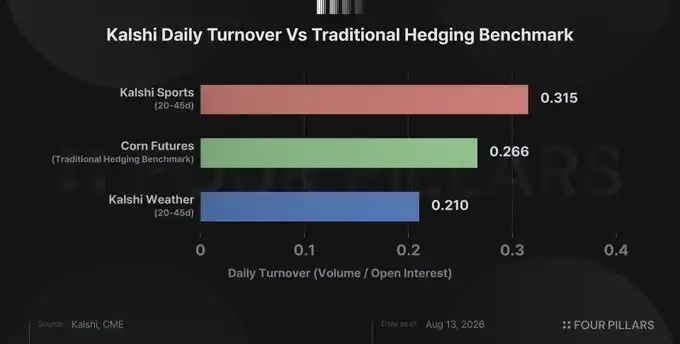
Sports contracts turn over about 1.5 times faster than weather contracts. This indicates a relatively longer holding tendency for weather contracts, initially suggesting the possible existence of real hedging demand.

However, a caveat: Corn futures' turnover rate sits in the middle, and the differences among the three data sets are not particularly stark. Based on turnover rate alone, we cannot fully confirm the existence of hedging demand in the weather market. What this data can definitively tell us so far is only that weather contract turnover is significantly lower than sports contract turnover.

IV. Data Point 2: Hold-to-Expiration Ratio

The second key metric is the hold-to-expiration ratio — measuring how many positions remain untouched in the market at settlement. It is calculated as the final open interest for each contract divided by the cumulative trading volume. A higher value indicates more positions were firmly held until the expiration date.
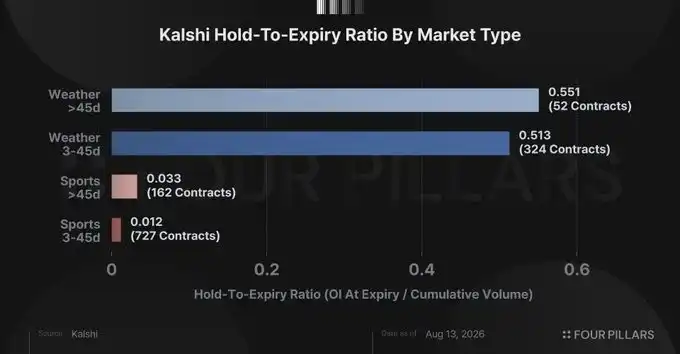
The difference in results is very striking: regardless of trading duration, the hold-to-expiration ratio for weather contracts exceeds 0.5. In contrast, sports contracts are only 0.012 and 0.033 respectively. In the 3 to 45-day trading interval, weather is 42.8 times that of sports; in the over 45-day interval, the gap is still 16.7 times.

This clearly shows: Weather contracts are far more inclined to "buy and hold" than sports contracts. Hedgers hold contracts to receive payouts if the risk materializes, not to chase price differences. Therefore, a high hold-to-expiration ratio strongly supports the judgment that there is real hedging demand in the weather market.

Of course, this cannot be directly interpreted as the entire weather market being used for hedging. This data does not track the identities of individual position buyers and sellers, so it cannot be simply equated with the proportion of original buyers holding to expiration. What can be confirmed at present is that the holding behavior of weather contracts is distinctly different from that of sports contracts.

V. Data Point 3: When Were Positions Established?

The final question is: When were these positions established? We divided the daily open interest for each contract by that contract's peak open interest, converted the time from launch to expiration into a progress bar from 0% to 100%, and then plotted the median curve.

The criterion for judgment is the point at which half of the peak open interest is reached. If half is reached when there is still more time until expiration, it means positions were built earlier — which is more in line with the behavior pattern of hedgers.
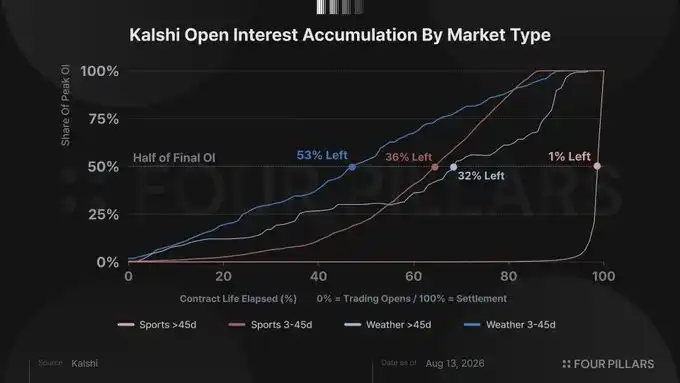
For weather contracts trading for 3 to 45 days, they had already reached half their peak open interest when their lifecycle was at 47%, leaving 53% of the time until expiration. Sports contracts in the same interval didn't reach half until 65%, with only 36% of the time remaining.

For contracts over 45 days, the difference is even more astonishing. Weather contracts reached half when there was still 32% until expiration, while sports contracts had only 1.3% left. Regardless of the interval, weather positions were established much earlier than sports positions.
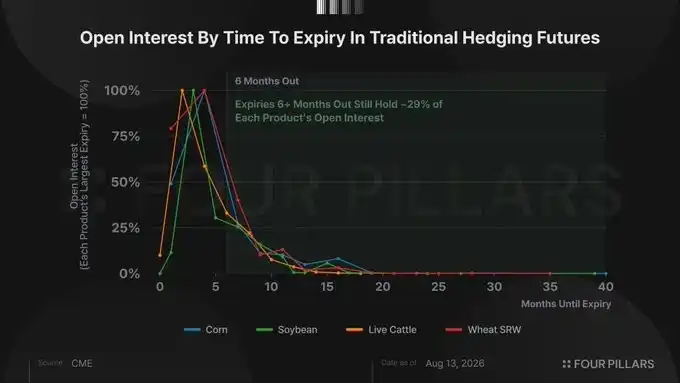
This behavior of "early positioning" is precisely a typical characteristic of traditional hedging markets. As of August 11, 2026, CME grain and livestock futures contracts expiring in six months had already accumulated massive open interest. Corn futures even held 65,127 positions on contracts expiring 16 months later.

This reflects the tendency to act well before the risk actually materializes. And the behavioral pattern of Kalshi weather contracts is clearly closer to traditional hedging markets than to sports markets.

VI. Hedging Relies on Liquidity Built by Speculation

Conclusion first: The Kalshi weather market is neither a purely hedging market nor a purely speculative one like sports. Speculative demand still contributes a significant portion of the liquidity, but on top of that, hedging demand has also emerged relatively clearly.

The three indicators point in the same direction: weather contracts trade less frequently, retain more positions at settlement, and positions are established earlier. No single indicator can confirm trading intent with 100% certainty, but the high consistency of these behaviors collectively supports a judgment — there indeed exists a holding demand in the Kalshi weather market distinct from sports, and a considerable part of it is likely real hedging demand.

More importantly, speculative demand is not so much a weakness of predictive markets as it is a prerequisite for the hedging function to exist. A market with only hedgers and no speculators would struggle to find sufficient counterparties and continuous liquidity.

In predictive markets, speculators are responsible for pricing and providing liquidity, while hedgers transfer the risks they do not wish to bear on this foundation. The risk is no longer directly underwritten by an insurance company but is naturally dispersed among market participants through trading.

Therefore, the next phase of growth for predictive markets is not about "squeezing out" speculation and shifting entirely to hedging. What truly matters is: How much real corporate hedging demand can be layered on top of the liquidity base already built by speculation? This is the core variable that determines whether it can upgrade from an "interesting speculative tool" to a "usable risk management infrastructure."


Trending Cryptos

Related Questions

QWhat is the main difference between using a prediction market and traditional insurance for business risk management?

AThe main difference is that in prediction markets, the insurance premium (price of the contract) is determined collectively by market participants based on their assessment of the event's probability, whereas in traditional insurance, the premium is calculated by the insurer's actuaries.

QWhat are the three data points used to analyze whether the Kalshi weather market is used for hedging?

AThe three data points are: 1) Average daily turnover rate, 2) Hold-to-expiration ratio, and 3) The timing of when positions are established (measured by the time it takes to reach 50% of peak open interest).

QAccording to the analysis, how does the trading behavior of Kalshi weather contracts compare to its sports contracts?

AThe analysis shows that Kalshi weather contracts have a lower turnover rate, a significantly higher hold-to-expiration ratio, and positions are established much earlier compared to Kalshi sports contracts. This suggests behavior more consistent with hedging.

QWhat is the primary role of speculators in a prediction market that aims to serve hedging purposes?

ASpeculators provide the necessary liquidity and price discovery in the prediction market, which creates a functional trading environment that allows hedgers to enter and exit positions to transfer their risks.

QWhat example is given to illustrate how a business could use a prediction market contract to hedge against operational risk?

AThe example given is an ice cream shop that could hedge against a cool summer. It could buy 20,000 temperature contracts at $0.30 each (total cost $6,000). If the summer is cool and average temperature falls below a threshold, each contract pays $1, offsetting the estimated $20,000 revenue loss, thereby locking the net loss at the initial $6,000 cost. If the summer is hot, the contracts expire worthless, and the shop loses the $6,000 premium but enjoys full revenue.

Related Reads

'The Idea of Catching the Absolute Bottom Is Wrong': Experts on a New Phase of Bitcoin Capitulation

Analysts from CryptoQuant advise investors against trying to pinpoint the exact bottom of Bitcoin's price. Their data shows the percentage of the Bitcoin supply in profit has fallen to 51.4%, a level historically associated with capitulation phases followed by accumulation. This means approximately 48.6% of circulating coins are held at an unrealized loss. The metric, based on UTXO analysis comparing a coin's last moved price to its current market value, last neared this level in early 2023 when Bitcoin traded between $16,000 and $20,000. CryptoQuant states that the idea of catching the "absolute bottom" is flawed. The decline in the average cost basis during a bear market reflects coins transferring from weak hands to stronger, long-term holders. While some investors realize losses, others may use the decline for gradual accumulation. The accumulation window may last longer than many expect, even as fear drives some participants away. Historically, a supply in profit below 55% has been linked to re-accumulation periods. Separately, Swan Bitcoin CEO Cory Klippsten offered a forecast, suggesting Bitcoin could form a bottom in October 2026, followed by a recovery towards approximately $130,000 ahead of the 2028 halving. This aligns with the historical pattern of local lows forming about 12 months after bull market peaks; Bitcoin hit its all-time high above $126,000 in early October 2025. However, Klippsten cautioned against over-relying on past cycles due to limited historical data.

cryptonews.ru3m ago

'The Idea of Catching the Absolute Bottom Is Wrong': Experts on a New Phase of Bitcoin Capitulation

cryptonews.ru3m ago

How Does FalconX Bring Institutional Lending On-Chain? Deep Dive into the FALX Operational Mechanism

FALX is a structured credit facility that brings institutional prime brokerage loans on-chain as fixed-income assets. It works by having FalconX originate overcollateralized loans to institutional clients (e.g., quant funds, market makers). These loan exposures enter a bankruptcy-remote SPV. The Pareto protocol provides the on-chain credit vault infrastructure, while M11 Credit acts as the credit curator, administrative agent, and collateral agent. Platforms like Plume, Ethereum, and Solana serve as distribution channels for investors. Investors deposit USDC into the vault, receiving an estimated ~7.4% net yield (after a 10% performance fee). This yield represents a premium over low-risk on-chain alternatives (like tokenized Treasuries at ~4%) to compensate for risks including FalconX operational risk, collateral liquidation risk, SPV legal risk, M11's execution risk, a 31-day redemption notice period, and potential contagion from DeFi re-collateralization. The structure incorporates multiple risk mitigations: overcollateralized underlying loans, a first-loss capital contribution from FalconX, and independent oversight by M11. However, challenges remain, such as scaling investor demand (current AUM is ~$148M against a ~$1B potential capacity), managing redemption liquidity, and addressing new risks from the vault token's use as collateral in DeFi lending protocols like Morpho. FALX demonstrates a pragmatic path for on-chain credit by leveraging existing institutional loan origination and combining it with legal structures, external curation, and blockchain-based distribution.

marsbit5m ago

How Does FalconX Bring Institutional Lending On-Chain? Deep Dive into the FALX Operational Mechanism

marsbit5m ago

AI Isn't Smarter Than Humans, It Can Just Afford to Fail; Fields Medalist Highlights 10 OpenAI Breakthroughs

"AI isn't smarter than humans, it just loses more." This is the core idea from Fields Medalist Timothy Gowers, analyzing OpenAI's ten new mathematical breakthroughs. These results, including disproving the 80-year-old Erdős unit distance conjecture and finding the first non-sofic group, caused a "Deep Blue moment" among mathematicians, prompting some to question their future role. Gowers argues the distinction between finding counterexamples and proving theorems is artificial. The real difference lies in the search strategy. AI excels in problems with well-defined, data-rich search paths where it can afford countless failed attempts—it "can lose." Its strengths are breadth of knowledge, speed, and resilience in brute-force exploration. However, AI currently struggles with problems requiring deep "pruning" of a vast decision tree—the intuitive judgment of which paths are fruitless. This is because training data consists of polished final proofs, lacking the crucial "natural friction" of human reasoning that highlights difficult steps. As Terence Tao noted, AI often misallocates emphasis, smoothing over this informative friction. True AI breakthrough, per Gowers, will arrive not when it solves isolated hard problems, but when it produces a method so novel and generative that it immediately redirects the research of an entire human mathematical community—like the cap-set problem solution did in 2016. For now, AI's advantage is stamina, not genius.

marsbit10m ago

AI Isn't Smarter Than Humans, It Can Just Afford to Fail; Fields Medalist Highlights 10 OpenAI Breakthroughs

marsbit10m ago

Looking Back at Information Hiding in the GenAI Era from Claude's Invisible Watermark: How Can Embedded Watermarks Ensure Losslessness?

On August 11, 2026, Anthropic announced that its new Claude models will embed invisible, machine-readable watermarks into generated text, allowing AI-generated content to be traced even after copying and redistribution, without affecting semantic quality or readability. This move follows global initiatives to watermark AI outputs, highlighted by the World Economic Forum and futurist Kevin Kelly. A core challenge is ensuring watermarking does not degrade model performance, leading to the key research goal of "provably lossless" generation. The theoretical foundation lies in provably secure steganography, which requires that watermarked data be indistinguishable from normal data in distribution. Early theoretical work was limited by the inability to precisely sample natural data distributions. The rise of generative AI models around 2018 provided a breakthrough, as these models learn and sample from explicit distributions. Pioneering work by a University of Science and Technology of China (USTC) team proposed frameworks for provably secure steganography using generative models, mapping encrypted messages to drive content generation. Subsequent research expanded the practicality of these techniques. Advancements include public-key steganography for asymmetric extraction, "box-less" extraction where the receiver doesn't need the original model, and "grey-box" scenarios for resource-constrained devices. A key innovation, SyncPool, resolved tokenization ambiguities in LLMs to ensure reliable message recovery. The principles of provably secure steganography directly enable "provably lossless" watermarks. If a watermark can be embedded without altering the model's sampling distribution, generation quality remains mathematically guaranteed. USTC's system, applied in platforms like Spark AI, offers plug-and-play watermarking for robust detection and model attribution. Internationally, research on "unbiased" or "distortion-free" watermarks for LLMs has accelerated, with work from Stanford, University of Maryland, and others. In the image domain, techniques like Gaussian Shading (CVPR 2024) embed watermarks by randomizing them into the latent space of diffusion models, proving no performance loss. Follow-up works enhanced robustness and addressed issues like parameter variation. The concept of "losslessness" has also been extended to model watermarking itself, using cryptographic constructs to ensure the watermark doesn't interfere with normal model use. The field has thus evolved from "empirical security" to "provable security," offering a theoretical guarantee against quality degradation from watermarking. The watermarking ecosystem involves an ongoing arms race between embedding and removal attempts, where the constraint of preserving content quality is a shared pursuit for both defenders and attackers, making the cost of removal a central part of the security博弈.

marsbit11m ago

Looking Back at Information Hiding in the GenAI Era from Claude's Invisible Watermark: How Can Embedded Watermarks Ensure Losslessness?

marsbit11m ago

Trading

Spot

Hot Articles

What is G$

Understanding GoodDollar ($G$): A Blueprint for Decentralised Universal Basic Income Introduction In the ever-evolving landscape of cryptocurrency and blockchain technology, initiatives that seek to address pressing social issues have garnered increased attention. One such project is GoodDollar ($G$), a Web3-based universal basic income (UBI) solution. GoodDollar endeavours to tackle inequality and bridge the wealth gap by creating and distributing accessible economic resources to those most in need. Through its innovative use of decentralised finance (DeFi), GoodDollar presents a unique model that could potentially reshape the way financial assistance is perceived and delivered globally. What is GoodDollar ($G$)? GoodDollar is a cryptocurrency protocol that facilitates the issuance and distribution of digital tokens, referred to as $G$, to its registered users on a daily basis. These tokens function as a form of universal basic income, promoting financial empowerment for individuals from various backgrounds, especially those traditionally excluded from the financial system. Operating on the blockchain, GoodDollar utilises multiple chains, including Ethereum, Celo, and Fuse, ensuring broad access and usability. The fundamental goal of GoodDollar is to make cryptocurrency accessible and beneficial to everyone, irrespective of their economic starting point. The Creator of GoodDollar ($G$) Details concerning the creator of GoodDollar remain somewhat obscure. However, it is notably highlighted that the project has strong backing from eToro, a widely recognised investment platform that provided the initial funding and foundational support for GoodDollar's development. The vision behind the project is not solely profit-driven but leans heavily towards social entrepreneurship, aiming for a systemic change in economic accessibility. Investors of GoodDollar ($G$) GoodDollar enjoys the financial backing and operational support of eToro. This partnership has played a significant role in launching the protocol and its subsequent developments. While eToro was instrumental in establishing the foundation of the project, GoodDollar envisions transitioning towards a model funded by its community in the long run. This shift to community funding is in line with GoodDollar's commitment to decentralisation, allowing its users to have a direct stake in the project's future. How Does GoodDollar ($G$) Work? GoodDollar's operational framework relies heavily on DeFi principles to generate interest from staked cryptocurrencies. This mechanism allows the project to mint and distribute $G$ tokens as a digital basic income for users worldwide. Several key features contribute to GoodDollar's uniqueness and innovation: Universal Basic Income (UBI): Every day, registered users receive free tokens, establishing an automatic income stream intended to alleviate financial pressures. Sustainable Economic Model: The project’s tokenomics aim to balance supply and demand for $G$ tokens, ensuring that the value remains stable over time. Reserve-Backed Tokens: Each $G$ token is backed by a reserve of cryptocurrencies, providing it with inherent value and reliability, a crucial aspect for maintaining user trust. Decentralised Governance: GoodDollar incorporates a democratic approach to decision-making through token-powered decentralised governance. This allows community members to actively participate in the shaping of the project's trajectory, making it truly community-driven. Global Accessibility: GoodDollar has established a considerable community footprint, boasting over 640,000 members spanning 181 countries. Such widespread reach is instrumental in facilitating UBI on a global scale. Timeline of GoodDollar ($G$) The evolution of GoodDollar is marked by several significant milestones throughout its history: 2019: The launch of the GoodDollar wallet marked the first step in operationalising its vision of delivering UBI through cryptocurrency. 2020: Following the successful wallet rollout, the GoodDollar protocol officially debuted. This marked a crucial phase in its mission to provide daily distributed income. 2021: The project advanced further with the introduction of its Decentralised Autonomous Organization (DAO), fostering a greater level of community involvement and governance. 2022: GoodDollar unveiled its DeFi-friendly version 2 (V2), striving for enhanced user engagement and operational efficiency. The same year also saw the transition to a decentralised governance structure via GoodDAO. 2022: A new roadmap was conceptualised, focusing on initiatives like a grant program designed to promote $G$-related entrepreneurial ventures and an upgraded GoodDollar Marketplace. Key Features of GoodDollar ($G$) The GoodDollar project introduces numerous critical features aimed at redefining the landscape of basic income: Universal Basic Income: Delivering daily free tokens to its users fundamentally underscores its mission to eliminate economic precarity. Multi-Chain Operation: Leveraging multiple blockchain networks enhances accessibility and scalability, ensuring broader participation. Engagement with Decentralised Finance: The use of DeFi allows for sustainable funding of the UBI model, reinforcing its viability as an economic solution. Community Engagement and Governance: GoodDollar envisions a model where the community influences operations through democratic participation, fostering transparency and accountability. Global Community: Boasting a diverse global community enables the project to implement UBI solutions tailored to various cultural and economic contexts. Conclusion GoodDollar represents a transformative leap towards incorporating the principles of universal basic income through the innovative lens of blockchain technology. By harnessing decentralised finance, the project not only provides a solution to financial inequality but also actively engages users in its governance and operations. With a growing community and evolving roadmap, GoodDollar stands as a significant player in the intersection of cryptocurrency and social good, paving the way for a more equitable financial future. As it continues to evolve, GoodDollar’s journey may ultimately inspire other initiatives to consider similar models, furthering the cause of economic empowerment for all.

319 Total ViewsPublished 2024.04.05Updated 2024.12.03

What is G$

What is @G

Graphite Network, $@G: Bridging TradFi and Web3 Introduction to Graphite Network, $@G In the vibrant world of cryptocurrencies and web3 projects, Graphite Network emerges as a beacon of innovation. With its native token, $@G, this Layer-1, Proof-of-Authority (PoA) blockchain is tailored to bridge the gap between traditional finance (TradFi) and the rapidly evolving Web3 ecosystem. As digital currencies gain traction, Graphite Network strives to offer a blockchain platform that prioritises security, compliance, and speed, presenting itself as a facilitator of trust and accountability. What is Graphite Network, $@G? Graphite Network is not merely another blockchain project; it aims to redefine how decentralisation, security, and user accountability are perceived in the digital finance realm. The project boasts a series of distinctive features: Reputation-Based Blockchain: At its core, Graphite Network implements a one-user, one-account policy, fortified with integrated Know Your Customer (KYC) verification and scoring mechanisms. This design ensures a balance between user privacy and transparency—a critical aspect of financial operations in today’s digital world. Entry-Point Node Income: The network incentivises users to set up entry-point nodes, allowing operators to earn rewards from network transactions. This income generation model not only boosts user engagement but also reinforces network health and decentralisation. EVM Compatibility: With an Ethereum-compatible virtual machine (VM), Graphite Network enables seamless integration of existing Solidity decentralised applications (dApps) and smart contracts, thereby inviting developers to leverage its capabilities without extensive modifications. KYC Integration: In an era where compliance is paramount, the integrated KYC framework with multiple verification tiers enhances control over financial operations without mandatory participation, setting a precedent for user autonomy. Who is the Creator of Graphite Network, $@G? The Graphite Network is borne out of the endeavours of the Graphite Foundation, a non-profit organisation dedicated to the development, maintenance, and evolution of the Graphite Network. The foundation’s commitment underscores the project’s vision to create a secure and sustainable blockchain environment focused on genuine user engagement and compliance. Who are the Investors of Graphite Network, $@G? Currently, there is limited information available on the specific investors backing the Graphite Network initiative. The founding organisation, the Graphite Foundation, functions independently in fostering the project’s growth while seeking partnerships that resonate with its vision of a compliant and accessible blockchain platform. How Does Graphite Network, $@G Work? Graphite Network’s operation is grounded in its unique Proof-of-Authority consensus mechanism, which strikes an impressive balance between high throughput and decentralisation. Let's delve into the various components that define its operation: Transport Nodes: Serving as the entry-point nodes, these are critical to the ecosystem. Operators can earn revenue from transactions that traverse the network, which not only empowers individual users but also bolsters network decentralisation. Authorised Nodes: At the heart of the Graphite Network are core validators who undergo rigorous compliance tests, encompassing robust KYC verification along with technical assessments. This layer of trust is essential for ensuring that transactions within the network maintain a high level of integrity. Ticker System: Graphite Network employs a distinctive ticker system for its wrapped tokens, denoted as @G. This feature enhances clarity in asset integration, making user transactions comprehensible and straightforward. Graphite Network’s innovative approach reflects a significant step in addressing the crucial issues of digital finance, positioning itself favourably for the future as more users transition from traditional forms of finance into the world of decentralised applications. Timeline of Graphite Network, $@G To understand the progression and milestones of Graphite Network, it is beneficial to overview key events in its timeline: 2021: The inception of Graphite Network by the Graphite Foundation marks the commencement of a new chapter in blockchain development, focusing on compliance and user empowerment. Key Developments: Following its launch, the introduction of entry-point node income, the establishment of a reputation-based model, integrated KYC verification, and the provision of EVM compatibility represent significant advancements in the project. Recent Activities: The continuous development and nurturing efforts of the Graphite Foundation have focused on augmenting network features while fostering the ecosystem's growth, demonstrating a long-term commitment to sustainability and innovation. Additional Key Points Beyond its foundational components, Graphite Network encompasses several tools and features that bolster its usability: Graphite Wallet: A user-friendly Chrome extension that facilitates access to various network features and applications across Ethereum-compatible chains, enhancing user convenience. Graphite Bridge: This utility allows seamless transfers of Graphite assets across different networks, fostering an integrated and interoperable ecosystem. Graphite Explorer: Serving as an essential tool within the ecosystem, this feature enables users to view and verify smart contract source code, track transactions, and explore other vital information in real-time. Graphite Testnet: The project provides a robust testing environment for developers, allowing them to ensure stability and scalability prior to mainnet deployment. This initiative not only empowers developers but also enhances the reliability of the entire network. Conclusion Graphite Network, with its native token $@G, represents a significant stride toward bridging traditional finance and cutting-edge blockchain technology. By focusing on security, compliance, and decentralisation, this innovative platform is set to lead the transition into the Web3 era. As user engagement grows and more projects leverage its capabilities, Graphite Network is poised to make lasting contributions to the rapidly evolving digital landscape. In conclusion, Graphite Network stands as a testament to what can be achieved when innovative thinking meets the growing demands of modern finance and technology. As the world explores the potential of decentralised finance, Graphite Network will undoubtedly remain a noteworthy player in this arena.

86 Total ViewsPublished 2025.01.06Updated 2025.01.06

What is @G

Discussions

Welcome to the HTX Community. Here, you can stay informed about the latest platform developments and gain access to professional market insights. Users' opinions on the price of G (G) are presented below.

活动图片