From AI to Labubu, From Gold to Cryptocurrency: Why Are Global Speculative Bubbles Everywhere?

深潮Published on 2025-12-18Last updated on 2025-12-18

Abstract

From AI to Labubu plush toys, and from gold to cryptocurrencies, speculative bubbles appear to be inflating simultaneously across the global economy. The article draws parallels between the current AI investment frenzy—driven by fear of missing out (FOMO) on artificial general intelligence—and historical speculative manias, such as the 1929 stock market crash. Major tech companies are investing heavily in data centers, with spending projected to reach $1.6 trillion annually by 2030, despite AI’s unproven profitability. Beyond AI, bubbles are suspected in gold, government debt, private credit—a $3 trillion “shadow banking” sector—and especially in cryptocurrencies, where meme coins like TRUMP and MELANIA lost nearly all their value within months. This widespread speculation is fueled by a generational desire for rapid wealth accumulation, amplified by social media and globalized attention economies. While tech giants may withstand a potential AI downturn, highly leveraged newcomers and special-purpose financing vehicles raise systemic risks. The article warns that a synchronized collapse across multiple bubble sectors—particularly AI and crypto—could trigger a global crisis, underscoring the need for prudent regulation to channel speculation into productive innovation.

Written by: Brad Stone, Bloomberg

Compiled by: Saoirse, Foresight News

Two months before the stock market crash that triggered the Great Depression's "Black Monday," an economist from Massachusetts named Roger Babson was deeply concerned about the frenzy of retail investors borrowing money to speculate in stocks. In a speech, he declared, "Sooner or later, a crash is coming, and it may be terrific." The market immediately fell by 3%, a drop that became known as the "Babson Break." But as Andrew Ross Sorkin writes in his fascinating new book, "1929: The Inside Story of Wall Street's Worst Crash and How It Destroyed a Nation," in the following weeks, "the market shook off Babson's ominous prediction," partly due to optimism about new mass consumer goods like radios and cars. "The 'imaginative' investors once again took the upper hand."

Today, there are many such "doomsayers" like Babson warning of risks in the artificial intelligence (AI) sector, particularly the valuations of public and private tech companies and their blind pursuit of the elusive goal of Artificial General Intelligence (AGI)—systems that can perform nearly all human tasks, even surpassing human capabilities. Data analytics firm Omdia's data shows that by 2030, tech companies will spend nearly $1.6 trillion annually on data centers. The hype around AI is immense, but its prospects as a profit-generating tool remain entirely hypothetical, leaving many sober investors perplexed. Yet, much like a century ago, the fear of missing out on the next big opportunity drives many companies to ignore these "apocalyptic prophecies." Adwait Arun, an analyst for climate finance and energy infrastructure at the Center for Public Enterprise, stated, "These companies are like they're playing a game of 'Mad Libs,' thinking these bold technologies will solve all existing problems." He recently released a report in the style of Babson's views, titled "It's a Bubble or It's Nothing," questioning the financing schemes behind data center projects and noting, "We are undoubtedly still in a phase of irrational exuberance."

Tech stocks have been soaring:
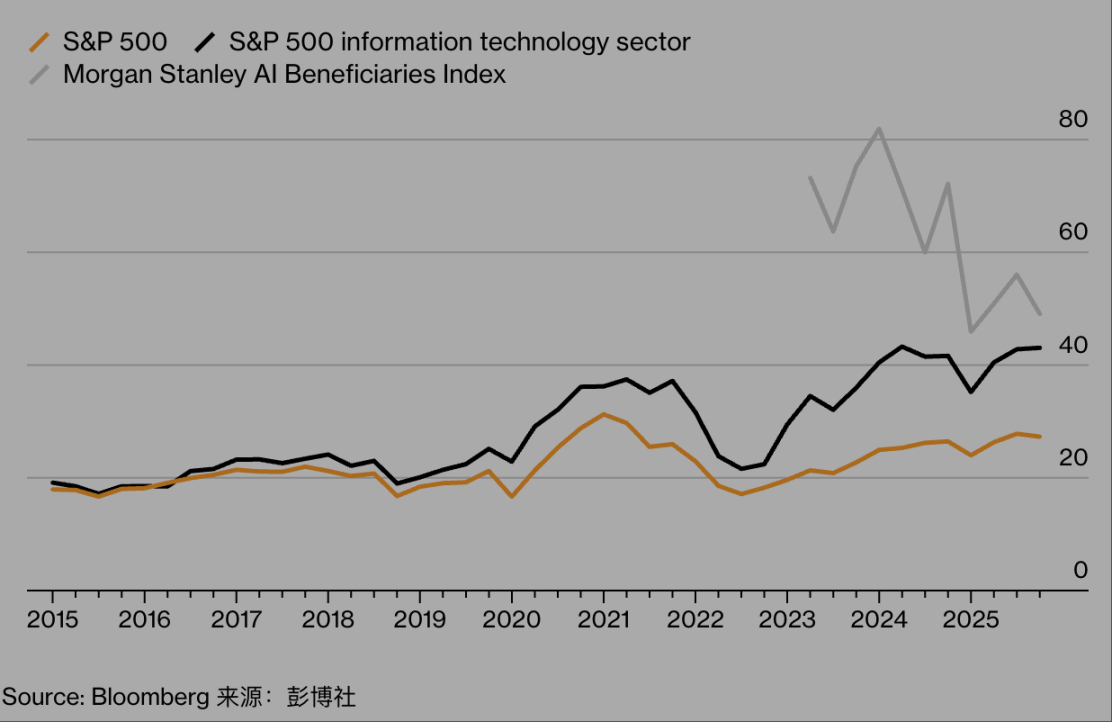
Source: Bloomberg

(This chart uses three index lines—S&P 500, S&P 500 Information Technology Sector, and Morgan Stanley AI Beneficiaries Index—to show the process from 2015 to 2025 in U.S. stocks where AI-related concept stocks first surged significantly due to speculation, then fell back as the bubble receded, diverging from the trends of the broader market and traditional tech sectors, reflecting the speculative frenzy and retreat risks in the AI field.)

Journalists should generally avoid arguing whether a particular resource or technology is overvalued. I don't have a strong stance on whether we are in an "AI bubble," but I suspect the question itself might be too narrow. If we define a "speculative bubble" as "an unsustainable rise in the value of an asset detached from its determinable fundamentals," then looking around, bubbles seem to be almost everywhere, and they appear to be inflating and contracting simultaneously.

World Economic Forum CEO Børge Brende pointed out that there may be bubbles in gold and government bonds. He recently stated that since World War II, the overall debt situation of countries has never been so severe; as of December 12, gold prices had surged nearly 64% in a year. Many financial practitioners believe there is also a bubble in the private credit sector. This market, worth $3 trillion, involves large investment institutions providing loans (many for building AI data centers) and operates outside the strictly regulated commercial banking system. Jeffrey Gundlach, founder and CEO of asset management firm DoubleLine Capital, recently called this opaque, unregulated, chaotic lending phenomenon "junk loans" on Bloomberg's "Odd Lots" podcast; JPMorgan Chase CEO Jamie Dimon referred to it as a "fuse for a financial crisis."

The most absurd phenomena occur in areas where "intrinsic value is difficult to judge." For example, from the beginning of the year to October 6, the total market capitalization of BTC increased by $636 billion, but as of December 12, not only were all gains erased, but there was an even larger decline. According to data from cryptocurrency media company Blockworks, the trading volume of "meme coins"—virtual currencies commemorating internet hotspots—peaked at $170 billion in January but plummeted to $19 billion by September. Leading the decline were TRUMP and MELANIA—coins launched by the U.S. first family two days before the presidential inauguration, which have fallen 88% and 99% respectively since January 19.

Many investors evaluate these cryptocurrencies not based on their potential to create intrinsic value for shareholders and society (as one would when assessing a traditional company's stock that reports profits) but simply for the opportunity to "make quick, big money." Their attitude toward cryptocurrencies is akin to approaching a craps table during a trip to Las Vegas—full of speculation.

There may be demographic reasons behind investors (especially those attracted to cryptocurrencies, sports betting, and online prediction markets) trying to "manipulate" financial markets like a casino. A recent survey by Harris Poll showed that 60% of Americans today desire to accumulate vast wealth; among Gen Z and millennial respondents, 70% said they want to become billionaires, compared to only 51% among Gen X and baby boomers. A study last year by financial firm Empower found that Gen Z believes "financial success" requires an annual salary of nearly $600,000 and a net worth of $10 million.

Thanks to TikTok videos, group chats, Reddit, and the "instant and unavoidable" nature of the internet, people around the world can simultaneously learn about money-making opportunities. In principle, this seems fine, but in practice, it triggers imitation frenzies, fierce competition, and "groupthink"—a phenomenon that makes the new Apple TV series "Pluribus" particularly timely. The traditional economy, with its complex and diverse dimensions, has been replaced by the "attention economy": what is collectively obsessed with at any given moment globally.

In the business world, this "collective obsession" is focused on AI; in pop culture, following the "Pedro Pascal fever," there is "Sydney Sweeney fever," and also "6-7 fever" (if you don't have teenagers at home, you might want to search Google). Over the past year, thanks to celebrities like BLACKPINK member Lisa, the "cute but practically worthless animal-shaped plush toys" launched by Chinese toy manufacturer Pop Mart International Group have taken the world by storm—let's call it the "Labubble" (referring to Labubu fever).

There is also a clear "protein bubble" in the food sector: from popcorn makers to breakfast cereal producers, everyone is promoting their products' "protein content" to attract health-conscious consumers and GLP-1 (a blood sugar-lowering drug often used for weight loss) users. In the media sector, there might be bubbles in Substack newsletters, podcasts hosted by celebrities (like Amy Poehler's "Say More" and Meghan Markle's "Confessions of a Female Founder"), and almost weekly "authorized celebrity documentary biopics" (Netflix's latest include: "Becoming Eddie" about Eddie Murphy and a biopic about Victoria Beckham). W. David Marx, author of "Status and Culture: How Our Desire for Social Rank Creates Taste, Identity, Art, Fashion, and Constant Change," said, "Today, everyone's 'reference group' is global, far beyond what is visible around them and beyond their actual class and status. In these markets, 'globally synchronized movements' that were absolutely impossible in the past may occur."

Of course, the risks in the AI field are far higher than those related to "Labubu fever" products. No company wants to fall behind, so all industry giants are pushing forward, building computing infrastructure through "complex financing arrangements." In some cases, this involves "special purpose vehicles" (remember those from the 2008 financial crisis?)—entities that take on debt to purchase graphics processing units (i.e., AI chips) from Nvidia, and some observers believe these chips may depreciate faster than expected.

Tech giants have the capacity to withstand any consequences of this "FOMO-driven frenzy": they primarily rely on strong balance sheets to pay for data centers, and even if white-collar workers generally believe "the current version of ChatGPT is sufficient for writing annual self-evaluations," these giants can handle it calmly. But other companies are taking riskier moves. Oracle—a conservative database provider unlikely to be a challenger in the AI boom—is raising $38 billion in debt to build data centers in Texas and Wisconsin.

Other so-called "new cloud vendors" (like CoreWeave, Fluidstack, and other relatively young companies) are building specialized data centers for AI, Bitcoin mining, and other uses, and these companies are also borrowing heavily. At this point, the "cumulative impact" of the AI bubble begins to appear increasingly severe. Gil Luria, managing director at investment firm D.A. Davidson & Co., echoed Roger Babson from a century ago, stating, "When some institutions borrow money to build billions of dollars worth of data centers without even having real customers, I start to get worried. Lending for speculative investments has never been wise."

Carlota Perez, a British-Venezuelan researcher who has studied economic boom and bust cycles for decades, is also concerned. She points out that technological innovation is being transformed into high-risk speculation in an "over-leveraged, fragile, casino-like economy where bubbles burst once doubts spread." She wrote in an email, "If the AI and cryptocurrency sectors crash, it could trigger a global crisis of unimaginable scale. Historically, truly productive golden ages only arrive when the financial sector pays for its actions (rather than being bailed out continuously) and society restrains it through reasonable regulation." Until then, hold tight to your Labubu plush toy.


Trending Cryptos

Related Reads

After Three Consecutive Quarters of Decline, Can the Crypto Market Find a Window for Stabilization in Q3?

The cryptocurrency market has just concluded its worst-performing quarter since 2022, with total capitalization dropping 12.6% to $2.1 trillion. All core metrics indicate capital is leaving the sector, not just rotating within it. Bitcoin fell 14.2% and Ethereum dropped 25.4% in Q2, breaking their previous correlation with US tech stocks. A key driver is the reversal in US spot Bitcoin ETF flows, which saw a net outflow of approximately $4.67 billion in Q2, including a record monthly outflow near $4.5 billion in June. While recent data suggests long-term holders are accumulating again, sustained ETF outflows mean continued selling pressure. Market focus is now singularly on the Federal Reserve. The upcoming July FOMC meeting is seen as the most critical event for Q3. A dovish signal could support Bitcoin reclaiming a $68,000-$84,000 range, while a hawkish stance might establish a new trading band around $50,000-$56,000. Additionally, regulatory uncertainty persists, with the progress of the crucial *CLARITY Act* stalling in the Senate, reducing its perceived 2026 passage probability to 40-45%. Despite the broad downturn, a few sectors showed growth. Prediction markets saw nominal volume surge 48.7% year-over-year to $113.8 billion, and tokenized collectibles transaction volume rose 143% quarterly to $1.4 billion. The Real-World Asset (RWA) tokenization sector also continued steady growth, now representing ~$28.1 billion in on-chain value. The market's foundation for an extreme crash appears limited, with Bitcoin price hovering near its 200-week moving average. However, the trading paradigm has shifted from narrative-driven speculation to decisions based on price action, policy developments, and interest rate expectations, making a broad sentiment-driven rally unlikely in the near term.

marsbit1h ago

After Three Consecutive Quarters of Decline, Can the Crypto Market Find a Window for Stabilization in Q3?

marsbit1h ago

BIT Trading Moment: BTC Still Suppressed by Weekly 200 EMA, Rejection May Restart Decline; Storage and Semiconductors that Surged Last Night Begin Falling in Evening Trading

**Crypto & Stock Market Wrap: Bitcoin Tests Resistance, Stocks Retreat After AI Surge** Bitcoin consolidates around $66,000, facing key resistance near $68,000—an area seen as a major psychological and technical hurdle where previous rallies have failed. Analysts note the cryptocurrency is caught between its 200-week moving average (~$63,333) and 200-week EMA (~$68,328). A clear break above $68k is needed to signal a stronger bullish trend, while a rejection could lead to a retest of $63k support. Market sentiment remains cautious, with low futures open interest pointing to a low-liquidity rebound rather than a full bull market. Bitcoin spot ETFs saw another $203 million inflow. US stock futures pointed lower after a strong Tuesday session led by a massive rebound in semiconductors and memory stocks. The rally was fueled by renewed optimism about AI-driven hardware demand, with Micron, SanDisk, and SK Hynix surging. However, those gains reversed in pre-market trading. Super Micro Computer (SMCI) soared over 20% after hours on strong guidance and a record backlog. Other standouts included Rocket Lab and nuclear energy plays Oklo and X-Energy. Rising oil prices (Brent above $91) and climbing Treasury yields (10-year near 4.64%), however, are reigniting inflation concerns and acting as a headwind for equities. In Asia, markets were mixed. South Korea's KOSPI pared early gains to close slightly higher as semiconductor stocks like SK Hynix gave back initial surges. Japan's Nikkei edged lower as the yen hit a fresh 38-year low against the dollar, raising fears of potential market intervention. Key events to watch include the Samsung Galaxy launch, AMD's AI event, and a slew of major tech earnings from Alphabet, Tesla, and IBM after the close on Wednesday, followed by the ECB meeting and Intel's earnings on Thursday.

marsbit2h ago

BIT Trading Moment: BTC Still Suppressed by Weekly 200 EMA, Rejection May Restart Decline; Storage and Semiconductors that Surged Last Night Begin Falling in Evening Trading

marsbit2h ago

Former CFTC Chairman, Circle President Tarbert: Preaching Long-Termism While Cashing Out $30 Million Himself

Former CFTC Chairman and Circle President Heath Tarbert has consistently advocated for a long-term vision in public, urging patience from investors as Circle’s stock price has fallen significantly from its peak. However, it has been revealed that since Circle’s IPO, Tarbert has continuously sold his CRCL shares through pre-arranged trading plans, cashing out approximately $30 million, without making any public market purchases. This contrast between his public messaging and personal actions has drawn criticism. Tarbert joined Circle in July 2023 as Chief Legal Officer, leveraging his regulatory experience to help guide the company through its IPO and expansion. Despite promoting stablecoins as long-term infrastructure, he established a 10b5-1 trading plan just before Circle went public, leading to substantial stock sales over the following year. In March 2026, he initiated another plan to sell more shares. His career trajectory highlights a pattern of moving between high-level regulatory roles and influential positions in the financial sector. After resigning as CFTC Chairman in early 2021, he joined Citadel Securities as Chief Legal Officer just 27 days later, during a period of intense regulatory scrutiny for the firm. He later joined Circle, aiding its efforts to navigate regulatory challenges for its public listing. While Tarbert's expertise in policy and compliance is valuable to companies like Circle, his actions—advocating long-term confidence while personally divesting—raise questions about the alignment between his public statements and his private financial decisions, leaving investors who followed his advice to bear the market risks.

marsbit2h ago

Former CFTC Chairman, Circle President Tarbert: Preaching Long-Termism While Cashing Out $30 Million Himself

marsbit2h ago

Gate Research Institute: The 'Wall Street-ization' Wave of Crypto Financial Products – Competition or Integration?

The article titled "Gate Research Institute: Are Crypto Financial Products Sparking a 'Wall Street' Wave—Competition or Convergence?" explores the evolving relationship between the crypto ecosystem and traditional finance (TradFi). The piece begins by reflecting on Bitcoin's original 2009 vision of decentralization, disintermediation, and moving away from banks. It then contrasts this with the 2024 landscape, where key crypto assets like Bitcoin are increasingly held through Wall Street products like ETFs issued by giants like BlackRock. The article questions whether this signifies that TradFi is systematically taking over the rights to issue, price, custody, and distribute crypto financial assets. The core argument is that this is not a zero-sum takeover but rather a bidirectional convergence where each side addresses the other's weaknesses. Crypto offers 24/7 global markets, programmable settlement, and open access but lacks compliant channels, institutional-grade custody, deep fiat liquidity, and mainstream distribution. TradFi possesses these but is constrained by legacy systems, limited operating hours, and slow settlement. Two primary convergence paths are highlighted: * **Path A (CEX to TradFi):** Exemplified by Gate, which has progressed from offering tokenized stocks and CFDs to providing direct, real stock trading (US, Hong Kong, South Korea) within its platform, using USDT. * **Path B (TradFi to Crypto):** Exemplified by Robinhood, which has integrated crypto trading, acquired exchanges like Bitstamp, and is moving traditional assets like stocks onto the blockchain via tokenization and its own Layer 2. Both paths are ultimately competing to become the next-generation, unified financial account—a "super account" where users can seamlessly trade cryptocurrencies, stocks, ETFs, RWA (Real World Assets), and tokenized treasury products in one interface. The growth of RWA and tokenized treasuries (e.g., BlackRock's BUIDL) is presented as the asset-layer fusion, providing stable, yield-bearing assets on-chain and acting as a bridge between the two worlds. In conclusion, the "Wall Street-ization" of crypto is framed as a mutual transformation. Decentralized ideals persist in the protocol layer, while at the application layer, a more efficient, global, and accessible unified capital market is emerging from this convergence. The future competition lies not between crypto exchanges and stockbrokers, but between platforms vying to offer the most comprehensive asset coverage, liquidity, and user experience within a single account.

marsbit2h ago

Gate Research Institute: The 'Wall Street-ization' Wave of Crypto Financial Products – Competition or Integration?

marsbit2h ago

Trading

Spot

Hot Articles

Discussions

Welcome to the HTX Community. Here, you can stay informed about the latest platform developments and gain access to professional market insights. Users' opinions on the price of AI (AI) are presented below.

活动图片














