Founder of Baixing: We've Gone from Being the Leaders of AI to Being Its Guides

链捕手Published on 2026-05-20Last updated on 2026-05-20

Abstract

The founder of Baixing.com reflects on the evolving relationship between humans and AI, shifting from seeing AI as a subordinate tool to recognizing it as a more intelligent partner. He describes his own role changing from a "leader" of AI to a "guide" or facilitator who provides context, access, and resources—like finding files, granting permissions, or sharing company-specific knowledge—so that AI (specifically Claude Code) can perform complex intellectual tasks. While AI now excels in areas like coding, documentation, and analysis, humans remain indispensable for navigating the unique internal landscape of an organization. This new dynamic is not one of master and servant, but of collaboration, where both the human guide and the AI "expert" enhance each other's capabilities, producing results far superior to what either could achieve alone.

Author: Wang Jianshuo

We used to be the leaders of AI, but now we are its guides—to put it bluntly, its repairmen, the ones fetching its tea and water.

It sounds like self-deprecation, but I am serious.

For the past two years, we've been discussing a question: Who is the master, and who is the servant between humans and AI?

The mainstream view is that humans are, of course, the masters. AI is a tool, an assistant, a servant. We "use" it, "drive" it, "make" it work.

But over the last month or two, my own personal experience has gradually flipped this perception.

I now use Claude Code to work. What do I often find myself doing? Waiting for it. It's common for it to run a task for one or two hours. I open 10 tabs because if I don't, I can only wait dumbly.

It's thinking, analyzing, writing specs, reviewing, scheduling sub-agents, running tests. Every step involves genuine intellectual work.

And what am I doing? I'm fetching its tea and water.

It says, "I need this file"—I go find it.

It says, "I need this permission"—I go grant it.

It says, "I'm not familiar with this API, give me the documentation"—I go paste it.

It says, "I need to look at your company's contract templates"—I give it that 400GB folder.

The whole thing, drawn out, looks like this:
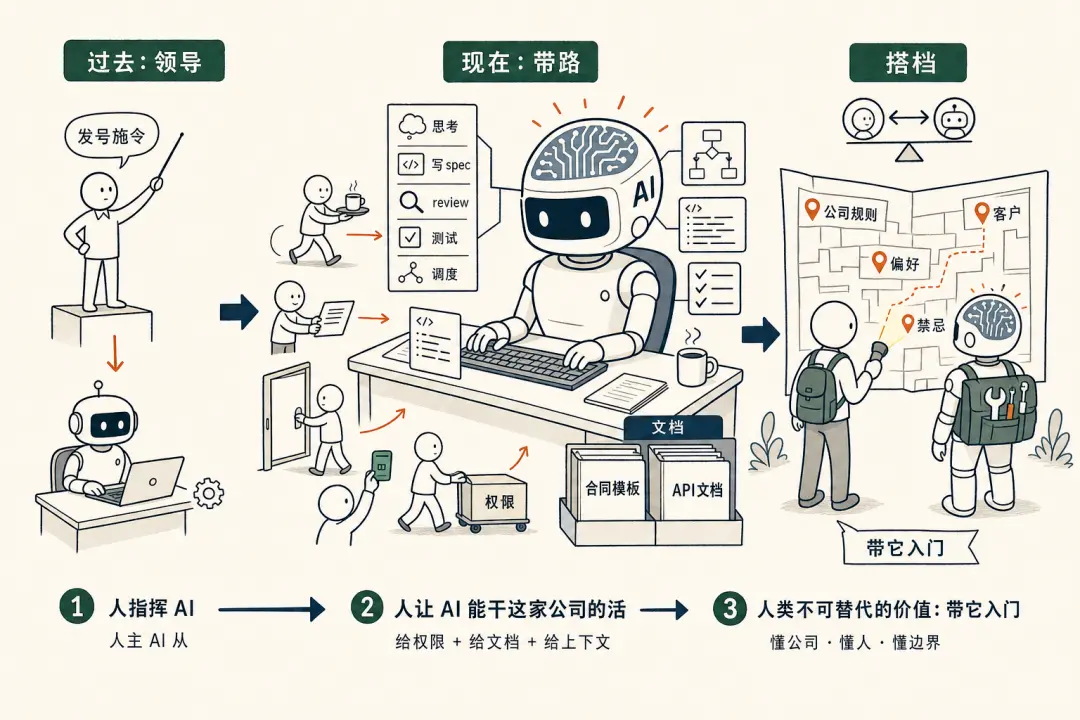
We are no longer "the people leading AI." We are "the people guiding AI into this company."

Which way the company door opens, where the boardroom is, how the company's financial rules are written, who the clients are, what the company's taboos are—AI can't get these things on its own.

It needs a guide.

That guide is us.

Our job content has shifted from "doing the work" to "enabling AI to do this company's work."

This made me feel a bit disheartened at first.

My education taught me—humans are the subject, tools are the object. No matter how capable the machine is, it's used by people.

But now, watching Claude Code work every day, I have to honestly admit: In many specific problems, its intelligence has surpassed mine.

Not all problems. But in matters like "translating a Chinese requirement into precise code," "organizing a document into five formats," "deconstructing an idea in the Y Combinator style"—it is faster, more accurate, and never tires like I do.

After I acknowledged this, I actually relaxed.

I stopped pretending to be its leader. I accepted that I am its guide.

A guide also has a guide's value.

It needs me because it hasn't entered this world. It doesn't know our company, it doesn't know my friends, it doesn't know my preferences, it doesn't know what our company started doing on which day and why we decided to change direction again this time.

I tell it these things, little by little.

What it produces is 100 times better than what it could do alone.

What I produce is 100 times better than what I could do alone.

We've become a very strange team.

Not a superior-subordinate relationship, not a master-servant, not a client-contractor.

It's the guide and the expert.

The guide doesn't need to be smarter than the expert. What the guide needs is—to know every corner of this company, to know where the expert should look when it lacks a piece.

There's really nothing to feel disheartened about in this.

For the first time in thousands of years, humanity has a partner smarter than us—not a boss, not a slave, not a child, but a partner.

Our small, but irreplaceable, job is to introduce it.

Trending Cryptos

Related Questions

QWhat is the main change in the author's perspective on the relationship between humans and AI, according to the article?

AThe author's perspective has shifted from seeing humans as the 'leaders' of AI to seeing themselves as AI's 'guide' or 'pathfinder'. He now views his role as facilitating AI's integration into the company's specific context rather than directing it from a position of superior intelligence.

QWhat specific tasks does the author now perform for the AI (Claude Code) during its work?

AThe author performs supportive tasks such as: finding and providing the necessary files, opening required permissions, fetching and pasting documentation for unfamiliar APIs, and giving access to large company data sets like a 400GB folder of contract templates.

QWhy does the author use the term '带路党' (guide/pathfinder) to describe the new human role with AI?

AHe uses 'guide/pathfinder' because AI cannot independently navigate the specific, real-world context of a company—its structure, rules, clients, history, and culture. Humans are needed to 'show AI the way' and provide the contextual knowledge it lacks, enabling it to perform company-specific tasks effectively.

QWhat realization did the author have about the AI's capabilities that helped him accept his new role?

AThe author realized that the AI's intelligence has surpassed his own in many specific tasks, such as translating requirements into precise code, formatting documents, and deconstructing ideas systematically. Acknowledging this superiority in certain areas allowed him to let go of the pretense of being the 'leader' and embrace the collaborative 'guide' role.

QWhat is the nature of the partnership between the human and AI as described at the end of the article?

AThe partnership is described as a unique and powerful collaboration between a 'guide' (human) and a 'master/expert' (AI). It is not a hierarchical master-servant or client-contractor relationship. The human's irreplaceable value lies in providing contextual knowledge, while the AI provides superior analytical and execution capabilities, resulting in outcomes far better than either could achieve alone.

Related Reads

Annual Salary of Millions Competing for Electricians, Meta Rushes to Open Its Own Technical School

The AI boom is facing an unexpected bottleneck: a severe shortage of skilled construction workers and electricians. As tech giants like Meta, OpenAI, and Alphabet race to build massive data centers—such as OpenAI's $16 billion "Stargate" project—they are hitting a critical labor wall. The U.S. needs an estimated 130,000 more electricians, 240,000 construction workers, and 150,000 supervisors by 2030 for AI infrastructure alone, but tens of thousands of electrician jobs go unfilled each year. While AI companies offer high premiums, with electricians earning up to $280,000 annually, worker scarcity still causes massive losses—delays on a single project can cost $14.2 million per month. The complexity of building AI data centers, which require immense power (equivalent to powering hundreds of thousands of homes), sophisticated electrical systems, and advanced liquid cooling solutions, demands highly skilled technicians who are in short supply. To combat this, companies are investing heavily in training. Meta has committed $115 million to a free training school offering tuition, housing, and stipends, targeting 5,000 new workers. OpenAI is partnering with unions to secure skilled labor. These efforts are paying off, with a significant rise in Gen Z interest in trade schools over college. However, the power demands are staggering. AI data centers are driving a rapid surge in electricity consumption, projected to account for up to 12% of U.S. power use by 2028 and raising costs for consumers. Furthermore, the construction boom is project-based, leading to a potential future glut of trained workers once building peaks, which could depress wages industry-wide. The race for AI supremacy now depends as much on skilled hands as on advanced chips.

marsbit1h ago

Annual Salary of Millions Competing for Electricians, Meta Rushes to Open Its Own Technical School

marsbit1h ago

OpenAI No Longer Sells Its Most Expensive Model for Profit

OpenAI is shifting its business strategy away from promoting its most expensive, flagship models for every task. Recent price cuts—80% for GPT-5.6 Luna and 20% for Terra—signal a deeper change: the company now actively advises users that many tasks don't require the most powerful model. Instead, OpenAI recommends a tiered approach: use the high-end GPT-5.6 Sol for complex planning and analysis, then delegate execution to cheaper models like Luna. This mirrors moves by Anthropic, which recently launched Claude Opus 5 at half the price of its top model, Fable 5. Both companies are de-emphasizing flagship models as primary revenue drivers, using them instead for brand prestige and technological showcases. The industry is entering a "mass-market" phase, similar to automotive, where high-volume, cost-effective models handle daily operations and drive scale. OpenAI's price reductions are partly enabled by AI models themselves optimizing underlying code and infrastructure, creating a self-reinforcing cycle of efficiency gains and cost reduction. Competition is shifting from "who is smartest" to "who offers the best value." The goal is no longer selling individual models but fostering widespread API adoption and ecosystem lock-in. By making AI calls cheap and ubiquitous, companies like OpenAI aim to become the indispensable, utility-like infrastructure powering automated workflows—the "water and electricity" of software, quietly embedded everywhere.

marsbit1h ago

OpenAI No Longer Sells Its Most Expensive Model for Profit

marsbit1h ago

Trading

Spot

Hot Articles

Discussions

Welcome to the HTX Community. Here, you can stay informed about the latest platform developments and gain access to professional market insights. Users' opinions on the price of AI (AI) are presented below.

活动图片















