Experienced Trader Peter Brandt Leans Towards a Bearish Bitcoin Scenario

cryptonews.ruPublished on 2026-08-10Last updated on 2026-08-10

Abstract

Experienced trader Peter Brandt leans towards a bearish outlook for Bitcoin, although he has not placed any bets on the cryptocurrency's future movement. In a social media post, he stated that while he is not currently making trades, if he were, he would bet on a decline. In Q3, Bitcoin's price has been fluctuating within a relatively narrow range, attempting to approach the key resistance level of $67,260. Brandt's chart analysis points to a large "head and shoulders" pattern formed between April and June. Bitcoin formed the left shoulder in April by exceeding $70,000, followed by a higher peak near $82,000 in May, creating the pattern's "head." A subsequent bounce above $70,000 in late May and early June formed what Brandt identifies as the "right shoulder." The neckline of this pattern was drawn around $75,000, which Bitcoin broke below in early June. This breakdown triggered a sell-off that pushed $BTC from $75,000 to below $60,000. Brandt's analysis indicates a potential drop toward the $58,000 zone, suggesting Bitcoin could retest its 2026 low. Analyst Ted Pillows, however, notes that for bullish momentum to resume, a close above $65,000 is necessary. A decisive break above the $67,260–$68,000 range would allow bulls to regain initiative, at least temporarily.

In his forecast, experienced trader Peter Brandt is leaning towards another drop in Bitcoin, although he himself has not made any bets on the cryptocurrency's further movement.

I'm not making any bets yet, but if I were, it would be on a drop, — Brandt wrote on a social network.
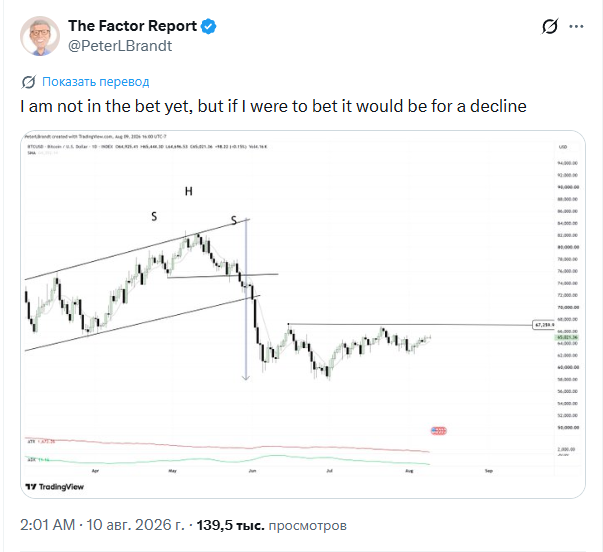
In the third quarter, the price of Bitcoin has been fluctuating within a relatively narrow range, attempting to rise to the key resistance level at $67,260.

Peter Brandt's chart shows a large "head and shoulders" pattern that formed between April and June. In April, Bitcoin formed the left shoulder, exceeding the $70,000 mark. In May, the cryptocurrency rose to a higher peak of around $82,000, forming the "head" of the pattern.

The subsequent bounce back to levels above $70,000 in late May and early June formed what Brandt calls the "right shoulder." Both shoulders are roughly the same height, although the May peak is significantly higher than them.

The pattern's neckline was drawn around $75,000. Bitcoin broke through this level in early June. The subsequent sell-off pushed $BTC down from $75,000 below $60,000.

The arrow drawn by Brandt points to the area around $58,000, meaning the flagship cryptocurrency could retest the 2026 low.

Analyst Ted Pillows believes a close above the $65,000 level is necessary to resume the bullish momentum. A breakout of the $67,260–68,000 level would allow the bulls to regain the initiative, at least for some time.

end-content

Trending Cryptos

Related Questions

QWhat is Peter Brandt's current trading stance on Bitcoin?

APeter Brandt is leaning towards a bearish scenario for Bitcoin, meaning he believes the price is likely to fall. However, he clarifies that he is not currently placing any bets on its future movement.

QWhat key chart pattern does Peter Brandt identify in Bitcoin's price action from April to June?

APeter Brandt identifies a large 'head and shoulders' pattern formed from April to June, with the left shoulder in April, the head at a peak of around $82,000 in May, and the right shoulder in late May/early June.

QAccording to the article, what price level is crucial for Bitcoin to regain a bullish momentum?

AAccording to analyst Ted Pillows, a close above $65,000 is necessary to renew bullish momentum. A breakout above the $67,260–$68,000 level would allow bulls to regain initiative.

QWhat is the target price zone indicated by the arrow on Peter Brandt's chart?

AThe arrow on Peter Brandt's chart points to a zone around $58,000, suggesting Bitcoin could retest its 2026 low.

QWhat was the consequence of Bitcoin breaking below the 'neckline' of the head and shoulders pattern?

AAfter Bitcoin broke below the neckline of the pattern, which was around $75,000 in early June, a subsequent sell-off pushed its price from $75,000 down below $60,000.

Related Reads

RIP: Atlas, Which Lived Only 292 Days

On August 9, 2026, OpenAI discontinued its standalone AI browser, Atlas, just 292 days after its launch on October 21, 2025. Initially positioned as a challenger to Chrome and the broader AI browser ecosystem, Atlas aimed to fundamentally redesign how users interact with browsers by deeply integrating ChatGPT. Its features included an AI-powered address bar, a sidebar for webpage analysis, Browser Memories for context retention, and an Agent Mode to automate multi-step tasks like shopping and research. Despite building on Chromium with a custom OWL (OpenAI Web Layer) framework, OpenAI struggled with the immense complexity of maintaining a full-fledged browser. The team spent significant time addressing basic functionalities—password managers, extensions, input methods—that mainstream browsers already handled seamlessly. Atlas's core AI agent capabilities also faced issues with reliability, speed, and security vulnerabilities like prompt injection. Furthermore, Atlas was limited to Apple Silicon Macs, failing to release promised Windows, iOS, and Android versions. This, coupled with the high switching cost for users entrenched in Chrome or Edge's ecosystems, hindered its adoption. By mid-2026, updates slowed, and OpenAI announced its shutdown, opting to integrate Atlas's AI explorations into the ChatGPT desktop app and browser extensions instead. The article contrasts two AI browser development paths: standalone products like Atlas, Perplexity's Comet, and Dia, which redesign the browser around AI but face user migration barriers; and the approach of incumbents like Chrome and Edge, which add AI features atop existing, widely-used platforms. The key question remains whether users need a completely new "AI browser" or simply AI capabilities within their current browser. While Atlas's experiment ended, the broader trend of AI integration into browsing continues.

marsbit19m ago

RIP: Atlas, Which Lived Only 292 Days

marsbit19m ago

Bitcoin's "Anti-Spam" Update Failed, Lasting Less Than a Day

A Bitcoin update proposal aimed at curbing spam by temporarily banning non-financial data from being stored on the network, BIP-110, has failed decisively. After months of debate, developers attempted to launch a separate blockchain, which collapsed within a day. The failure stemmed from a critical lack of miner support, with less than 1% signaling approval for the update. The vast majority of miners chose to continue mining the main Bitcoin blockchain without providing explanations. Despite this, the initiative's developers proceeded to launch an alternative blockchain—a hard fork of Bitcoin—on August 8. This meant a small subset of miners stopped mining Bitcoin to support the new chain with BIP-110 changes. However, the new network inherited Bitcoin's mining difficulty. With only a tiny fraction of the total computational power, block times stretched to roughly 7 hours instead of the standard 10 minutes, rendering the network practically non-functional. Michael Saylor, founder of major corporate Bitcoin holder MicroStrategy and a vocal opponent of BIP-110, commented: "Bitcoin worked exactly as designed. The BIP-110 fork occurred, and network participants were free to choose which chain to follow. As a result, about 99.85% of the network's hash power remained with Bitcoin." The event had no significant impact on Bitcoin's price, which traded in a narrow range between approximately $64.5k and $65.5k from August 7 through August 10.

cryptonews.ru25m ago

Bitcoin's "Anti-Spam" Update Failed, Lasting Less Than a Day

cryptonews.ru25m ago

Trading

Spot

Hot Articles

What is $BITCOIN

DIGITAL GOLD ($BITCOIN): A Comprehensive Analysis Introduction to DIGITAL GOLD ($BITCOIN) DIGITAL GOLD ($BITCOIN) is a blockchain-based project operating on the Solana network, which aims to combine the characteristics of traditional precious metals with the innovation of decentralized technologies. While it shares a name with Bitcoin, often referred to as “digital gold” due to its perception as a store of value, DIGITAL GOLD is a separate token designed to create a unique ecosystem within the Web3 landscape. Its goal is to position itself as a viable alternative digital asset, although specifics regarding its applications and functionalities are still developing. What is DIGITAL GOLD ($BITCOIN)? DIGITAL GOLD ($BITCOIN) is a cryptocurrency token explicitly designed for use on the Solana blockchain. In contrast to Bitcoin, which provides a widely recognized value storage role, this token appears to focus on broader applications and characteristics. Notable aspects include: Blockchain Infrastructure: The token is built on the Solana blockchain, known for its capacity to handle high-speed and low-cost transactions. Supply Dynamics: DIGITAL GOLD has a maximum supply capped at 100 quadrillion tokens (100P $BITCOIN), although details regarding its circulating supply are currently undisclosed. Utility: While precise functionalities are not explicitly outlined, there are indications that the token could be utilized for various applications, potentially involving decentralized applications (dApps) or asset tokenization strategies. Who is the Creator of DIGITAL GOLD ($BITCOIN)? At present, the identity of the creators and development team behind DIGITAL GOLD ($BITCOIN) remains unknown. This situation is typical among many innovative projects within the blockchain space, particularly those aligning with decentralized finance and meme coin phenomena. While such anonymity may foster a community-driven culture, it intensifies concerns about governance and accountability. Who are the Investors of DIGITAL GOLD ($BITCOIN)? The available information indicates that DIGITAL GOLD ($BITCOIN) does not have any known institutional backers or prominent venture capital investments. The project seems to operate on a peer-to-peer model focused on community support and adoption rather than traditional funding routes. Its activity and liquidity are primarily situated on decentralized exchanges (DEXs), such as PumpSwap, rather than established centralized trading platforms, further highlighting its grassroots approach. How DIGITAL GOLD ($BITCOIN) Works The operational mechanics of DIGITAL GOLD ($BITCOIN) can be elaborated on based on its blockchain design and network attributes: Consensus Mechanism: By leveraging Solana’s unique proof-of-history (PoH) combined with a proof-of-stake (PoS) model, the project ensures efficient transaction validation contributing to the network's high performance. Tokenomics: While specific deflationary mechanisms have not been extensively detailed, the vast maximum token supply implies that it may cater to microtransactions or niche use cases that are still to be defined. Interoperability: There exists the potential for integration with Solana’s broader ecosystem, including various decentralized finance (DeFi) platforms. However, the details regarding specific integrations remain unspecified. Timeline of Key Events Here is a timeline that highlights significant milestones concerning DIGITAL GOLD ($BITCOIN): 2023: The initial deployment of the token occurs on the Solana blockchain, marked by its contract address. 2024: DIGITAL GOLD gains visibility as it becomes available for trading on decentralized exchanges like PumpSwap, allowing users to trade it against SOL. 2025: The project witnesses sporadic trading activity and potential interest in community-led engagements, although no noteworthy partnerships or technical advancements have been documented as of yet. Critical Analysis Strengths Scalability: The underlying Solana infrastructure supports high transaction volumes, which could enhance the utility of $BITCOIN in various transaction scenarios. Accessibility: The potential low trading price per token could attract retail investors, facilitating wider participation due to fractional ownership opportunities. Risks Lack of Transparency: The absence of publicly known backers, developers, or an audit process may yield skepticism regarding the project's sustainability and trustworthiness. Market Volatility: The trading activity is heavily reliant on speculative behavior, which can result in significant price volatility and uncertainty for investors. Conclusion DIGITAL GOLD ($BITCOIN) emerges as an intriguing yet ambiguous project within the rapidly evolving Solana ecosystem. While it attempts to leverage the “digital gold” narrative, its departure from Bitcoin's established role as a store of value underscores the need for a clearer differentiation of its intended utility and governance structure. Future acceptance and adoption will likely depend on addressing the current opacity and defining its operational and economic strategies more explicitly. Note: This report encompasses synthesised information available as of October 2023, and developments may have transpired beyond the research period.

1.7k Total ViewsPublished 2025.05.13Updated 2025.05.13

What is $BITCOIN

Discussions

Welcome to the HTX Community. Here, you can stay informed about the latest platform developments and gain access to professional market insights. Users' opinions on the price of BTC (BTC) are presented below.

活动图片