Ethereum Exchange Balances Collapse To Levels Not Seen Since 2016 – Here’s What To Know

bitcoinistPublished on 2026-02-11Last updated on 2026-02-11

Abstract

Ethereum exchange balances have plummeted to levels not seen since 2016, signaling a major shift in investor behavior. Despite recent price volatility, ETH has held above $2,000 as large amounts are being withdrawn from exchanges. This indicates investors are moving their holdings into long-term storage, staking, or self-custody rather than keeping them available for immediate sale. The significant reduction in exchange supply suggests decreased selling pressure and a stronger conviction in ETH's long-term prospects compared to Bitcoin. Additionally, institutional accumulation continues, with companies like Bitmine making substantial purchases, buying over $83 million worth of ETH in a single week. If this trend persists and demand returns, the limited available supply could lead to rapid price discovery.

Ethereum’s price has managed to hold above the $2,000 even as heightened volatility persists in the market. During the recent pullback, investors’ sentiment appears to be slowly leaning toward a bullish outlook, which is primarily indicated by the notable ETH withdrawals from crypto exchanges, matching key past levels.

Exchanges Are Seeing Massive Ethereum Withdrawals

Following the sharp pullback in price, Ethereum’s on-chain supply dynamics have now reached a striking milestone. This milestone is taking place on the ETH exchange reserves, which have experienced one of their steepest drop in years.

In a post on the social media platform X, CryptoRus revealed that the ETH supply on crypto exchanges has fallen back to levels last seen in mid-2016. “That’s wild when you think about how much bigger the ecosystem is today,” CryptoRus added.

The significant decline in ETH on centralized platforms indicates that, instead of having their coins easily accessible for sale, more investors are transferring them into long-term storage, staking, or self-custody. Such a development often signals reduced selling pressure and a stronger long-term holder base.

Ethereum investors are showing more notable bullish sentiment towards the altcoin than Bitcoin investors. While Bitcoin has recently returned to crypto exchanges, ETH has been silently disappearing from these platforms. The behavior underscores increasing conviction in the altcoin’s near-term and long-term prospects compared to BTC.
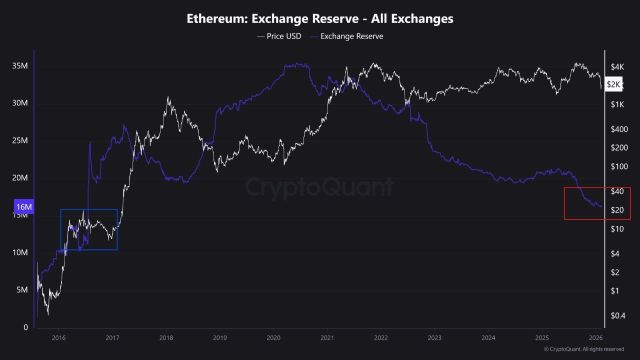
ETH leaving crypto exchanges at a rapid rate | Source: Chart from CryptoRus on X

The majority of this ETH is not lost or abandoned. Rather, it is owned by investors, and they are not sitting on the sidelines. At the same time, Over-The-Counter (OTC) supply has also increased, but it is still far behind in comparison to the total supply of Ethereum.

If OTC liquidity also dries up and ETH exchange balances remain this tight, price discovery will occur quickly rather than smoothly. Nonetheless, when demand returns to the market, there may not be enough ETH available to fill that desire.

Institutions Are Still Buying More ETH In Unfavorable Conditions

Despite the ongoing volatile landscape, Ethereum institutional accumulation has continued, and big firms like Bitmine Immersion are not done buying the dip. The leading public company has recently made another ETH purchase that is making waves in the cryptocurrency community.

On-chain data shared by Ash Crypto, a market expert and investor, shows that Bitmine bought about 20,000 ETH valued at $41.08 million on Monday. This purchase implies that big players are displaying renewed confidence and betting on a potential bounce in the near future.

According to the expert, the company’s total ETH purchase last week alone was valued at $83.45 million. After the purchase, Bitmine’s ETH holdings skyrocketed to $9.19 billion, representing over 3.6% of the total ETH supply. Bitmine’s persistent ETH purchase underscores the firm’s unwavering goal to become the largest Ethereum treasury company in the world.

ETH trading at $2,008 on the 1D chart | Source: ETHUSDT on Tradingview.com

Related Reads

Unveiling the 'White-haired Stock God' Serenity: A Spiritual Remedy for Anxious Retail Investors

The article details the rise of Serenity, dubbed the "White-Haired Stock God," whose social media posts have recently caused significant volatility in China's A-share market. Previously gaining fame in international retail investor communities, Serenity is known for his "Chokepoint Investment" strategy targeting small monopolies in the AI supply chain, reportedly achieving returns over 3612% this year. His influence stems from his background as a former AI research scientist, detailed analysis, and a massive following on X, where his subscriber count has surpassed Elon Musk's. In early June, Serenity's Chinese-language posts mentioning A-shares like LeaderDrive (Lide Xiebo), Easun, and Innolight triggered immediate 20% surges in their stock prices. He later clarified that some recommendations were crowdsourced from followers and claimed he did not hold positions in these stocks, stating his actions were "just for fun" to offer a foreign perspective on Chinese markets. This activity drew scrutiny from Chinese financial media, which warned of potential "pump-and-dump" schemes and legal risks. While anonymous, clues suggest Serenity is likely a Chinese-speaking individual living in Japan. He maintains his anonymity due to past harassment but enjoys substantial monthly income from his paid subscriptions. The article posits that Serenity embodies the market's current appetite for a charismatic, successful figure during the AI bull run, serving as an "outward projection" of bullish sentiment. It concludes by noting the cyclical nature of such market icons, warning that the same crowds that elevate them often seek scapegoats when trends reverse.

Odaily星球日报4m ago

Unveiling the 'White-haired Stock God' Serenity: A Spiritual Remedy for Anxious Retail Investors

Odaily星球日报4m ago

Unveiling the 'White-Haired Stock God' Serenity: The Mental Elixir for Anxious Retail Investors

The anonymous stock influencer known as "White-Haired Stock God" Serenity has ignited a frenzy in the A-share market. From June 5-9, Serenity's posts on platform X mentioning A-shares like LeaderDrive, Easun, and Innolight triggered sharp price surges, with some stocks hitting 20% daily limits. Serenity, who claims a 3612% personal return this year, gained fame internationally using a "chokepoint investment" strategy focused on small, monopolistic AI supply chain companies. With over 810k X followers, his influence rivals top analysts. His recent foray into Chinese stocks, which he claims is "for fun" to offer a "foreign perspective," has drawn scrutiny. While Serenity denies holding positions in these A-shares and states his posts are not recommendations, his actions have caused significant market volatility. He monetizes through a $1/month subscription, earning an estimated $54k monthly. Facing accusations of market manipulation, he maintains he promotes "information democracy." Community analysis suggests Serenity is likely an English-speaking Chinese national living in Japan, based on his posting patterns and shared personal details. He maintains anonymity due to past harassment. Ultimately, Serenity is seen by many as a manifestation of the current AI bull market's euphoria—a mysterious, seemingly successful figure who fulfills the market's desire for a "stock god," though such personas often face intense scrutiny when market sentiment shifts.

marsbit5m ago

Unveiling the 'White-Haired Stock God' Serenity: The Mental Elixir for Anxious Retail Investors

marsbit5m ago

Korean Youth, Making a 'Last Stand' in an Epic Bull Market

South Korea is experiencing an unprecedented stock market boom in the first half of 2026, with the KOSPI index doubling in six months, driven primarily by tech giants Samsung Electronics and SK Hynix. This "epic bull run," tied to the semiconductor cycle, has sparked a nationwide frenzy for stock trading. The country, with a population of just over 50 million, now has over 105 million securities accounts. The article, from the perspective of a Chinese national living in Seoul, explores how this speculative fever reflects deeper societal anxieties among Korean youth. Facing stagnant wages, high costs of living, housing pressures, and rigid social stratification, many young people see the volatile market as a "last chance" to alter their predetermined life trajectories and escape financial precarity. Stories include a young office worker investing her meager savings, a couple delaying marriage due to financial pressures, and a seasoned trader navigating exclusive social circles where market information is currency. However, the boom also exposes and exacerbates existing inequalities. While some achieve windfalls, others face devastating losses, with borrowing to invest reaching record highs. The narrative contrasts the illusion of equal opportunity with the harsh reality that the ability to absorb risk is unevenly distributed. Ultimately, the market frenzy is portrayed not as a solution, but as a symptom of a generation's struggle against a system offering limited upward mobility, where daily life is a precarious balance of bills, debts, and societal expectations.

marsbit32m ago

Korean Youth, Making a 'Last Stand' in an Epic Bull Market

marsbit32m ago

Young South Koreans, Making a 'Last-Ditch Effort' in an Epic Bull Market

This article explores how an unprecedented stock market boom in South Korea during the first half of 2026, driven by the semiconductor industry, is transforming the lives of ordinary people, particularly the youth. The KOSPI index doubled in six months, fueled by giants Samsung and SK Hynix, leading to a frenzy of retail investing. With over 105 million stock accounts in a population of just over 50 million, a sense of "FOMO" (fear of missing out) is pervasive. Through the perspective of Li Yuning, a Chinese woman living in Seoul, the piece follows several young Koreans who see the market as a last chance to escape stifling economic pressures, high housing costs, and narrow social mobility. Individuals like Minji, a low-paid office worker, and Junho, saving for marriage, invest their limited savings, while experienced traders like Suhu navigate exclusive social circles. The narrative reveals that this speculative fever stems less from greed and more from deep-seated anxiety about being left behind in a society with growing wealth inequality and rigid class structures. However, the boom also exposes stark social divides. It exacerbates wealth gaps, as those with family support or existing capital fare better. The pressure to succeed is immense, with stories of devastating losses leading to personal tragedy. Ultimately, the article suggests the牛市 acts as a pressure valve and a temporary illusion of opportunity in a system where traditional paths to advancement seem increasingly closed, leaving young people to gamble on the market as a final, desperate bid for a better future.

链捕手38m ago

Young South Koreans, Making a 'Last-Ditch Effort' in an Epic Bull Market

链捕手38m ago

Trading

Spot
Futures

Hot Articles

Discussions

Welcome to the HTX Community. Here, you can stay informed about the latest platform developments and gain access to professional market insights. Users' opinions on the price of ETH (ETH) are presented below.

活动图片















