Ethereum ETFs close week in red, end 5-day inflow streak

cointelegraphPublished on 2026-07-27Last updated on 2026-07-27

Abstract

U.S. spot Ethereum ETFs saw $70.62 million in net outflows on Friday, ending a five-day inflow streak. However, they still recorded $103.9 million in net inflows for the week, extending their weekly inflow streak to three weeks. Total net inflows for July reached $337.74 million. Spot crypto ETF flows are a key gauge of demand for digital assets through traditional products, with U.S. funds dominating in assets and volume. Bitcoin ETFs mirrored this pattern, posting $240.08 million in net outflows on Friday after a seven-day inflow streak. They also notched a third consecutive week of net inflows, adding $103.9 million for the week and $233.96 million in July. This follows a record $4.5 billion outflow in June. Bitcoin traded near $64,000, down from the week's high, while Ether traded at $1,837. In related news, following Japan's crypto regulatory reforms, an analysis forecasts that a mature Japanese spot Bitcoin ETF market could reach approximately $18.4 billion, leveraging demand from various investor types and drawing parallels to the successful adoption in the U.S. market.

US-listed spot Ethereum exchange-traded funds (ETFs) logged $70.62 million in net outflows on Friday, ending a five-day inflow streak.

Ethereum funds saw $211.25 million in net inflows over the previous five sessions from July 17, according to SoSoValue data. They still posted $103.9 million in net inflows for the week ended Friday.

Despite the outflows, Ethereum ETFs extended their weekly inflow streak to three straight and have attracted $337.74 million in net inflows so far in July.

Spot crypto ETF flows have become one of the market’s most closely watched gauges of demand for Bitcoin (BTC) and Ether (ETH) through traditional investment products.

Although similar funds have launched in other jurisdictions, including Hong Kong, US-listed ETFs account for the vast majority of assets and trading volumes.
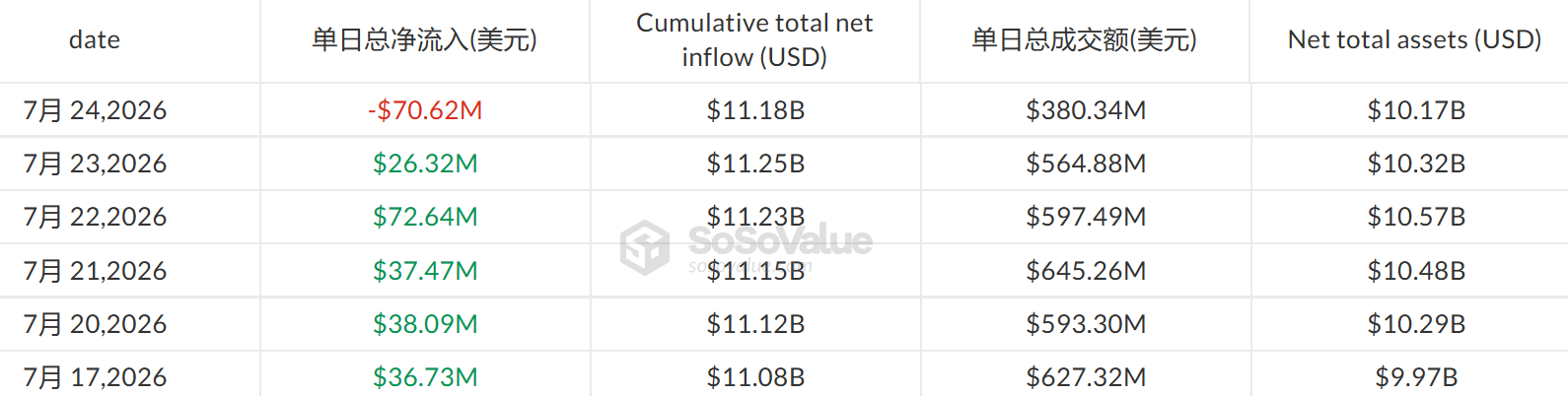
Daily spot Ethereum ETF net flows from July 17-24. Source: SoSoValue

Bitcoin ETFs also end week with outflows

The reversal followed a similar pattern in Bitcoin ETFs, which ended a seven-day inflow streak on Thursday and recorded $240.08 million in net outflows on Friday.

Bitcoin ETFs also extended their net inflow streak to three consecutive weeks, adding $103.90 million during the week ended Friday and $233.96 million so far in July. They followed a record June, when $4.5 billion flowed out of the funds.

BTC traded just under $64,000 at the time of writing, tumbling from the week’s high of $66,892 on Tuesday, according to CoinGecko. ETH traded at $1,837, down from Wednesday’s weekly high of $1,954.

Related: Bitcoin falls under $64K as surging US bond yields boost Fed rate-hike odds

Japan’s crypto reforms fuel $18.4 billion BTC ETF forecast

Following Japan’s recent overhaul of its crypto regulations, which is widely viewed as laying the groundwork for future spot Bitcoin ETFs, crypto management platform XWIN estimated that a mature Japanese spot Bitcoin ETF market could reach about $18.4 billion, equal to roughly 0.13% of the country’s $14.6 trillion in household financial assets.

In analysis posted at CryptoQuant, XWIN said the estimate assumes demand from existing crypto holders, new retail investors using brokerage accounts and institutional allocators.

The report cited the US market as an example, noting that spot Bitcoin ETFs excluding Grayscale’s GBTC have accumulated roughly 1 million Bitcoin, demonstrating how regulated ETF products can connect traditional finance with digital assets.

“The key is access,” XWIN said, adding that a Japanese spot Bitcoin ETF would allow investors to gain Bitcoin exposure through familiar brokerage and custody systems. It characterized the $18.4 billion figure as “an achievable upper-end market scenario.”

Magazine: A quantum roadmap would push Bitcoin much higher: Charles Edwards

Trending Cryptos

Related Questions

QHow much in net outflows did US-listed spot Ethereum ETFs record on Friday?

AUS-listed spot Ethereum ETFs recorded $70.62 million in net outflows on Friday.

QWhat was the trend for Ethereum ETFs in terms of weekly net inflows as of the week ended Friday?

AEthereum ETFs extended their weekly net inflow streak to three consecutive weeks, with $103.9 million in net inflows for the week ended Friday.

QWhat was the situation for Bitcoin ETFs at the end of the week mentioned in the article?

ABitcoin ETFs ended the week with $240.08 million in net outflows on Friday, following the end of a seven-day inflow streak on Thursday.

QAccording to the analysis by XWIN, what is the estimated potential size of a mature Japanese spot Bitcoin ETF market?

AAccording to XWIN's analysis, a mature Japanese spot Bitcoin ETF market could reach about $18.4 billion.

QWhy are spot crypto ETF flows considered an important market gauge?

ASpot crypto ETF flows have become one of the market's most closely watched gauges of demand for Bitcoin and Ether through traditional investment products.

Related Reads

Thanks to Dice Rolls, Bitcoin Keys Are Stored Offline, But Not Everyone Will Do It

The article discusses using dice rolls to generate secure Bitcoin wallet seeds, providing entropy independent of potentially flawed hardware random number generators. It explains that each fair dice roll offers about 2.585 bits of entropy, with around 50 rolls needed for a standard 12-word seed phrase and 99+ recommended for higher security. This method gained attention after a vulnerability was revealed in some Coldcard hardware wallets, where a faulty firmware RNG (dating back to 2021) compromised generated keys. The analysis notes that while a dice-generated main seed was safe from this specific flaw, other Coldcard functions (like creating paper wallets, backup keys, or passwords) could still be vulnerable if they used the defective RNG. The piece argues that while dice-based entropy is technically robust, the manual process is error-prone, tedious, and unrealistic for most new users, who might make mistakes in recording or inputting rolls. It concludes that while manual entropy generation should remain an option for advanced users, the long-term goal is to develop reliable, user-friendly hardware and software that securely generates randomness without requiring specialized knowledge. Coldcard users are advised to check their firmware version and replace any secondary secrets (like paper wallet keys) created with vulnerable devices, while also considering multi-signature setups with devices from different manufacturers for added security.

cryptonews.ru3h ago

Thanks to Dice Rolls, Bitcoin Keys Are Stored Offline, But Not Everyone Will Do It

cryptonews.ru3h ago

Trading

Spot

Hot Articles

Discussions

Welcome to the HTX Community. Here, you can stay informed about the latest platform developments and gain access to professional market insights. Users' opinions on the price of ETH (ETH) are presented below.

活动图片















