Ethereum: 2 factors strengthening ETH’s potential bullish breakout

AmbcryptoPublished on 2026-01-12Last updated on 2026-06-15

Abstract

Ethereum’s weekly trading volume has decreased during the past two months as prices consolidated around $3k.

Ethereum [ETH] was in the news for attracting a growing amount of institutional interest. Bitmine Immersion added 86,400 ETH to its staking holdings, worth $266.3 million.

The Ethereum-focused company now has 1.08 million ETH worth $3.33 billion in total staked holdings.
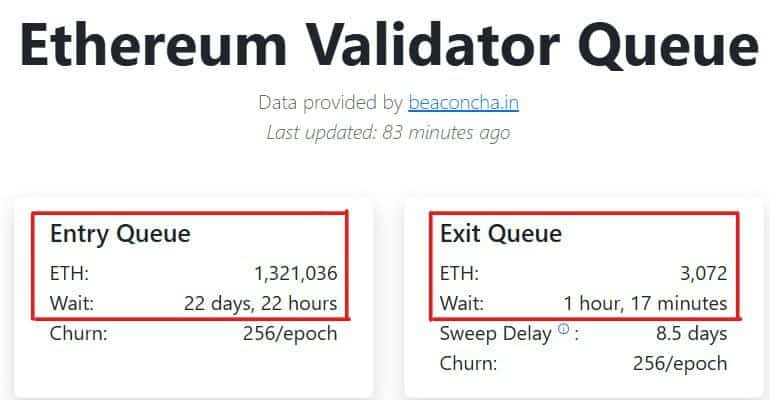
The Ethereum staking queue was longer than the unstaking queue, revealed X user Bull Theory. Around 1.32 million ETH is lined up to enter staking, with an average wait time of 23 days.

Such a large spike in staking activity reflected long-term investor confidence in the leading altcoin.

Ethereum’s price action and the net taker volume metric showed there was potential for a price breakout beyond the $3,200 local supply zone.

Assessing the bullish potential of Ethereum
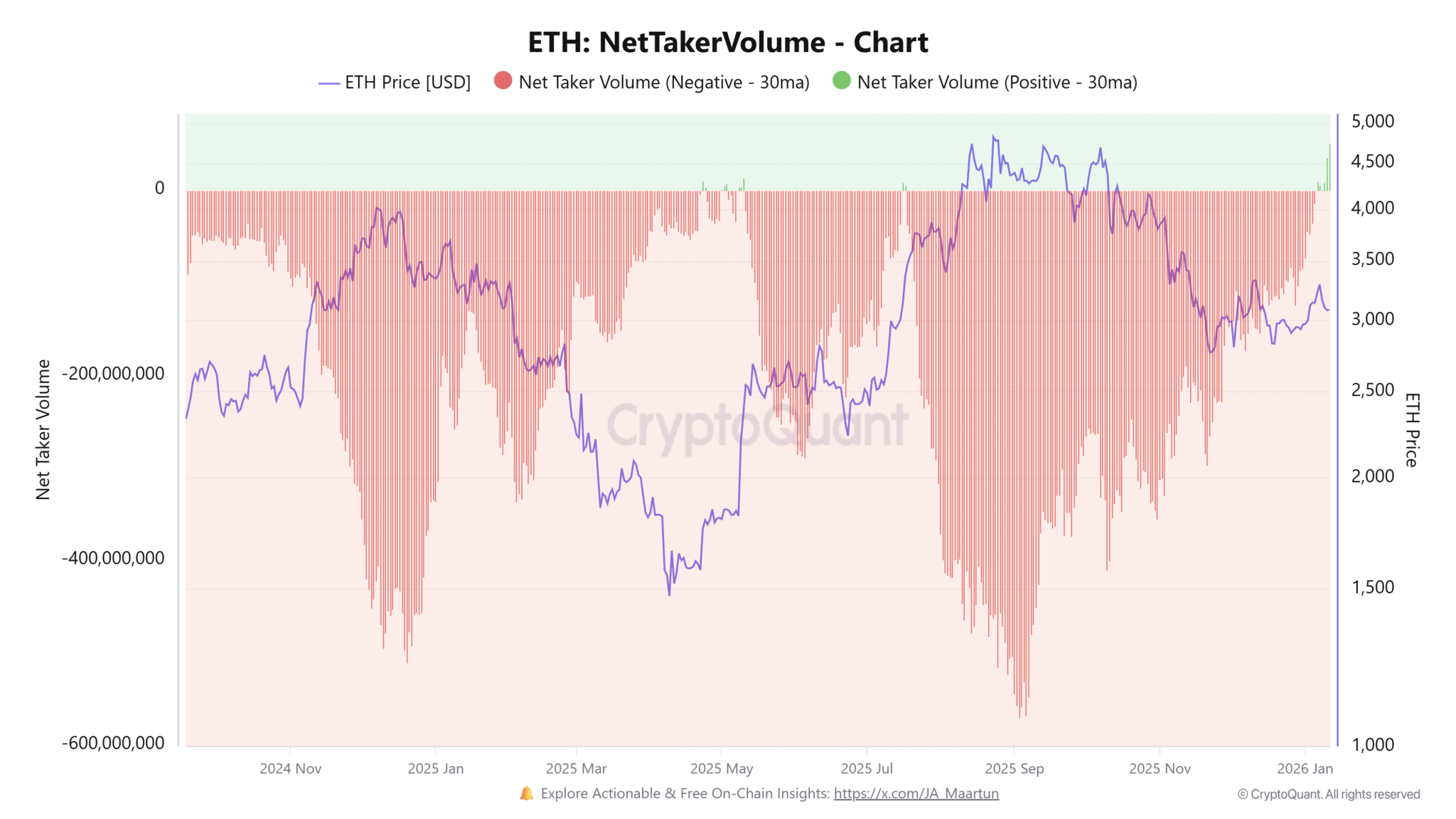
Crypto analyst Maartunn’s Net Taker Volume metric uses perpetual derivatives data to identify the aggressive actors in the market.

The aggressive participants use market orders, or taker orders, and are the ones who drive prices.

The derivatives market saw a shift from high taker sell volume to a buyer-dominated taker volume. The magnitude of the buyer volume does not match the peaks in taker sell volume in September 2025, but it was a good start.

The spot taker CVD has also been taker buy-dominant since the start of the month. Together, the metrics showed sellers might be exhausted.
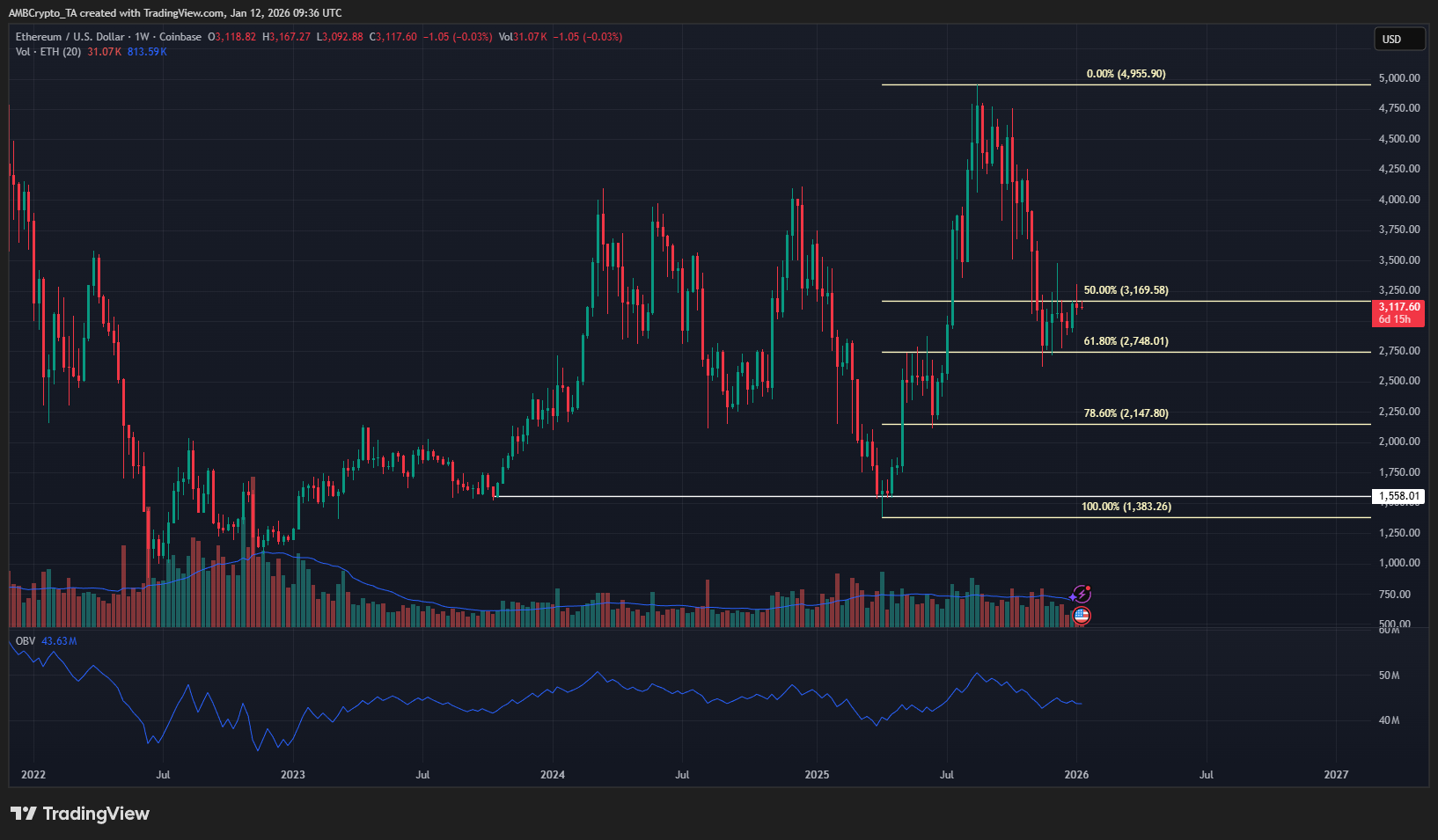
The weekly chart revealed that the $2,748 level was a key retracement support level. It was defended in recent weeks, and ETH bulls were challenging the $3,169 level.

The $3,150-$3,250 area has been a supply zone since mid-November.

The weekly trading volume has decreased during the past two months. A breakout past $3,200 would likely see increased trading volume. The OBV was in a retracement phase alongside the ETH prices.

The metrics and price action supported the bullish breakout potential for Ethereum. It remains to be seen if macro conditions and market sentiment will allow another bullish impulse move or not.

Final Thoughts

  • The Ethereum staking queue was miles longer than the unstaking queue, reflecting long-term confidence in the market.
  • The ETH spot and derivatives markets were taker-buy dominant since the beginning of January.

Related Questions

QWhat recent institutional action was taken by Bitmine Immersion regarding Ethereum, and what is the total value of their staked holdings?

ABitmine Immersion added 86,400 ETH, worth $266.3 million, to its staking holdings. The company now has a total of 1.08 million ETH staked, valued at $3.33 billion.

QAccording to the article, what does the Net Taker Volume metric measure and what recent shift did it show in the derivatives market?

AThe Net Taker Volume metric uses perpetual derivatives data to identify aggressive actors in the market who use market (taker) orders to drive prices. It recently showed a shift from high taker sell volume to a buyer-dominated taker volume.

QWhat key price level on the weekly chart was identified as a crucial retracement support level for Ethereum?

AThe $2,748 level was identified as a key retracement support level on the weekly chart, which has been defended in recent weeks.

QWhat two factors does the article suggest are strengthening ETH's potential for a bullish breakout?

AThe two factors are: 1) A large spike in staking activity, reflected by a staking queue much longer than the unstaking queue, showing long-term investor confidence. 2) A buyer-dominated taker volume in both the spot and derivatives markets, suggesting sellers might be exhausted.

QWhat supply zone has been a significant resistance area for Ethereum's price since mid-November?

AThe $3,150-$3,250 price area has been a significant supply zone (resistance) for Ethereum since mid-November.

Related Reads

The Value Distribution of Stablecoins

**Summary: The Value Distribution of Stablecoins** The article argues that stablecoins are evolving from mere trading tools into broader channels for dollar access. It divides the stablecoin ecosystem into four layers to analyze how value is distributed: 1. **Issuance Layer:** Mints stablecoins, holds reserve assets, and captures the spread between reserve yield and user costs (e.g., Tether, Circle). This layer currently earns the largest profit margin. 2. **Infrastructure Layer:** Connects stablecoins to the traditional financial system, handling fiat on/off-ramps, banking integration, compliance (KYC/AML), and asset management (e.g., Bridge, BVNK). This is the "unglamorous" but critical work, building the essential bridges between crypto and real-world finance. 3. **Acquiring/Distribution Layer:** Integrates stablecoins into merchant systems, manages payment flows, and provides enterprise financial software (e.g., Stripe, Coinbase). They act as the access point for businesses. 4. **Application Layer:** The end-users and businesses that ultimately use stablecoins for payments, settlements, or as a store of value. They benefit from convenience but have little pricing power. The core thesis is that while the issuance layer currently dominates profits, the often-overlooked **infrastructure layer holds significant long-term potential**. The real challenge and barrier to mass adoption is not the on-chain transfer of stablecoins (which is simple), but the complex "last mile" integration into existing business workflows, banking systems, and regulatory frameworks across different countries. Companies in this layer are currently in a "land grab" phase, investing heavily to build networks, secure bank partnerships, and establish compliance pathways. While their position is currently pressured by the profitable issuers above and distribution platforms below, the article suggests that if stablecoins become a default financial rail for businesses, the infrastructure providers who have done the hard work of integration will ultimately gain strong pricing power and become entrenched, essential players.

marsbit9m ago

The Value Distribution of Stablecoins

marsbit9m ago

The Value Distribution of Stablecoins

The Value Distribution of Stablecoins The article argues that stablecoins are evolving from a mere trading tool into a broad "dollar channel." It analyzes the industry's value chain through four layers: 1. **Issuance Layer (e.g., Tether, Circle):** The top layer that mints stablecoins, holds reserve assets, and captures the thickest interest rate spread. 2. **Infrastructure Layer (e.g., Bridge, BVNK):** Connects stablecoins to the traditional financial system, handling critical but complex "dirty work" like fiat on/off-ramps, banking integration, compliance (KYC/AML), and cross-border settlement. 3. **Acquiring/Distribution Layer (e.g., Stripe, Coinbase):** Embeds stablecoins into merchant systems, manages payment flows, and integrates with enterprise software. 4. **Application Layer:** End-users and businesses that ultimately use stablecoins for payments, settlement, or storing value. The author posits that while the issuance layer currently captures the most profit, the most overlooked and potentially critical layer is infrastructure. The core challenge for stablecoin adoption isn't the on-chain transfer (which is simple), but bridging the gap between blockchain and the real-world financial system. This involves solving practical problems for businesses: fiat conversion, reconciliation, tax handling, and user onboarding. Infrastructure companies are currently in a difficult "land-grab" phase—building networks, securing banking relationships, and achieving compliance country-by-country. They face pressure from both the profitable issuance layer above and distribution platforms below. However, the author suggests this layer is building a crucial moat. Once stablecoins become a default business rail, the infrastructure players who have done the hard work of integration may gain significant, durable value and pricing power.

链捕手13m ago

The Value Distribution of Stablecoins

链捕手13m ago

How to Do Research Well: Deliberately Practice the Real Skills That Matter

No one truly teaches you how to do research. You're often given a desk, a pre-selected problem, and vague instructions to "create something new." Consequently, many people reverse-engineer the job based on visible outputs—papers, posts, announcements—learning only how to *appear* like a researcher rather than how to *become* one. True research capability is built from stacking small, trainable skills, nearly all of which can be developed through deliberate practice. **Pick Your Own Problem:** Most researchers absorb problems from advisors or trends, lacking the underlying reasoning. Choosing a problem you genuinely care about, as John Schulman advises, leads to original work. Develop "taste" like a muscle: predict experiment outcomes, guess paper results from methods, and track which findings remain important over time. **Upgrade Your Inputs:** Relying on shared reading lists (arXiv hot lists, filtered group chats) leads to unoriginal conclusions. Undervalued old literature often holds crucial insights (e.g., MoE, LSTM, backpropagation). Richard Sutton's "The Bitter Lesson" or Claude Shannon's 1952 talk on creative thinking are more predictive than lengthy modern surveys. Breadth matters as much as depth: draw from neuroscience, mechanism design, hardware knowledge, and honest statistics. Read papers directly, especially appendices and limitations sections. **Write Everything Down:** As Paul Graham noted, writing exposes flaws in seemingly mature ideas. Writing is the cheapest defense against self-deception. Following Feynman's principle, Darwin programmatically wrote down facts contradicting his theory to combat memory bias. Maintain a detailed log of hypotheses, setups, predictions, results, and updated understandings. Reviewing past logs fosters essential humility.

marsbit2h ago

How to Do Research Well: Deliberately Practice the Real Skills That Matter

marsbit2h ago

Trading

Spot
Futures

Hot Articles

Discussions

Welcome to the HTX Community. Here, you can stay informed about the latest platform developments and gain access to professional market insights. Users' opinions on the price of ETH (ETH) are presented below.

活动图片















