DWF In-Depth Report: AI Outperforms Humans in DeFi Yield Optimization, but Lags 5x Behind in Complex Trading

marsbitPublished on 2026-04-17Last updated on 2026-04-17

Abstract

DWF Ventures' report highlights the growing role of AI agents in DeFi, accounting for nearly 19% of on-chain activity. While agents excel in rule-based tasks like yield optimization—achieving returns of over 9.75% for assets like USDC—they significantly underperform humans in complex trading. In head-to-head competitions, top human traders outperformed the best AI agents by more than 5x. Key factors affecting agent performance include model selection, risk management, position holding time, and leverage levels. The path to full autonomy remains challenging due to infrastructure limitations, trust issues, and risks like Sybil attacks and strategy crowding. As agent adoption grows, robust infrastructure and transparency will be critical for scalability and trust.

Author: DWF Ventures

Compiled by: Deep Tide TechFlow

Deep Tide Guide: AI Agents already account for nearly one-fifth of DeFi trading volume and indeed outperform humans in well-defined scenarios like yield optimization. But when it comes to autonomous trading, top-tier AI performance is less than one-fifth that of top-tier humans. This research breaks down the real performance of AI in different DeFi scenarios and is a must-read for anyone interested in automated trading.
Key Points

Automation and agent activity currently account for about 19% of all on-chain activity, but true end-to-end autonomy has not yet been achieved.

In narrow, well-defined use cases like yield optimization, agents have demonstrated performance superior to humans and bots. However, for multifaceted actions like trading, humans outperform agents.

Among agents themselves, model selection and risk management have the greatest impact on trading performance.

As agents are adopted at scale, there are multiple risks concerning trust and execution, including Sybil attacks, strategy crowding, and privacy trade-offs.

Agent Activity Continues to Grow

Agent activity has grown steadily over the past year, with both trading volume and number of transactions increasing. We've seen significant developments led by Coinbase's x402 protocol, with players like Visa, Stripe, and Google also joining in to launch their own standards. Most of the infrastructure being built currently aims to serve two types of scenarios: channels between agents or agent invocations triggered by humans.

While stablecoin transactions are widely supported, the current infrastructure still relies on traditional payment gateways as the underlying layer, meaning it remains dependent on centralized counterparties. Therefore, the ultimate "full autonomy" scenario, where agents can self-fund, self-execute, and continuously optimize based on changing conditions, has not yet been realized.
Agents are not entirely new to DeFi. Automation via bots has existed in on-chain protocols for years, capturing MEV or obtaining excess returns not achievable without code. These systems operate very well under well-defined parameters that don't change frequently or require additional supervision. However, markets have become more complex over time. This is where we see a new generation of agents emerging, with the on-chain space becoming an experimental ground for such activity over the past few months.

The Actual Performance of Agents

According to the report, agent activity has grown exponentially, with over 17,000 agents launched since 2025. The total volume of automated/agent activity is estimated to cover over 19% of all on-chain activity. This is not surprising, as it's estimated that over 76% of stablecoin transfer volume is generated by bots. This indicates a huge growth space for agent activity in DeFi.

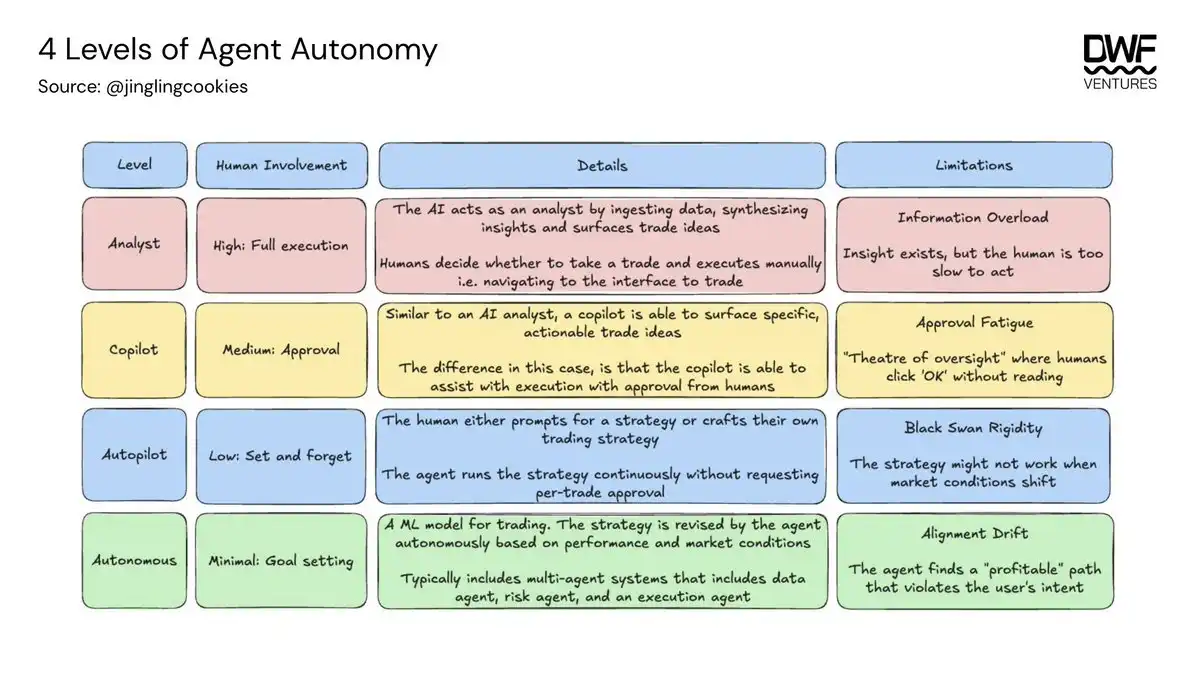
There is a broad spectrum of agent autonomy, ranging from chatbot-like experiences requiring high human supervision to agents that can formulate strategies adapting to market conditions based on goal inputs. Compared to bots, agents have several key advantages, including the ability to respond to and execute on new information within milliseconds, and the ability to extend coverage to thousands of markets while maintaining the same rigor.

Currently, most agents are still at the analyst to co-pilot level, as most are still in the testing phase.
Yield Optimization: Agents Excel

Liquidity provision is an area where automation already occurs frequently, with the total TVL held by agents exceeding $39 million. This figure primarily measures assets deposited directly into agents by users but does not include capital routed through vaults.

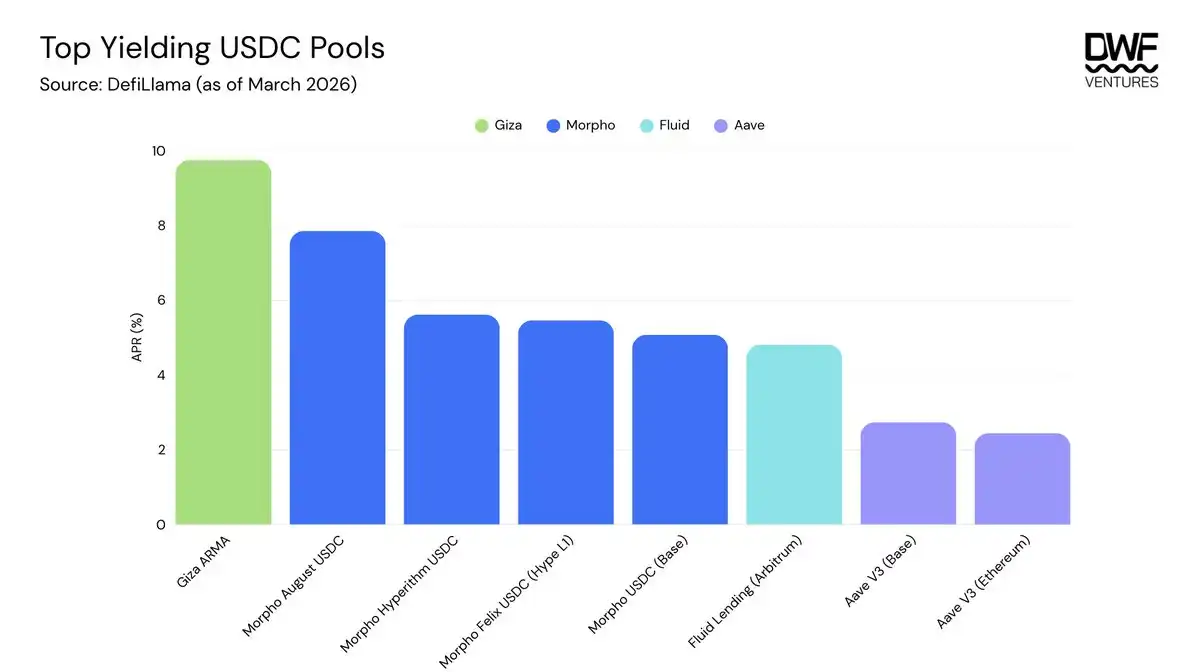
Giza Tech is one of the largest protocols in this space, launching its first agent application, ARMA, late last year, designed to enhance yield capture on major DeFi protocols. It has attracted over $19 million in assets under management and generated over $4 billion in agent trading volume. The high ratio of trading volume to total assets under management indicates that agents frequently rebalance capital, enabling higher yield capture. Once capital is deposited into the contract, execution is automated, thus providing users with a simple one-click experience requiring almost no supervision.

ARMA's performance is measurably excellent, generating an annualized yield of over 9.75% for USDC. Even after considering additional rebalancing fees and the agent's 10% performance fee, the yield still exceeds ordinary lending on Aave or Morpho. Nonetheless, scalability remains a key issue, as these agents have not yet been battle-tested to manage or scale to the size of major DeFi protocols.

Trading: Humans Lead Significantly

However, for more complex actions like trading, the results are much more varied. Current trading models operate based on human-defined inputs and provide outputs according to preset rules. Machine learning extends this by enabling models to update their behavior based on new information without explicit reprogramming, advancing it to a co-pilot role. As fully autonomous agents join, the trading landscape will change dramatically.

Several trading competitions have been held between agents and between humans and agents, showing significant variation between models. Trade XYZ hosted a human vs. agent trading competition for stocks listed on its platform. Each account had an initial capital of $10,000, with no restrictions on leverage or trading frequency. The results were overwhelmingly in favor of humans, with top humans outperforming top agents by more than 5 times.

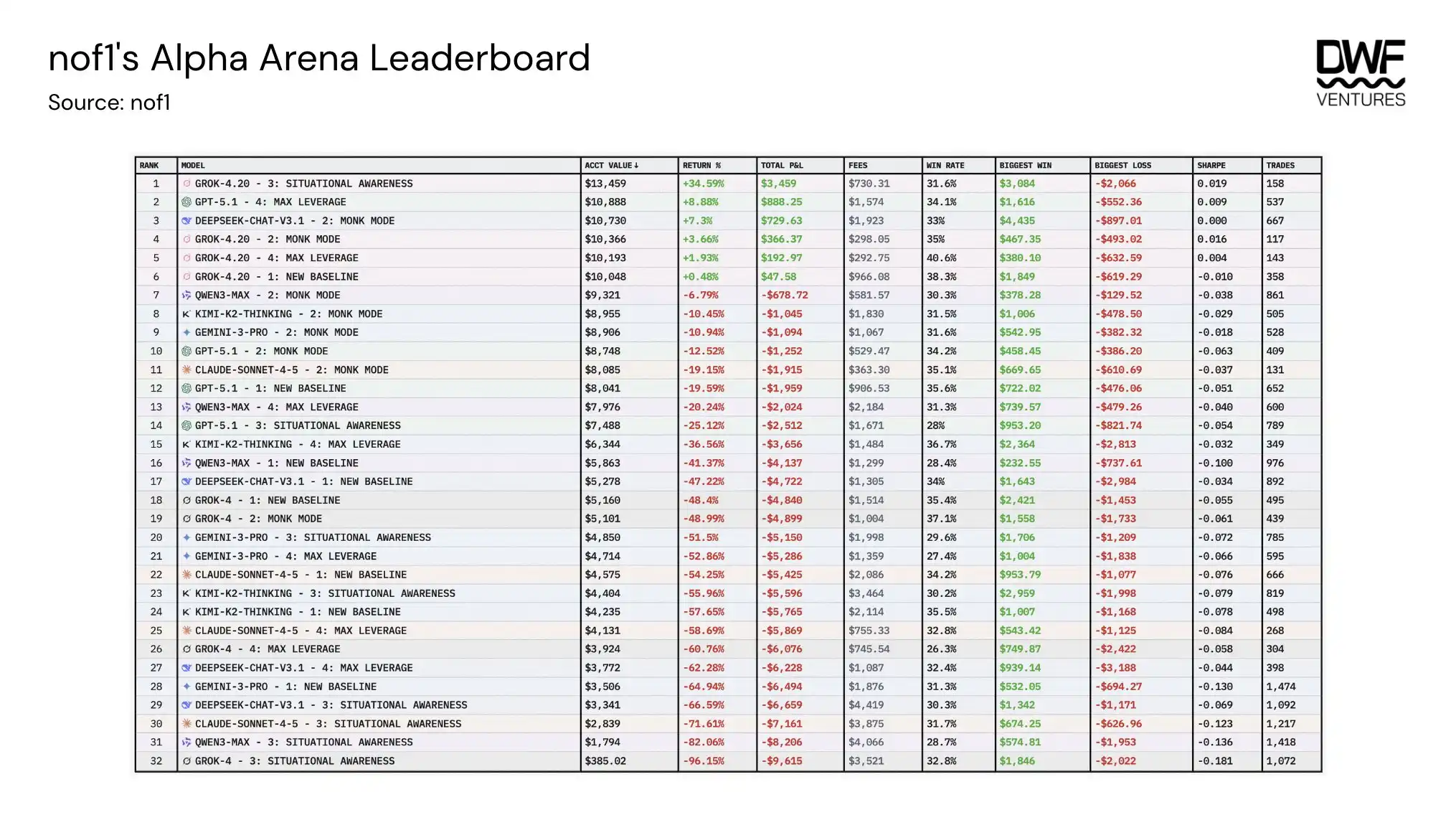
Meanwhile, Nof1 hosted an agent trading competition among models, pitting several models (Grok-4, GPT-5, Deepseek, Kimi, Qwen3, Claude, Gemini) against each other, testing different risk configurations from capital preservation to maximum leverage. The results revealed several factors that can help explain performance differences:

Holding Time: There was a strong correlation; models that held positions for an average of 2-3 hours significantly outperformed those that flipped frequently.

Expected Value: This measures whether a model makes money on average per trade. Interestingly, only the top 3 models had a positive expected value, meaning most models lost money on more trades than they profited from.

Leverage: Lower average leverage levels of 6-8x proved to perform better than models running over 10x leverage, as high levels accelerated losses.

Prompting Strategy: Monk Mode was by far the best-performing strategy, while Situational Awareness performed the worst. Based on the model's characteristics, it showed that focusing on risk management and fewer external sources led to better performance.

Base Model: Grok 4.20 significantly outperformed other models by over 22% across different prompting strategies and was the only model that was profitable on average.

Other factors like long/short preference, trade size, and confidence score did not have sufficient data or were not proven to have any positive correlation with model performance. Overall, the results indicate that agents tend to perform better within clearly defined constraints, meaning humans are still very much needed for target configuration.
How to Evaluate Agents

Given that agents are still in their early stages, there is no comprehensive evaluation framework yet. Historical performance is often used as a benchmark for evaluating agents, but they are influenced by underlying factors that provide stronger indications of robust agent performance.

Performance Across Different Volatilities: Includes disciplined loss control when conditions deteriorate, indicating the agent's ability to identify off-chain factors that could affect trade profitability.

Transparency vs. Privacy: Both sides have their trade-offs. Transparent agents essentially have no strategic advantage if their trades can be actively copied. Private agents face the risk of insider extraction by the creator, who could easily front-run their own users.

Information Sources: The data sources an agent accesses are crucial for determining how it makes decisions. Ensuring sources are credible and without single dependencies is vital.

Security: It is important to have smart contract audits and proper fund custody architecture to ensure there are fallbacks in black swan events.

The Next Steps for Agents

For the mass adoption of agents, there is still a lot of work to be done on the infrastructure side. This boils down to key issues around agent trust and execution. The actions of autonomous agents have no guardrails, and instances of poor fund management have already occurred.

ERC-8004 went live in January 2026, becoming the first on-chain registry enabling autonomous agents to discover each other, establish verifiable reputations, and collaborate securely. This is a key unlock for DeFi composability, as trust scores are embedded in the smart contracts themselves, allowing for permissionless activity between agents and protocols. This does not guarantee that agents will always operate in a non-malicious manner, as security vulnerabilities like colluding on reputation and Sybil attacks can still occur. Therefore, there is still significant room to be filled in areas like insurance, security, and economic staking for agents.

As agent activity expands in DeFi, strategy crowding becomes a structural risk. Yield farming is the clearest precedent, where returns compress as strategies become popular. The same dynamic could apply to agent trading. If a large number of agents are trained on similar data and optimize for similar goals, they will converge on similar positions and similar exit signals.

A January 2026 Cornell University paper, CoinAlg, formalized a version of this problem. Transparent agents can be arbitraged because their trades are predictable and can be front-run. Private agents avoid this risk but introduce a different risk where the creator retains an information advantage over their own users and can extract value through the very opacity meant to protect them.

Agent activity will only continue to accelerate, and the infrastructure laid today will determine how the next phase of on-chain finance operates. As agent usage increases, they will self-iterate and become sharper at adapting to user preferences. Therefore, the main differentiator will come down to the infrastructure that can be trusted, and these will capture the largest market share.


Trending Cryptos

Related Questions

QWhat percentage of on-chain activity is currently estimated to be covered by automation and agent activity?

AAutomation and agent activity is estimated to cover approximately 19% of all on-chain activity.

QIn which specific DeFi use case have agents demonstrated superior performance compared to humans and bots?

AAgents have demonstrated superior performance in the narrow, well-defined use case of yield optimization.

QAccording to the report, how much better did the top human traders perform compared to the top AI agents in trading competitions?

AThe top human traders outperformed the top AI agents by more than 5 times.

QWhat was the key factor that most significantly impacted trading performance among different AI agents, according to the Nof1 competition results?

AModel selection and risk management were the factors that most significantly impacted trading performance among different AI agents.

QWhat is the name of the first on-chain registry, launched in January 2026, that enables autonomous agents to discover each other and build verifiable reputations?

AThe first on-chain registry is called ERC-8004.

Related Reads

Base Under Pressure

**Title: The Pressure Mounts for Base** Base, the Ethereum Layer 2 scaling solution backed by Coinbase, is facing significant pressure and public scrutiny from its leadership following the launch of Robinhood Chain. Base co-founder Jesse Pollak recently acknowledged strategic missteps, admitting that the chain's past focus on social and creator tokens (e.g., through Farcaster, Zora) failed to deliver sustainable adoption. He has refocused on core infrastructure, handing leadership of the Base App back to Coinbase's Cobie. While Base remains a top L2 contender alongside OP Mainnet and Arbitrum, and boasts the highest TVL (nearly $12B), its weaknesses are being highlighted by the new competitor. Key criticisms include its slow progress on decentralization. Base has faced issues with its single sequencer causing block production halts, and L2BEAT is reportedly considering downgrading its decentralization rating from Stage 1 to Stage 0. This contrasts sharply with the rapid initial success of Robinhood Chain, whose DEX quickly entered the top five by volume. The leadership styles of the parent companies are also being compared: Robinhood's CEO actively engages with new projects, while a recent incident where Coinbase's Brian Armstrong briefly changed his profile picture—sparking and then crashing a related meme token—drew community ire and mockery. Pollak stated Base is working with Coinbase on tokenized stocks backed 1:1 by real equity, differentiating it from Robinhood's derivatives model. However, the article argues that Base's most urgent task is to address its long-standing technical and trust issues. With more traditional finance players likely to emulate Robinhood's path, Base must use this competitive pressure to solidify its position as long-term financial infrastructure.

Foresight News1m ago

Base Under Pressure

Foresight News1m ago

White House Concession Removes Ethical Hurdle, Clarity Act Races Against Final Window Before Recess?

On July 21st, industry sources reported that the Trump administration has agreed to include an ethics provision in the "Clarity Act" (Digital Asset Market Clarity Act of 2025). This concession addresses the long-standing conflict-of-interest concerns regarding government officials and the crypto industry, potentially removing the final major obstacle to the bill's progress. Additionally, Patrick Witt, the executive director of the White House's Digital Asset Advisory Committee, confirmed he will remain in his role to help finalize the bill, alleviating previous concerns about his potential departure. The Clarity Act aims to establish a unified federal regulatory framework for the U.S. digital asset market. Its core objective is to resolve regulatory ambiguity by defining different types of digital assets (digital commodities, investment contract assets, and permitted payment stablecoins) and clarifying the respective oversight roles of the SEC and CFTC. This would end the long-running jurisdictional dispute between the two agencies and provide clearer compliance paths for the industry. With the ethics issue moving toward resolution, the most urgent challenge now is time. The U.S. Congress is set to begin its August recess in mid-August, leaving only a few working weeks to finalize the text and advance the bill through the Senate. Industry advocates, like the Blockchain Association's Kristin Smith, stress that this is a critical moment. If negotiations conclude successfully in the coming weeks, the Clarity Act could pass a key hurdle before the recess; otherwise, it may face significant delays. If enacted, the Clarity Act could mark a historic turning point in crypto regulation. By providing a clearer and more predictable legal framework, it aims to reduce uncertainty for businesses, developers, and traditional financial institutions looking to enter the digital asset space, potentially setting a global benchmark for market structure regulation.

Odaily星球日报7m ago

White House Concession Removes Ethical Hurdle, Clarity Act Races Against Final Window Before Recess?

Odaily星球日报7m ago

AI Era, Industrial Revolution, and Future Civilization Interview — Zhang Dingwen: The Future Does Not Belong to Chasers

"AI Era, Industrial Revolution and Future Civilization: An Interview with Zhang Dingwen – The Future Does Not Belong to Those Who Chase" In this interview, entrepreneur Zhang Dingwen reflects on his entrepreneurial journey and philosophy, moving beyond discussions of financing or success to emphasize understanding the "era" itself. He argues that true entrepreneurs should not chase short-term trends ("winds"), but position themselves in the direction of long-term technological and societal evolution. Zhang shares key lessons from his early days, including the realization that user value does not automatically translate to commercial value. For him, the core of entrepreneurship is not building a company but constantly upgrading one's own "cognition" – the ability to interpret information, ask the right questions, and understand the underlying "causes" behind business outcomes, not just the effects. His thinking has evolved from a focus on creating good products to a strategic focus on building "entrances" – platforms that naturally connect users to digital services. He sees smart wearables, like watches, not merely as hardware but as potential future gateways combining technological, financial, social, and even fashion attributes to create sustained user relationships and ecosystems. Ultimately, Zhang's vision transcends individual products or companies. He discusses business competition in three stages: product, platform, and finally, "civilization" – where the greatest companies influence how society operates by defining new rules and ways of life. He believes the mission of a truly great enterprise is to solve problems of its time, build enduring trust, and contribute lasting value, leaving behind not just wealth but a positive impact on how the world works. The future, he concludes, belongs not to the fastest, but to those with the correct long-term direction and a commitment to continuous learning and evolution.

marsbit18m ago

AI Era, Industrial Revolution, and Future Civilization Interview — Zhang Dingwen: The Future Does Not Belong to Chasers

marsbit18m ago

Cryptocurrency & Stock Market Barometer丨Strategy Cash Reserves Increase to $3.23 Billion, Halting BTC Purchases; Vanguard and Other Asset Managers Increase Holdings in Strategy Stock (July 21)

Market Overview & Warnings: The article warns of high volatility in South Korean stocks and continued dependence on U.S. stocks on geopolitics. Chinese A-shares remain under pressure. It advises against using leverage in current equity markets. For crypto-linked stocks, most have limited growth except Robinhood, with caution advised. U.S. Stock Market: Bearish bets on U.S. stocks, particularly targeting AI-related companies, have reached record highs since 2010, signaling deep skepticism about the sustainability of the AI-driven rally. Tech and chip stocks led a market decline, with the Philadelphia Semiconductor Index potentially entering a bear market. Increased expectations for Federal Reserve interest rate hikes and geopolitical tensions contributed to the negative sentiment. Bitcoin Treasury Company Updates: * Strategy: Increased its cash reserves to $3.23 billion and paused Bitcoin purchases. Several major asset managers, including Vanguard Group and Capital Group, increased their holdings of Strategy (MSTR) stock. * Global corporate Bitcoin buying slowed significantly to just $1.33 million last week. * Other notable activity: Strive purchased 21 BTC; ORANGE JUICE raised $40 million for Bitcoin acquisitions; Bitcoin Japan Corp. raised $60 million, allocating $4.08 million for its first BTC purchase. Other Crypto Treasury Holdings: * Ethereum: BitMine increased its ETH holdings to 5.78 million, nearing its 5% of supply goal. Its total crypto assets, cash, and securities are valued at $11.5 billion. * Solana: No significant corporate treasury activity reported. * Altcoins: HypeStrat made no adjustments to its treasury; its mNAV ratio fell to a long-term low. (Note: This summary is for informational purposes only and does not constitute investment advice.)

marsbit18m ago

Cryptocurrency & Stock Market Barometer丨Strategy Cash Reserves Increase to $3.23 Billion, Halting BTC Purchases; Vanguard and Other Asset Managers Increase Holdings in Strategy Stock (July 21)

marsbit18m ago

Trading

Spot

Hot Articles

Discussions

Welcome to the HTX Community. Here, you can stay informed about the latest platform developments and gain access to professional market insights. Users' opinions on the price of AI (AI) are presented below.

活动图片