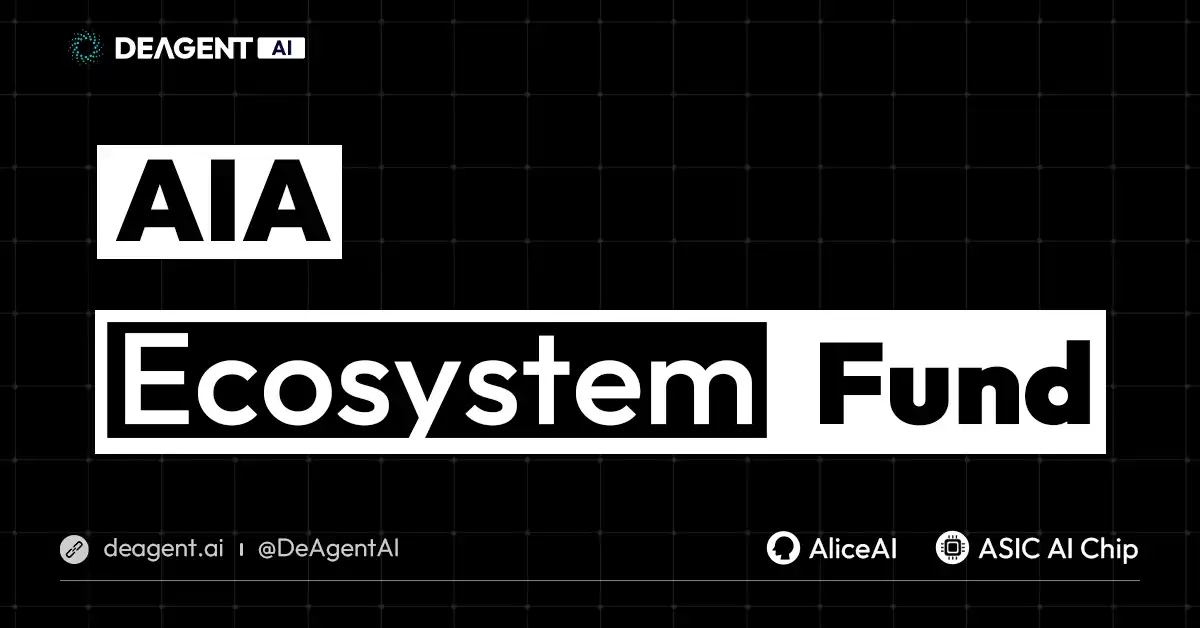
DeAgentAI Announces Establishment of AIA Ecosystem Fund, Focusing on 'AI Agent + Physical AI' Track

marsbitPublished on 2026-04-14Last updated on 2026-04-14

Abstract

DeAgentAI, a leading decentralized AI infrastructure project on SUI and BNB Chain, has announced the establishment of the AIA Ecosystem Fund. The fund will focus on the integrated track of "AI Agent + Physical AI," aiming to incubate and accelerate the next generation of AI applications with autonomous decision-making capabilities and extend AI technology from on-chain intelligence to the real world. The fund will provide comprehensive support in technology, user traffic, and ecosystem resources. Its core investment directions include AI Agent applications with autonomous on-chain execution and multi-agent collaboration capabilities, and Physical AI projects that extend AI inference into the physical world through hardware and computing efficiency. The fund has already made seed-round investments in two projects: - AliceAI: An AI-driven prediction market decision system that compresses fragmented information into verifiable, tamper-proof decision signals, offering a full-cycle solution from signal generation to automated execution via Telegram Bot. - An ASIC AI chip project: A custom hardware solution designed specifically for Transformer-based inference, aiming to reduce token processing costs to less than one-tenth of current GPU solutions while significantly improving energy efficiency and lowering latency. According to DeAgentAI’s founder, the goal is to bridge the gap between on-chain intelligence and the physical world, supporting key protocols that connect users...

April 14, 2026, DeAgentAI, a leading decentralized AI infrastructure project in the SUI and BNB ecosystems, today announced the establishment of the AIA Ecosystem Fund. This fund will focus on the integrated track of "AI Agent + Physical AI," dedicated to incubating and accelerating the next generation of AI application ecosystems with autonomous decision-making capabilities, and promoting the extension of AI technology from on-chain intelligence to the real world.

Ecosystem Accelerator for the AI Era

The establishment of the AIA Ecosystem Fund marks DeAgentAI's strategic extension from a single infrastructure provider to an ecosystem investor. Leveraging DeAgentAI's accumulated AI Agent infrastructure capabilities in the SUI, BSC, and BTC ecosystems, as well as the AlphaX product matrix with over 191 million on-chain interactions, the AIA Ecosystem Fund will provide comprehensive support to invested projects in terms of technology, traffic, and ecosystem resources.

The fund's core investment directions focus on two major areas:

AI Agent: Application-layer projects with autonomous decision-making, on-chain execution, and multi-agent collaboration capabilities;

Physical AI: Hardware infrastructure and computing power optimization projects that extend AI inference capabilities to the real world.

Seed Round Already Invests in Two Ecosystem Projects

Currently, the AIA Ecosystem Fund has completed strategic investments in two projects during the seed round:

AliceAI: AI-Driven Prediction Market Decision System

In 2026, with the proliferation of deepfakes and extreme information noise overload, mere predictions have lost their scarcity, and "verifiable decision-making judgment" has become the gold standard of the AI era. AliceAI is not a simple prediction tool; it compresses multi-source, fragmented asymmetric information into a single, tamper-proof decision signal through a decentralized protocol, covering scenarios such as crypto markets, sports events, political issues, and public events.

Through the lightweight entry point of Telegram Bot, AliceAI provides core functions such as judgment signal推送, automatic copy-trading execution, fixed-amount orders, automatic stop-loss, and position visualization, achieving a complete closed loop from "signal generation" to "automatic execution." The AIA Ecosystem Fund is optimistic about the new paradigm of "verifiable judgment" pioneered by AliceAI and believes it has the potential to become the core infrastructure of the prediction market track.

ASIC AI Chip

If AI Agent is the soul, then efficient computing hardware is the body of Physical AI. The current AI inference market is experiencing a structural矛盾 between exploding demand and high costs. The general-purpose GPU architecture faces significant computing power redundancy and energy efficiency losses when handling large-scale Transformer inference loads, and this bottleneck is becoming a core obstacle to the large-scale adoption of AI Agents.

The ASIC AI chip project invested in by the AIA Ecosystem Fund has undergone hardware-level deep customization tailored to the inference computing characteristics of the Transformer architecture. In terms of energy efficiency ratio, the design of dedicated inference paths enables the chip to handle higher-density token throughput under the same power budget, aiming to compress the per-token processing cost to less than one-tenth of existing mainstream GPU solutions while significantly reducing inference latency.

Lower inference costs mean that on-chain Agents' autonomous decisions can run in real-time with higher frequency and lower barriers. The competition in the Physical AI era is essentially a competition in computing efficiency. The AIA Ecosystem Fund's decision to介入 at the seed round is based on this judgment: true AI democratization requires reconstruction starting from the hardware layer.

The founder of DeAgentAI stated: "The evolution path of AI is progressing from 'souls in dialog boxes' to 'bodies in the physical world.' The original intention of the AIA Ecosystem Fund is to break the boundary between on-chain intelligence and physical reality. We are not just looking for good projects; we are looking for 'key protocols' that can connect users to the future AI physical world."

About DeAgentAI:

DeAgentAI is a leading decentralized AI infrastructure in the SUI and BNB ecosystems. Through its self-developed Minimum Entropy Consensus mechanism, DeAgentAI addresses the three core challenges faced by AI Agents in distributed environments from the ground up: Identity consistency, State continuity, and Result credibility. It is committed to building a truly trustworthy on-chain AI agent ecosystem.


Trending Cryptos

Related Questions

QWhat is the main focus of the AIA Ecosystem Fund announced by DeAgentAI?

AThe AIA Ecosystem Fund focuses on the 'AI Agent + Physical AI' integration, aiming to incubate and accelerate the next generation of AI applications with autonomous decision-making capabilities, extending AI technology from on-chain intelligence to the real world.

QWhich two key areas does the AIA Ecosystem Fund primarily invest in?

AThe fund invests in two core areas: AI Agent (applications with autonomous decision-making, on-chain execution, and multi-agent collaboration capabilities) and Physical AI (hardware infrastructure and computing optimization projects that extend AI reasoning into the real world).

QWhat is the unique value proposition of AliceAI, one of the seed-round projects supported by the AIA fund?

AAliceAI is an AI-driven predictive market decision system that compresses multi-source, fragmented asymmetric information into a single, tamper-proof decision signal. It provides a complete closed loop from signal generation to automatic execution via a Telegram Bot, offering verifiable judgment in an era of information overload.

QHow does the ASIC AI chip project, backed by the AIA fund, address current challenges in AI inference?

AThe ASIC AI chip is custom-designed for Transformer architecture inference, significantly improving energy efficiency and reducing latency. It aims to compress the per-token processing cost to less than one-tenth of mainstream GPU solutions, enabling higher-frequency, lower-cost autonomous decision-making for on-chain Agents.

QWhat underlying technology does DeAgentAI use to address core challenges in distributed AI Agent environments?

ADeAgentAI employs a self-developed Minimum Entropy Consensus mechanism to solve the core challenges of identity consistency, state continuity, and result credibility for AI Agents in distributed environments, aiming to build a trustworthy on-chain AI Agent ecosystem.

Related Reads

Global Stock Market's Storm Center: South Korea's Stock Market De-leveraging Is Largely Complete

Storm's Eye: South Korean Market De-leveraging Nears Completion The recent sharp correction in South Korean equities, with the KOSPI index dropping 32% from its June high, has been a key trigger for global tech stock volatility. The core driver was not a fundamental shift but a forced de-leveraging process within the market's unique structure, which is now largely complete. Two main leverage channels amplified the sell-off: 1. **Leveraged ETFs:** Their size, proportionally four times larger than in the U.S., peaked near $50 billion. Their mandatory daily rebalancing mechanism created a vicious cycle of "price drop → forced selling → further drop." Approximately 75% of this excess has been unwound, shrinking to $26 billion, with regulatory curbs now blocking new inflows. 2. **Hedge Fund Leverage:** Using swaps to magnify exposure, hedge funds saw their net long positioning fall by over 50% from peak levels. The most intense phase of this institutional de-leveraging is over. In contrast, **retail margin debt** poses minimal systemic risk. At 0.5% of market cap, it is far lower than in the U.S. or China, lacks automatic triggers, and is concentrated in smaller stocks. The conclusion: the high-leverage structures most prone to "chain-reaction selling" have been substantially cleared. The market is transitioning from a liquidity-driven crash to one priced more on fundamentals. The article argues that the AI trend—centered on Korean memory chips—remains intact. This episode represents a painful but necessary clearing of crowded trades, not the end of the AI revolution. For investors, the key question is conviction in the long-term AI direction; if the trend is real, current volatility is a cost of entry, not a terminal risk.

链捕手46m ago

Global Stock Market's Storm Center: South Korea's Stock Market De-leveraging Is Largely Complete

链捕手46m ago

The Eternal Fragments of Money: Third-Party Payment Has No First Principle

"The Enduring Fragments of Money: Third-Party Payments Lack a First Principle" Stripe is reportedly attempting to acquire PayPal, marking a significant shift reminiscent of PayPal's merger with the original X.com 30 years ago. The article analyzes Stripe's strategic challenges and the broader payments industry landscape. Despite its initial success with a developer-friendly API model, Stripe missed its optimal IPO window during the pandemic and has since seen its valuation decline. Its attempts to expand through acquisitions and new ventures, particularly in stablecoins (like its OUSD project) and Agent-focused payments (ACP/MPP protocols), have faced headwinds. The author argues that the payment industry remains highly fragmented and is ultimately an adjunct to the traditional banking system. This structure limits the potential for any single player, including Stripe, to achieve complete dominance. While stablecoins and the future rise of autonomous Agent economies present potential growth avenues, they are not yet mainstream and still require integration with the existing financial system. For now, Agent-based transactions are largely used for speculative "volume boosting" rather than substantive business applications. Stripe's current move to acquire PayPal is seen as an attempt to bolster its weak consumer-facing (C-side) business after its stablecoin-focused strategies faltered. Meanwhile, PayPal is described as structurally outdated, unable to revive itself through new products like Venmo or PYUSD. The future of payments may lie not in payments themselves but in value-added services like more efficient settlement networks. The author suggests that companies like Stripe and Circle, which are building their own blockchains (Tempo, Arc) and stablecoins, are positioning themselves to eventually profit from high-efficiency settlement systems. These new networks could potentially bypass some traditional banking layers. In conclusion, the article posits that third-party payment is a perpetually fragmented battlefield where scale alone cannot ensure victory. Players must find new models, focusing on efficiency to compete with the entrenched banking system. Stripe's acquisition of PayPal represents a bet on this uncertain future.

链捕手1h ago

The Eternal Fragments of Money: Third-Party Payment Has No First Principle

链捕手1h ago

Trading

Spot

Hot Articles

Discussions

Welcome to the HTX Community. Here, you can stay informed about the latest platform developments and gain access to professional market insights. Users' opinions on the price of AI (AI) are presented below.

活动图片













