WTI crude oil maintained slight consolidation during the early Asian session on Thursday, trading around $84.50/barrel, after experiencing a minor pullback in the previous trading session. Oil prices have regained support, mainly due to the ongoing escalation of tensions in the Middle East, limited progress in relevant negotiations between the United States and Iran, and increasing market concerns about further disruptions to the crude oil supply chain. Against a backdrop of relatively complex inventory and demand factors, geopolitical risk has once again become a crucial variable determining short-term oil price direction.
Recent market focus has been particularly on the shipping situation in the Strait of Hormuz. As a vital global energy transit chokepoint, any sustained disruption in this region could rapidly elevate the supply risk premium in the international crude oil market. US President Trump stated that crude oil transportation continues to pass through this strait, while leaving the possibility for future negotiations open. This suggests the market currently does not see certainty of a complete supply disruption, but the risk persists.
For the crude oil market, what truly influences prices is not just the number of vessels currently able to pass normally, but the market's expectation regarding future transportation security. If related risks persist, costs for shipping, insurance, and transit times may all increase. Even before actual supply shows a significant decline, traders might preemptively raise risk premiums, thereby keeping crude oil prices at relatively elevated levels.
The further complication of the regional situation also adds to market uncertainty. The UAE announced a suspension of some financial and economic transactions related to Iran, reinforcing market concerns about regional economic exchanges. Meanwhile, Gulf oil-producing nations are maintaining relatively high export volumes through alternative shipping routes and more discreet maritime methods, which somewhat alleviates actual supply-side impacts.
Therefore, the crude oil market currently exhibits a relatively distinct characteristic: risk premiums have clearly risen, but actual supply has not yet shown a disruption fully matching the risk sentiment. If major Gulf producers can continue to maintain stable exports, the upside for oil prices may be limited. Conversely, if transportation facilities, tankers, or key energy infrastructure face further impacts, the market could swiftly shift from "risk trading" to "supply shortage trading."
TD Securities believes the crude oil market environment remains fragile. Risks to transportation security, escalating tensions, and stalled negotiations could all keep energy markets in a high-risk state. For Brent crude and refined products, supply disruption risks may continue to sustain elevated risk premiums. This implies that even if there is no immediate obvious imbalance in actual crude supply and demand, prices may remain highly volatile due to risk expectations.
US inventory data, however, presents another constraint on oil price gains. The latest data from the US Energy Information Administration showed that US crude oil inventories increased by approximately 4.4 million barrels last week. The unexpected rise in inventories indicates relatively ample short-term supply and may also reflect changes in refinery demand or import patterns. Inventory builds typically imply increased pressure on spot market supply and demand, making it a key bearish factor to watch during WTI's current upward move.
Nevertheless, US refined product inventory performance is not entirely pessimistic. Distillate inventories fell by about 1.5 million barrels over the same period, dropping to a one-month low, suggesting there is still some destocking pressure in the refined product market. If refinery run rates remain high in the future and product demand continues to improve, crude oil processing demand may increase, partially offsetting the bearish impact of rising crude inventories.
From a global market perspective, the core contradiction for current oil prices remains the tug-of-war between "escalating geopolitical risk" and "relatively ample inventory and supply." If Middle Eastern risks escalate further, the market may further raise supply disruption premiums, giving WTI the chance to challenge higher price zones. If related risks are contained and US crude inventories continue to build, oil prices may revert to a correction mode dominated by fundamentals.
Going forward, close attention needs to be paid to whether Strait of Hormuz transportation remains stable, changes in US crude and product inventories, export situations from Gulf producers, and progress in US-Iran related negotiations. Particularly, if there is a sustained disruption in crude oil transportation, even before actual inventories rapidly decline, the market might preemptively trade the future supply gap, thereby amplifying oil price gains.
From a daily chart structure perspective, WTI has returned above $84, with the overall trend remaining relatively strong. The price regaining upward momentum after a period of consolidation indicates bulls still hold some initiative. The market currently needs to focus on short-term resistance around $86.00. If oil prices can effectively break through and stabilize above this area, the likelihood of a further run towards $88.00 or even the $90.00 threshold will increase significantly. Initial support below is seen around $84.00. If the price finds support upon retreating to this area, the bullish structure remains intact. A further drop below $84 might expand correction pressure towards the $82.50 vicinity, with more crucial medium-term support around the $80 integer level. Overall, geopolitical risks provide fundamental support for the technical bullish structure, but a swift price rise still warrants caution against profit-taking.
From a 4-hour chart perspective, WTI maintains a consolidation-strong pattern in the short term, with some recovery in bullish momentum after reclaiming $85. The area around $84.50 currently serves as an important observation zone. If the price can break above and hold above $86, the short-term uptrend may strengthen further. If consecutive attempts to break $86 fail, a technical correction may occur. During a correction, $84 is the key level for judging short-term bullish strength. Holding above this area suggests the market may still be gathering strength for an attack, while breaking below $84 would indicate weakening short-term momentum. In summary, the 4-hour chart still leans bullish, but whether oil prices can advance further will highly depend on whether geopolitical risks continue to drive an expansion in the risk premium.
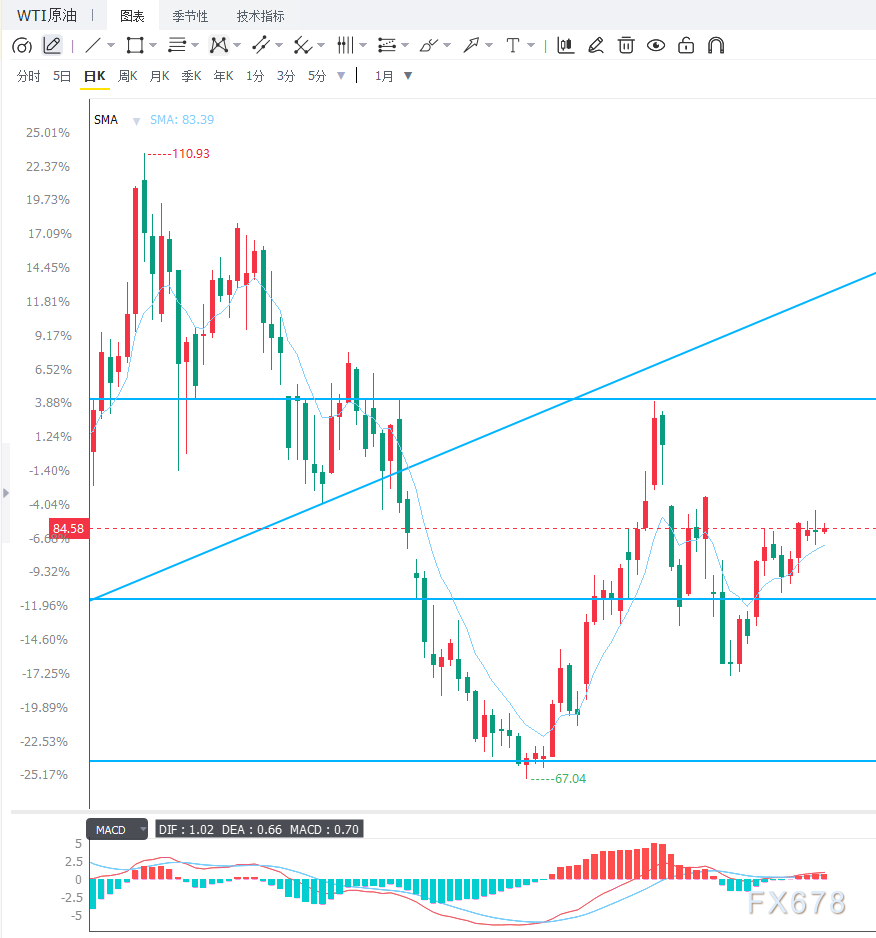
The core driving force behind the current WTI crude oil rally stems from escalating Middle East tensions and the risk to Strait of Hormuz transportation, while rising US crude inventories pose a clear fundamental constraint. As long as the key transit corridor remains basically open, oil price gains reflect more of an expansion in risk premium rather than an actual supply gap. Therefore, WTI may still maintain a consolidation-strong pattern at elevated levels in the short term, but sustained gains would require confirmation from new supply-side shocks. If geopolitical tensions worsen further, the area above $86 could become the next breakout zone. If tensions ease and US inventories continue to rise, oil prices may retreat back towards the $82.50-$84 range. The current market presents both opportunity and risk, and focus should be on whether the supply chain shifts from a "state of risk" to "actual disruption."