Covenant AI accuses Bittensor of ‘centralized control with decentralized branding’ amid exit

ambcryptoPublished on 2026-04-10Last updated on 2026-04-10

Abstract

Covenant AI, a major subnet on the Bittensor network, has exited, citing concerns over centralization. In a statement on X, the team accused Bittensor’s leadership of exercising centralized control while maintaining a decentralized brand. They claimed key decisions, such as suspending subnet emissions and removing community control, were influenced by a centralized authority. Additionally, they alleged the network deprecated infrastructure and applied economic pressure through token sales. This exit has generated uncertainty, highlighting ongoing tensions between decentralization ideals and operational realities in AI-driven crypto networks.

OkThe AI-driven momentum across crypto reflects how far decentralization has evolved.

What started as an attempt to decentralize financial infrastructure, allowing peer-to-peer transactions without intermediaries, has now expanded into blockchain networks integrating AI to speed up systems.

In this context, the recent FUD around Bittensor [TAO] seems largely sentiment-driven. For context, Covenant AI, one of the largest and most active subnets on Bittensor, recently exited the network, sparking uncertainty.

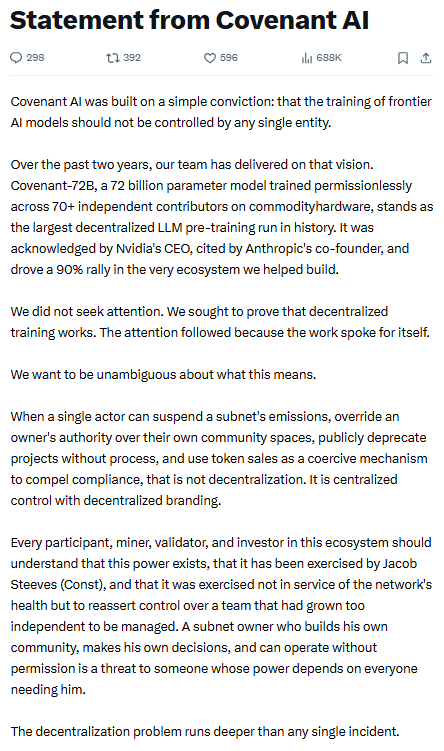
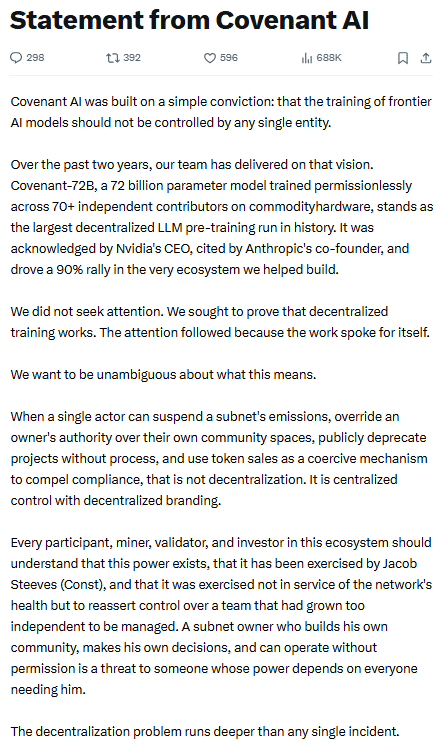
However, the bigger concern isn’t just the exit itself, but the reasoning behind it. In a post on X, Covenant AI said that Bittensor no longer functions as a truly decentralized network.
Source: X

The team argued that key decisions remain influenced by centralized authority. They claimed network leadership suspended subnet emissions and removed community control. The team also said leadership deprecated infrastructure and applied economic pressure through token sales.


Trending Cryptos

Related Questions

QWhat is the main accusation that Covenant AI has made against Bittensor?

ACovenant AI accused Bittensor of 'centralized control with decentralized branding', claiming that key decisions are influenced by a centralized authority rather than being truly decentralized.

QWhy did Covenant AI exit the Bittensor network?

ACovenant AI exited due to concerns that Bittensor no longer functions as a truly decentralized network, citing centralized control over key decisions and network operations.

QWhat specific actions did Covenant AI claim Bittensor's leadership took?

AThey claimed leadership suspended subnet emissions, removed community control, deprecated infrastructure, and applied economic pressure through token sales.

QHow does the article describe the broader trend of AI integration in crypto?

AThe article describes it as an evolution of decentralization, expanding from decentralizing financial infrastructure to blockchain networks integrating AI to speed up systems.

QWhat does the article suggest is the primary driver behind the recent FUD around Bittensor?

AThe article suggests the recent FUD is largely sentiment-driven, sparked by Covenant AI's exit and their accusations against Bittensor.

Related Reads

L2 'Recalibration': When L1 Becomes Its Own Rollup, What Is Ethereum's Endgame?

The article discusses the evolving relationship between Ethereum's Layer 1 (L1) and Layer 2 (L2) solutions, moving beyond the initial "L2 for scaling" model. As Ethereum L1 itself scales (increasing Gas Limit, statelessness, zkEVM), the unique value proposition of L2s shifts from merely providing cheap execution to offering differentiated features like application-specific optimization, privacy, and flexible governance. The piece explores three key themes: 1. **L2's New Role:** L2s are transitioning from a pure scaling technology to a spectrum of execution environments with varying degrees of security inheritance from Ethereum L1. 2. **Interoperability as State Trust:** Solving L2 fragmentation is less about cross-chain bridges and more about enabling faster, trust-minimized state verification between environments. This involves initiatives like faster L1 finality, intent-based architectures (Open Intents Framework), and native account abstraction. 3. **Blurring Layers:** With the potential integration of zk-proofs into L1 validation (making L1 akin to its own "Rollup") and the concept of "Native Rollups," the rigid boundary between L1 and L2 may fade. The future could be a unified system with multiple execution domains (for DeFi, gaming, privacy, etc.) sharing a common security, settlement, and state framework. In conclusion, Ethereum's goal is not to abandon L2s or re-centralize everything on L1, but to re-integrate the fragmented user experience—liquidity, accounts, applications—while preserving the scaling benefits of a multi-environment ecosystem. The endgame is a cohesive "one chain" feeling for users, powered by diverse but securely interconnected execution layers.

marsbit37m ago

L2 'Recalibration': When L1 Becomes Its Own Rollup, What Is Ethereum's Endgame?

marsbit37m ago

Trading

Spot

Hot Articles

Discussions

Welcome to the HTX Community. Here, you can stay informed about the latest platform developments and gain access to professional market insights. Users' opinions on the price of AI (AI) are presented below.

活动图片