CoreWeave plans $2B note offering to scale AI business while managing dilution

cointelegraphPublished on 2025-12-08Last updated on 2025-12-08

Abstract

CoreWeave plans to raise $2 billion through a private offering of convertible notes due 2031, with an option for an additional $300 million. Proceeds will be used for general corporate purposes and capped-call transactions to reduce potential shareholder dilution. The notes can be settled in cash, shares, or a combination. Founded as a crypto miner in 2017, the company pivoted to AI infrastructure in 2019 and now operates over 33 data centers. The stock fell 9.2% on the news. Separately, CoreWeave's recent $9 billion bid to acquire Bitcoin miner Core Scientific failed after shareholders rejected it. The company stated the acquisition was primarily aimed at securing power capacity for future AI expansion, not a return to crypto.

AI infrastructure provider CoreWeave (CRWV) plans to raise $2 billion through a private offering of convertible senior notes due 2031, with proceeds earmarked for general corporate purposes and for capped-call transactions that could reduce potential future shareholder dilution.

The notes include an option for purchasers to buy an additional $300 million, the company said Monday. They can be settled in cash, shares or a combination of both at CoreWeave’s discretion.

To limit dilution if the notes are ultimately converted into equity, CoreWeave is entering into capped-call transactions. This hedge increases the effective conversion price and provides a degree of protection for existing shareholders while preserving financial flexibility.

CoreWeave was founded in 2017 as Atlantic Crypto, a company that used GPUs to mine Ether (ETH). As the crypto market weakened, it pivoted in 2019 into cloud and high-performance computing services, eventually refocusing its GPU infrastructure on AI workloads.

The company now operates a network of data centers built specifically for AI, and as of this year, reported running more than 33 facilities. It has not said whether proceeds from its latest fundraising will go toward further expanding that footprint.
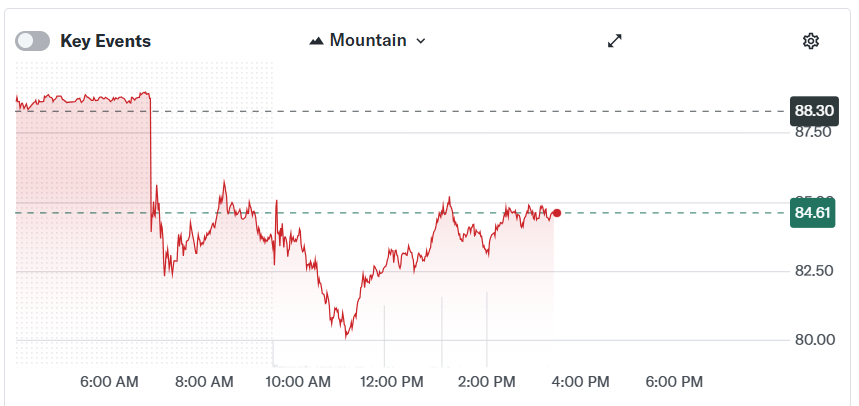
CoreWeave stock reacted negatively to the private note offering, falling as much as 9.2% on Monday. Source: Yahoo Finance

Related: TeraWulf looks to raise $500M as it bets big that AI is new Bitcoin

CoreWeave’s failed takeover bid of Core Scientific

Despite shifting its focus away from digital asset mining as its primary business, CoreWeave recently pursued a $9 billion acquisition of Core Scientific, one of the largest Bitcoin (BTC) mining operators. However, the deal fell through after Core Scientific’s shareholders voted against the proposal.

The attempted takeover fueled speculation about a return to crypto, but CoreWeave has characterized the effort differently.

The company stated that the acquisition aimed to secure access to approximately 1.3 gigawatts of power capacity across Core Scientific’s sites, which could be leveraged for future expansion in AI, cloud computing or other GPU-intensive workloads.

CoreWeave had spent more than a year pursuing Core Scientific, beginning with an initial offer in June 2024 that the miner rejected. As Core Scientific’s stock rose, the price needed to secure a deal also increased, ultimately contributing to the failure of the final proposal when shareholders voted it down.

Related: Crypto Biz: Mining weakness tests Bitcoin’s market cycle

Trending Cryptos

Related Reads

Bitcoin Withdrawals Continue: 8 Years of Storage in a Coldcard Cold Wallet Ended in Zero

Coldcard Hardware Wallet Hacked: Losses Mount Due to Vulnerable Seed Generation A critical vulnerability in Coldcard hardware wallets has led to a continued wave of fund thefts. According to Galaxy Research, the total stolen has reached 1,367.05 BTC (approx. $88.6 million) from 4,585 addresses, a significant increase from the initial 594.5 BTC reported on July 30, 2026. Most of the stolen funds remain on the attackers' addresses. The issue is not with the current firmware, which Coinkite has updated, but with seed phrases generated on vulnerable devices between March 2021 and the release of fixed firmware versions. Due to a programmer error, devices switched from using a hardware random number generator to the software-based Yasmarang generator, which was initialized with publicly accessible data like the chip's serial number. This made the seed phrases predictable through offline brute-force attacks, meaning wallets remain at risk until funds are moved to a new wallet generated with the patched firmware. Affected devices include Mk2/Mk3 with firmware 4.0.1–4.1.9 (and up to 5.0.3), Mk4/Mk5 up to version 5.6.0, and Q models up to 1.5.0Q. The only exceptions are seeds created with a high-entropy method like at least 50 independent dice rolls or a strong unique BIP-39 passphrase. All other owners must generate a new seed on the fixed firmware and transfer their assets. A case highlighting the human impact involves a 39-year-old long-term investor who lost 2 BTC (approx. $130,000) in minutes. He had accumulated the Bitcoin over eight years through physical labor, viewing it as a financial lifeline and a retirement plan in a country suffering from hyperinflation. His story underscores that even conservative "buy and hold in cold storage" strategies can be compromised by such underlying technical flaws. From a technical perspective, this incident echoes historical failures where weak random number generators undermined cryptographic security, challenging the assumption that offline storage is automatically foolproof.

cryptonews.ru1h ago

Bitcoin Withdrawals Continue: 8 Years of Storage in a Coldcard Cold Wallet Ended in Zero

cryptonews.ru1h ago

Trading

Spot

Hot Articles

Discussions

Welcome to the HTX Community. Here, you can stay informed about the latest platform developments and gain access to professional market insights. Users' opinions on the price of AI (AI) are presented below.

活动图片















