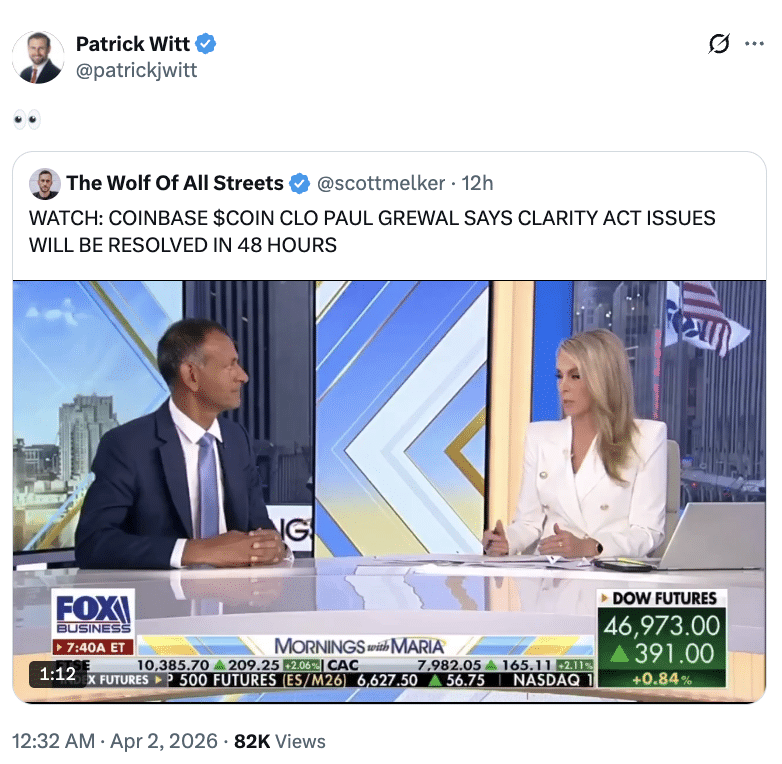
Coinbase CLO turns bullish on CLARITY: ‘Confident we’re going to see progress’

ambcryptoPublished on 2026-04-02Last updated on 2026-04-02

Abstract

Coinbase Chief Legal Officer Paul Grewal expressed strong optimism about the imminent passage of the Digital Asset Market CLARITY Act of 2025, predicting a breakthrough in U.S. crypto regulation within the next 48 hours. Despite resistance from traditional banks, Grewal emphasized the importance of the bill in fulfilling former President Trump’s vision of making the U.S. a global crypto capital. He differentiated crypto from fractional-reserve banking, dismissing concerns about deposit flight due to stablecoins. His shift in stance surprised Patrick Witt of the President’s Council on Digital Assets, given Coinbase’s previous hesitation. Polymarket odds of the bill becoming law by 2026 rose to 65%, reflecting growing confidence.

An interesting plot twist has emerged in the ongoing chatter around the Digital Asset Market CLARITY Act of 2025.

Coinbase Chief Legal Officer (CLO) Paul Grewal, in a recent television appearance, has shared his optimism about the passage of the crypto bill. He believes that the U.S. is on the verge of a major crypto breakthrough despite banks’ resistance.

More importantly, Grewal revealed that the deal between crypto and banks will likely pass within the next 48 hours.

I’m very confident we’re going to see progress.

However, he also pointed out that,

Other key elements of the bill are critically important to making sure that President Trump’s vision of the United States as the crypto capital world is fulfilled.

Coinbase’s CLO is confident about the CLARITY Act passage

Explaining his stance, Coinbase CLO underlined that rules might be different for banks and crypto because “the game is very different”.

While comparing traditional banks and stablecoins, Grewal highlighted how banks operate on fractional reserve lending—where they hold less and focus more on deposits and lend-outs.

However, as the ongoing debate around ‘yield generations’ surges, critics believe that stablecoin could halt people from withdrawing money from banks. But speaking in defense, Grewal rejected that notion, stating,

There has been no evidence of deposit flight whatsoever.

He also stressed how the GENIUS Act introduced the initial rule for crypto and that the CLARITY Act is the finish line for a complete regulatory framework.

Shift in stance shocks executives

This optimism from Grewal comes after Coinbase’s recent holdout. For those unaware, this stepback had pushed Patrick Witt, the executive director of the President’s Council on Digital Assets, to issue a hidden warning at Coinbase.

However, after hearing Paul Grewal’s shift in stance. Witt expressed his surprise.
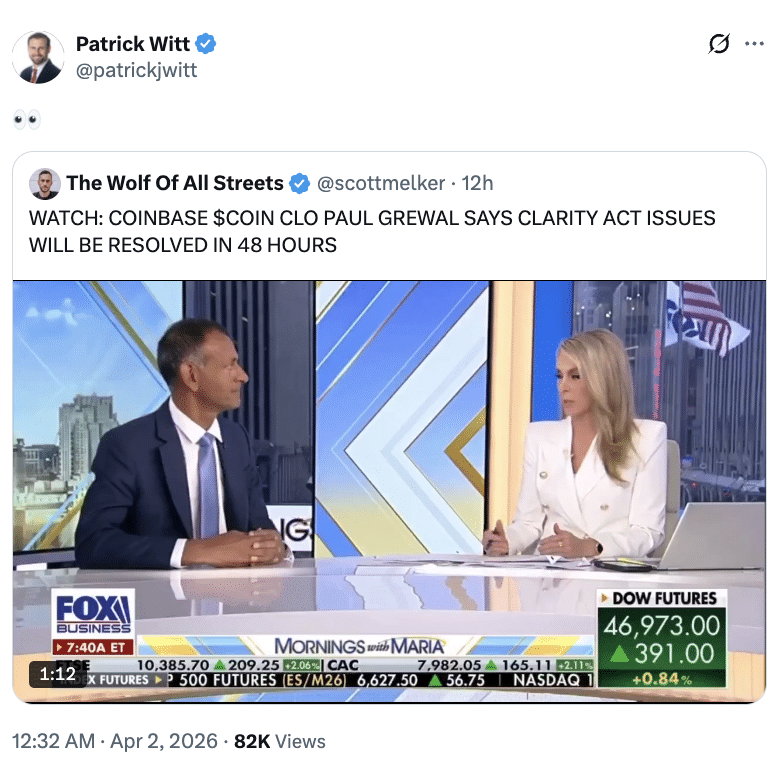
Source: Patrick Witt/X

Meanwhile, the Polymarket odds of the CLARITY Act being signed into law in 2026 confirmed the positive sentiment, as it stood at 65% at the time of reporting.
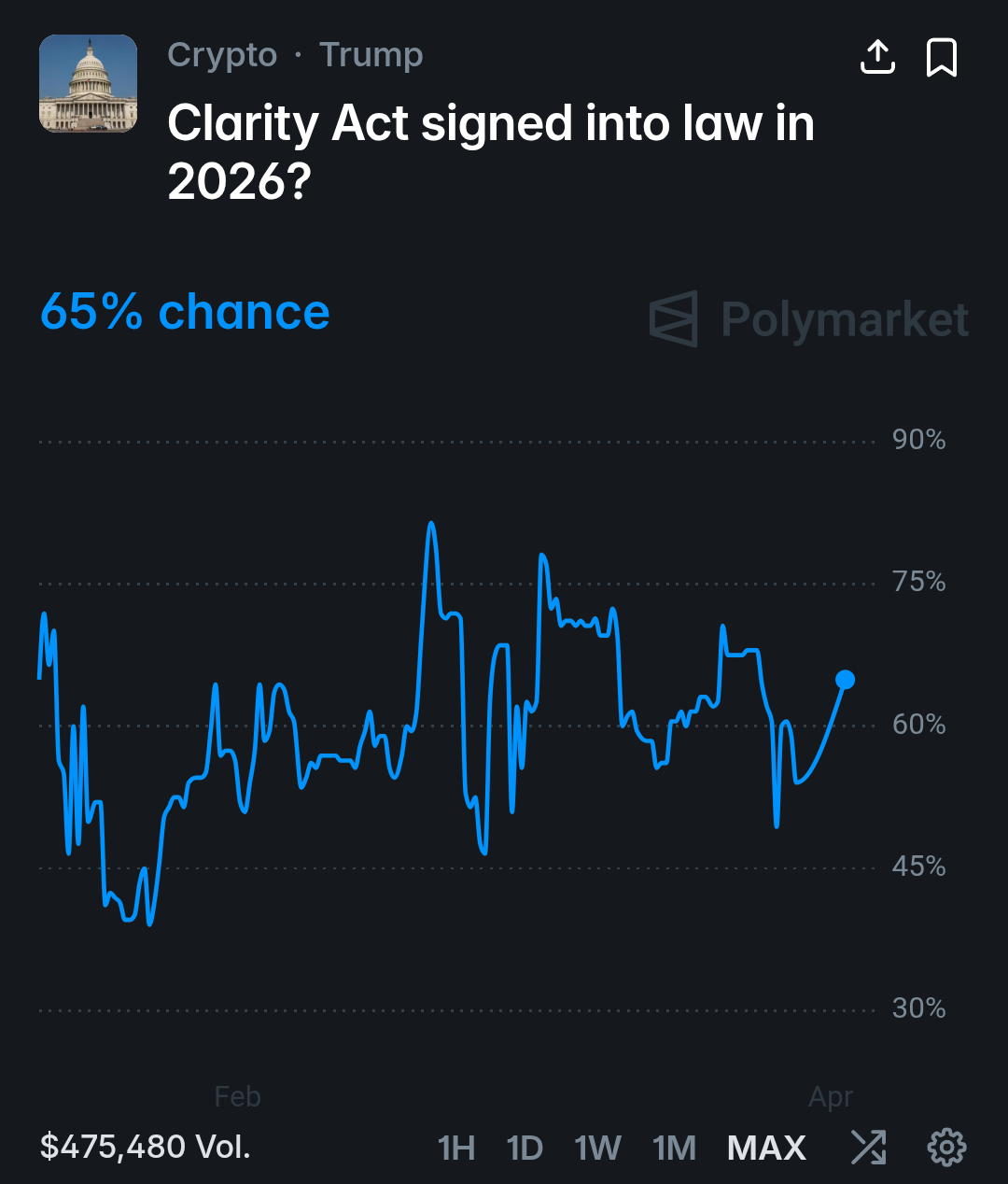
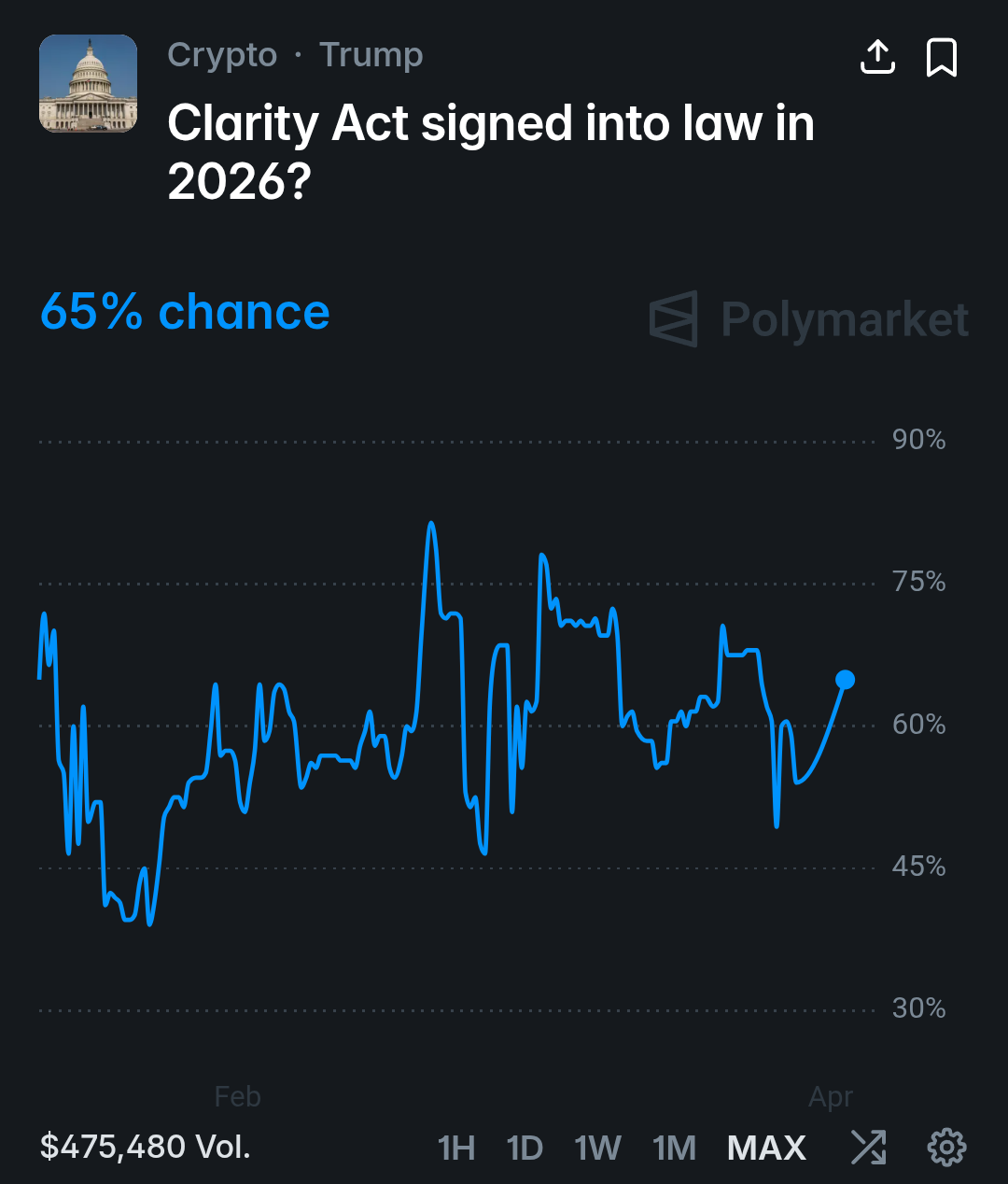
Source: Polymarket

Final Summary

  • Paul Grewal’s optimism about the CLARTY Act shocks Patrick Witt, considering Coinbase’s past holdout.
  • Polymarket odds rocketed to 65%, reflecting this increased optimism.

Related Questions

QWhat is Paul Grewal's position at Coinbase and what is his recent stance on the CLARITY Act?

APaul Grewal is the Chief Legal Officer (CLO) of Coinbase, and he has recently expressed optimism and confidence about the passage of the CLARITY Act.

QAccording to Grewal, when is the deal between crypto and banks likely to pass?

AGrewal revealed that the deal between crypto and banks is likely to pass within the next 48 hours.

QHow did Patrick Witt react to Paul Grewal's shift in stance on the CLARITY Act?

APatrick Witt, the executive director of the President’s Council on Digital Assets, expressed surprise at Paul Grewal's shift in stance, considering Coinbase's previous holdout.

QWhat were the Polymarket odds for the CLARITY Act being signed into law in 2026 at the time of reporting?

AThe Polymarket odds for the CLARITY Act being signed into law in 2026 stood at 65% at the time of reporting.

QWhat key difference did Grewal highlight between traditional banks and stablecoins?

AGrewal highlighted that traditional banks operate on fractional reserve lending, where they hold less and focus more on deposits and lend-outs, while implying stablecoins operate differently.

Related Reads

Wall Street Morning News: V-shaped Rebound at Month-end, but Nasdaq Suffers Worst July in 12 Years; Funds Accelerate Concentration Towards Cloud Giants

Despite a V-shaped rebound at the end of July, the Nasdaq posted its worst July since 2004, while the S&P 500 had its worst July since 2014. Markets were jolted by geopolitical shifts, as President Trump canceled a planned strike on Iran, leading WTI crude to plunge over 8%. This, alongside OPEC+ announcing a supply increase, reversed crude's sharp July gains. Treasury yields surged, with the 10-year yield rising over 30 basis points in July—its largest July increase since 2005. In a rare move, the US and Japan jointly intervened to weaken the USD/JPY, aiming to prevent potential Japanese sales of US Treasuries. While the tech sector faced deleveraging pressure throughout July, cloud giants staged a massive rally on strong earnings. Microsoft, Amazon, and Google collectively added nearly $1.5 trillion in market value last week. Amazon soared over 15% on accelerating AWS growth, Microsoft extended historic gains, Google fully recovered post-earnings losses, and Meta ended an 11-day losing streak. In contrast, Apple tumbled over 7% on supply chain and guidance concerns, ceding its "world's most valuable company" title to Nvidia. The memory and storage sector corrected sharply. Gold edged up 0.91% in July, with analysts viewing the ~30% pullback from January highs as a potential basing period, supported by long-term central bank demand. Key events to watch this week include earnings from Palantir, AMD, SpaceX (its first post-IPO report), and memory giants like Western Digital. The US July non-farm payrolls report on Friday will be critical for gauging the Fed's policy path. SpaceX also faces a significant lock-up expiration, testing market liquidity.

marsbit50m ago

Wall Street Morning News: V-shaped Rebound at Month-end, but Nasdaq Suffers Worst July in 12 Years; Funds Accelerate Concentration Towards Cloud Giants

marsbit50m ago

Rubin Ultra Makes Major Cuts, Even Nvidia Can't Handle Memory Price Hikes?

NVIDIA's Rubin Ultra, the top-tier variant of the newly announced Rubin AI accelerators, has reportedly seen significant specification downgrades, according to an industry report from SemiAnalysis. Initially designed with four compute dies (4-die), the Rubin Ultra is now said to be reduced to a 2-die design. Key changes highlighted in the report include: * **No increase in peak theoretical compute performance**, remaining at 35 PFLOPs like the standard Rubin. * **Severe reduction in memory capacity** to 192GB using 8-Hi HBM stacks, which is less than the standard Rubin's 288GB using 12-Hi stacks. * **Negligible memory bandwidth improvement** of only 1 TB/s. * **Slightly higher chip-level power consumption**. * The **primary upgrade is a massive increase in scale-up interconnect capacity**, supporting connections for up to 576 GPUs via NVLink, compared to 72 for the standard Rubin. The report suggests the redesign is primarily a cost-optimization move driven by the sharp rise in HBM (High-Bandwidth Memory) prices. By reducing the expensive HBM content and shifting investment towards enhanced system-scale networking, NVIDIA aims to maintain the platform's value for large-scale AI training clusters while managing soaring material costs. The news reportedly triggered a sell-off in South Korean memory stocks, with SK Hynix and Samsung shares falling around 8%, as markets grew concerned that NVIDIA—a major HBM buyer—might be reducing its reliance on high-capacity memory, potentially capping future pricing power for memory makers.

Odaily星球日报1h ago

Rubin Ultra Makes Major Cuts, Even Nvidia Can't Handle Memory Price Hikes?

Odaily星球日报1h ago

Trading

Spot
活动图片