Chainlink and Mastercard Join Swapper Finance To Bring Direct Deposits To 3.5B Users

bitcoinistPublished on 2025-12-10Last updated on 2025-12-10

Abstract

Swapper Finance has launched Direct Deposits in collaboration with Chainlink and Mastercard, aiming to bring global payments directly into the on-chain economy for over 3.5 billion users. This new feature, powered by Chainlink Runtime Environment (CRE) and Mastercard’s global network, allows users to deposit into DeFi protocols using payment cards, crypto transfers, or Web3 wallets through a single, secure, and compliant on-chain workflow. The solution eliminates traditional bottlenecks like multi-step onboarding, KYC, compliance, and settlement by unifying these processes into one verifiable orchestration layer. Chainlink and Mastercard’s involvement highlights the integration of traditional payment infrastructure with blockchain, simplifying user onboarding and expanding access to DeFi. Several leading Web3 platforms have already integrated the technology, signaling strong demand for a unified card-to-onchain standard. Swapper’s CTO described it as a "turning point" for Web3 adoption, making the process intuitive and accessible for billions.

Swapper Finance has launched Direct Deposits in collaboration with Chainlink and Mastercard, aiming to bring global payments directly into the on-chain economy to more than 3.5 billion users worldwide.

Swapper Finance Launches Direct Deposits With Chainlink, Mastercard

On Tuesday, Swapper Finance, a next-generation payments infrastructure layer that connects global users to on-chain applications, announced the launch of Direct Deposits in collaboration with Chainlink, Mastercard, and multiple key partners.

Direct Deposits, which are live now, are set to bring “the global payments world directly into the on-chain economy through a unified, secure, and compliant flow,” powered by Chainlink Runtime Environment (CRE) and Mastercard’s recognized global network.

According to the announcement, users will be able to deposit into Decentralized Finance (DeFi) protocols using payment cards, crypto transfers, or Web3 wallets inside a single, end-to-end on-chain workflow for the first time.

Swapper’s Direct Deposits aim to unlock instant access to DeFi for billions of people worldwide by eliminating traditional bottlenecks, exchanges, and multi-step onboarding. This has historically required stitching together isolated systems, including Know Your Client (KYC) requirements, compliance, card payments, fiat conversion, settlement, and liquidity routing, which has created friction, high drop-off rates, and inconsistent security across the process.

Direct Deposits are set to replace this old-fashioned flow through one “unified, verifiable, on-chain orchestration layer,” with every component of the process executed inside a secure on-chain environment.

Roman Tirone, Senior Manager, Chainlink Build at Chainlink Labs, affirmed that “by unifying identity, compliance, token swaps, settlement, and more in a single orchestration layer, CRE is enabling the onboarding of billions of cardholders into the onchain economy.”

This creates a simple and familiar checkout experience that quickly moves a user from traditional finance to on-chain, supported by institutional-grade security and global reach. Meanwhile, the launch represents another step in Mastercard’s efforts to integrate traditional payment infrastructure with blockchain-based applications, helping it expand its digital asset strategy.

‘The Onboarding Layer For Web3’

Swapper’s launch will see multiple leading Web3 platforms integrate the Direct Deposits technology directly into their user flows, including Pi Squared, Stake.link, KyberSwap, AITECH, NPC, Teneo, BigWater, Rhuna, TrebleSwap, MyStandard, Landwolf, Dolomite, HyperSwap, Turbo, APU, and Radiant Capital, among others.

This signals strong demand for a unified card-to-on-chain standard, the announcement added, which suggests that Direct Deposits “are quickly becoming a foundational component for user acquisition across Web3.”

The launch also represents “deep technical collaboration across Mastercard, Chainlink, Swapper Finance, and key partners” to bring together payment authorization, compliance, execution, and liquidity routing in a single verifiable workflow powered by CRE and Swapper Finance.

Arthur, CTO of Swapper Finance, affirmed that “this is the onboarding layer we always believed the industry needed,” adding that Direct Deposits represent a “turning point” for how people enter the space as “the first truly unified onboarding layer for Web3.”

“Our goal has always been to remove the barriers that keep billions of people from accessing DeFi, and with this launch, that future becomes real,” Arthur stated, concluding that “Direct Deposits represent a turning point for how people enter Web3. For the first time, the process feels intuitive rather than intimidating. We expect this launch to dramatically expand the number of users who can participate in onchain markets.”
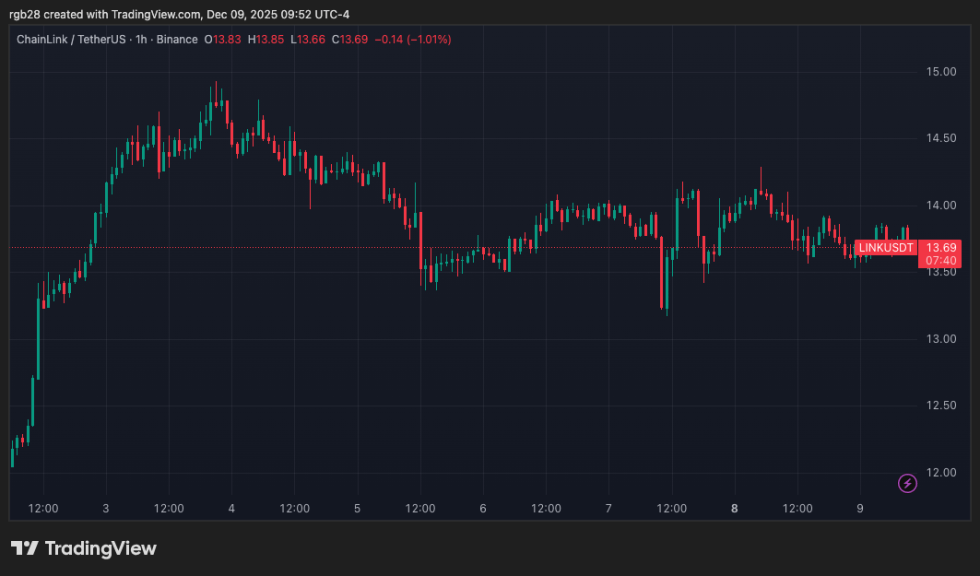
LINK trades at $13.69 in the one-week chart. Source: LINKUSDT on TradingView


Related Reads

Can a Hair Dryer Earn $34,000? Deciphering the Reflexivity Paradox in Prediction Markets

An individual manipulated a weather sensor at Paris Charles de Gaulle Airport with a portable heat source, causing a Polymarket weather market to settle at 22°C and earning $34,000. This incident highlights a fundamental issue in prediction markets: when a market aims to reflect reality, it also incentivizes participants to influence that reality. Prediction markets operate on two layers: platform rules (what outcome counts as a win) and data sources (what actually happened). While most focus on rules, the real vulnerability lies in the data source. If reality is recorded through a specific source, influencing that source directly affects market settlement. The article categorizes markets by their vulnerability: 1. **Single-point physical data sources** (e.g., weather stations): Easily manipulated through physical interference. 2. **Insider information markets** (e.g., MrBeast video details): Insiders like team members use non-public information to trade. Kalshi fined a剪辑师 $20,000 for insider trading. 3. **Actor-manipulated markets** (e.g., Andrew Tate’s tweet counts): The subject of the market can control the outcome. Evidence suggests Tate’sociated accounts coordinated to profit. 4. **Individual-action markets** (e.g., WNBA disruptions): A single person can execute an event to profit from their pre-placed bets. Kalshi and Polymarket handle these issues differently. Kalshi enforces strict KYC, publicly penalizes insider trading, and reports to regulators. Polymarket, with its anonymous wallet-based system, has historically been more permissive, arguing that insider information improves market accuracy. However, it cooperated with authorities in the "Van Dyke case," where a user traded on classified government information. The core paradox is reflexivity: prediction markets are designed to discover truth, but their financial incentives can distort reality. The more valuable a prediction becomes, the more likely participants are to influence the event itself. The market ceases to be a mirror of reality and instead shapes it.

marsbit36m ago

Can a Hair Dryer Earn $34,000? Deciphering the Reflexivity Paradox in Prediction Markets

marsbit36m ago

First Day Review of "Musk's WeChat" XChat: Even Worse Than Expected

Elon Musk's much-anticipated "WeChat-like" app, XChat, has officially launched after multiple delays. The initial review reveals a product that falls short of expectations, offering an experience largely similar to X Platform's (formerly Twitter) direct messages, despite being marketed as an encrypted communication tool. Key observations from the first-day test include: 1. The app's promoted "end-to-end encryption" and its claimed relation to Bitcoin's architecture were criticized by experts as a superficial attempt to capitalize on crypto buzz, with no real technical connection. 2. Musk's vision of an ad-free "secure communication system" is technically met, but only because the app is currently extremely basic, featuring only a single chat interface. 3. A promised anti-screenshot feature appears inconsistent; it works in X Platform group chats but fails within the XChat app itself, where screenshots still capture avatars. 4. The app supports 45 languages and has a 16+ age rating, indicating a broader tolerance for content compared to WeChat's 13+ rating. 5. A puzzling login process requires users to verify the email associated with their X account. 6. The touted encryption" feels minimal in practice, with its presence only indicated by a simple "Encrypted - Yes" label on messages. 7. Disappearing message timers for groups can be set from 5 minutes to 4 weeks, with the timer starting upon being read by a user. 8. Group invite links are shared with X Platform groups. 9. Group size limits are planned to be increased, aiming for 1000 members, a move that has drawn user criticism. 10. The app offers 8 different colored icons, and its chat bubbles are notably similar to WeChat's. Message deletion options mimic Telegram's. Crucially, many pre-announced features like importing X contacts, integrating Grok AI, X Money payments, and Cashtags are not yet available. The initial release is seen as a bare-bones and underwhelming first step.

Odaily星球日报1h ago

First Day Review of "Musk's WeChat" XChat: Even Worse Than Expected

Odaily星球日报1h ago

Trading

Spot
Futures

Hot Articles

How to Buy LINK

Welcome to HTX.com! We've made purchasing ChainLink (LINK) simple and convenient. Follow our step-by-step guide to embark on your crypto journey.Step 1: Create Your HTX AccountUse your email or phone number to sign up for a free account on HTX. Experience a hassle-free registration journey and unlock all features.Get My AccountStep 2: Go to Buy Crypto and Choose Your Payment MethodCredit/Debit Card: Use your Visa or Mastercard to buy ChainLink (LINK) instantly.Balance: Use funds from your HTX account balance to trade seamlessly.Third Parties: We've added popular payment methods such as Google Pay and Apple Pay to enhance convenience.P2P: Trade directly with other users on HTX.Over-the-Counter (OTC): We offer tailor-made services and competitive exchange rates for traders.Step 3: Store Your ChainLink (LINK)After purchasing your ChainLink (LINK), store it in your HTX account. Alternatively, you can send it elsewhere via blockchain transfer or use it to trade other cryptocurrencies.Step 4: Trade ChainLink (LINK)Easily trade ChainLink (LINK) on HTX's spot market. Simply access your account, select your trading pair, execute your trades, and monitor in real-time. We offer a user-friendly experience for both beginners and seasoned traders.

8.1k Total ViewsPublished 2024.03.29Updated 2025.06.26

How to Buy LINK

Discussions

Welcome to the HTX Community. Here, you can stay informed about the latest platform developments and gain access to professional market insights. Users' opinions on the price of LINK (LINK) are presented below.

活动图片