Cardano Network Sees Sharp Growth As User Activity Reaches New Heights

bitcoinistPublished on 2026-04-09Last updated on 2026-04-09

Abstract

Despite facing prolonged bearish price pressure, the Cardano network has experienced a significant surge in user activity and engagement, reaching a historic milestone of over 120 million transactions on its mainnet. This growth reflects heightened adoption and strengthens Cardano's position in the blockchain sector. Additionally, large investors, or "whales," are returning, with addresses holding at least 10 million ADA increasing by 5.2% over nine weeks, indicating renewed confidence in the network's long-term potential. While ADA’s price remains under pressure, the rise in both transactions and whale activity could signal a potential recovery and broader market performance ahead.

Cardano’s (ADA) prolonged downside price action has failed to influence or slow down the engagement and demand for the leading blockchain network. During fading price strength, the network has been building up its pace with user activity witnessing one of its biggest growth in history.

Network Usage On Cardano Makes History

With a growing, volatile cryptocurrency landscape, the price of Cardano has steadily faced bearish pressure and persistent pullback. However, this has not been the case for the Cardano network, as momentum has been observed growing across the blockchain and its ecosystem.

After a steady growth, the network is experiencing notable interest, reaching yet another major milestone in its activity. As more players connect through transactions, decentralized apps, and on-chain services, the most recent milestone is indicative of consistent growth in the network’s user base.

In this waning period, transactions conducted on the network are spiking hard. Data from Cexplorer, the biggest and most featured OG blockchain explorer, shows that Cardano has just crossed 120,000,000 on the mainnet, cementing its position as a top contender in the crypto and blockchain sector.
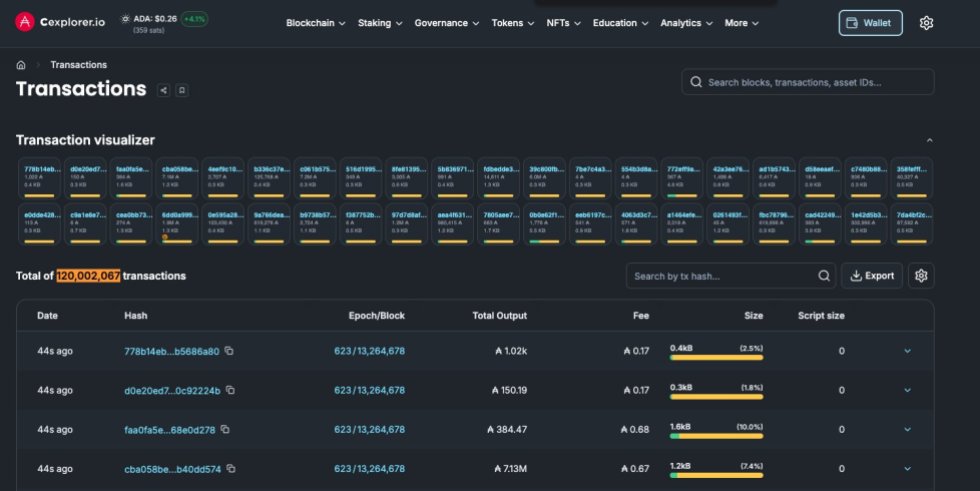
Source: Chart from Cexplorer on X

Currently, transaction counts on the network stand at 120,002,067, as seen in the chart shared by the platform. Such a huge amount of transactions demonstrates heightened adoption and strengthens Cardano’s standing in the larger blockchain environment. Should the user engagement continue expanding, it could spur a broader market performance, allowing ADA’s price to bounce back to key resistance levels.

Large ADA Investors Are Stepping Back In At A Fast Rate

Prior to the report regarding transaction growth, there was news about wallet addresses on the network spiking significantly to levels not seen in several months. These are not just mere ADA holders but wallet addresses holding a substantial amount of ADA, who are considered large investors or whales.

In the report shared on X by Santiment, a leading on-chain data analytics platform, it was highlighted that the number of wallet addresses holding at least 10 million ADA has skyrocketed. The rise in large-holder addresses indicates that wealthy investors are gradually increasing their holdings, which may indicate a resurgence of faith in the network’s long-term prospects.

Currently, these investors are not positioned at a 4-high 424, which represents a +5.2% rise in 9 weeks. Despite its downside trend, Cardano has not yet decoupled from other leading altcoins in 2026. ADA’s market value experienced a +11% since it reached its bottom back on February 5th, 2026.

Large investors are often seen as the main drivers for massive price movements, which implies that their activity could shape the impending move for ADA in the short and long term. In a bullish outlook, the growth might mark the start of a stronger phase for the altcoin.

ADA trading at $0.25 on the 1D chart | Source: ADAUSDT on Tradingview.com

Related Questions

QWhat major milestone did the Cardano network recently achieve in terms of transaction count?

AThe Cardano network recently crossed 120,000,000 transactions on its mainnet.

QAccording to the article, what is the significance of the increase in wallet addresses holding at least 10 million ADA?

AThe increase indicates that large investors, or 'whales', are gradually increasing their holdings, which may signal a resurgence of faith in the network's long-term prospects.

QWhat is the current price of ADA as shown in the chart from Tradingview.com?

AADA is trading at $0.25.

QWhich on-chain data analytics platform reported the growth in large ADA wallet addresses?

ASantiment, a leading on-chain data analytics platform, reported the growth on X.

QDespite ADA's bearish price trend, what has been the trend in user activity on the Cardano network?

AUser activity on the Cardano network has been growing significantly, reaching new heights and major milestones, with transactions spiking hard.

Related Reads

How Risky is the "Death Spiral" of MSTR and STRC?

Summary: This article explores the perceived "death spiral" risk between MicroStrategy (MSTR), its Bitcoin holdings, and its perpetual preferred stock (STRC), drawing comparisons to the LUNA-UST collapse. While both systems feature price anchors, high yields for holders, and potential feedback loops, their core mechanisms differ fundamentally. The MSTR-STRC structure relies on continuous financing to sustain its high dividend payouts, primarily through stock ATM offerings. A negative feedback cycle could occur: falling MSTR stock price makes raising equity capital harder, increasing pressure to sell Bitcoin, which undermines STRC confidence and further depresses MSTR. However, unlike LUNA-UST's automated, direct linkage, the MSTR-STRC loop is weaker and has brakes: STRC dividends can be deferred or rates lowered, and STRC holders have a $100/share liquidation preference in bankruptcy, providing a price floor. The company's sustainability hinges on its ability to continue financing. Its current ~$900 million USD reserves cover only about 6.3 months of its ~$1.71 billion annual interest/dividend burden. The next six months are critical, aligning with both the potential bottom in Bitcoin's four-year cycle and the depletion timeline of its reserves. While a LUNA-style catastrophic collapse is deemed highly unlikely due to structural differences, the key question is whether MicroStrategy can navigate this period through healthy deleveraging to restart its capital engine.

Foresight News20m ago

How Risky is the "Death Spiral" of MSTR and STRC?

Foresight News20m ago

How Much Debt Does Strategy Really Have? Is There a Risk of Implosion?

MicroStrategy's Debt Risk: A Turning Point in the "Never Sell" Strategy As of June 3, 2026, MicroStrategy holds 843,706 bitcoins (valued at ~$53.1B) but faces significant financial obligations. Its capital structure includes $6.75B in convertible notes and $15.48B in perpetual preferred stock (led by the $8.5B STRC series), creating an annual payout burden of ~$1.71B. With software revenue at only ~$500M, interest and dividend obligations far exceed operating income. A critical shift occurred in late May 2026 when the company sold 32 bitcoins for ~$2.5M to cover dividends, breaking CEO Michael Saylor's long-standing "never sell" pledge. This symbolic move triggered a sharp decline in both Bitcoin's price and MSTR stock, reflecting market fears about cash flow sustainability. The core of the strain is the STRC perpetual preferred stock, designed as a "permanent loan" with no maturity date but requiring high monthly dividends (currently 11.5%). Its business model relies on a three-part cycle: issuing new STRC shares, using proceeds to buy more Bitcoin and fund a USD reserve, and using that reserve to pay dividends. This cycle depends on continuous investor demand for STRC and Bitcoin's price appreciation. Analysis shows Bitcoin needs to appreciate at least 2.3% annually to cover the $1.71B in yearly obligations at current holdings. With Bitcoin price down ~22% from March 2026 highs, this pressure has intensified. The company's $900M USD reserve can only cover about 7 months of payments if STRC issuance stalls. Key risks are not immediate bankruptcy or forced Bitcoin liquidation (as BTC is not collateral), but rather: 1) The erosion of MSTR's premium to its Bitcoin holdings (mNAV), which would cripple its ability to raise cheap capital; 2) A vicious cycle where stagnant Bitcoin prices reduce STRC demand, draining the USD reserve and forcing BTC sales, further depressing prices. The period from February 2027 to September 2028 is a crucial test, with over $5.9B in convertible notes facing put options or maturity. In essence, MicroStrategy has evolved from a simple Bitcoin holder into a complex financial entity acting like a "private Bitcoin bank," leveraging its BTC holdings to create layered financial products. Its survival depends on maintaining Bitcoin's price trend, its stock premium, and market appetite for its preferred shares. The recent token sale marks not a betrayal of its Bitcoin thesis, but an admission that the leveraged strategy must eventually be paid for.

marsbit30m ago

How Much Debt Does Strategy Really Have? Is There a Risk of Implosion?

marsbit30m ago

Anthropic Cries Wolf: Is the AGI Threat Real, or Just an IPO Story?

Anthropic has published an article titled "When AI builds itself," discussing the emerging concept of "recursive self-improvement," where AI begins to actively participate in designing, training, testing, and optimizing its own subsequent versions. The company presents internal data showing that by May 2026, over 80% of code merged into its codebase was written by Claude, its AI model. Claude's capabilities have expanded to handling complex, open-ended engineering tasks, achieving a 76% success rate in such areas, and even contributing to research processes, such as optimizing code performance and conducting AI safety experiments. Anthropic outlines an evolution from human-driven development to AI-assisted workflows, culminating in the current stage where AI agents can autonomously write, run, and delegate code. The company cautions that the path toward a "closed loop," where AI continuously improves itself, is becoming visible. It calls for coordinated global mechanisms to potentially slow or pause frontier AI development to allow safety research and societal structures to catch up. However, the timing of this warning coincides with Anthropic's preparations for an IPO, framing the narrative not just as a safety concern but also as a demonstration of Claude's advanced capabilities and its integral role in accelerating Anthropic's own R&D—creating a potential "flywheel" effect for competitive advantage. This contrasts with OpenAI's recent, more policy-oriented discussion of the same risks, highlighting the competitive dynamics in the AI industry as companies position themselves in both the technological and regulatory landscape.

marsbit1h ago

Anthropic Cries Wolf: Is the AGI Threat Real, or Just an IPO Story?

marsbit1h ago

Trading

Spot
Futures

Hot Articles

Discussions

Welcome to the HTX Community. Here, you can stay informed about the latest platform developments and gain access to professional market insights. Users' opinions on the price of ADA (ADA) are presented below.

活动图片