Cardano Brings Pyth Oracles On-Chain In First Pentad Integration

bitcoinistPublished on 2025-12-12Last updated on 2025-12-12

Abstract

Cardano has announced its first major integration under the new "Pentad" governance structure, bringing Pyth's Lazer oracle to the blockchain by early 2026. This marks a strategic shift from building in-house oracle solutions to adopting established external infrastructure. Pyth provides ultra-low latency, institutional-grade market data across thousands of price feeds, which is used by hundreds of DeFi applications globally. Charles Hoskinson emphasized that this integration connects Cardano to broader cryptocurrency information networks and is just the first of many planned critical integrations—including bridges, stablecoins, and analytics—aimed at making Cardano a more viable DeFi platform. The move signals a focus on execution and infrastructure readiness as Cardano positions itself for growth in 2026.

Cardano is finally doing the unsexy but absolutely necessary plumbing work: getting serious, external oracle infrastructure wired in, with a governance wrapper that looks a lot more like “adult supervision” than the old ad-hoc ecosystem scramble.

On a Dec. 11 livestream, Charles Hoskinson said the ecosystem’s new “Pentad” structure — the coordination bloc spanning Input Output, the Cardano Foundation, EMURGO, the Midnight Foundation, and Intersect — has approved its first major integration under the “critical integrations” framework: bringing Pyth’s Lazer oracle to Cardano, with deployment targeted for early 2026.

Pyth Deal Kicks Off Cardano’s Critical Integrations Push

“This is the appetizer announcement,” Hoskinson said, framing Pyth as the first of what he expects to be a broader menu: bridges, stablecoins, analytics, custodians — the stuff that turns a chain into a DeFi venue people actually build on, not just a community that argues about roadmaps.

Hoskinson didn’t really sugarcoat why this matters. “Oracles are really the first part of major integrations,” he said, because you need reliable data coming in and you need credible pathways to the rest of the industry. He also admitted the in-house approach hasn’t landed the way it should’ve: Cardano “tried to build an indigenous oracle solution and it hasn’t worked out as well as it should.” So [...] Pyth. That’s the pivot.

Pyth, in its own marketing, has been pushing Lazer as an ultra-low latency product designed for speed-sensitive trading use cases — basically, price updates fast enough that perps and other twitchy DeFi apps don’t feel like they’re operating on last cycle’s data. Hoskinson called Pyth “one of the most advanced Oracle solutions on market,” and emphasized the practical angle: lots of feeds, lots of publishers, and broad distribution across chains.

Intersect’s announcement (the one Hoskinson pulled up mid-stream) from X states: “One of the first concrete outcomes of the Critical Cardano Integrations workstream is now in place! The Steering Committee [...] has approved the first major integration under this framework: bringing Pyth Lazer oracle to Cardano. Pyth provides low-latency, institutional-grade market data across thousands of price feeds spanning crypto, equities, FX, commodities and ETFs, already used by hundreds of DeFi applications across 100+ blockchains to power trading, lending and risk management.”

Hoskinson argued, “[Pyth] effectively attaches Cardano now to the information networks of the entire cryptocurrency space.” He said the team is already exploring whether it can switch parts of the ecosystem — including Djed — over to Pyth, and he wants Cardano dapp teams to seriously evaluate the integration once it’s available.

“Pyth is just the appetizer in the Cardano critical integrations,” he said. “There are many more things to come.”

The broader context is that Cardano’s new “Pentad” has been positioning “critical integrations” as a coordinated, treasury-backed effort to “prime Cardano for 2026,” including a budget proposal tied to ecosystem-wide enablers. If Pyth is the first concrete output, it’s also a signal the Pentad model is going to be judged on execution, not vibes.

Hoskinson, closing out, put it in his usual rally language: “Cardano is not an island anymore [...] the cavalry has come.” The market can do what it wants in the short term. But getting credible oracle rails in place is the kind of boring upgrade that tends to matter later — when teams are deciding where to deploy, and where liquidity is willing to live.

At press time, ADA traded at $0.4253.
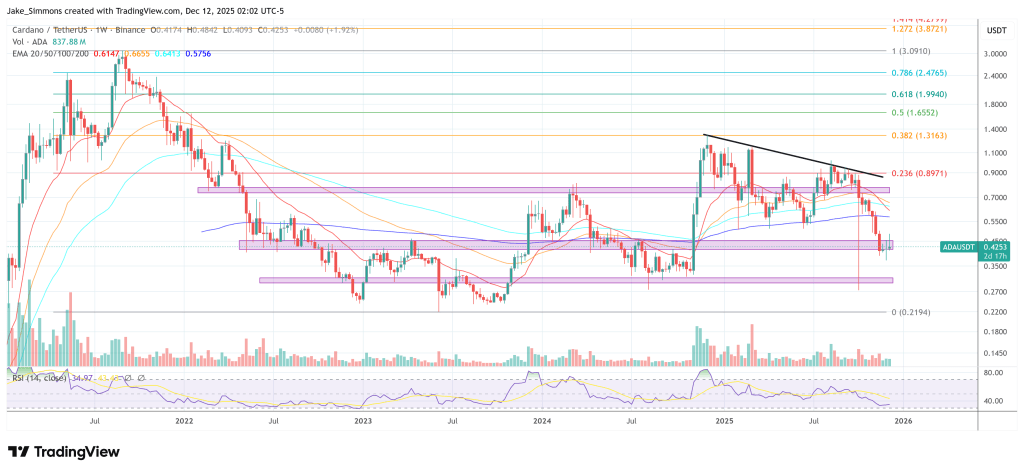
ADA bounces from key support, 1-week chart | Source: ADAUSDT on TradingView.com

Trending Cryptos

Related Reads

Saeed Al-Marri: How Tokenization Unlocks New Opportunities for Shipping Funds

Said Al-Marri: How Tokenization Opens New Opportunities for Shipping Funds For centuries, commercial shipping has been a capital-intensive asset class limited to institutional funds and shipping dynasties. Said bin Saleh Al-Marri, CEO of Ethra Invest and Ethra Ship, aims to break down these barriers by combining Real World Asset (RWA) tokenization with conservative private equity principles. This bridges decentralized finance (DeFi) with the physical realities of global trade. Tokenization allows fractional ownership of ships on a blockchain, giving smaller investors access to previously inaccessible markets. However, Al-Marri warns it is not a regulatory loophole or a cure for asset illiquidity. The core physical risks are isolated in Special Purpose Vehicles (SPVs) for qualified investors. While tokenization enhances transparency and ownership record-keeping, Al-Marri stresses that a liquid secondary market depends on transparent asset valuation and must not interfere with ship operations managed by professionals. Regarding legal enforcement, smart contracts cannot physically seize a ship. Legal recourse still relies on traditional maritime courts, ship mortgages, and flag state laws, with blockchain records needing to mirror legal ownership in the SPV perfectly. Beyond ownership, the industry faces administrative hurdles like paper-based bills of lading. Al-Marri argues the bottleneck is legal and operational standardization, not technology. He advocates for a hybrid model combining digital trade documents and programmable settlements with support from regulated financial institutions, rather than a full crypto replacement for tools like Letters of Credit. A major challenge is decarbonizing the global fleet by 2050. Transitioning to green fuels requires massive upfront investment. Al-Marri emphasizes a conservative, holistic approach to underwriting these projects, evaluating technology, fuel availability, safety, and resale value. Investments must be justified under conservative forecasts, not just optimistic ones. By combining pragmatic risk management with digital infrastructure, leaders like Al-Marri show that the evolution of maritime finance is about mobilizing capital to build a modernized and sustainable global fleet, not just putting ships on a blockchain.

cryptonews.ru15m ago

Saeed Al-Marri: How Tokenization Unlocks New Opportunities for Shipping Funds

cryptonews.ru15m ago

Six Years Later, UNI Finally Welcomes Its Own "Buyback Bull"

After years of debate, Uniswap's UNI token has finally entered a 'buyback bull' phase following the long-awaited activation of its fee-switch mechanism. The UNIfication proposal, executed in December 2025, redirected a portion of protocol fees from select pools and Unichain sequencer revenue into a treasury (TokenJar) dedicated to buying back and permanently burning UNI. Initial market reaction was muted due to modest early burn rates. A significant shift occurred in July 2026 with the launch of Robinhood Chain. Uniswap's immediate deployment there skyrocketed trading volume, making it a top fee-generator. Subsequently, governance votes extended the fee mechanism to v4 pools and Robinhood Chain, causing protocol revenue to nearly triple. Daily funds directed to UNI burns rose sharply, with Robinhood Chain contributing over half. This transitioned UNI's narrative from a governance token to a cash-flow asset backed by a perpetual automatic buyer. UNI's price, which had languished around $2.30 in early June, nearly doubled to approach $4.60 by late July. Analysts credit this to the tangible cash flow from fees rather than mere speculation. Unlike many newer projects where buybacks are offset by large investor unlocks, UNI's six-year history has resulted in a widely distributed and relatively clean supply, allowing the buyback pressure to effectively impact the secondary market. The key test will be whether trading activity, particularly on Robinhood Chain, sustains after its initial gas subsidies expire.

marsbit20m ago

Six Years Later, UNI Finally Welcomes Its Own "Buyback Bull"

marsbit20m ago

Only 153 Venture Capital Firms Invested in July: Is the Crypto VC Industry Experiencing a 'Mass Extinction'?

In July 2026, only 153 unique venture capital firms participated in disclosed crypto funding rounds, marking the lowest monthly count since November 2020. This figure represents an 87% decline from the peak of 1,177 firms in 2022. Overall, the first seven months of 2026 saw crypto projects raise approximately $11.78 billion across 481 rounds. This crypto VC contraction contrasts sharply with the broader venture capital landscape, where global VC investment reached a record $560.4 billion in H1 2026, heavily fueled by major AI company financings. This shift in capital allocation has drawn funds away from the crypto sector. Within crypto, funding is highly concentrated. Trading platforms, prediction markets, and payment sectors absorbed 53% of the total capital. While early-stage deals remain frequent, the largest sums flow to a few late-stage rounds and mergers & acquisitions, which surged to $7.23 billion in Q2 2026. The market is consolidating around top funds like a16z crypto and Dragonfly, which successfully raised new multi-billion dollar funds, while many smaller firms have retreated. Analysts describe this as a "great extinction" for crypto VCs, where capital is becoming more selective, favoring proven business models and assets over early-stage speculation. This raises the bar for project quality, funding efficiency, and viable exit paths.

marsbit40m ago

Only 153 Venture Capital Firms Invested in July: Is the Crypto VC Industry Experiencing a 'Mass Extinction'?

marsbit40m ago

Trading

Spot

Hot Articles

How to Buy PYTH

Welcome to HTX.com! We've made purchasing PYTH (Pyth) (PYTH) simple and convenient. Follow our step-by-step guide to embark on your crypto journey.Step 1: Create Your HTX AccountUse your email or phone number to sign up for a free account on HTX. Experience a hassle-free registration journey and unlock all features.Get My AccountStep 2: Go to Buy Crypto and Choose Your Payment MethodCredit/Debit Card: Use your Visa or Mastercard to buy PYTH (Pyth) (PYTH) instantly.Balance: Use funds from your HTX account balance to trade seamlessly.Third Parties: We've added popular payment methods such as Google Pay and Apple Pay to enhance convenience.P2P: Trade directly with other users on HTX.Over-the-Counter (OTC): We offer tailor-made services and competitive exchange rates for traders.Step 3: Store Your PYTH (Pyth) (PYTH)After purchasing your PYTH (Pyth) (PYTH), store it in your HTX account. Alternatively, you can send it elsewhere via blockchain transfer or use it to trade other cryptocurrencies.Step 4: Trade PYTH (Pyth) (PYTH)Easily trade PYTH (Pyth) (PYTH) on HTX's spot market. Simply access your account, select your trading pair, execute your trades, and monitor in real-time. We offer a user-friendly experience for both beginners and seasoned traders.

4.1k Total ViewsPublished 2024.03.29Updated 2026.06.02

How to Buy PYTH

Discussions

Welcome to the HTX Community. Here, you can stay informed about the latest platform developments and gain access to professional market insights. Users' opinions on the price of PYTH (PYTH) are presented below.

活动图片