BNB Could Reach $1,600: Ozak AI Price Prediction Outshines Every Major Altcoin

TheNewsCryptoPublished on 2025-12-10Last updated on 2025-12-10

Abstract

Analysts highlight Ozak AI (OZ) as a leading early-stage crypto contender, with its long-term growth potential surpassing even major altcoins like BNB. While BNB shows a strong bullish structure and could reach $1,600 in the next cycle, Ozak AI’s AI-driven architecture—featuring millisecond predictive models, real-time market signals, and autonomous on-chain agents—positions it for a steeper growth trajectory. Its presale has already raised over $4.8 million, drawing significant investor interest due to its real-time utility and cross-chain capabilities via the Perceptron Network. Despite BNB’s established role, Ozak AI is viewed as a more asymmetric opportunity due to its compounding utility independent of market cycles.

Ozak AI (OZ) is rapidly emerging as the strongest early-stage contender in the crypto market, with analysts increasingly noting that its long-term predictive trajectory outshines even the largest altcoins—including BNB.

While BNB builds a powerful bullish structure that could carry it toward $1,600 during the next major cycle, Ozak AI’s intelligence-driven architecture, millisecond predictive engine, and autonomous AI systems give it a far steeper expected growth curve. With the Ozak AI presale already exceeding $4.8 million, investor attention has shifted sharply toward its real-time utility, positioning it as one of the most aggressively forecasted projects of the decade.

Ozak AI Momentum Accelerates

Ozak AI continues dominating analyst discussions because it enters the market with working, real-time AI infrastructure instead of promises or future roadmaps. Millisecond-speed predictive models form the backbone of Ozak AI’s intelligence engine, designed to analyze market shifts instantly.
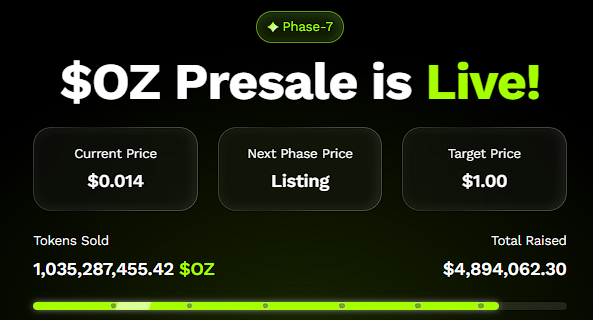
Ultra-fast 30 ms HIVE market signals enhance reaction accuracy, while SINT-powered autonomous agents can interpret blockchain conditions and execute strategies without delay. Integration with Perceptron Network’s 700K+ nodes expands Ozak AI’s visibility across multiple chains, creating a continuously evolving intelligence layer that gets more accurate as network data increases. This compounding utility is why analysts believe Ozak AI’s long-term price potential eclipses even top-tier altcoins.

BNB

BNB trades around $889 and continues to show one of the healthiest large-cap structures in the market. Support at $865 maintains its bullish momentum, with deeper zones at $842 and $819 reinforcing long-term accumulation strength.

Analysts expect BNB to accelerate once it challenges resistance at $905, which historically triggers stronger follow-through patterns. Higher breakout zones around $932 and $958 could act as stepping stones toward triple-digit growth as cycle liquidity deepens. These strong structural signals support forecasts that place BNB’s next peak near—or even above—the $1,600 region.
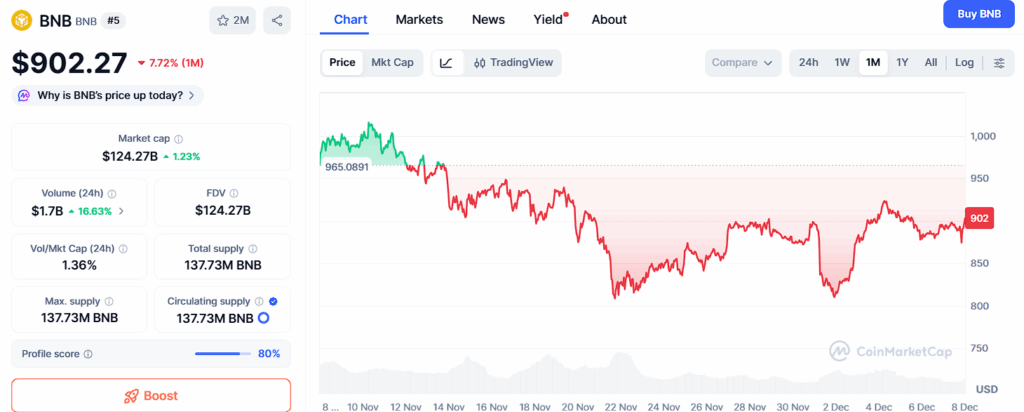
Yet even with BNB’s established dominance, analysts consistently point to Ozak AI as the more asymmetric long-term opportunity. BNB’s trajectory, while bullish, remains tied to the broader Binance ecosystem. Ozak AI’s intelligence-driven architecture gives it a growth path that compounds independently of hype or exchange trends.

Ozak AI’s Intelligence Layer Sets a New Standard

Ozak AI introduces a next-generation set of AI-driven capabilities that elevate it far above typical presales and emerging altcoins. Its system is built to function continuously and adaptively:

  • Real-time predictive modeling running at millisecond precision
  • 30 ms HIVE market signals feeding execution-grade insights
  • SINT-powered autonomous agents capable of instant on-chain strategy automation
  • Cross-chain visibility enabled by Perceptron’s vast decentralized node network
This multilayer intelligence ecosystem gives Ozak AI the ability to scale influence across trading platforms, AI-powered applications, DeFi automation, and predictive analytics—sectors projected to expand exponentially through 2026 and beyond.

Ozak AI Becomes the Top Long-Term Forecast

BNB holds a dominant position among large-cap altcoins, and its structure supports a strong move toward $1,600 during the next major expansion. However, analysts consistently highlight that Ozak AI operates on an entirely different growth curve. Its compounding intelligence systems allow value to expand even when market conditions stagnate, making it one of the rare assets capable of generating utility continuously rather than cyclically.

As investors seek high-upside, early-stage opportunities with real, evolving utility, Ozak AI stands as the project with the strongest long-term prediction in the current market—outshining even powerhouse altcoins like BNB in multi-year growth potential.

About Ozak AI

Ozak AI is a blockchain-based crypto project that provides a technology platform that specializes in predictive AI and advanced data analytics for financial markets. Through machine learning algorithms and decentralized network technologies, Ozak AI enables real-time, accurate, and actionable insights to help crypto enthusiasts and businesses make the correct decisions.

For more, visit:

  • Website: https://ozak.ai/
  • Telegram: https://t.me/OzakAGI
  • Twitter: https://x.com/ozakagi

Disclaimer: TheNewsCrypto does not endorse any content on this page. The content depicted in this Press Release does not represent any investment advice. TheNewsCrypto recommends our readers to make decisions based on their own research. TheNewsCrypto is not accountable for any damage or loss related to content, products, or services stated in this Press Release.


TagsBlockchainOzak AI

Trending Cryptos

Related Reads

Unitree's IPO Frenzy: The Real Mystery is How It Will Spend the 42 Billion Raised

Unitree, a Chinese robotics company, is set for a public listing after its IPO registration was approved by regulators. The company, which started with quadruped robots and has expanded into humanoids, plans to raise approximately 4.2 billion yuan through its offering. The article traces Unitree's rapid growth from its founding in 2016 to its current status. It highlights key milestones like the 2021 CCTV Spring Festival Gala performance, the 2023 launch of its affordable Go2 robot dog and the H1 humanoid robot, and a series of subsequent product launches. By 2025, the company reported revenue of 1.71 billion yuan, profitability, and sales exceeding 5,500 humanoid robots. As the first publicly-listed humanoid robot company on China's STAR Market, Unitree's main challenges are sustaining growth and deploying its newly raised capital effectively. The humanoid robot sector in China is crowded, with over 140 companies. Competitors include UBTech (focusing on industrial and consumer markets), Fourier, and international players like Tesla Optimus and 1X NEO. The article outlines three critical challenges for Unitree: establishing a strong second product line beyond its quadruped robots, maintaining its price advantage while ensuring quality, and successfully advancing its embodied AI capabilities through partnerships like the one with NVIDIA for the H2 Plus platform. Unitree's likely strategy involves a "developer tools + industry benchmarks" approach: using low-cost models like the R1 and G1 to build developer adoption and volume, leveraging high-end platforms for AI training, and securing pilot projects in sectors like logistics and manufacturing to build case studies. The company's future success hinges on converting its current momentum in shipments and pilot programs into sustainable, large-scale commercial contracts as the broader market evolves.

marsbit3m ago

Unitree's IPO Frenzy: The Real Mystery is How It Will Spend the 42 Billion Raised

marsbit3m ago

Examining the Open USD Partner Lineup: Follow Who's Joining to See Where the Money Flows

**Title: Deciphering the Open USD Partner Roster: Following the Money** The launch of Open USD is notable less for the stablecoin itself and more for its expansive list of over 140 founding partners, which reads like a "who's who" of global finance and tech. This coalition, including asset managers like BlackRock, card networks Visa and Mastercard, banks (BNY Mellon, Standard Chartered, etc.), tech giants (Google, IBM), merchants (Shopify), and crypto firms (Coinbase, Ripple, Aave, MetaMask), signals a strategic shift. The diverse membership reveals that stablecoins are increasingly viewed not as products to compete over, but as shared infrastructure too critical to be left to any single entity. Each partner category has distinct motives. Asset managers like BlackRock seek to manage the large, sticky cash reserves, a lucrative fee-generating opportunity. Merchants like Shopify aim for lower-cost settlement and potential yield on balances. Banks join defensively to retain custody and settlement roles, fearing deposit outflows to stablecoins. Tech companies bet on programmable money for future machine-to-machine commerce. Crypto firms gain mainstream legitimacy and distribution channels. Remarkably, the consortium includes direct competitors (Visa vs. Mastercard, Coinbase vs. Ripple), indicating that the fear of exclusion from this emerging financial layer outweighs competitive rivalries. However, this shared governance could also lead to slow decision-making. The roster's composition is the real message: it represents a collective bet that a widely accepted, consortium-owned stablecoin is preferable to proprietary versions or having none at all. For incumbents like Circle and Tether, this alliance poses a significant threat, as potential clients have collectively chosen to build their own alternative. The absence of major U.S. retail banks (busy with their own tokenized deposit networks) is equally telling. In essence, the partner list maps where the industry believes value and risk will flow in a tokenized dollar future, marking stablecoin's evolution from a product to a utility.

Foresight News26m ago

Examining the Open USD Partner Lineup: Follow Who's Joining to See Where the Money Flows

Foresight News26m ago

IOSG: Q-Day Countdown, Will Quantum Computing End Cryptocurrency?

IOSG: The Q-Day Countdown – Will Quantum Computing End Cryptocurrency? This analysis explores the looming threat quantum computing poses to blockchain technology. Quantum computers, leveraging Shor's algorithm, could theoretically break the elliptic curve cryptography (ECC) underpinning cryptocurrencies like Bitcoin and Ethereum. The article outlines a hypothetical "Q-Day" scenario where exposed public keys from dormant assets are compromised, leading to fund theft and a deep governance crisis. The core risk is not the complete erasure of blockchains but a systemic reset of public-key cryptography. Bitcoin faces significant challenges due to its "code-is-law" ethos and the immense social consensus required for migration. Its primary vulnerability lies in legacy UTXOs with publicly exposed keys. Ethereum's path involves a more complex, full-stack cryptographic agility upgrade across execution, consensus, and data layers. The industry has a limited "engineering comfort window" of 5-8 years to coordinate a migration to post-quantum cryptography (PQC), such as lattice-based or hash-based signatures. While the existential threat is often overstated, the real bottleneck is the immense coordination required across protocol developers, node operators, wallet providers, exchanges, and custodians. Market repricing of crypto assets may occur well before an actual Q-Day if quantum hardware roadmaps accelerate or regulatory pressure mounts. The article concludes that quantum computing is not a doomsday weapon but a severe stress test for blockchain's foundational security model and governance structures.

marsbit55m ago

IOSG: Q-Day Countdown, Will Quantum Computing End Cryptocurrency?

marsbit55m ago

Trading

Spot

Hot Articles

Discussions

Welcome to the HTX Community. Here, you can stay informed about the latest platform developments and gain access to professional market insights. Users' opinions on the price of AI (AI) are presented below.

活动图片