BNB Could Reach $1,600: Ozak AI Price Prediction Outshines Every Major Altcoin

TheNewsCryptoPublished on 2025-12-10Last updated on 2025-12-10

Abstract

Analysts highlight Ozak AI (OZ) as a leading early-stage crypto contender, with its long-term growth potential surpassing even major altcoins like BNB. While BNB shows a strong bullish structure and could reach $1,600 in the next cycle, Ozak AI’s AI-driven architecture—featuring millisecond predictive models, real-time market signals, and autonomous on-chain agents—positions it for a steeper growth trajectory. Its presale has already raised over $4.8 million, drawing significant investor interest due to its real-time utility and cross-chain capabilities via the Perceptron Network. Despite BNB’s established role, Ozak AI is viewed as a more asymmetric opportunity due to its compounding utility independent of market cycles.

Ozak AI (OZ) is rapidly emerging as the strongest early-stage contender in the crypto market, with analysts increasingly noting that its long-term predictive trajectory outshines even the largest altcoins—including BNB.

While BNB builds a powerful bullish structure that could carry it toward $1,600 during the next major cycle, Ozak AI’s intelligence-driven architecture, millisecond predictive engine, and autonomous AI systems give it a far steeper expected growth curve. With the Ozak AI presale already exceeding $4.8 million, investor attention has shifted sharply toward its real-time utility, positioning it as one of the most aggressively forecasted projects of the decade.

Ozak AI Momentum Accelerates

Ozak AI continues dominating analyst discussions because it enters the market with working, real-time AI infrastructure instead of promises or future roadmaps. Millisecond-speed predictive models form the backbone of Ozak AI’s intelligence engine, designed to analyze market shifts instantly.
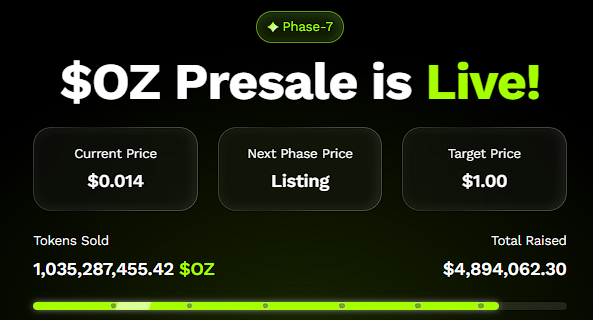
Ultra-fast 30 ms HIVE market signals enhance reaction accuracy, while SINT-powered autonomous agents can interpret blockchain conditions and execute strategies without delay. Integration with Perceptron Network’s 700K+ nodes expands Ozak AI’s visibility across multiple chains, creating a continuously evolving intelligence layer that gets more accurate as network data increases. This compounding utility is why analysts believe Ozak AI’s long-term price potential eclipses even top-tier altcoins.

BNB

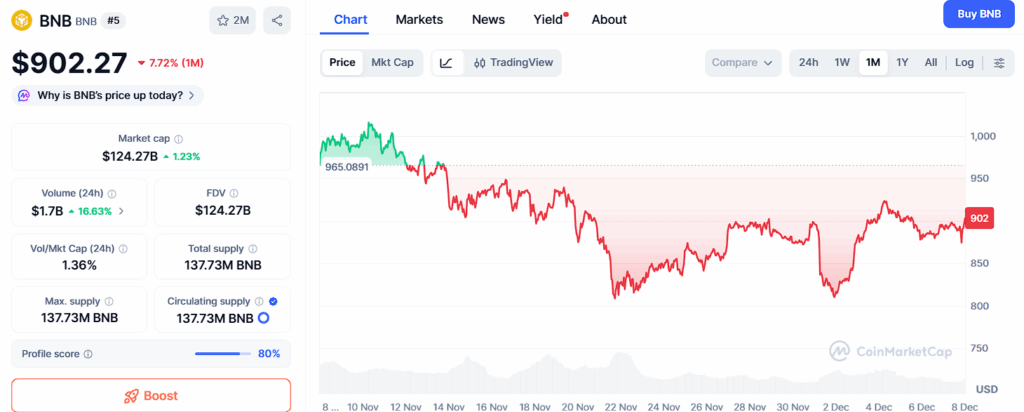
BNB trades around $889 and continues to show one of the healthiest large-cap structures in the market. Support at $865 maintains its bullish momentum, with deeper zones at $842 and $819 reinforcing long-term accumulation strength.

Analysts expect BNB to accelerate once it challenges resistance at $905, which historically triggers stronger follow-through patterns. Higher breakout zones around $932 and $958 could act as stepping stones toward triple-digit growth as cycle liquidity deepens. These strong structural signals support forecasts that place BNB’s next peak near—or even above—the $1,600 region.
Yet even with BNB’s established dominance, analysts consistently point to Ozak AI as the more asymmetric long-term opportunity. BNB’s trajectory, while bullish, remains tied to the broader Binance ecosystem. Ozak AI’s intelligence-driven architecture gives it a growth path that compounds independently of hype or exchange trends.

Ozak AI’s Intelligence Layer Sets a New Standard

Ozak AI introduces a next-generation set of AI-driven capabilities that elevate it far above typical presales and emerging altcoins. Its system is built to function continuously and adaptively:

  • Real-time predictive modeling running at millisecond precision
  • 30 ms HIVE market signals feeding execution-grade insights
  • SINT-powered autonomous agents capable of instant on-chain strategy automation
  • Cross-chain visibility enabled by Perceptron’s vast decentralized node network

This multilayer intelligence ecosystem gives Ozak AI the ability to scale influence across trading platforms, AI-powered applications, DeFi automation, and predictive analytics—sectors projected to expand exponentially through 2026 and beyond.

Ozak AI Becomes the Top Long-Term Forecast

BNB holds a dominant position among large-cap altcoins, and its structure supports a strong move toward $1,600 during the next major expansion. However, analysts consistently highlight that Ozak AI operates on an entirely different growth curve. Its compounding intelligence systems allow value to expand even when market conditions stagnate, making it one of the rare assets capable of generating utility continuously rather than cyclically.

As investors seek high-upside, early-stage opportunities with real, evolving utility, Ozak AI stands as the project with the strongest long-term prediction in the current market—outshining even powerhouse altcoins like BNB in multi-year growth potential.

About Ozak AI

Ozak AI is a blockchain-based crypto project that provides a technology platform that specializes in predictive AI and advanced data analytics for financial markets. Through machine learning algorithms and decentralized network technologies, Ozak AI enables real-time, accurate, and actionable insights to help crypto enthusiasts and businesses make the correct decisions.

For more, visit:

  • Website: https://ozak.ai/
  • Telegram: https://t.me/OzakAGI
  • Twitter: https://x.com/ozakagi

Disclaimer: TheNewsCrypto does not endorse any content on this page. The content depicted in this Press Release does not represent any investment advice. TheNewsCrypto recommends our readers to make decisions based on their own research. TheNewsCrypto is not accountable for any damage or loss related to content, products, or services stated in this Press Release.


TagsBlockchainOzak AI

Trending Cryptos

Related Reads

Gate Research Institute: The 'Wall Street-ization' Wave of Crypto Financial Products – Competition or Integration?

The article titled "Gate Research Institute: Are Crypto Financial Products Sparking a 'Wall Street' Wave—Competition or Convergence?" explores the evolving relationship between the crypto ecosystem and traditional finance (TradFi). The piece begins by reflecting on Bitcoin's original 2009 vision of decentralization, disintermediation, and moving away from banks. It then contrasts this with the 2024 landscape, where key crypto assets like Bitcoin are increasingly held through Wall Street products like ETFs issued by giants like BlackRock. The article questions whether this signifies that TradFi is systematically taking over the rights to issue, price, custody, and distribute crypto financial assets. The core argument is that this is not a zero-sum takeover but rather a bidirectional convergence where each side addresses the other's weaknesses. Crypto offers 24/7 global markets, programmable settlement, and open access but lacks compliant channels, institutional-grade custody, deep fiat liquidity, and mainstream distribution. TradFi possesses these but is constrained by legacy systems, limited operating hours, and slow settlement. Two primary convergence paths are highlighted: * **Path A (CEX to TradFi):** Exemplified by Gate, which has progressed from offering tokenized stocks and CFDs to providing direct, real stock trading (US, Hong Kong, South Korea) within its platform, using USDT. * **Path B (TradFi to Crypto):** Exemplified by Robinhood, which has integrated crypto trading, acquired exchanges like Bitstamp, and is moving traditional assets like stocks onto the blockchain via tokenization and its own Layer 2. Both paths are ultimately competing to become the next-generation, unified financial account—a "super account" where users can seamlessly trade cryptocurrencies, stocks, ETFs, RWA (Real World Assets), and tokenized treasury products in one interface. The growth of RWA and tokenized treasuries (e.g., BlackRock's BUIDL) is presented as the asset-layer fusion, providing stable, yield-bearing assets on-chain and acting as a bridge between the two worlds. In conclusion, the "Wall Street-ization" of crypto is framed as a mutual transformation. Decentralized ideals persist in the protocol layer, while at the application layer, a more efficient, global, and accessible unified capital market is emerging from this convergence. The future competition lies not between crypto exchanges and stockbrokers, but between platforms vying to offer the most comprehensive asset coverage, liquidity, and user experience within a single account.

marsbit5m ago

Gate Research Institute: The 'Wall Street-ization' Wave of Crypto Financial Products – Competition or Integration?

marsbit5m ago

Claude's Major New Feature: Screen Recording + Voice, Distilling Your Skills into AI Tasks in One Click

Claude has introduced a major new feature called "Record a Skill," available for Pro, Max, and Team users. This function, found in the Claude desktop app's CoWork menu, allows users to create reusable AI skills simply by recording their screen and providing voice narration while performing a task. Claude then automatically analyzes the recording and generates a functional Skill. A hands-on test confirmed the feature works seamlessly. Users start recording via the Skills manager, perform their workflow while verbally explaining the steps and logic, and avoid including sensitive information. After recording, Claude processes the content and creates the Skill, which can be saved and later invoked with a slash command (/). This eliminates the need for manual adjustments or writing complex instruction files. The innovation goes beyond mere efficiency. Previously, creating a Skill required writing a detailed SKILL.md file in Markdown—a significant barrier for non-technical users. "Record a Skill" bypasses this by directly capturing both actions and the implicit reasoning shared in the narration. This lowers the barrier to knowledge transfer and automation, addressing a core challenge in corporate knowledge management: the difficulty of getting experts to write and maintain documentation. However, the feature also highlights a shift in the nature of work. A case study from March 2026 showed a freelancer whose five-year client relationship was effectively replaced by a hand-coded Claude Skill automating their content workflow. With the even lower barrier of screen recording, the ability to distill personal expertise into automatable skills accelerates this trend. The "moat" for work is moving from simply knowing how to do a task to mastering tasks that are difficult or impossible to automate.

marsbit9m ago

Claude's Major New Feature: Screen Recording + Voice, Distilling Your Skills into AI Tasks in One Click

marsbit9m ago

Feeding AI "Noise" Can Also Boost Scores, This Work Enables Positive Transfer with Noise

Feeding "Noise" to AI Can Improve Performance: A Method Enables Positive Transfer from Noise This work, Semi-Supervised Noise Adaptation (SSNA), introduces a Noise Adaptation Framework (NAF) that challenges traditional transfer learning. Instead of requiring a labeled source domain of real data (e.g., images, text), NAF uses randomly generated Gaussian noise as the source. For a target task with C classes, it constructs C noise clusters by sampling from Gaussian distributions. Although this synthetic noise contains no semantic meaning, NAF trains it to form a discriminative class structure in a shared representation space—clustering same-class noise and separating different classes. The key is aligning this learned structure from the noise domain to the real, sparsely labeled target domain. A small number of target labels are still essential to establish the correspondence between noise clusters and actual classes. The training objective combines: 1) supervised loss on the few labeled target samples, 2) classification loss for the noise to build its structure, and 3) a distribution alignment loss (using Negative Domain Similarity) to minimize the gap between the noise and target domains in the shared space. Experiments show significant gains in few-label settings. With just 4 labels per class, NAF with a ResNet-18 backbone improves accuracy over a standard supervised baseline (ERM) by +12.35% on CIFAR-10, +7.61% on CIFAR-100, +4.38% on DTD-47, and +2.74% on Caltech-101. It also benefits fine-grained datasets and scales to ImageNet-1K (with 100 labels/class) and text classification (AG News). NAF can be integrated into existing semi-supervised methods like FixMatch for further gains. Ablation studies confirm the transferred benefit comes from the discriminative structure of the noise, not randomness itself. Collapsing all noise into a single point causes negative transfer, while increasing separation between noise cluster centers improves performance. The amount of noise per class is less critical once a basic structure forms. In conclusion, this work demonstrates that for positive transfer, the semantic content of source data may not be necessary. What can be effectively transferred is the *organizational structure* of categories within a representation space. This offers a promising alternative for scenarios where real source data is unavailable due to privacy, copyright, or procurement constraints.

marsbit11m ago

Feeding AI "Noise" Can Also Boost Scores, This Work Enables Positive Transfer with Noise

marsbit11m ago

Trading

Spot

Hot Articles

Discussions

Welcome to the HTX Community. Here, you can stay informed about the latest platform developments and gain access to professional market insights. Users' opinions on the price of AI (AI) are presented below.

活动图片