BNB Could Reach $1,600: Ozak AI Price Prediction Outshines Every Major Altcoin

TheNewsCryptoPublished on 2025-12-10Last updated on 2025-12-10

Abstract

Analysts highlight Ozak AI (OZ) as a leading early-stage crypto contender, with its long-term growth potential surpassing even major altcoins like BNB. While BNB shows a strong bullish structure and could reach $1,600 in the next cycle, Ozak AI’s AI-driven architecture—featuring millisecond predictive models, real-time market signals, and autonomous on-chain agents—positions it for a steeper growth trajectory. Its presale has already raised over $4.8 million, drawing significant investor interest due to its real-time utility and cross-chain capabilities via the Perceptron Network. Despite BNB’s established role, Ozak AI is viewed as a more asymmetric opportunity due to its compounding utility independent of market cycles.

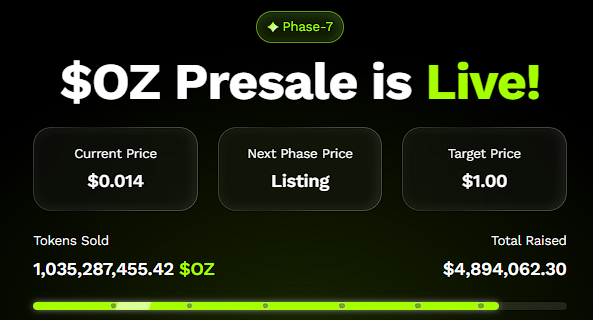
Ozak AI (OZ) is rapidly emerging as the strongest early-stage contender in the crypto market, with analysts increasingly noting that its long-term predictive trajectory outshines even the largest altcoins—including BNB.

While BNB builds a powerful bullish structure that could carry it toward $1,600 during the next major cycle, Ozak AI’s intelligence-driven architecture, millisecond predictive engine, and autonomous AI systems give it a far steeper expected growth curve. With the Ozak AI presale already exceeding $4.8 million, investor attention has shifted sharply toward its real-time utility, positioning it as one of the most aggressively forecasted projects of the decade.

Ozak AI Momentum Accelerates

Ozak AI continues dominating analyst discussions because it enters the market with working, real-time AI infrastructure instead of promises or future roadmaps. Millisecond-speed predictive models form the backbone of Ozak AI’s intelligence engine, designed to analyze market shifts instantly.
Ultra-fast 30 ms HIVE market signals enhance reaction accuracy, while SINT-powered autonomous agents can interpret blockchain conditions and execute strategies without delay. Integration with Perceptron Network’s 700K+ nodes expands Ozak AI’s visibility across multiple chains, creating a continuously evolving intelligence layer that gets more accurate as network data increases. This compounding utility is why analysts believe Ozak AI’s long-term price potential eclipses even top-tier altcoins.

BNB

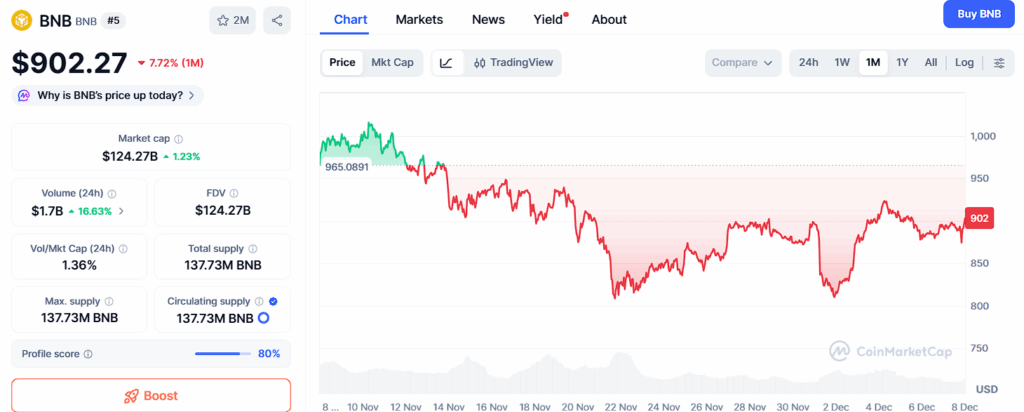
BNB trades around $889 and continues to show one of the healthiest large-cap structures in the market. Support at $865 maintains its bullish momentum, with deeper zones at $842 and $819 reinforcing long-term accumulation strength.

Analysts expect BNB to accelerate once it challenges resistance at $905, which historically triggers stronger follow-through patterns. Higher breakout zones around $932 and $958 could act as stepping stones toward triple-digit growth as cycle liquidity deepens. These strong structural signals support forecasts that place BNB’s next peak near—or even above—the $1,600 region.
Yet even with BNB’s established dominance, analysts consistently point to Ozak AI as the more asymmetric long-term opportunity. BNB’s trajectory, while bullish, remains tied to the broader Binance ecosystem. Ozak AI’s intelligence-driven architecture gives it a growth path that compounds independently of hype or exchange trends.

Ozak AI’s Intelligence Layer Sets a New Standard

Ozak AI introduces a next-generation set of AI-driven capabilities that elevate it far above typical presales and emerging altcoins. Its system is built to function continuously and adaptively:

  • Real-time predictive modeling running at millisecond precision
  • 30 ms HIVE market signals feeding execution-grade insights
  • SINT-powered autonomous agents capable of instant on-chain strategy automation
  • Cross-chain visibility enabled by Perceptron’s vast decentralized node network
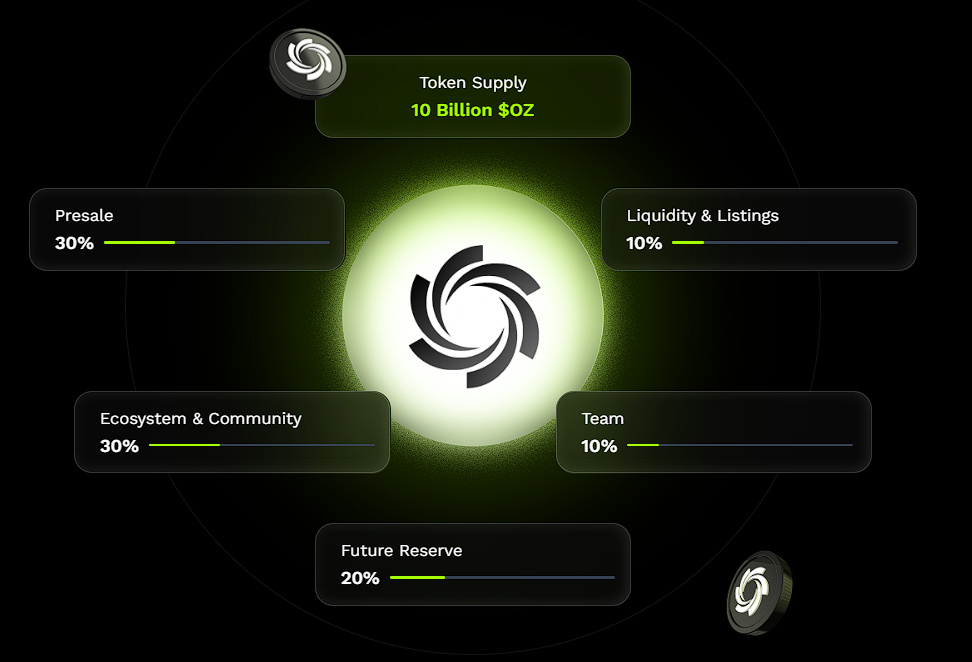
This multilayer intelligence ecosystem gives Ozak AI the ability to scale influence across trading platforms, AI-powered applications, DeFi automation, and predictive analytics—sectors projected to expand exponentially through 2026 and beyond.

Ozak AI Becomes the Top Long-Term Forecast

BNB holds a dominant position among large-cap altcoins, and its structure supports a strong move toward $1,600 during the next major expansion. However, analysts consistently highlight that Ozak AI operates on an entirely different growth curve. Its compounding intelligence systems allow value to expand even when market conditions stagnate, making it one of the rare assets capable of generating utility continuously rather than cyclically.

As investors seek high-upside, early-stage opportunities with real, evolving utility, Ozak AI stands as the project with the strongest long-term prediction in the current market—outshining even powerhouse altcoins like BNB in multi-year growth potential.

About Ozak AI

Ozak AI is a blockchain-based crypto project that provides a technology platform that specializes in predictive AI and advanced data analytics for financial markets. Through machine learning algorithms and decentralized network technologies, Ozak AI enables real-time, accurate, and actionable insights to help crypto enthusiasts and businesses make the correct decisions.

For more, visit:

  • Website: https://ozak.ai/
  • Telegram: https://t.me/OzakAGI
  • Twitter: https://x.com/ozakagi

Disclaimer: TheNewsCrypto does not endorse any content on this page. The content depicted in this Press Release does not represent any investment advice. TheNewsCrypto recommends our readers to make decisions based on their own research. TheNewsCrypto is not accountable for any damage or loss related to content, products, or services stated in this Press Release.


TagsBlockchainOzak AI

Trending Cryptos

Related Reads

From South Korea to the United States: Blue-Collar Jobs Are Becoming Increasingly Popular, Thanks to AI

AI is reshaping the labor market's value proposition. The traditional four-year college degree is losing its appeal as a guaranteed career path, while skilled blue-collar trades like electricians, welders, and plumbers are experiencing historic demand and wage premiums. This shift is driven by dual pressures: AI's displacement of certain white-collar roles and a booming need for physical infrastructure and data center construction. Data confirms the trend. In the U.S., vocational school revenue surged, and a significant portion of recent layoffs are AI-related. Surveys show a majority of Gen Z adults plan to pursue blue-collar work, citing better job security against AI automation. Vocational education interest has exploded recently. Experts cite a psychological shift as younger generations seek tangible, AI-resistant careers and avoid high student debt. In many cases, salaries for skilled trades now match or exceed those requiring a bachelor's degree. In South Korea, semiconductor vocational high schools boast near-total employment, with graduates securing high-paying roles at companies like Samsung. The shortage is structural, exacerbated by a retiring baby boomer workforce and massive infrastructure projects. Companies like JPMorgan Chase, Meta, and Lowe's are investing heavily in training programs. However, overcoming historical stigma and a "perception gap" around trade careers remains a key challenge to closing the talent gap.

marsbit7m ago

From South Korea to the United States: Blue-Collar Jobs Are Becoming Increasingly Popular, Thanks to AI

marsbit7m ago

Qualcomm: AI Hype Subsides, When Will Smartphones Emerge from the Gloom?

Qualcomm reported its Q3 FY2026 results (ending June 2026), with revenue of $9.95B, down 4% YoY but above expectations. Gross margin declined to 53.1%, pressured by rising costs across manufacturing and memory. Key business segments showed mixed performance: Handset revenue fell 19.6% YoY to $5.09B, dragged by an 11% decline in non-Apple Android shipments and weaker high-end mix. Conversely, Automotive revenue surged 61% to $1.59B, and IoT grew 9% to $1.83B. Core operating profit dropped 41% YoY due to margin compression and higher expenses. Management's Q4 FY2026 guidance projects revenue of $9.7B-$10.5B, in line with consensus, but Non-GAAP EPS guidance of $2.05-$2.25 fell short of expectations. Amidst persistent weakness in its core handset market, Qualcomm is pursuing growth in AI, focusing on Edge AI (smartphones, PCs, automotive) and Data Center AI. Its data center strategy includes four pillars: AI accelerators (e.g., AI200), commercial CPUs (Dragonfly C1000), custom silicon, and connectivity solutions. While these initiatives initially boosted its stock, concerns over AI capital expenditure sustainability have since erased those gains. The company targets $5B in data center revenue for FY2027 and $15B for FY2029. The report concludes that with the traditional handset business still under pressure, the data center opportunity is currently viewed as a longer-term option, and a more conservative valuation based on core operations may be warranted until AI contributions materialize.

marsbit11m ago

Qualcomm: AI Hype Subsides, When Will Smartphones Emerge from the Gloom?

marsbit11m ago

From TPU to Self-Evolving Agents: How Jeff Dean Predicts the Next Step in AI

At the 2026 YC Startup School, Jeff Dean outlined his vision for AI's next phase, shifting focus from simply scaling models to building intelligent, autonomous systems. He believes AI's progress is no longer just about creating smarter models, but about integrating them into systems capable of long-term, iterative work, automated experimentation, and continuous learning. This evolution moves the competition from "who has the bigger model" to "who can best organize intelligence." Dean suggests AI capabilities are now comparable to a junior engineer, enabling the automation of complex workflows. However, the true challenge and opportunity lie in managing these AI "workers" at scale. He emphasizes the importance of **context engineering**—structuring tools, memory, and feedback loops—over raw model power. For startups, this means building deep expertise in niche domains where general models currently fail (near 0-1% success rates), leveraging proprietary data, specialized tools, and domain-specific evaluators. A recurring theme is re-examining fundamental constraints. Dean's past work, like moving Google's search index to memory or creating the TPU, stemmed from questioning outdated assumptions about hardware and cost. He sees similar inflection points today, particularly in **specialized inference hardware** to drastically reduce latency and energy consumption for real-time Agent operation. Notably, he points out that in modern AI systems, the dominant cost is often not computation but **data movement**. Reliable, long-running Agents require robust system design, borrowing concepts from distributed computing like checkpointing, state management, and parallel exploration to handle failures and maintain progress over days or weeks. As AI automates execution, the scarcest human skills will shift to **defining clear specifications**, **judging what problems are worth solving** (taste), and designing effective feedback loops. Ultimately, Dean's framework prioritizes understanding the problem deeply, identifying the true bottlenecks, and systematically building closed-loop systems where AI can not only perform tasks but also improve AI itself.

marsbit11m ago

From TPU to Self-Evolving Agents: How Jeff Dean Predicts the Next Step in AI

marsbit11m ago

Trading

Spot

Hot Articles

Discussions

Welcome to the HTX Community. Here, you can stay informed about the latest platform developments and gain access to professional market insights. Users' opinions on the price of AI (AI) are presented below.

活动图片














