BlackRock and Fidelity Drive $297.5 Million Bitcoin ETF Market Recovery

cryptonews.ruPublished on 2026-08-18Last updated on 2026-08-18

Abstract

The crypto ETF market saw a strong rebound, with Bitcoin ETFs attracting nearly $300 million in a single session. Blackrock's IBIT led with $160.23 million inflows, followed by Fidelity's FBTC with $111.90 million, together accounting for over 90% of the daily total. ARK 21Shares' ARKB and Morgan Stanley's MSBT also saw inflows. Concurrently, Ethereum ETFs attracted $30.85 million, led by Blackrock's ETHA. This recovery followed three consecutive days of outflows for Bitcoin funds. Institutional involvement was highlighted by Jane Street disclosing over $1 billion in spot Bitcoin ETF holdings, primarily in Blackrock's IBIT. Harvard Management Company also maintained its IBIT position. While Bitcoin and Ethereum ETFs saw renewed demand, products tied to Solana, XRP, and other altcoins remained quiet with no net flows.

The new week began with a decisive return of capital to the largest cryptocurrency funds. Bitcoin ETFs attracted nearly $300 million in a single session, with BlackRock and Fidelity leading the way, while ether products also showed a broad recovery of their own.

This growth occurred after a challenging end to last week, when Bitcoin funds faced share redemptions for three consecutive days.

BlackRock and Fidelity Stimulate Bitcoin Recovery

Bitcoin ETFs attracted $297.56 million across four funds, with none of the products recording outflows. BlackRock's IBIT fund led the session, attracting $160.23 million in new capital. It was followed by Fidelity's FBTC with $111.90 million, and these two funds accounted for over 90% of the total daily volume.

The ARKB fund from ARK 21Shares attracted $14.18 million, and the MSBT fund from Morgan Stanley attracted $11.24 million. Trading volume for Bitcoin ETFs reached $2.12 billion. The aggregate net asset value at close was $77.41 billion.
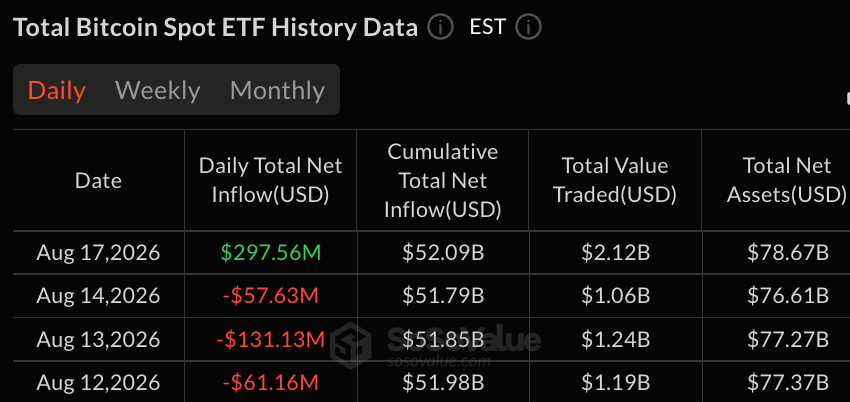
Bitcoin ETFs showed inflows again after three days of outflows. Source: Sosovalue

This session also coincided with new evidence of institutional investor participation in the sector. Quantitative trading firm Jane Street disclosed that as of June 30, its portfolio of U.S. spot Bitcoin ETFs exceeded $1 billion, with approximately $828 million invested in BlackRock's IBIT. The remainder was distributed among products like Fidelity's FBTC and Grayscale's GBTC.

Harvard Management Company also maintained its position in IBIT in the second quarter. As of June 30, this endowment reported ownership of 3,044,612 shares worth $101.4 million, unchanged from the previous quarter after two consecutive quarters of sales.

Ether Joins Recovery While Altcoins Languish

Ether ETFs attracted $30.85 million, with inflows distributed across three funds. BlackRock's ETHA accounted for the majority of demand, with inflows of $25.90 million. Fidelity's FETH fund attracted $4.27 million, and Bitwise's ETHW fund attracted about $682,000.

No ether ETF recorded outflows; total trading volume reached $459.73 million, and the aggregate net asset value at the end of the session was $10.59 billion.

Activity in the rest of the crypto ETF market was subdued. Products based on Solana, XRP, and HYPE recorded no net inflows or redemptions during the session.

Monday's flow data allowed the week to start on a more positive note following seller pressure in recent sessions. Bitcoin once again attracted the bulk of institutional demand, followed on a smaller scale by ether, while the altcoin ETF market largely remained on the sidelines.

end-content

Trending Cryptos

Related Questions

QWhich two firms were the main drivers of the recovery in Bitcoin ETF inflows, according to the article?

ABlackrock and Fidelity were the main drivers, with their IBIT and FBTC funds accounting for over 90% of the total daily volume.

QWhat was the total amount of capital attracted by Bitcoin ETFs in the single session described in the article?

ABitcoin ETFs attracted a total of $297.56 million in new capital during that session.

QWhat evidence of institutional involvement in the Bitcoin ETF sector is mentioned, involving the firm Jane Street?

AQuantitative trading firm Jane Street disclosed that as of June 30, its portfolio of U.S. spot Bitcoin ETFs exceeded $1 billion, with roughly $828 million invested in Blackrock's IBIT.

QHow did Ethereum ETFs perform alongside Bitcoin ETFs during this recovery session?

AEthereum ETFs attracted $30.85 million in inflows. Blackrock's ETHA fund saw the largest demand at $25.90 million, and no Ethereum ETF recorded outflows.

QWhat was the state of the altcoin ETF market (Solana, XRP, HYPE) during the session described?

AThe altcoin ETF market remained subdued. Products based on Solana, XRP, and HYPE recorded no net inflows or redemptions during the session.

Related Reads

Polymarket Report for H1 2026: High-Frequency Traders, or Superforecasters?

**Polymarket 2026 H1 Report: Summary** The report analyzes Polymarket's two distinct markets in the first half of 2026: the international platform and the newer, CFTC-regulated US market. **Key Market Dynamics:** * The US market grew rapidly, reaching 67% of the international market's volume by July. * Sports and crypto markets are the primary fee engines for the international platform, generating 98% of its ~$184M in gross fees, with crypto producing more fees despite lower volume. * High turnover categories drive volume; capital efficiency (turnover) is more determined by market category (e.g., crypto, sports) than by platform. **User & Growth Analysis (International Market):** * User activity is highly concentrated: ~6% of wallets (robots & professional users) account for ~80% of taker volume. Robots (~5.9% of wallets) execute ~2/3 of all trades. * User growth is flat (monthly active wallets ~590k), with significant churn (43-49% monthly) offset by ~1.13M new wallets. * User acquisition is decentralized; no single "blockbuster" market drives growth. The top market brought in <7k new wallets. * Platform retention is 51-57% month-over-month, but users frequently switch from their initial category of entry to others. World/Geo-politics acts as a connective layer between user interests. **Market Microstructure & Profitability:** * Analysis segments users into **Robots, Professional/Informed, and Retail** based on behavioral heuristics. * **Robots** dominate volume in crypto (~80%) and sports (~72%), but constitute a small fraction of wallets per category. * **Fee sensitivity experiments** show fees reduce activity from Professional users more than from Retail or Robots. * **Entry timing** varies by category. Users typically enter sports/crypto markets very late (>90% through lifecycle), while weather markets see earlier entry. * **Profitability:** Robots as a group netted ~$108M in gross PnL, while Retail and Professional users were net losers. However, only 27% of robot wallets were profitable. Sustained profitability is rare; only 146 wallets had positive cash flow for six consecutive months. Gross PnL across all users nets to approximately zero before fees.

marsbit13m ago

Polymarket Report for H1 2026: High-Frequency Traders, or Superforecasters?

marsbit13m ago

From Traffic Logic to Task Logic: AI Agent Is Ending the Free Lunch of the Internet

From Traffic to Task: How AI Agents Are Ending the Internet’s Free Lunch Andrej Karpathy recently highlighted the rise of an "agent-native" economy, requiring a rewrite of software, documents, and processes for AI agents. This shift raises a critical question: who pays for this transformation, and how is value redistributed? The answer lies in a fundamental change in cost structure, challenging the core internet business model built on near-zero marginal costs. The internet economy thrived on the premise that serving additional users incurred minimal extra costs, enabling profitable models like advertising, subscriptions, and commissions. Advertising, in particular, leveraged long user journeys—searching, comparing, browsing—to insert commercial touchpoints. AI agents disrupt this logic. They execute tasks—reasoning, reading files, calling tools—each consuming real GPU compute, power, and depreciation costs. Marginal cost per task is significant and varies greatly (MC > 0). While the cost per token may fall, agents tackle more complex tasks, increasing total expenditure—an AI version of Jevons's Paradox. Furthermore, fixed costs become perpetual due to the need for costly, frequent model retraining every 6-12 months. This cost structure prevents the internet's "profit explosion past breakeven" dynamic. The business logic shifts from monetizing attention to delivering value. The basic unit changes from a "click" to a "task." An agent doesn't just list links for "best renovation company"; it can compare quotes, check reputations, and schedule appointments. Its value lies in task completion and decision agency. This compresses the user journey, reducing the number of touchpoints where traditional ads can intervene. Ads must become more explicit within AI responses to maintain user trust in the agent's objectivity. This transition reshapes industry dynamics: 1. **Entry Points & Distribution:** Control shifts from search engines/app stores to agents that decide *how* a task is completed—which tools, data, and merchants are used. 2. **Platform & Middleman Economics:** Pure listing/intermediation platforms are vulnerable. Competitive moats shift from traffic control to owning indispensable supply, fulfillment, and execution capabilities that agents cannot bypass. 3. **Software & Service Boundaries Blur:** SaaS transitions from a tool (System of Record) used by employees to a capability (System of Action) that completes tasks autonomously. This expands the software market from IT budgets into larger labor and service budgets (e.g., customer service, research). In essence, AI agent economics ends the internet's simple "more users = more profit" equation. Scarcity is no longer just about traffic/attention but about high-value tasks and the data, permissions, and execution capabilities needed to complete them. As the fundamental economic unit changes from "click" to "task," the business models, platform power, and profit distribution built over the last two decades are set for a major recalculation.

marsbit13m ago

From Traffic Logic to Task Logic: AI Agent Is Ending the Free Lunch of the Internet

marsbit13m ago

STONK Surges 250% Following StonkFun's Integration with Raydium

The STONK token, associated with the Solana-based StonkFun platform, surged dramatically following its integration with the Raydium LaunchLab infrastructure. On its peak on September 6, 2026, the token saw over 250% daily growth, with its market cap reaching approximately $140 million. Following the rally, STONK partially corrected and was trading around $0.129 at the time of writing, with a market cap of about $113.2 million. StonkFun is a launchpad within the Solana ecosystem that enables token creation and trading pair formation, including with tokenized stocks and ETFs like SPYx. The growth was primarily driven by the integration with Raydium LaunchLab, which aims to reduce asset deployment costs, minimize sniper risks, and improve post-launch liquidity. The announcement was amplified by support from Solana's official account. This move also positively impacted other Solana ecosystem assets like RAY and JUP. Furthermore, StonkFun's economic model, which allocates a portion of trading fees to token buybacks and burns, contributed to the momentum. The platform reported over $1 million in cumulative buybacks and approximately $904,500 used for supply reduction from a single day's revenue of about $1.5 million. A similar trend of speculative interest in memecoins combined with tokenized assets was noted on the Robinhood Chain, exemplified by assets like $PONS and MEME, which saw explosive growth.

cryptonews.ru18m ago

STONK Surges 250% Following StonkFun's Integration with Raydium

cryptonews.ru18m ago

Trading

Spot

Hot Articles

What is $BITCOIN

DIGITAL GOLD ($BITCOIN): A Comprehensive Analysis Introduction to DIGITAL GOLD ($BITCOIN) DIGITAL GOLD ($BITCOIN) is a blockchain-based project operating on the Solana network, which aims to combine the characteristics of traditional precious metals with the innovation of decentralized technologies. While it shares a name with Bitcoin, often referred to as “digital gold” due to its perception as a store of value, DIGITAL GOLD is a separate token designed to create a unique ecosystem within the Web3 landscape. Its goal is to position itself as a viable alternative digital asset, although specifics regarding its applications and functionalities are still developing. What is DIGITAL GOLD ($BITCOIN)? DIGITAL GOLD ($BITCOIN) is a cryptocurrency token explicitly designed for use on the Solana blockchain. In contrast to Bitcoin, which provides a widely recognized value storage role, this token appears to focus on broader applications and characteristics. Notable aspects include: Blockchain Infrastructure: The token is built on the Solana blockchain, known for its capacity to handle high-speed and low-cost transactions. Supply Dynamics: DIGITAL GOLD has a maximum supply capped at 100 quadrillion tokens (100P $BITCOIN), although details regarding its circulating supply are currently undisclosed. Utility: While precise functionalities are not explicitly outlined, there are indications that the token could be utilized for various applications, potentially involving decentralized applications (dApps) or asset tokenization strategies. Who is the Creator of DIGITAL GOLD ($BITCOIN)? At present, the identity of the creators and development team behind DIGITAL GOLD ($BITCOIN) remains unknown. This situation is typical among many innovative projects within the blockchain space, particularly those aligning with decentralized finance and meme coin phenomena. While such anonymity may foster a community-driven culture, it intensifies concerns about governance and accountability. Who are the Investors of DIGITAL GOLD ($BITCOIN)? The available information indicates that DIGITAL GOLD ($BITCOIN) does not have any known institutional backers or prominent venture capital investments. The project seems to operate on a peer-to-peer model focused on community support and adoption rather than traditional funding routes. Its activity and liquidity are primarily situated on decentralized exchanges (DEXs), such as PumpSwap, rather than established centralized trading platforms, further highlighting its grassroots approach. How DIGITAL GOLD ($BITCOIN) Works The operational mechanics of DIGITAL GOLD ($BITCOIN) can be elaborated on based on its blockchain design and network attributes: Consensus Mechanism: By leveraging Solana’s unique proof-of-history (PoH) combined with a proof-of-stake (PoS) model, the project ensures efficient transaction validation contributing to the network's high performance. Tokenomics: While specific deflationary mechanisms have not been extensively detailed, the vast maximum token supply implies that it may cater to microtransactions or niche use cases that are still to be defined. Interoperability: There exists the potential for integration with Solana’s broader ecosystem, including various decentralized finance (DeFi) platforms. However, the details regarding specific integrations remain unspecified. Timeline of Key Events Here is a timeline that highlights significant milestones concerning DIGITAL GOLD ($BITCOIN): 2023: The initial deployment of the token occurs on the Solana blockchain, marked by its contract address. 2024: DIGITAL GOLD gains visibility as it becomes available for trading on decentralized exchanges like PumpSwap, allowing users to trade it against SOL. 2025: The project witnesses sporadic trading activity and potential interest in community-led engagements, although no noteworthy partnerships or technical advancements have been documented as of yet. Critical Analysis Strengths Scalability: The underlying Solana infrastructure supports high transaction volumes, which could enhance the utility of $BITCOIN in various transaction scenarios. Accessibility: The potential low trading price per token could attract retail investors, facilitating wider participation due to fractional ownership opportunities. Risks Lack of Transparency: The absence of publicly known backers, developers, or an audit process may yield skepticism regarding the project's sustainability and trustworthiness. Market Volatility: The trading activity is heavily reliant on speculative behavior, which can result in significant price volatility and uncertainty for investors. Conclusion DIGITAL GOLD ($BITCOIN) emerges as an intriguing yet ambiguous project within the rapidly evolving Solana ecosystem. While it attempts to leverage the “digital gold” narrative, its departure from Bitcoin's established role as a store of value underscores the need for a clearer differentiation of its intended utility and governance structure. Future acceptance and adoption will likely depend on addressing the current opacity and defining its operational and economic strategies more explicitly. Note: This report encompasses synthesised information available as of October 2023, and developments may have transpired beyond the research period.

2.5k Total ViewsPublished 2025.05.13Updated 2025.05.13

What is $BITCOIN

Discussions

Welcome to the HTX Community. Here, you can stay informed about the latest platform developments and gain access to professional market insights. Users' opinions on the price of BTC (BTC) are presented below.

活动图片