Bitfarms Dumps Bitcoin, Rebrands As Keel Infrastructure In Full AI Shift

bitcoinistPublished on 2026-04-01Last updated on 2026-04-01

Abstract

Bitfarms, a former Bitcoin mining company, is fully exiting the cryptocurrency business and rebranding as Keel Infrastructure. The company is relocating from Canada to the US and shifting its focus entirely to building data centers for high-performance computing and artificial intelligence. This strategic pivot follows a fiscal year 2025 net loss of $284.5 million, driven by falling Bitcoin prices and increased mining difficulty. Despite the loss, investors reacted positively, with shares rising 6.6%. The company still holds approximately $161 million in debt-free Bitcoin, providing financial flexibility during its transition. This move aligns with a broader industry trend of crypto miners seeking higher margins in AI and computing.

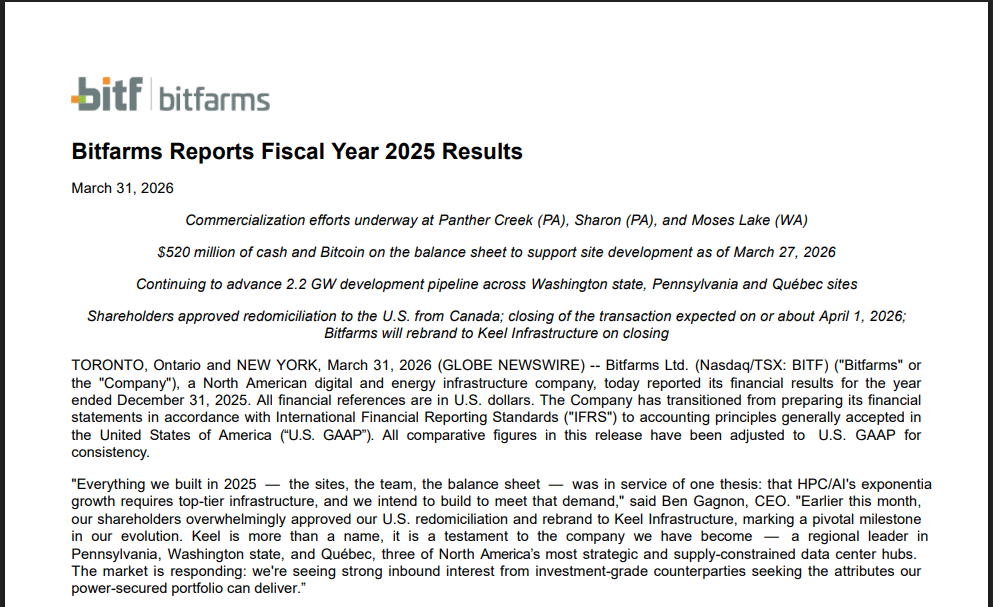
A company that built its name on cryptocurrency mining is walking away from the business entirely. Bitfarms announced plans Tuesday to rebrand as Keel Infrastructure and move its legal base from Canada to the US, capping a five-month exit from Bitcoin that management described as a deliberate break from the past.

No Half-Measures In The Company’s New Direction

CEO Ben Gagnon made the company’s position plain during an earnings call. “No half-measures, no compromises, and in time, no Bitcoin,” he said. “We built a new company.” Bitfarms is now focused on building and operating data centers that power high-performance computing and artificial intelligence platforms.

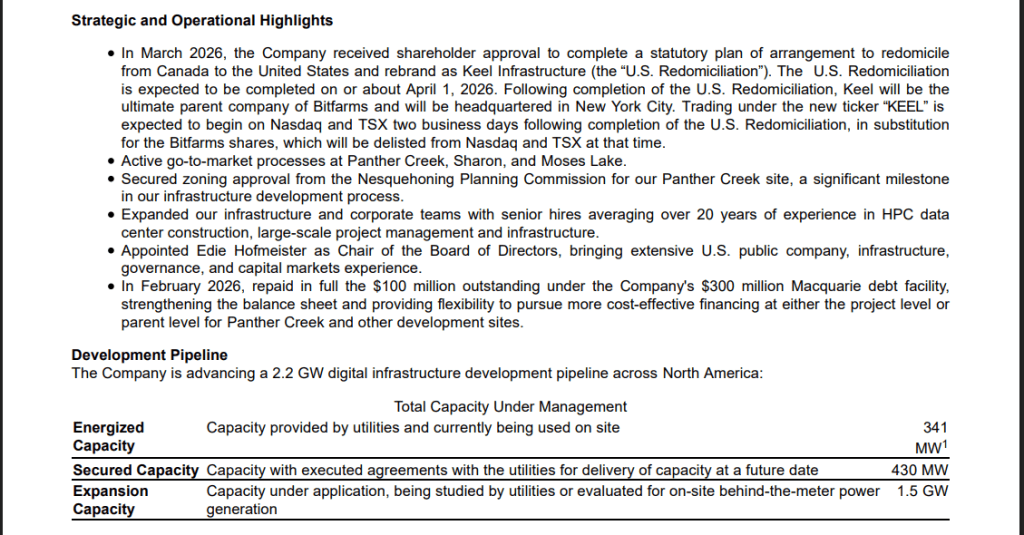
According to company filings, it is developing a 2.2-gigawatt infrastructure pipeline across North America, targeting what it calls hyperscalers and next-generation cloud providers.

The rebrand and the relocation have both received shareholder approval. The move to the US signals a deliberate repositioning — one aimed at tapping a market where AI infrastructure spending has been climbing steadily.
Bitfarms Fiscal Year 2025 Results. Source: Bitfarms

A Year Of Heavy Losses Tied To Falling Bitcoin Prices

The company’s 2025 financial results, also released Tuesday, showed a net loss of $284.5 million — wider than the year before. Revenue rose 70% year-on-year to close to $230 million, but the cost of generating that revenue came in at $248 million, producing a gross loss before other expenses were counted.

General and administrative costs also increased. A swing in the fair value of digital assets cost the company almost $51 million last year, compared to a $26 million gain in 2024. A $28 million gain from selling digital assets partially offset those figures.
Bitfarms Fiscal Year 2025 Results. Source: Bitfarms

Bitcoin mining has become a harder business to run. Data shows the leading cryptocurrency has dropped 45% from its October high. Mining difficulty — a measure of how hard it is to earn new coins — has risen 58% since the last halving in May 2024. Those conditions squeezed margins across the industry, not just at Bitfarms.

Despite the losses, investors responded positively. Shares closed Tuesday up 6.60%, trading at 2.73 Canadian dollars, or roughly $1.96 US.

BTCUSD trading at $68,780 on the 24-hour chart: TradingView

Bitcoin Holdings Still On The Books For Now

Reports indicate the company still holds about $161 million in Bitcoin that carries no debt against it. That reserve provides some financial flexibility as the transition continues.

Bitfarms is not alone in making this kind of shift. Iris Energy has been scaling AI cloud services using Nvidia graphics processors. Cipher Mining locked in a long-term hosting deal with AI cloud firm Fluidstack.

Riot Platforms and MARA Holdings have both expanded into AI and high-performance computing as well. The pattern reflects a broader move by mining companies seeking higher margins in a different corner of the tech sector.

For Bitfarms, the message from leadership is that the old business is done. What comes next is being built from the ground up — under a new name, in a new country, chasing a different market entirely.

Featured image from Akos Stiller/Bloomberg via Getty Images, chart from TradingView

Trending Cryptos

Related Questions

QWhat is the new name and focus of Bitfarms after its rebranding?

AThe company has rebranded as Keel Infrastructure and is now focused on building and operating data centers that power high-performance computing and artificial intelligence platforms.

QWhat was the key financial result that contributed to Bitfarms' net loss in fiscal year 2025?

AThe company reported a net loss of $284.5 million, which was influenced by a $51 million loss from the change in fair value of its digital assets, despite a 70% increase in revenue.

QHow did the market conditions for Bitcoin mining affect Bitfarms' decision to shift its business?

ABitcoin's price dropped 45% from its October high, and mining difficulty increased by 58% since the last halving in May 2024, squeezing industry margins and prompting the shift to a more profitable sector.

QWhat strategic move did Bitfarms make alongside its rebrand to position itself in the AI infrastructure market?

AThe company received shareholder approval to relocate its legal base from Canada to the United States, aiming to tap into a market where AI infrastructure spending has been steadily climbing.

QWhich other cryptocurrency mining companies have similarly expanded into AI and high-performance computing?

AIris Energy, Cipher Mining, Riot Platforms, and MARA Holdings have all expanded into AI and high-performance computing, reflecting a broader industry trend towards higher-margin tech sectors.

Related Reads

Global Stock Market's Storm Center: South Korea's Stock Market De-leveraging Is Largely Complete

Storm's Eye: South Korean Market De-leveraging Nears Completion The recent sharp correction in South Korean equities, with the KOSPI index dropping 32% from its June high, has been a key trigger for global tech stock volatility. The core driver was not a fundamental shift but a forced de-leveraging process within the market's unique structure, which is now largely complete. Two main leverage channels amplified the sell-off: 1. **Leveraged ETFs:** Their size, proportionally four times larger than in the U.S., peaked near $50 billion. Their mandatory daily rebalancing mechanism created a vicious cycle of "price drop → forced selling → further drop." Approximately 75% of this excess has been unwound, shrinking to $26 billion, with regulatory curbs now blocking new inflows. 2. **Hedge Fund Leverage:** Using swaps to magnify exposure, hedge funds saw their net long positioning fall by over 50% from peak levels. The most intense phase of this institutional de-leveraging is over. In contrast, **retail margin debt** poses minimal systemic risk. At 0.5% of market cap, it is far lower than in the U.S. or China, lacks automatic triggers, and is concentrated in smaller stocks. The conclusion: the high-leverage structures most prone to "chain-reaction selling" have been substantially cleared. The market is transitioning from a liquidity-driven crash to one priced more on fundamentals. The article argues that the AI trend—centered on Korean memory chips—remains intact. This episode represents a painful but necessary clearing of crowded trades, not the end of the AI revolution. For investors, the key question is conviction in the long-term AI direction; if the trend is real, current volatility is a cost of entry, not a terminal risk.

链捕手45m ago

Global Stock Market's Storm Center: South Korea's Stock Market De-leveraging Is Largely Complete

链捕手45m ago

The Eternal Fragments of Money: Third-Party Payment Has No First Principle

"The Enduring Fragments of Money: Third-Party Payments Lack a First Principle" Stripe is reportedly attempting to acquire PayPal, marking a significant shift reminiscent of PayPal's merger with the original X.com 30 years ago. The article analyzes Stripe's strategic challenges and the broader payments industry landscape. Despite its initial success with a developer-friendly API model, Stripe missed its optimal IPO window during the pandemic and has since seen its valuation decline. Its attempts to expand through acquisitions and new ventures, particularly in stablecoins (like its OUSD project) and Agent-focused payments (ACP/MPP protocols), have faced headwinds. The author argues that the payment industry remains highly fragmented and is ultimately an adjunct to the traditional banking system. This structure limits the potential for any single player, including Stripe, to achieve complete dominance. While stablecoins and the future rise of autonomous Agent economies present potential growth avenues, they are not yet mainstream and still require integration with the existing financial system. For now, Agent-based transactions are largely used for speculative "volume boosting" rather than substantive business applications. Stripe's current move to acquire PayPal is seen as an attempt to bolster its weak consumer-facing (C-side) business after its stablecoin-focused strategies faltered. Meanwhile, PayPal is described as structurally outdated, unable to revive itself through new products like Venmo or PYUSD. The future of payments may lie not in payments themselves but in value-added services like more efficient settlement networks. The author suggests that companies like Stripe and Circle, which are building their own blockchains (Tempo, Arc) and stablecoins, are positioning themselves to eventually profit from high-efficiency settlement systems. These new networks could potentially bypass some traditional banking layers. In conclusion, the article posits that third-party payment is a perpetually fragmented battlefield where scale alone cannot ensure victory. Players must find new models, focusing on efficiency to compete with the entrenched banking system. Stripe's acquisition of PayPal represents a bet on this uncertain future.

链捕手1h ago

The Eternal Fragments of Money: Third-Party Payment Has No First Principle

链捕手1h ago

Trading

Spot

Hot Articles

Discussions

Welcome to the HTX Community. Here, you can stay informed about the latest platform developments and gain access to professional market insights. Users' opinions on the price of AI (AI) are presented below.

活动图片