Bitcoin PMI Says This Is Not A Peak, Here’s What It Is

bitcoinistPublished on 2026-04-08Last updated on 2026-04-08

Abstract

Bitcoin's price action has divided, with some calling a cycle peak and others expecting further rallies. A key macroeconomic indicator, the Bitcoin PMI, suggests the current phase is not the top. Historically, Bitcoin has never formed a true all-time high when the PMI was below 50. Each previous cycle peak occurred only after the PMI entered expansion territory above 50. Despite strong rallies and new highs in late 2025, the PMI remained sub-50, creating a disconnect with price action. Analysts argue that calling the top now is premature, similar to mistakes made in 2019-2020. This period may instead be a prolonged accumulation phase, with the real cycle peak likely occurring only after PMI surpasses 50.

Bitcoin’s price structure has continued to divide the market, with some saying the leading cryptocurrency has already peaked for this cycle, and others saying there is room for more rallies. Price has moved strongly at different points, and sentiment has flipped back and forth, but one important macro signal does not line up with the idea of a completed top.

This indicator is the Bitcoin PMI, which is still sitting below where every true previous cycle peak has formed.

PMI Below 50 Has Never Marked A Bitcoin Peak

The PMI is a monthly economic indicator that measures the level of activity across both the manufacturing and services sectors. The PMI may seem disconnected from the Bitcoin price, but the foundation of this analysis comes down to a simple historical pattern with the two metrics. BTC has never printed a true all-time high at any point when the PMI was below 50, and that has held consistently across every past cycle.

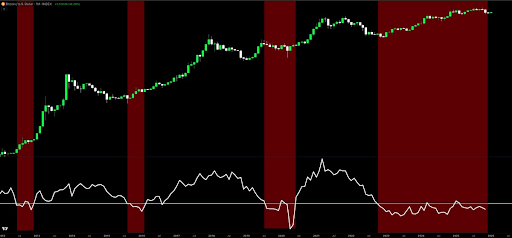
As shown in the chart below, each red-shaded zone represents extended periods where PMI was under the 50 threshold. These zones have consistently coincided with phases of consolidation and early trend development in the BTC price. On the other hand, major Bitcoin price tops have always formed after PMI breaks above 50 and enters expansion territory.
Source: Chart from Crypto Tice on X

What makes the current cycle stand out is how long Bitcoin has been trading with the PMI indicator below 50. Even during the July to October 2025 period, when the Bitcoin price climbed to new highs and printed strong rallies, the PMI stayed below 50. This creates a disconnect between the current price action and a long-standing signal.

Calling The Top Now Could Be Premature

At the time of writing, Bitcoin is trading at $69,043, which places it about 45% below its all-time high of $126,080 on October 6, 2025. There have been various reasons to believe that the Bitcoin price has already reached a peak for this cycle.

These theories rely heavily on price-based signals and changes in sentiment, but the PMI model introduces a much larger context based on the activity in the manufacturing and services sectors.

According to a crypto analyst with the pseudonym Crypto Tice on the social media platform X, the people calling this the top are making the same mistake they made in 2019 and 2020.

In that sense, what many are calling a top may instead be a lengthy accumulation period. If historical trends continue, the real cycle peak would only come once PMI moves above 50.

The Bitcoin-PMI chart above also shows how previous sub-50 periods ended. Each time, Bitcoin transitioned from these zones into stronger bullish phases once liquidity conditions improved. Those who interpreted the consolidation as a top ended up missing the best part of the rallies.

BTC trading at $68,933 on the 1D chart | Source: BTCUSDT on Tradingview.com

Related Questions

QWhat does the Bitcoin PMI indicator measure and why is it relevant to Bitcoin's price cycle?

AThe Bitcoin PMI is a monthly economic indicator that measures the level of activity across both the manufacturing and services sectors. It is relevant because historically, Bitcoin has never printed a true all-time high when the PMI was below 50, and major tops have only formed after PMI breaks above 50 into expansion territory.

QAccording to the article, what is the current relationship between Bitcoin's price and the PMI indicator?

AThe article states that there is a disconnect between Bitcoin's current price action and the PMI indicator. Despite Bitcoin reaching new highs in July to October 2025, the PMI has remained below 50, which is unusual and contradicts the historical pattern where true cycle peaks occur above PMI 50.

QWhy does the analyst Crypto Tice believe that calling the current price a top is premature?

ACrypto Tice believes that calling the current price a top is premature because it would be repeating the same mistake made in 2019 and 2020. Historical trends show that the real cycle peak only comes once the PMI moves above 50, and the current sub-50 period may instead be a lengthy accumulation phase.

QWhat historical pattern does the article highlight regarding PMI zones below 50 and Bitcoin's price action?

AThe article highlights that historical periods where the PMI was under the 50 threshold (red-shaded zones on the chart) have consistently coincided with phases of consolidation and early trend development in Bitcoin's price. These periods eventually transition into stronger bullish phases once liquidity conditions improve.

QHow far is Bitcoin's current price from its all-time high mentioned in the article, and what does this suggest?

AAt the time of writing, Bitcoin is trading at $69,043, which is about 45% below its all-time high of $126,080 reached on October 6, 2025. This significant distance from the peak, combined with the PMI still being below 50, suggests that the cycle top may not yet be in.

Related Reads

From Payment to Deployment: Stripe Bets on the AI Agent Economy

From Payments to Deployment: Stripe Bets on the AI Agent Economy Stripe is redefining economic infrastructure for the AI era, shifting its focus from serving primarily human users and software companies to enabling machine agents as active economic participants. The core thesis is that AI agents are evolving from tools into independent buyers and builders on the internet, necessitating a complete overhaul of traditional payment, billing, and deployment models. To empower agents as **buyers**, Stripe, in collaboration with Tempo, developed the Machine Payments Protocol. This protocol allows businesses to programmatically accept payments from agents without human intervention, using machine-readable payment instructions. Furthermore, Stripe's consumer wallet, Link, is being adapted to let users securely authorize agents to spend on their behalf. To empower agents as **builders**, Stripe Projects aims to simplify the deployment process. It allows developers and their agents to register, manage, and integrate the services needed to deploy applications directly from the command line, making "vibe-deploying" as seamless as "vibe-coding." This agent-driven economy, where products have real, variable costs (like AI tokens), disrupts traditional SaaS models. **Token-based monetization** is becoming central, requiring usage-based billing that charges for actual resource consumption, as seen with companies like Lovable and ElevenLabs. However, this model introduces new challenges like **token theft**, where fraudsters exploit services and vanish before billing. Stripe Radar helps combat this by assessing new accounts and predicting abuse risks. A critical innovation to balance customer experience and financial risk is **streaming payments**. By combining Metronome (for real-time usage tracking) with Tempo (for low-cost, high-frequency stablecoin payments), Stripe enables AI companies to collect fees *as tokens are consumed*. This eliminates the trade-off between imposing hard usage caps and risking unpaid invoices. In summary, Stripe's vision for AI economic infrastructure now encompasses providing a commercial framework for agents, wallets for agents, deployment tools for agents, token-based billing, fraud prevention for token abuse, and streaming payment capabilities. As AI transforms both commerce and software creation, Stripe is building the foundational infrastructure to support it.

marsbit32m ago

From Payment to Deployment: Stripe Bets on the AI Agent Economy

marsbit32m ago

Trading

Spot
Futures

Hot Articles

What is $BITCOIN

DIGITAL GOLD ($BITCOIN): A Comprehensive Analysis Introduction to DIGITAL GOLD ($BITCOIN) DIGITAL GOLD ($BITCOIN) is a blockchain-based project operating on the Solana network, which aims to combine the characteristics of traditional precious metals with the innovation of decentralized technologies. While it shares a name with Bitcoin, often referred to as “digital gold” due to its perception as a store of value, DIGITAL GOLD is a separate token designed to create a unique ecosystem within the Web3 landscape. Its goal is to position itself as a viable alternative digital asset, although specifics regarding its applications and functionalities are still developing. What is DIGITAL GOLD ($BITCOIN)? DIGITAL GOLD ($BITCOIN) is a cryptocurrency token explicitly designed for use on the Solana blockchain. In contrast to Bitcoin, which provides a widely recognized value storage role, this token appears to focus on broader applications and characteristics. Notable aspects include: Blockchain Infrastructure: The token is built on the Solana blockchain, known for its capacity to handle high-speed and low-cost transactions. Supply Dynamics: DIGITAL GOLD has a maximum supply capped at 100 quadrillion tokens (100P $BITCOIN), although details regarding its circulating supply are currently undisclosed. Utility: While precise functionalities are not explicitly outlined, there are indications that the token could be utilized for various applications, potentially involving decentralized applications (dApps) or asset tokenization strategies. Who is the Creator of DIGITAL GOLD ($BITCOIN)? At present, the identity of the creators and development team behind DIGITAL GOLD ($BITCOIN) remains unknown. This situation is typical among many innovative projects within the blockchain space, particularly those aligning with decentralized finance and meme coin phenomena. While such anonymity may foster a community-driven culture, it intensifies concerns about governance and accountability. Who are the Investors of DIGITAL GOLD ($BITCOIN)? The available information indicates that DIGITAL GOLD ($BITCOIN) does not have any known institutional backers or prominent venture capital investments. The project seems to operate on a peer-to-peer model focused on community support and adoption rather than traditional funding routes. Its activity and liquidity are primarily situated on decentralized exchanges (DEXs), such as PumpSwap, rather than established centralized trading platforms, further highlighting its grassroots approach. How DIGITAL GOLD ($BITCOIN) Works The operational mechanics of DIGITAL GOLD ($BITCOIN) can be elaborated on based on its blockchain design and network attributes: Consensus Mechanism: By leveraging Solana’s unique proof-of-history (PoH) combined with a proof-of-stake (PoS) model, the project ensures efficient transaction validation contributing to the network's high performance. Tokenomics: While specific deflationary mechanisms have not been extensively detailed, the vast maximum token supply implies that it may cater to microtransactions or niche use cases that are still to be defined. Interoperability: There exists the potential for integration with Solana’s broader ecosystem, including various decentralized finance (DeFi) platforms. However, the details regarding specific integrations remain unspecified. Timeline of Key Events Here is a timeline that highlights significant milestones concerning DIGITAL GOLD ($BITCOIN): 2023: The initial deployment of the token occurs on the Solana blockchain, marked by its contract address. 2024: DIGITAL GOLD gains visibility as it becomes available for trading on decentralized exchanges like PumpSwap, allowing users to trade it against SOL. 2025: The project witnesses sporadic trading activity and potential interest in community-led engagements, although no noteworthy partnerships or technical advancements have been documented as of yet. Critical Analysis Strengths Scalability: The underlying Solana infrastructure supports high transaction volumes, which could enhance the utility of $BITCOIN in various transaction scenarios. Accessibility: The potential low trading price per token could attract retail investors, facilitating wider participation due to fractional ownership opportunities. Risks Lack of Transparency: The absence of publicly known backers, developers, or an audit process may yield skepticism regarding the project's sustainability and trustworthiness. Market Volatility: The trading activity is heavily reliant on speculative behavior, which can result in significant price volatility and uncertainty for investors. Conclusion DIGITAL GOLD ($BITCOIN) emerges as an intriguing yet ambiguous project within the rapidly evolving Solana ecosystem. While it attempts to leverage the “digital gold” narrative, its departure from Bitcoin's established role as a store of value underscores the need for a clearer differentiation of its intended utility and governance structure. Future acceptance and adoption will likely depend on addressing the current opacity and defining its operational and economic strategies more explicitly. Note: This report encompasses synthesised information available as of October 2023, and developments may have transpired beyond the research period.

363 Total ViewsPublished 2025.05.13Updated 2025.05.13

What is $BITCOIN

Discussions

Welcome to the HTX Community. Here, you can stay informed about the latest platform developments and gain access to professional market insights. Users' opinions on the price of BTC (BTC) are presented below.

活动图片















