Bitcoin Down 20% Over the Past 90 Days, While Stocks Have Risen

cryptonews.ruPublished on 2026-08-11Last updated on 2026-08-11

Abstract

According to Glassnode, Bitcoin has underperformed stocks significantly. Over the past 90 days, Bitcoin fell 20%, a drop four times larger than the S&P 500's 5% gain. This year, the crypto market has been the worst-performing among major asset classes, with Bitcoin down 35% and altcoins down 57% since January. In contrast, commodities like gold, copper, and silver, alongside stock indices, have posted substantial gains. Glassnode states the market will remain stock-dominated until Bitcoin begins to recover its relative performance against these indices. This trend persisted over the past week. Notably, in July, Bitcoin and Ethereum posted gains of 9% and 20% respectively, diverging from a broader stock market correction and breaking their previously high correlation with tech stocks. Robert Mitchnick of BlackRock views this decoupling from equities as "useful" for investors seeking diversification, calling July a potential turning point. He noted improving market sentiment and a resumed inflow into Bitcoin ETFs, with BlackRock's IBIT seeing significant August inflows. U.S. spot Bitcoin ETFs had their strongest week since mid-April in early August.

According to Glassnode, Bitcoin is significantly lagging behind stocks, and until it begins to recover its position, the current market will continue to be dominated by equities.

Over the past 90 days, Bitcoin has fallen by 20%, which is four times greater than the S&P 500 index's 5% gain over the same period.

Looking at a longer timeframe, the cryptocurrency market has shown the worst performance among major asset classes this year.

Since January, Bitcoin has fallen by 35%, and altcoins by 57%.

In contrast, gold has increased by 60%, copper by 66%, and silver by 107%. The Nasdaq and Russell 2000 indices have risen by 38% and 31% respectively, making cryptocurrencies the weakest asset on this list for the stated period.
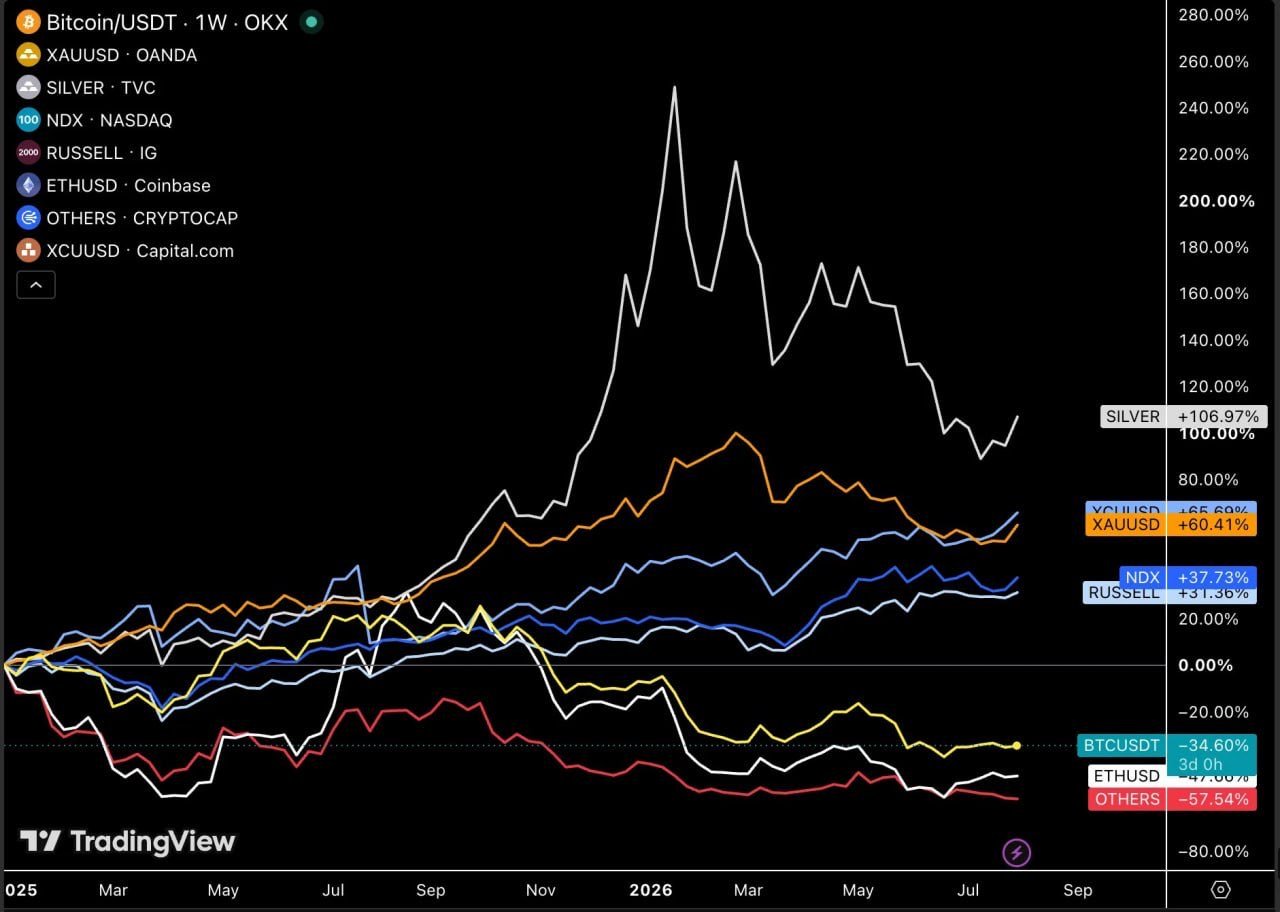
In its message on Tuesday, Glassnode stated the market will continue to be led by stocks until this gap narrows.

According to Glassnode, Markets Are Still "Influenced by the Stock Market," Except for Bitcoin Movements

According to Glassnode, this trend continued throughout the past week as well.

"The last 7 days show the same pattern," Glassnode wrote. "Until Bitcoin recovers its position relative to the indices, the market will still be oriented towards stocks."

Over the past 90 days, the S&P 500 index rose by 5%, while Bitcoin fell by 20%. The last 7 days demonstrate the same trend.

Until Bitcoin recovers its position relative to the indices, the situation remains predominantly stock-oriented.

It is noteworthy that NASDAQ is lagging behind other major indices, indicating an unfavorable situation... pic.twitter.com/TpfDwoYB9y

— glassnode (@glassnode) August 11, 2026

Glassnode's statement highlights Bitcoin's market dynamics in July.

In July, stocks of companies in artificial intelligence and semiconductors experienced a sharp market correction, with ETFs investing in the chip industry falling by more than 20%. The Nasdaq-100 index also fell by nearly 7%.

However, in the same month, Bitcoin and Ethereum rose by 9% and 20% respectively, distinguishing them from the rest of the stock market.

This is a significant change compared to their previous close correlation. In May, according to TradingView data, the 90-day correlation between Bitcoin and Nasdaq was 0.89. By July 28, K33 Research found the 30-day correlation had dropped to 0.43.

BlackRock States That Such a Separation Is a "Useful" Phenomenon

Robert Mitchnick, Head of Digital Assets at BlackRock, stated on Monday that Bitcoin's separation from stocks is "useful" for investors who see Bitcoin as a means of diversification, calling July's performance a turning point for the cryptocurrency market.

Mitchnick also noted that sentiment in the cryptocurrency market began to improve over the past month, and inflows into ETFs have resumed.

According to SoSoValue, as of August 7, the net assets of BlackRock's iShares Bitcoin Trust (IBIT) were $48.51 billion, and in August the company attracted $693.64 million.

"Over the last month or so, we've seen a noticeable, albeit subtle, shift in sentiment," Mitchnick said.

U.S. spot Bitcoin ETFs brought in $853.5 million for the week ending August 7, the best result since mid-April. IBIT accounted for about $693 million of that amount.


Trending Cryptos

Related Questions

QAccording to Glassnode, why is the market still dominated by stocks?

AAccording to Glassnode, the market will continue to be dominated by stocks until Bitcoin begins to recover and narrow the performance gap with major stock indices like the S&P 500.

QWhat was the performance difference between Bitcoin and the S&P 500 over the last 90 days?

AOver the last 90 days, Bitcoin fell by 20%, while the S&P 500 index grew by 5%.

QHow does Bitcoin's performance in 2026 compare to other major asset classes like gold or silver?

AIn 2026, Bitcoin has been the worst-performing major asset class. Since January, Bitcoin fell by 35%, while gold increased by 60%, silver by 107%, and the Nasdaq and Russell 2000 indices grew by 38% and 31% respectively.

QWhat significant market shift was observed in July regarding Bitcoin and stocks?

AIn July, Bitcoin and Ethereum rose by 9% and 20% respectively, diverging from the stock market, which experienced a sharp correction, particularly in AI and semiconductor stocks. This broke their previously strong correlation with indices like the Nasdaq.

QAccording to BlackRock's Robert Mitchnick, why is the decoupling of Bitcoin from stocks 'useful'?

ABlackRock's Robert Mitchnick stated that the decoupling of Bitcoin from stocks is 'useful' for investors who view Bitcoin as a means of portfolio diversification. He cited July's performance as a potential turning point for the crypto market.

Related Reads

Weak US Employment and $1.1 Billion into ETFs: Wintermute on the New Rally and Inflation Risks

Analysts at Wintermute stated that the cryptocurrency market gained support following a weak U.S. jobs report. Against this backdrop, U.S. spot Bitcoin and Ethereum ETFs collectively attracted $1.1 billion in inflows over the week. While demand via ETFs has recovered, there is insufficient data to confirm a sustainable shift in market sentiment. U.S. spot Bitcoin ETFs saw inflows of $853.5 million over five sessions, the best weekly result since mid-April. Ethereum ETFs attracted another $244.9 million, marking a fifth consecutive positive week. Over 80% of the inflows into both groups went to BlackRock. Wintermute notes that relatively restrained trading volumes may indicate large investors gradually building positions rather than short-term capital rotation. A disappointing U.S. employment report for July, which showed a loss of 23,000 jobs versus an expected gain of 80,000, led markets to reduce the probability of a Federal Reserve rate hike in September. This supported risk assets, including crypto. However, Wintermute cautions that the upcoming U.S. Consumer Price Index report on August 12 poses a key test. Higher-than-expected inflation could revive rate hike fears above 50%, risking a reversal of the recent rally. Beyond ETFs, institutional adoption of blockchain infrastructure continues, exemplified by Wells Fargo's planned launch of tokenized deposits. Wintermute views this as banks modernizing their settlement systems, which could eventually support broader digital asset integration. The firm concludes that while the ETF inflows are a positive signal, one week is not enough to confirm a durable trend, and the market remains highly sensitive to macroeconomic data, particularly inflation.

cryptonews.ru35m ago

Weak US Employment and $1.1 Billion into ETFs: Wintermute on the New Rally and Inflation Risks

cryptonews.ru35m ago

Trading

Spot

Hot Articles

What is $BITCOIN

DIGITAL GOLD ($BITCOIN): A Comprehensive Analysis Introduction to DIGITAL GOLD ($BITCOIN) DIGITAL GOLD ($BITCOIN) is a blockchain-based project operating on the Solana network, which aims to combine the characteristics of traditional precious metals with the innovation of decentralized technologies. While it shares a name with Bitcoin, often referred to as “digital gold” due to its perception as a store of value, DIGITAL GOLD is a separate token designed to create a unique ecosystem within the Web3 landscape. Its goal is to position itself as a viable alternative digital asset, although specifics regarding its applications and functionalities are still developing. What is DIGITAL GOLD ($BITCOIN)? DIGITAL GOLD ($BITCOIN) is a cryptocurrency token explicitly designed for use on the Solana blockchain. In contrast to Bitcoin, which provides a widely recognized value storage role, this token appears to focus on broader applications and characteristics. Notable aspects include: Blockchain Infrastructure: The token is built on the Solana blockchain, known for its capacity to handle high-speed and low-cost transactions. Supply Dynamics: DIGITAL GOLD has a maximum supply capped at 100 quadrillion tokens (100P $BITCOIN), although details regarding its circulating supply are currently undisclosed. Utility: While precise functionalities are not explicitly outlined, there are indications that the token could be utilized for various applications, potentially involving decentralized applications (dApps) or asset tokenization strategies. Who is the Creator of DIGITAL GOLD ($BITCOIN)? At present, the identity of the creators and development team behind DIGITAL GOLD ($BITCOIN) remains unknown. This situation is typical among many innovative projects within the blockchain space, particularly those aligning with decentralized finance and meme coin phenomena. While such anonymity may foster a community-driven culture, it intensifies concerns about governance and accountability. Who are the Investors of DIGITAL GOLD ($BITCOIN)? The available information indicates that DIGITAL GOLD ($BITCOIN) does not have any known institutional backers or prominent venture capital investments. The project seems to operate on a peer-to-peer model focused on community support and adoption rather than traditional funding routes. Its activity and liquidity are primarily situated on decentralized exchanges (DEXs), such as PumpSwap, rather than established centralized trading platforms, further highlighting its grassroots approach. How DIGITAL GOLD ($BITCOIN) Works The operational mechanics of DIGITAL GOLD ($BITCOIN) can be elaborated on based on its blockchain design and network attributes: Consensus Mechanism: By leveraging Solana’s unique proof-of-history (PoH) combined with a proof-of-stake (PoS) model, the project ensures efficient transaction validation contributing to the network's high performance. Tokenomics: While specific deflationary mechanisms have not been extensively detailed, the vast maximum token supply implies that it may cater to microtransactions or niche use cases that are still to be defined. Interoperability: There exists the potential for integration with Solana’s broader ecosystem, including various decentralized finance (DeFi) platforms. However, the details regarding specific integrations remain unspecified. Timeline of Key Events Here is a timeline that highlights significant milestones concerning DIGITAL GOLD ($BITCOIN): 2023: The initial deployment of the token occurs on the Solana blockchain, marked by its contract address. 2024: DIGITAL GOLD gains visibility as it becomes available for trading on decentralized exchanges like PumpSwap, allowing users to trade it against SOL. 2025: The project witnesses sporadic trading activity and potential interest in community-led engagements, although no noteworthy partnerships or technical advancements have been documented as of yet. Critical Analysis Strengths Scalability: The underlying Solana infrastructure supports high transaction volumes, which could enhance the utility of $BITCOIN in various transaction scenarios. Accessibility: The potential low trading price per token could attract retail investors, facilitating wider participation due to fractional ownership opportunities. Risks Lack of Transparency: The absence of publicly known backers, developers, or an audit process may yield skepticism regarding the project's sustainability and trustworthiness. Market Volatility: The trading activity is heavily reliant on speculative behavior, which can result in significant price volatility and uncertainty for investors. Conclusion DIGITAL GOLD ($BITCOIN) emerges as an intriguing yet ambiguous project within the rapidly evolving Solana ecosystem. While it attempts to leverage the “digital gold” narrative, its departure from Bitcoin's established role as a store of value underscores the need for a clearer differentiation of its intended utility and governance structure. Future acceptance and adoption will likely depend on addressing the current opacity and defining its operational and economic strategies more explicitly. Note: This report encompasses synthesised information available as of October 2023, and developments may have transpired beyond the research period.

1.8k Total ViewsPublished 2025.05.13Updated 2025.05.13

What is $BITCOIN

Discussions

Welcome to the HTX Community. Here, you can stay informed about the latest platform developments and gain access to professional market insights. Users' opinions on the price of BTC (BTC) are presented below.

活动图片