Bitcoin demand stays weak despite $1B USDT injection – Here is why!

ambcryptoPublished on 2026-07-10Last updated on 2026-07-10

Abstract

Bitcoin is exhibiting a clear divergence between spot and derivatives markets. While futures demand has rebounded sharply, spot demand remains weak, indicating the current recovery is primarily driven by leverage. This makes the rally fragile and vulnerable to a sharp correction, especially amid renewed macro uncertainty from events like U.S.-Iran tensions. Recent data supports this cautious view: spot Bitcoin ETFs saw net outflows, and the Coinbase Premium Index turned negative, signaling weaker U.S. institutional demand. Despite Tether injecting $1 billion in new USDT, much of this liquidity appears to be sitting on the sidelines rather than flowing into Bitcoin spot purchases. This fresh capital could further fuel speculative derivatives activity instead of attracting real buyers. Historically, the current bear market of 248 days is shorter than previous major cycles (381 days in 2022, 385 days in 2018), suggesting the broader downtrend may have further room to run. In summary, Bitcoin's bear cycle remains intact, with the recovery being led by fragile derivatives speculation rather than strong spot demand.

Bitcoin is showing a textbook spot-versus-derivatives divergence.

However, how this setup plays out depends on the broader macro environment.

In a risk-on market, higher derivatives activity can support more upside. In a risk-off market, rising leverage increases the risk of a sharp correction. Recent U.S.-Iran uncertainty brought macro FUD back into the market.

However, the Crypto Fear & Greed Index held above extreme fear. That resilience has revived the debate over whether BTC’s bear market could be nearing its end.

History, however, tells a different story.

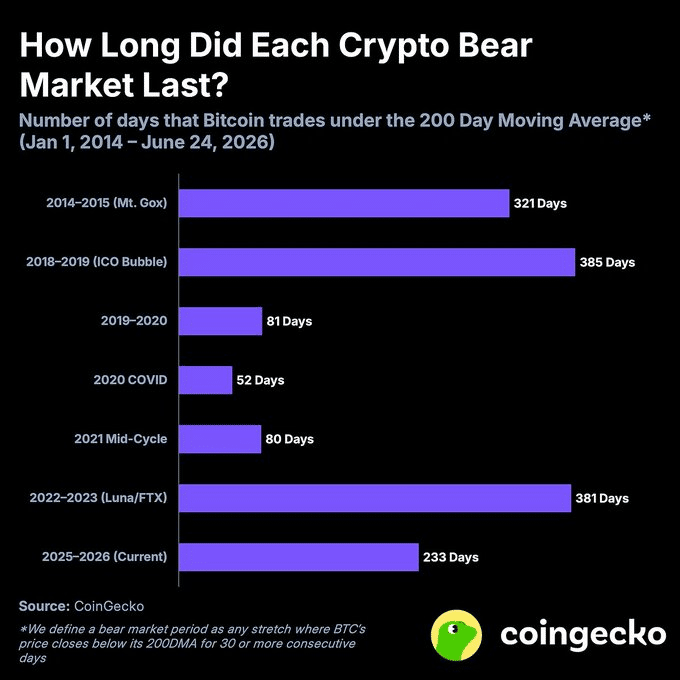
As the chart shows, Bitcoin’s current bear market has lasted 248 days. By comparison, the 2022 bear market lasted 381 days, while the 2018 one lasted 385 days, suggesting the current cycle may still have further room to run.
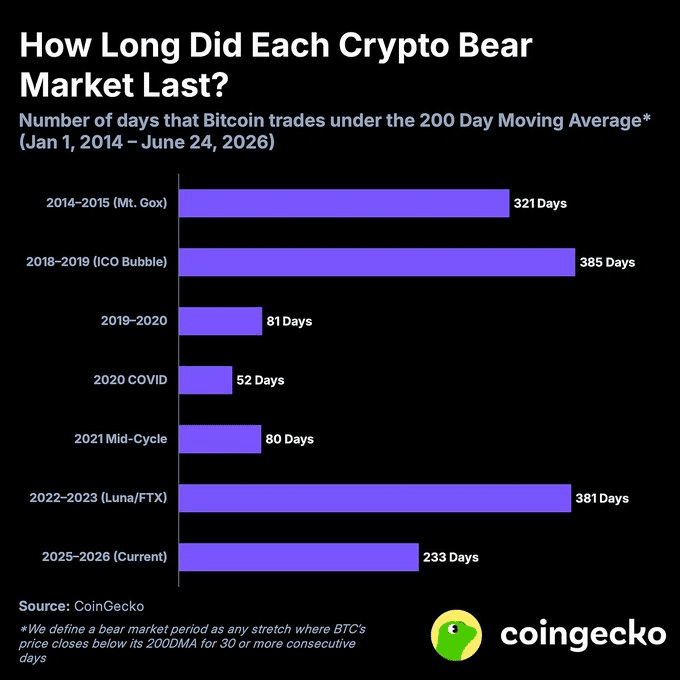
Source: CoinGecko

Institutional positioning also supports that view.

As the market flipped risk-off, spot Bitcoin ETFs saw more than $85 million in net outflows after three straight days of inflows, showing how quickly institutions pulled back as macro uncertainty returned.

Bitcoin’s Coinbase Premium Index tells a similar story.

The index has flipped negative, signaling weaker U.S. spot demand and suggesting institutional buyers have become more cautious as risk sentiment deteriorates.

Taken together, the data suggest Bitcoin is still far from a sustained risk-on environment, with the broader bear cycle remaining intact. Against this backdrop, the growing spot-versus-derivatives divergence becomes even more important.

So, what is it telling us about Bitcoin’s next move?

Bitcoin derivatives surge as spot demand lags

In a volatile market, liquidity injections can send mixed signals.

This time, the timing looks more bearish than bullish.

Tether recently minted $1 billion in fresh USDT even as the overall stablecoin market continues to shrink. Rather than flowing into risk assets, much of that liquidity appears to be sitting on the sidelines, suggesting investors are holding dry powder instead of buying Bitcoin.

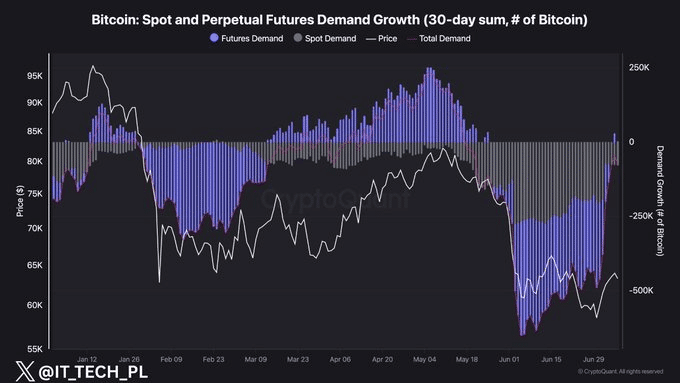
The chart below shows why that matters.

Bitcoin’s 30-day cumulative demand has rebounded sharply from nearly -500,000 BTC to around -75,000 BTC, but the recovery has been driven almost entirely by derivatives. Futures demand has surged from roughly -295,000 BTC to slightly positive, while spot demand remains weak at around -78,000 BTC.
Source: CryptoQuant

Naturally, that leaves Bitcoin in a clear spot-versus-derivatives divergence.

Against this backdrop, the recent $1 billion USDT injection could add more fuel to Bitcoin’s derivatives market than its spot market.

With speculative positioning already leading the recovery, the fresh liquidity could drive leverage even higher instead of attracting real spot buyers. That would leave Bitcoin’s recovery more vulnerable to a sharp flush if sentiment flips risk-off.

In that context, Bitcoin’s bear cycle still looks far from over. If history is any indication, the current cycle has yet to reach the length of previous bear markets.


Final Summary

  • Bitcoin’s recovery is being driven by leverage, while spot demand remains weak, making the rally more fragile.
  • With macro uncertainty still high and fresh USDT liquidity entering the market, Bitcoin’s bear cycle may still have further to run.


Trending Cryptos

Related Questions

QAccording to the article, what does the divergence between spot and derivatives markets indicate about Bitcoin's current situation?

AThe divergence indicates that Bitcoin's recent price recovery is being driven primarily by increased leverage and speculative activity in the derivatives market, while underlying spot demand from institutions and investors remains weak. This makes the rally more fragile and vulnerable to a sharp correction if market sentiment turns negative.

QWhat is the significance of the recent $1 billion USDT injection mentioned in the article?

AThe $1 billion USDT injection is significant because it occurred while the overall stablecoin market is shrinking. The article suggests this new liquidity is not flowing into buying Bitcoin in the spot market but is instead sitting on the sidelines as 'dry powder' or potentially fueling more leverage in the derivatives market, which does not support a sustainable price recovery.

QHow does the article use historical bear market data to assess the current Bitcoin cycle?

AThe article compares the length of the current bear market (248 days as of the writing) to previous major bear markets in 2022 (381 days) and 2018 (385 days). It argues that because the current bear market is shorter than these previous cycles, it suggests the downturn may still have further room to run and is not necessarily near its end.

QWhat evidence does the article provide to show that institutional demand for Bitcoin is weak?

AThe article points to two key pieces of evidence: 1) U.S. spot Bitcoin ETFs saw over $85 million in net outflows after a brief period of inflows, showing institutions quickly pulled back amid macro uncertainty. 2) The Bitcoin Coinbase Premium Index turned negative, signaling weaker spot buying demand from U.S. institutional investors on the Coinbase exchange.

QWhat is the overall conclusion of the article regarding Bitcoin's near-term outlook?

AThe overall conclusion is that Bitcoin's bear cycle remains intact and is far from over. The recovery is seen as fragile due to being fueled by derivatives leverage rather than strong spot demand. Combined with ongoing macroeconomic uncertainty and historical cycle analysis, the article suggests the bear market may still have further to run.

Related Reads

Behind Robinhood's Launch of Its Own Chain, the Beautifully Packaged "Tokenized Stocks" Still Have No Equity Rights

Robinhood has launched "Robinhood Chain," an Ethereum-based Layer 2 built with Arbitrum technology, and introduced "Stock Tokens." This article clarifies that these tokens are not actual on-chain equity. They are tokenized debt securities issued by Robinhood Assets Jersey Limited, offering economic exposure to reference stocks or ETFs but lacking direct ownership, voting rights, or other shareholder privileges. The legal structure is conservative, relying on traditional financial intermediaries, custody, KYC/AML controls, and specific jurisdiction rules, even though the tokens are transferable on-chain. The move is part of Robinhood's broader strategy to evolve from a retail brokerage into a global financial ecosystem, integrating services like banking, retirement, crypto, and DeFi. Robinhood Chain aims to provide a programmable settlement layer, making financial products more portable and accessible while masking underlying complexity. However, the "brokerage chain paradox" lies in balancing a simple user interface with the intricate, regulated reality of the wrapped assets. The success of this model depends on users and regulators accepting this structured approach without misunderstanding the tokens as direct stock ownership. Key components supporting this strategy include the Bitstamp acquisition (expanding institutional crypto capabilities), the Robinhood Wallet (bridging brokerage and self-custody), the Robinhood Earn program (integrating DeFi lending), and the Lighter perpetual contracts platform. While ambitious, the initiative is still early, facing challenges in achieving liquidity, developer adoption, and regulatory clarity across jurisdictions.

marsbit37m ago

Behind Robinhood's Launch of Its Own Chain, the Beautifully Packaged "Tokenized Stocks" Still Have No Equity Rights

marsbit37m ago

Strategy's Accounting Gimmick: The Cap on BTC Sales Far Exceeds $1.25 Billion

The article, originally from Bankless, discusses how MicroStrategy's (MSTR) recent Bitcoin (BTC) sales reveal a much larger potential selling capacity than the widely reported $1.25 billion "reserve-building" cap. On July 7, MicroStrategy disclosed a sale of 3,588 BTC (~$216M) to pay dividends for its STRAT (STRC) preferred shares and replenish its USD Reserve. Crucially, the company stated this sale did not count against its stated $1.25 billion "reserve-building capacity." The analysis explains that MicroStrategy's "BTC Monetization Plan," part of its broader "Digital Credit Capital Framework," actually outlines three main purposes for selling BTC, only one of which has the $1.25B cap: 1. **Building the USD Reserve** (capped at $1.25B). 2. **Covering preferred share/ debt costs** (replenishing the reserve after payments). 3. **Funding buybacks** (up to $10B for preferred shares and $10B for MSTR common stock). The key nuance is the accounting distinction between "building" the reserve (selling BTC before making payments) and "replenishing" it (selling BTC after using reserve funds for payments). While functionally the same—converting BTC to cash for obligations—only "building" counts against the publicized $1.25B limit. This means sales for "replenishing" and the $20B+ buyback pool allow for total potential sales exceeding $30B. The article frames this as part of MicroStrategy's shift from a simple "buy and hold" Bitcoin narrative to an "active capital management" model, where BTC becomes a balance-sheet tool to manage pressures between its common stock, preferred shares, dollar reserve, and Bitcoin holdings. This creates complex trade-offs and potential conflicts of interest. The conclusion warns investors that the $1.25B figure is not a total sales ceiling. Understanding terms like "build," "replenish," and "repurchase" in MicroStrategy's disclosures is now critical, as the company navigates a new, more complex role as an actively managed entity rather than a passive Bitcoin accumulator.

Odaily星球日报53m ago

Strategy's Accounting Gimmick: The Cap on BTC Sales Far Exceeds $1.25 Billion

Odaily星球日报53m ago

The Networking Game in Silicon Valley's Elite Circles: Those with Connections Get $50 Million, While the Truly Talented Can't Raise Money?

"Silicon Valley's Meritocracy to Relationship Game: How Networks Now Trump Talent." The article argues that Silicon Valley has shifted from a meritocracy to a "kingmaker" system where connections and background outweigh true ability. Key factors driving this change include: 1. **AI-Distorted Expectations:** Unprecedented growth curves (e.g., Anthropic) have led VCs to seek only "sure things" or pattern-match against past successes. 2. **Capital Concentration:** LP funds are concentrated in a few large, multi-stage funds, pushing VCs to overpay for hot deals to secure capital. 3. **VC Professionalization:** The industry has become a standardized career path, attracting conformist "NPCs" rather than independent thinkers. The long IPO timeline incentivizes safe, consensus bets for career advancement over risky, fund-returning outliers. This consensus capital fuels consensus founders. Startups are now a standard career option, with accelerators pressuring uniform ideas (e.g., 81% AI). Founders from elite schools (Stanford, OpenAI) easily raise millions based on pedigree, not proof. Large funds preemptively back "centrally cast" teams with $10-50M war chests to dominate categories, sidelining outsiders. The "kingmaker" strategy has downstream effects: it encourages aggressive, sometimes fraudulent, revenue reporting and allows founders to sell significant secondary shares early, attracting grifters. The author predicts a mean reversion. History shows the hottest trends rarely produce the most valuable companies. They advocate backing underestimated outsiders with "a chip on their shoulder" over anointed insiders, believing true meritocracy will ultimately win. "Those chasing the herd are set up for slaughter."

marsbit1h ago

The Networking Game in Silicon Valley's Elite Circles: Those with Connections Get $50 Million, While the Truly Talented Can't Raise Money?

marsbit1h ago

From 2 Million Monthly Active Users to Zero: Zapper's Demise in the "Maturation" of DeFi

From 2M MAU to Zero: The Demise of Zapper in a Maturing DeFi Landscape On July 8, 2026, Zapper co-founder Seb Audet announced the platform's full shutdown. Once a DeFi star with 2 million monthly active users, $13B in processed transactions, and $16.5M in funding, Zapper's journey ends. Born in 2020 from the merger of DeFiZap and DeFiSnap, Zapper rode the "DeFi Summer" wave. It became essential for users to track complex, multi-protocol yield farming positions across chains. At its peak, it supported 14 chains, 450+ protocols, and 7000+ tokens, with its signature "Zap" feature simplifying multi-step DeFi actions. However, sustainable revenue never materialized. Its primary model—taking small fees from DEX aggregation—faced fierce competition and squeezed margins. Meanwhile, maintaining its extensive, real-time data indexing system was costly. Crucially, the DeFi ecosystem matured, with activity and liquidity concentrating in fewer top protocols. The core demand for a complex, multi-protocol dashboard waned as user behavior simplified. Zapper attempted multiple pivots that failed to gain traction: an NFT-based points system (2021), a social app called Chainchat (2023), and plans for a ZAP token and open protocol (2024). These efforts reflected a persistent "blockchain-native" mindset focused on creating new C端 (consumer) needs rather than addressing existing pain points or bolstering its revenue-generating products. The article contrasts Zapper with DeBank, which successfully narrowed its asset-tracking focus while developing Rabby Wallet—a revenue-stabilizing, competitive product. Zapper's story serves as a cautionary tale for tooling projects: over-immersion in a purist vision, coupled with an inability to adapt business models to market shifts—like the consolidation of DeFi activity—can be fatal, even for once-dominant platforms.

marsbit1h ago

From 2 Million Monthly Active Users to Zero: Zapper's Demise in the "Maturation" of DeFi

marsbit1h ago

Trading

Spot

Hot Articles

What is $BITCOIN

DIGITAL GOLD ($BITCOIN): A Comprehensive Analysis Introduction to DIGITAL GOLD ($BITCOIN) DIGITAL GOLD ($BITCOIN) is a blockchain-based project operating on the Solana network, which aims to combine the characteristics of traditional precious metals with the innovation of decentralized technologies. While it shares a name with Bitcoin, often referred to as “digital gold” due to its perception as a store of value, DIGITAL GOLD is a separate token designed to create a unique ecosystem within the Web3 landscape. Its goal is to position itself as a viable alternative digital asset, although specifics regarding its applications and functionalities are still developing. What is DIGITAL GOLD ($BITCOIN)? DIGITAL GOLD ($BITCOIN) is a cryptocurrency token explicitly designed for use on the Solana blockchain. In contrast to Bitcoin, which provides a widely recognized value storage role, this token appears to focus on broader applications and characteristics. Notable aspects include: Blockchain Infrastructure: The token is built on the Solana blockchain, known for its capacity to handle high-speed and low-cost transactions. Supply Dynamics: DIGITAL GOLD has a maximum supply capped at 100 quadrillion tokens (100P $BITCOIN), although details regarding its circulating supply are currently undisclosed. Utility: While precise functionalities are not explicitly outlined, there are indications that the token could be utilized for various applications, potentially involving decentralized applications (dApps) or asset tokenization strategies. Who is the Creator of DIGITAL GOLD ($BITCOIN)? At present, the identity of the creators and development team behind DIGITAL GOLD ($BITCOIN) remains unknown. This situation is typical among many innovative projects within the blockchain space, particularly those aligning with decentralized finance and meme coin phenomena. While such anonymity may foster a community-driven culture, it intensifies concerns about governance and accountability. Who are the Investors of DIGITAL GOLD ($BITCOIN)? The available information indicates that DIGITAL GOLD ($BITCOIN) does not have any known institutional backers or prominent venture capital investments. The project seems to operate on a peer-to-peer model focused on community support and adoption rather than traditional funding routes. Its activity and liquidity are primarily situated on decentralized exchanges (DEXs), such as PumpSwap, rather than established centralized trading platforms, further highlighting its grassroots approach. How DIGITAL GOLD ($BITCOIN) Works The operational mechanics of DIGITAL GOLD ($BITCOIN) can be elaborated on based on its blockchain design and network attributes: Consensus Mechanism: By leveraging Solana’s unique proof-of-history (PoH) combined with a proof-of-stake (PoS) model, the project ensures efficient transaction validation contributing to the network's high performance. Tokenomics: While specific deflationary mechanisms have not been extensively detailed, the vast maximum token supply implies that it may cater to microtransactions or niche use cases that are still to be defined. Interoperability: There exists the potential for integration with Solana’s broader ecosystem, including various decentralized finance (DeFi) platforms. However, the details regarding specific integrations remain unspecified. Timeline of Key Events Here is a timeline that highlights significant milestones concerning DIGITAL GOLD ($BITCOIN): 2023: The initial deployment of the token occurs on the Solana blockchain, marked by its contract address. 2024: DIGITAL GOLD gains visibility as it becomes available for trading on decentralized exchanges like PumpSwap, allowing users to trade it against SOL. 2025: The project witnesses sporadic trading activity and potential interest in community-led engagements, although no noteworthy partnerships or technical advancements have been documented as of yet. Critical Analysis Strengths Scalability: The underlying Solana infrastructure supports high transaction volumes, which could enhance the utility of $BITCOIN in various transaction scenarios. Accessibility: The potential low trading price per token could attract retail investors, facilitating wider participation due to fractional ownership opportunities. Risks Lack of Transparency: The absence of publicly known backers, developers, or an audit process may yield skepticism regarding the project's sustainability and trustworthiness. Market Volatility: The trading activity is heavily reliant on speculative behavior, which can result in significant price volatility and uncertainty for investors. Conclusion DIGITAL GOLD ($BITCOIN) emerges as an intriguing yet ambiguous project within the rapidly evolving Solana ecosystem. While it attempts to leverage the “digital gold” narrative, its departure from Bitcoin's established role as a store of value underscores the need for a clearer differentiation of its intended utility and governance structure. Future acceptance and adoption will likely depend on addressing the current opacity and defining its operational and economic strategies more explicitly. Note: This report encompasses synthesised information available as of October 2023, and developments may have transpired beyond the research period.

702 Total ViewsPublished 2025.05.13Updated 2025.05.13

What is $BITCOIN

Discussions

Welcome to the HTX Community. Here, you can stay informed about the latest platform developments and gain access to professional market insights. Users' opinions on the price of BTC (BTC) are presented below.

活动图片