Bitcoin Briefly Falls Below $71,000 as Market Confidence is Repriced

比推Published on 2026-02-05Last updated on 2026-02-05

Abstract

Bitcoin has fallen below the $71,000 mark, reaching its lowest level since November 2024, with a year-to-date decline of approximately 17%. The drop is part of a broader market sell-off, as global risk aversion intensified, pulling down the Nasdaq 100 by over 2% and pressuring rate-sensitive tech sectors. Unlike previous declines driven by crypto-specific liquidations, this downturn reflects wider cross-asset stress, challenging Bitcoin’s narrative as a safe-haven asset. Market sentiment has shifted toward "extreme fear," with analysts warning that losing the $72,000 support could lead to further declines toward $68,000 or even lower. Prediction markets now indicate an 83% probability that Bitcoin falls to $65,000 this year. The crypto market has lost over $460 billion in just one week, with total capitalization down $1.7 trillion from its peak. Despite a brief inflow into U.S. spot Bitcoin ETFs, fund flows have turned volatile, adding to uncertainty. The current environment suggests Bitcoin is increasingly perceived as a high-risk, volatile asset rather than a reliable store of value during market stress.

Bitcoin fell below the $72,000 mark (Note: Bitcoin has now fallen below $71,000), bringing the issue of 'faith' in the crypto market to the forefront. Against the backdrop of a sharp decline in global risk appetite, investors are reassessing Bitcoin's position during market turbulence, and the safe-haven narrative of crypto assets is being questioned.

According to Bloomberg, Bitcoin fell to $71,739 in late trading in New York on Wednesday, marking the first time it dropped below $72,000 in about 15 months. Compared to its peak in October of last year, Bitcoin has experienced a cumulative pullback of over 42%, with a year-to-date decline of about 17%, sliding to its lowest level since November 6, 2024.
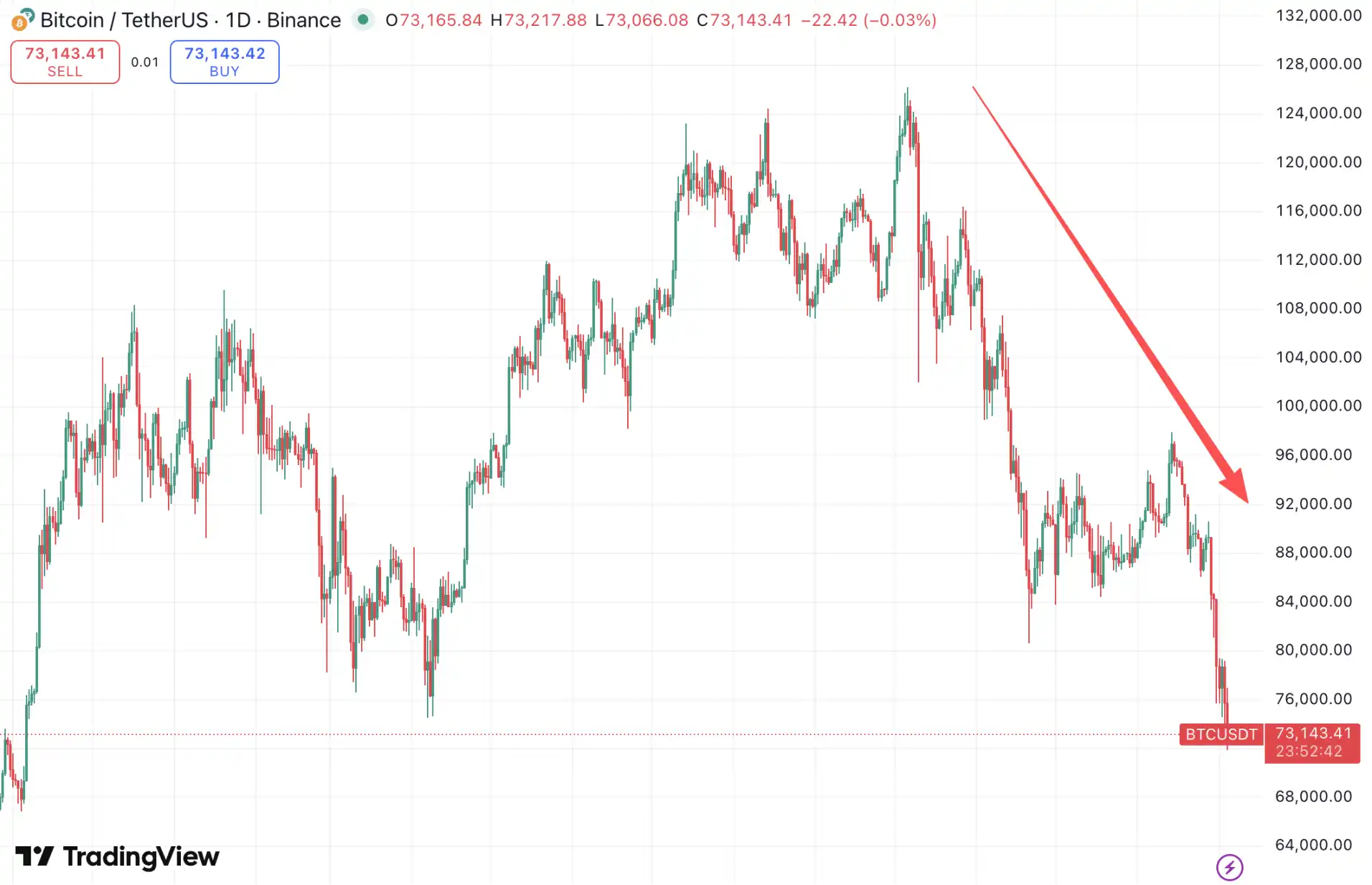
This round of decline is no longer just a continuation of internal deleveraging in the crypto market but is driven by broader cross-asset pressures. Global markets saw synchronized selling on Wednesday, with the Nasdaq 100 index falling over 2%. Sectors more sensitive to interest rates, such as software and chips, were generally under pressure, and Bitcoin weakened accordingly.

On the sentiment front, a 'crisis of faith' is forming. Shiliang Tang, Managing Partner of Monarq Asset Management, stated that the market is experiencing a 'crisis of faith.'

Andrew Tu, Head of Business Development at Efficient Frontier, added that crypto market sentiment is already in 'extreme fear.' If the $72,000 level is lost, Bitcoin could fall to $68,000 or even return to the low range seen before the initial rebound in early 2024.

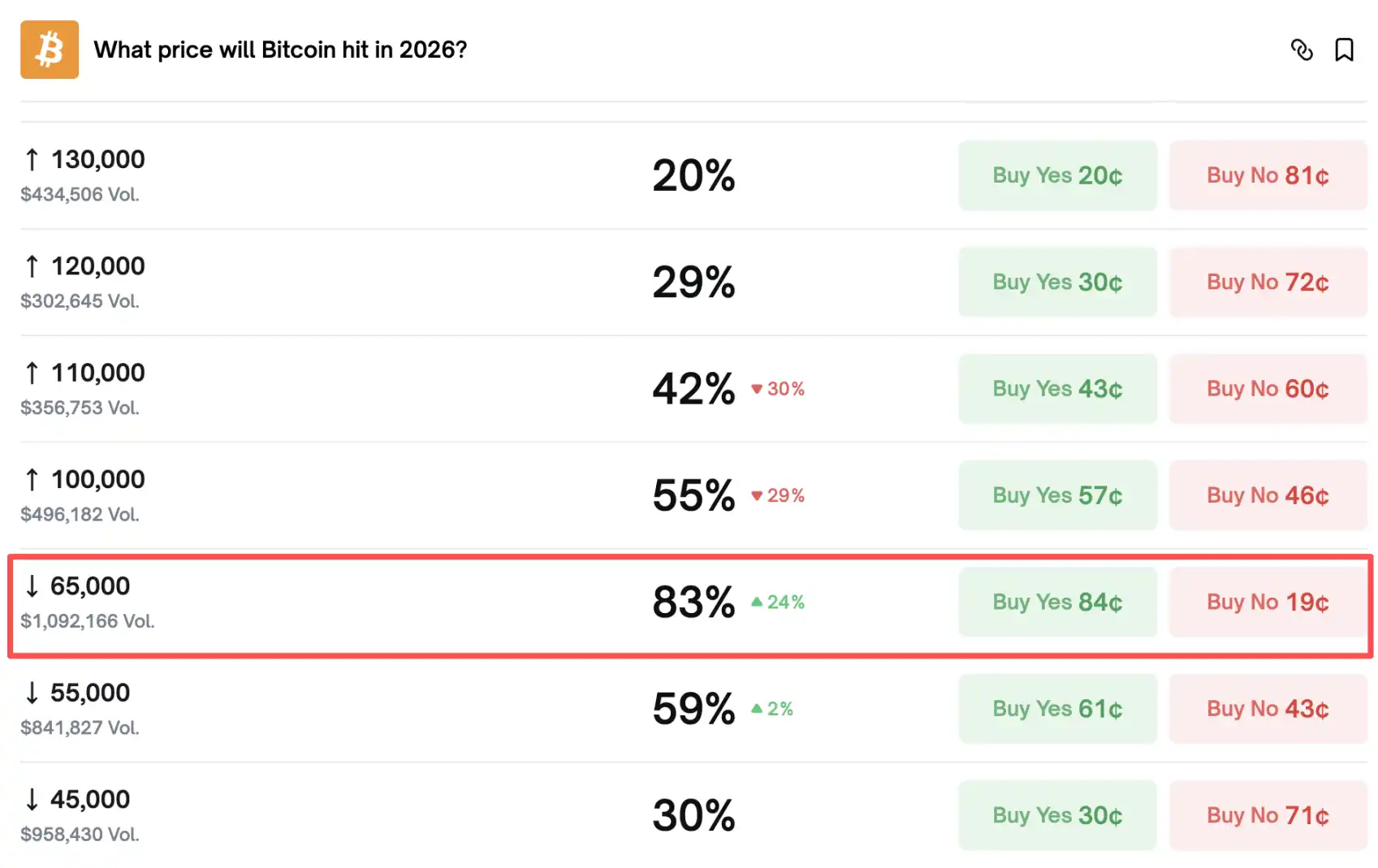
According to Polymarket, there is an 83% probability that Bitcoin will fall to $65,000 this year, while the probability of breaking below $55,000 has climbed to about 59%.
Risk appetite shifts sharply, Bitcoin treated as a 'high-volatility risk asset'

According to Bloomberg, the selling pressure on Bitcoin on Wednesday was related to broader cross-asset tensions rather than being solely driven by internal crypto asset liquidations. This point is clear to investors: during synchronized selling phases, Bitcoin has not demonstrated resilience independent of risk assets but instead behaves more like a high-volatility, long-tail risk asset.

The Nasdaq 100 index fell over 2% on the same day, with losses spreading to sectors such as software and chips. Bitcoin broke below key integer levels during the same trading session, reinforcing the market's perception of its correlation with risk appetite.

42% pullback from peak, crypto market loses over $460 billion in a week

The price pullback is quickly translating into market cap contraction. According to CoinGecko data, the total market capitalization of crypto assets has shrunk by approximately $1.7 trillion since the peak in October last year. In the past week alone, the crypto market cap decreased by over $460 billion.

As the largest cryptocurrency, the extent and speed of Bitcoin's decline have an 'anchoring effect' on market sentiment. When Bitcoin's year-to-date losses expand to about 17%, risk control, margin management, and redemption pressures often rise simultaneously, further exacerbating overall volatility.

How the 'crisis of faith' emerged: From liquidation shocks to emotional collapse

Statements from market participants indicate that sentiment changes are becoming a core variable. The 'crisis of faith' mentioned by Shiliang Tang refers to investors' simultaneous wavering in both the long-term narrative of crypto assets and their short-term pricing mechanisms.

More critically, the driver of the decline has changed. According to Bloomberg, previous decline phases were more driven by crypto-specific liquidations, while Wednesday's pressure came from broader cross-market tensions.

This means that even if internal leverage unwinding in the crypto market concludes, Bitcoin may still lack independent catalysts for a rebound as long as external risk assets remain under pressure.

$72,000 becomes short-term watershed, prediction markets bet on drop to $65,000 within the year

Several traders view the $72,000 level as a key short-term price point. Andrew Tu pointed out that if this level cannot be held, Bitcoin is 'very likely' to test $68,000 and may return to the low range seen before the initial rebound in early 2024.

According to Polymarket, there is an 83% probability that Bitcoin will fall to $65,000 this year, while the probability of breaking below $55,000 has climbed to about 59%.

The funding side is also sending mixed signals. According to data compiled by Bloomberg, U.S.-listed spot Bitcoin ETFs recorded approximately $562 million in net inflows on Monday but turned to net outflows of $272 million on Tuesday, indicating that incremental capital is not stable.

Amid the price decline and反复的资金流 (repeated fund flow fluctuations), market skepticism about Bitcoin's role as a 'safe-haven asset during periods of pressure' is rising.


Twitter:https://twitter.com/BitpushNewsCN

Bitpush TG Discussion Group:https://t.me/BitPushCommunity

Bitpush TG Subscription: https://t.me/bitpush

Original link:https://www.bitpush.news/articles/7608941

Related Questions

QWhat key price level did Bitcoin fall below, according to the article?

ABitcoin fell below the $72,000 level, and later dropped below $71,000.

QWhat is the main reason cited for the recent sell-off in Bitcoin, distinguishing it from previous declines?

AThe recent sell-off was driven by broader cross-asset pressure and a global decline in risk appetite, rather than being solely driven by internal crypto market liquidations.

QAccording to market participants, what is the significant psychological term used to describe the current market sentiment?

AMarket participants describe the current sentiment as a 'crisis of faith' or being in a state of 'extreme fear'.

QWhat is the probability, according to Polymarket, that Bitcoin will drop to $65,000 this year?

AAccording to Polymarket, there is an 83% probability that Bitcoin will drop to $65,000 this year.

QWhat does the recent flow data for US-listed spot Bitcoin ETFs indicate about investor behavior?

AThe flow data indicates unstable investor behavior, with the ETFs seeing a net inflow of approximately $562 million on Monday, followed by a net outflow of $272 million on Tuesday.

Related Reads

Unveiling the 'White-haired Stock God' Serenity: A Spiritual Remedy for Anxious Retail Investors

The article details the rise of Serenity, dubbed the "White-Haired Stock God," whose social media posts have recently caused significant volatility in China's A-share market. Previously gaining fame in international retail investor communities, Serenity is known for his "Chokepoint Investment" strategy targeting small monopolies in the AI supply chain, reportedly achieving returns over 3612% this year. His influence stems from his background as a former AI research scientist, detailed analysis, and a massive following on X, where his subscriber count has surpassed Elon Musk's. In early June, Serenity's Chinese-language posts mentioning A-shares like LeaderDrive (Lide Xiebo), Easun, and Innolight triggered immediate 20% surges in their stock prices. He later clarified that some recommendations were crowdsourced from followers and claimed he did not hold positions in these stocks, stating his actions were "just for fun" to offer a foreign perspective on Chinese markets. This activity drew scrutiny from Chinese financial media, which warned of potential "pump-and-dump" schemes and legal risks. While anonymous, clues suggest Serenity is likely a Chinese-speaking individual living in Japan. He maintains his anonymity due to past harassment but enjoys substantial monthly income from his paid subscriptions. The article posits that Serenity embodies the market's current appetite for a charismatic, successful figure during the AI bull run, serving as an "outward projection" of bullish sentiment. It concludes by noting the cyclical nature of such market icons, warning that the same crowds that elevate them often seek scapegoats when trends reverse.

Odaily星球日报4m ago

Unveiling the 'White-haired Stock God' Serenity: A Spiritual Remedy for Anxious Retail Investors

Odaily星球日报4m ago

Unveiling the 'White-Haired Stock God' Serenity: The Mental Elixir for Anxious Retail Investors

The anonymous stock influencer known as "White-Haired Stock God" Serenity has ignited a frenzy in the A-share market. From June 5-9, Serenity's posts on platform X mentioning A-shares like LeaderDrive, Easun, and Innolight triggered sharp price surges, with some stocks hitting 20% daily limits. Serenity, who claims a 3612% personal return this year, gained fame internationally using a "chokepoint investment" strategy focused on small, monopolistic AI supply chain companies. With over 810k X followers, his influence rivals top analysts. His recent foray into Chinese stocks, which he claims is "for fun" to offer a "foreign perspective," has drawn scrutiny. While Serenity denies holding positions in these A-shares and states his posts are not recommendations, his actions have caused significant market volatility. He monetizes through a $1/month subscription, earning an estimated $54k monthly. Facing accusations of market manipulation, he maintains he promotes "information democracy." Community analysis suggests Serenity is likely an English-speaking Chinese national living in Japan, based on his posting patterns and shared personal details. He maintains anonymity due to past harassment. Ultimately, Serenity is seen by many as a manifestation of the current AI bull market's euphoria—a mysterious, seemingly successful figure who fulfills the market's desire for a "stock god," though such personas often face intense scrutiny when market sentiment shifts.

marsbit5m ago

Unveiling the 'White-Haired Stock God' Serenity: The Mental Elixir for Anxious Retail Investors

marsbit5m ago

Korean Youth, Making a 'Last Stand' in an Epic Bull Market

South Korea is experiencing an unprecedented stock market boom in the first half of 2026, with the KOSPI index doubling in six months, driven primarily by tech giants Samsung Electronics and SK Hynix. This "epic bull run," tied to the semiconductor cycle, has sparked a nationwide frenzy for stock trading. The country, with a population of just over 50 million, now has over 105 million securities accounts. The article, from the perspective of a Chinese national living in Seoul, explores how this speculative fever reflects deeper societal anxieties among Korean youth. Facing stagnant wages, high costs of living, housing pressures, and rigid social stratification, many young people see the volatile market as a "last chance" to alter their predetermined life trajectories and escape financial precarity. Stories include a young office worker investing her meager savings, a couple delaying marriage due to financial pressures, and a seasoned trader navigating exclusive social circles where market information is currency. However, the boom also exposes and exacerbates existing inequalities. While some achieve windfalls, others face devastating losses, with borrowing to invest reaching record highs. The narrative contrasts the illusion of equal opportunity with the harsh reality that the ability to absorb risk is unevenly distributed. Ultimately, the market frenzy is portrayed not as a solution, but as a symptom of a generation's struggle against a system offering limited upward mobility, where daily life is a precarious balance of bills, debts, and societal expectations.

marsbit32m ago

Korean Youth, Making a 'Last Stand' in an Epic Bull Market

marsbit32m ago

Young South Koreans, Making a 'Last-Ditch Effort' in an Epic Bull Market

This article explores how an unprecedented stock market boom in South Korea during the first half of 2026, driven by the semiconductor industry, is transforming the lives of ordinary people, particularly the youth. The KOSPI index doubled in six months, fueled by giants Samsung and SK Hynix, leading to a frenzy of retail investing. With over 105 million stock accounts in a population of just over 50 million, a sense of "FOMO" (fear of missing out) is pervasive. Through the perspective of Li Yuning, a Chinese woman living in Seoul, the piece follows several young Koreans who see the market as a last chance to escape stifling economic pressures, high housing costs, and narrow social mobility. Individuals like Minji, a low-paid office worker, and Junho, saving for marriage, invest their limited savings, while experienced traders like Suhu navigate exclusive social circles. The narrative reveals that this speculative fever stems less from greed and more from deep-seated anxiety about being left behind in a society with growing wealth inequality and rigid class structures. However, the boom also exposes stark social divides. It exacerbates wealth gaps, as those with family support or existing capital fare better. The pressure to succeed is immense, with stories of devastating losses leading to personal tragedy. Ultimately, the article suggests the牛市 acts as a pressure valve and a temporary illusion of opportunity in a system where traditional paths to advancement seem increasingly closed, leaving young people to gamble on the market as a final, desperate bid for a better future.

链捕手38m ago

Young South Koreans, Making a 'Last-Ditch Effort' in an Epic Bull Market

链捕手38m ago

Trading

Spot
Futures

Hot Articles

What is $BITCOIN

DIGITAL GOLD ($BITCOIN): A Comprehensive Analysis Introduction to DIGITAL GOLD ($BITCOIN) DIGITAL GOLD ($BITCOIN) is a blockchain-based project operating on the Solana network, which aims to combine the characteristics of traditional precious metals with the innovation of decentralized technologies. While it shares a name with Bitcoin, often referred to as “digital gold” due to its perception as a store of value, DIGITAL GOLD is a separate token designed to create a unique ecosystem within the Web3 landscape. Its goal is to position itself as a viable alternative digital asset, although specifics regarding its applications and functionalities are still developing. What is DIGITAL GOLD ($BITCOIN)? DIGITAL GOLD ($BITCOIN) is a cryptocurrency token explicitly designed for use on the Solana blockchain. In contrast to Bitcoin, which provides a widely recognized value storage role, this token appears to focus on broader applications and characteristics. Notable aspects include: Blockchain Infrastructure: The token is built on the Solana blockchain, known for its capacity to handle high-speed and low-cost transactions. Supply Dynamics: DIGITAL GOLD has a maximum supply capped at 100 quadrillion tokens (100P $BITCOIN), although details regarding its circulating supply are currently undisclosed. Utility: While precise functionalities are not explicitly outlined, there are indications that the token could be utilized for various applications, potentially involving decentralized applications (dApps) or asset tokenization strategies. Who is the Creator of DIGITAL GOLD ($BITCOIN)? At present, the identity of the creators and development team behind DIGITAL GOLD ($BITCOIN) remains unknown. This situation is typical among many innovative projects within the blockchain space, particularly those aligning with decentralized finance and meme coin phenomena. While such anonymity may foster a community-driven culture, it intensifies concerns about governance and accountability. Who are the Investors of DIGITAL GOLD ($BITCOIN)? The available information indicates that DIGITAL GOLD ($BITCOIN) does not have any known institutional backers or prominent venture capital investments. The project seems to operate on a peer-to-peer model focused on community support and adoption rather than traditional funding routes. Its activity and liquidity are primarily situated on decentralized exchanges (DEXs), such as PumpSwap, rather than established centralized trading platforms, further highlighting its grassroots approach. How DIGITAL GOLD ($BITCOIN) Works The operational mechanics of DIGITAL GOLD ($BITCOIN) can be elaborated on based on its blockchain design and network attributes: Consensus Mechanism: By leveraging Solana’s unique proof-of-history (PoH) combined with a proof-of-stake (PoS) model, the project ensures efficient transaction validation contributing to the network's high performance. Tokenomics: While specific deflationary mechanisms have not been extensively detailed, the vast maximum token supply implies that it may cater to microtransactions or niche use cases that are still to be defined. Interoperability: There exists the potential for integration with Solana’s broader ecosystem, including various decentralized finance (DeFi) platforms. However, the details regarding specific integrations remain unspecified. Timeline of Key Events Here is a timeline that highlights significant milestones concerning DIGITAL GOLD ($BITCOIN): 2023: The initial deployment of the token occurs on the Solana blockchain, marked by its contract address. 2024: DIGITAL GOLD gains visibility as it becomes available for trading on decentralized exchanges like PumpSwap, allowing users to trade it against SOL. 2025: The project witnesses sporadic trading activity and potential interest in community-led engagements, although no noteworthy partnerships or technical advancements have been documented as of yet. Critical Analysis Strengths Scalability: The underlying Solana infrastructure supports high transaction volumes, which could enhance the utility of $BITCOIN in various transaction scenarios. Accessibility: The potential low trading price per token could attract retail investors, facilitating wider participation due to fractional ownership opportunities. Risks Lack of Transparency: The absence of publicly known backers, developers, or an audit process may yield skepticism regarding the project's sustainability and trustworthiness. Market Volatility: The trading activity is heavily reliant on speculative behavior, which can result in significant price volatility and uncertainty for investors. Conclusion DIGITAL GOLD ($BITCOIN) emerges as an intriguing yet ambiguous project within the rapidly evolving Solana ecosystem. While it attempts to leverage the “digital gold” narrative, its departure from Bitcoin's established role as a store of value underscores the need for a clearer differentiation of its intended utility and governance structure. Future acceptance and adoption will likely depend on addressing the current opacity and defining its operational and economic strategies more explicitly. Note: This report encompasses synthesised information available as of October 2023, and developments may have transpired beyond the research period.

363 Total ViewsPublished 2025.05.13Updated 2025.05.13

What is $BITCOIN

Discussions

Welcome to the HTX Community. Here, you can stay informed about the latest platform developments and gain access to professional market insights. Users' opinions on the price of BTC (BTC) are presented below.

活动图片















