Bitcoin banking adoption hits 32%, but ‘we’re still early,’ says Strategy’s Saylor

ambcryptoPublished on 2026-07-15Last updated on 2026-07-15

Abstract

Major banks are accelerating Bitcoin adoption, reaching a 32% overall adoption rate according to Michael Saylor's Bitcoin Banking Adoption Index. However, Saylor notes this adoption is "still early." Fidelity leads with a 71% rating, followed by BNY Mellon and Goldman Sachs. A key finding is banks' preference for using Spot Bitcoin ETFs, rather than physical BTC, as collateral for credit—a practice that remains relatively low. This is significant for Saylor's vision of turning his firm, Strategy, into a "Bitcoin bank" that uses its BTC holdings to create new credit instruments. The current data suggests treating Bitcoin as high-quality collateral is not yet widespread, making this vision a longer-term prospect. In related news, Strategy has increased its cash reserves to $3 billion, providing 20 months of coverage for its obligations, following analyst recommendations to bolster financial stability. While the "Bitcoin bank" concept faces hurdles, growing bank engagement indicates potential future viability.

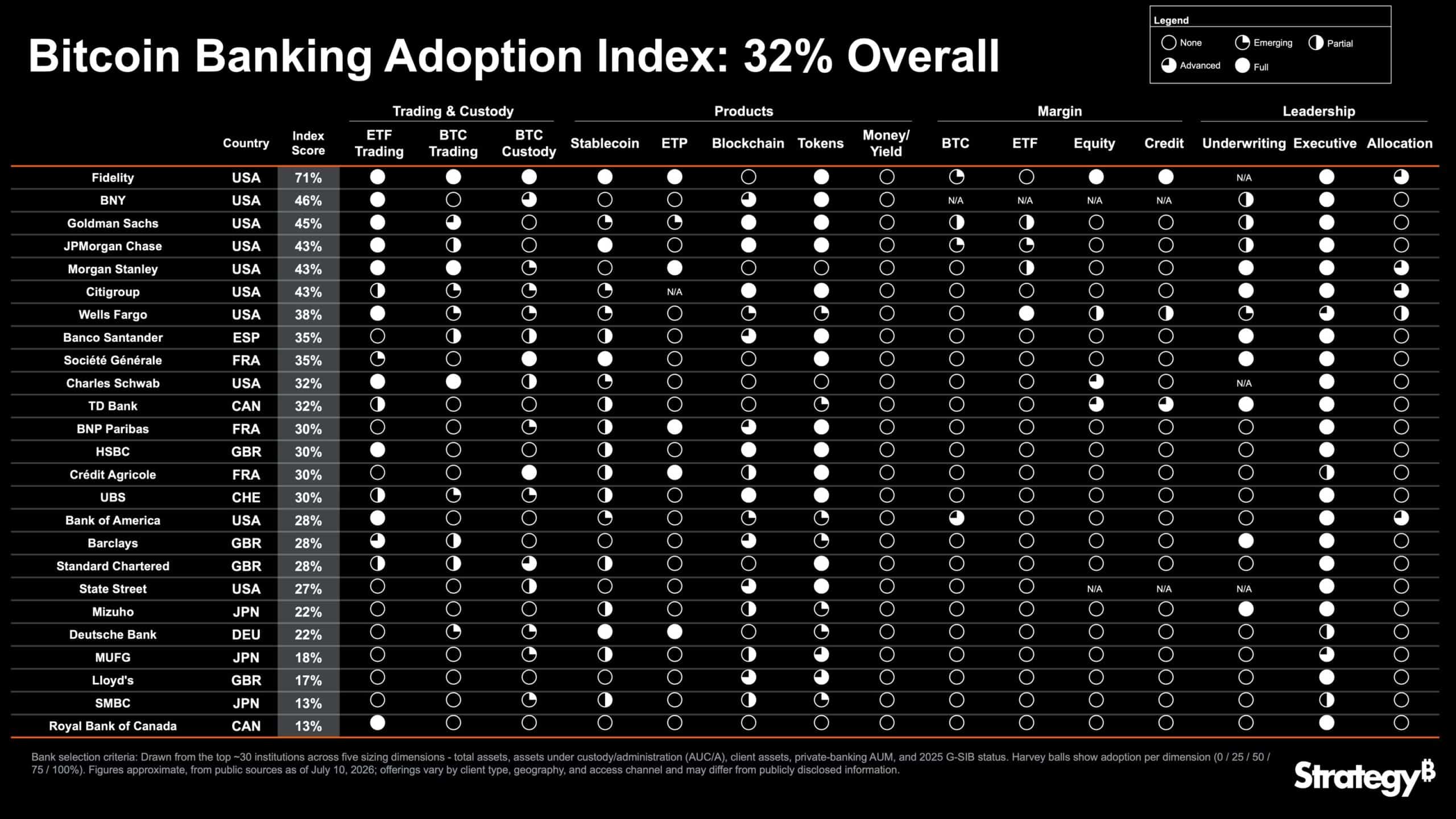
Bitcoin has seen accelerated adoption by major global banks, but the traction is “still early.” This, according to Michael Saylor, founder of Strategy, the world’s largest BTC treasury firm. In a newly released Bitcoin Banking Adoption Index, covering ETF trading, credit and more, Saylor added,

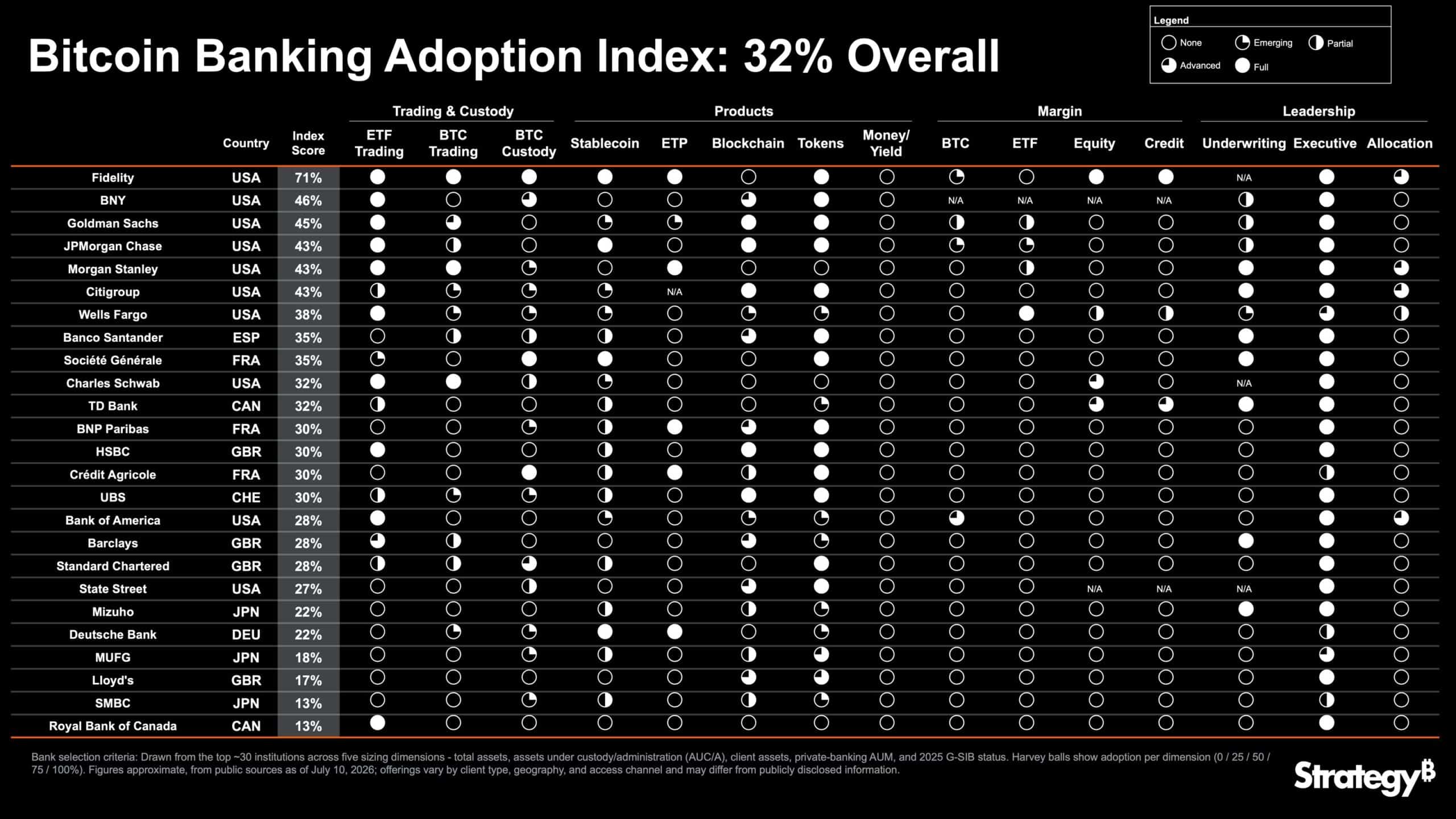
Major-bank Bitcoin adoption is accelerating, but still early: 32% overall as measured by the index.
Source: Strategy

Fidelity leads in the adoption race with a 71% rating, with a full score for custody, BTC, and ETF trading alongside stablecoin issuance. BNY Mellon comes in second with a 46% score, while Goldman Sachs closed the top three list with a 45% rating.

Other top-ranking global players were Spain’s Banco Santander, France’s Société Générale, and the UK’s Standard Chartered.

Is Strategy still eyeing ‘Bitcoin bank’ vision?

The most interesting part of the new composite index is the ‘credit’ section, or banks enabling credit against spot BTC or derivatives like BlackRock’s iShares Bitcoin Trust (IBIT). In other words, banks that allow leverage or offer credit using Spot BTC or ETFs as collateral.

As of 2026, most banks were more inclined towards Spot BTC ETFs for collateral, rather than spot BTC. However, given the empty circles, it meant adoption of BTC or ETF margin was still relatively low.

This is particularly important because Saylor has floated positioning Strategy as the “world’s first Bitcoin bank.” According to him, the firm could use its vast BTC holdings as collateral to create new credit instruments beyond STRC and partner with leading banks for the same.

The 32% bank adoption is commendable. However, the adoption index clearly shows that BTC is not fully treated as high-quality collateral, at least as of 2026. By extension, it means its vision of being a “BTC bank” could still be far from being viable.

Interestingly, Metaplanet is exploring something similar but for the Japanese bond market.

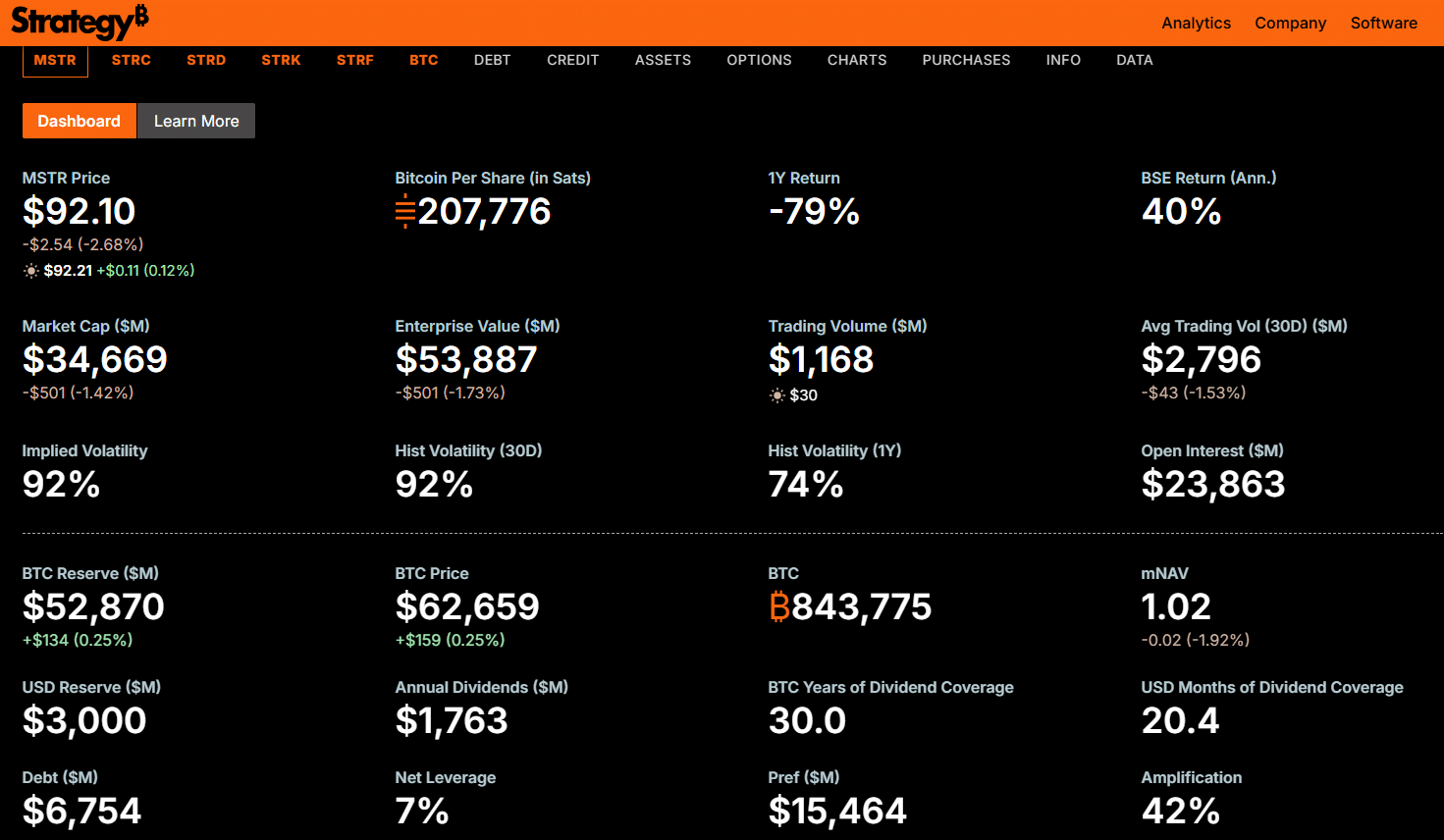
In other developments, Strategy has increased its cash reserve to $3B after a $467M MSTR share sale. This has effectively increased its coverage for its financial obligations to 20 months.
Source: Strategy

It seems that the firm was partly following the recommendations by JPMorgan analysts who urged for a 24-36 months cash reserve by selling more MSTR, not its BTC holdings.

Overall, Strategy’s “Bitcoin bank” dreams may still be far from reach right now. Even so, there is traction across banks that could determine whether it will be viable in the future.


Final Summary

  • Bitcoin adoption among banks has surged by 32%, but Spot BTC ETFs may be preferred for margin than physical BTC.
  • Strategy increased its cash reserves to $3B and 20 months of coverage, just shy of 24 months recommended by JPMorgan.


Trending Cryptos

Related Questions

QAccording to the article, what is the overall Bitcoin banking adoption rate as of 2026 according to Michael Saylor's index?

AThe overall Bitcoin banking adoption rate is 32% as measured by the Bitcoin Banking Adoption Index.

QWhich three major banks lead in Bitcoin adoption according to the index, and what are their scores?

AFidelity leads with a 71% rating, BNY Mellon comes second with a 46% score, and Goldman Sachs is third with a 45% rating.

QWhat is the key reason the article suggests Strategy's vision of becoming a 'Bitcoin bank' is still far from viable?

AThe adoption index shows that Bitcoin is not yet fully treated as high-quality collateral by banks, particularly for credit and margin purposes, which is crucial for a Bitcoin banking model.

QWhat did Strategy do to increase its cash reserves and financial coverage, and what was the recommended target from JPMorgan?

AStrategy increased its cash reserve to $3 billion after a $467 million MSTR share sale, giving it 20 months of coverage for its financial obligations. JPMorgan analysts had recommended a 24-36 month cash reserve.

QAccording to the index, are banks in 2026 more inclined to use Spot BTC or Spot BTC ETFs as collateral for credit?

AAs of 2026, most banks were more inclined towards using Spot Bitcoin ETFs for collateral, rather than spot BTC itself.

Related Reads

With NOXA's Exit, Who Will Take the Crown of Robinhood Chain's Token Launch?

Original by Odaily Planet Daily, author Asher. The hottest token launch platform on Robinhood Chain, NOXA, suddenly halted its token issuance business at its peak traffic. Over about two weeks, NOXA had dominated Robinhood Chain's meme scene, launching around 60,000 tokens and accounting for over 75% of new tokens on the chain. It produced the meme coin CASHCAT, which reached a market cap exceeding $200 million, and its protocol fees surpassed $14.5 million. However, NOXA suspended new launches on July 11th citing issues like bot attacks. While it later restored a static site for viewing historical tokens and claiming creator fees, its core launch function was permanently shut down, effectively exiting the competition. Following NOXA's departure, daily token creation on Robinhood Chain quickly rebounded and hit a new high, with demand shifting to over 20 other launchpads. Flap emerged as the largest beneficiary by volume, capturing over 35% of daily launches. Bankr, backed by Coinbase Ventures, offers an AI Agent-based launch entry point. Klik attracted traders by refunding all platform fees to them, while trench.today also saw significant launch volume. The article concludes that merely handling high launch volumes is insufficient to become the next leader. The key, as demonstrated by NOXA with CASHCAT, is to produce a flagship meme token with significant market capitalization and wealth effect. Until such a token emerges from a new platform, the landscape on Robinhood Chain remains a fiercely contested battle with no clear frontrunner.

Odaily星球日报21m ago

With NOXA's Exit, Who Will Take the Crown of Robinhood Chain's Token Launch?

Odaily星球日报21m ago

Trading

Spot

Hot Articles

What is $BITCOIN

DIGITAL GOLD ($BITCOIN): A Comprehensive Analysis Introduction to DIGITAL GOLD ($BITCOIN) DIGITAL GOLD ($BITCOIN) is a blockchain-based project operating on the Solana network, which aims to combine the characteristics of traditional precious metals with the innovation of decentralized technologies. While it shares a name with Bitcoin, often referred to as “digital gold” due to its perception as a store of value, DIGITAL GOLD is a separate token designed to create a unique ecosystem within the Web3 landscape. Its goal is to position itself as a viable alternative digital asset, although specifics regarding its applications and functionalities are still developing. What is DIGITAL GOLD ($BITCOIN)? DIGITAL GOLD ($BITCOIN) is a cryptocurrency token explicitly designed for use on the Solana blockchain. In contrast to Bitcoin, which provides a widely recognized value storage role, this token appears to focus on broader applications and characteristics. Notable aspects include: Blockchain Infrastructure: The token is built on the Solana blockchain, known for its capacity to handle high-speed and low-cost transactions. Supply Dynamics: DIGITAL GOLD has a maximum supply capped at 100 quadrillion tokens (100P $BITCOIN), although details regarding its circulating supply are currently undisclosed. Utility: While precise functionalities are not explicitly outlined, there are indications that the token could be utilized for various applications, potentially involving decentralized applications (dApps) or asset tokenization strategies. Who is the Creator of DIGITAL GOLD ($BITCOIN)? At present, the identity of the creators and development team behind DIGITAL GOLD ($BITCOIN) remains unknown. This situation is typical among many innovative projects within the blockchain space, particularly those aligning with decentralized finance and meme coin phenomena. While such anonymity may foster a community-driven culture, it intensifies concerns about governance and accountability. Who are the Investors of DIGITAL GOLD ($BITCOIN)? The available information indicates that DIGITAL GOLD ($BITCOIN) does not have any known institutional backers or prominent venture capital investments. The project seems to operate on a peer-to-peer model focused on community support and adoption rather than traditional funding routes. Its activity and liquidity are primarily situated on decentralized exchanges (DEXs), such as PumpSwap, rather than established centralized trading platforms, further highlighting its grassroots approach. How DIGITAL GOLD ($BITCOIN) Works The operational mechanics of DIGITAL GOLD ($BITCOIN) can be elaborated on based on its blockchain design and network attributes: Consensus Mechanism: By leveraging Solana’s unique proof-of-history (PoH) combined with a proof-of-stake (PoS) model, the project ensures efficient transaction validation contributing to the network's high performance. Tokenomics: While specific deflationary mechanisms have not been extensively detailed, the vast maximum token supply implies that it may cater to microtransactions or niche use cases that are still to be defined. Interoperability: There exists the potential for integration with Solana’s broader ecosystem, including various decentralized finance (DeFi) platforms. However, the details regarding specific integrations remain unspecified. Timeline of Key Events Here is a timeline that highlights significant milestones concerning DIGITAL GOLD ($BITCOIN): 2023: The initial deployment of the token occurs on the Solana blockchain, marked by its contract address. 2024: DIGITAL GOLD gains visibility as it becomes available for trading on decentralized exchanges like PumpSwap, allowing users to trade it against SOL. 2025: The project witnesses sporadic trading activity and potential interest in community-led engagements, although no noteworthy partnerships or technical advancements have been documented as of yet. Critical Analysis Strengths Scalability: The underlying Solana infrastructure supports high transaction volumes, which could enhance the utility of $BITCOIN in various transaction scenarios. Accessibility: The potential low trading price per token could attract retail investors, facilitating wider participation due to fractional ownership opportunities. Risks Lack of Transparency: The absence of publicly known backers, developers, or an audit process may yield skepticism regarding the project's sustainability and trustworthiness. Market Volatility: The trading activity is heavily reliant on speculative behavior, which can result in significant price volatility and uncertainty for investors. Conclusion DIGITAL GOLD ($BITCOIN) emerges as an intriguing yet ambiguous project within the rapidly evolving Solana ecosystem. While it attempts to leverage the “digital gold” narrative, its departure from Bitcoin's established role as a store of value underscores the need for a clearer differentiation of its intended utility and governance structure. Future acceptance and adoption will likely depend on addressing the current opacity and defining its operational and economic strategies more explicitly. Note: This report encompasses synthesised information available as of October 2023, and developments may have transpired beyond the research period.

803 Total ViewsPublished 2025.05.13Updated 2025.05.13

What is $BITCOIN

Discussions

Welcome to the HTX Community. Here, you can stay informed about the latest platform developments and gain access to professional market insights. Users' opinions on the price of BTC (BTC) are presented below.

活动图片