Michael Burry's paid newsletter, 'Cassandra Unchained,' surpassed 300,000 subscribers in just 231 days. At an annual fee of $379, this translates to a theoretical yearly revenue of approximately $113.7 million. Meanwhile, his short positions in AI and semiconductor stocks like NVIDIA, Micron, and AMAT have faced significant pressure this year, with Micron's stock price surging as much as 697% year-to-date.
Shorting AI stocks is losing big, but selling subscriptions could be a jackpot—Michael Burry's most profitable venture this year might not be stock trading, but blogging.
'Big Short' investor Michael Burry's investment newsletter on Substack, 'Cassandra Unchained,' surpassed 300,000 subscribers in just 231 days. At an annual fee of $379, this translates to a theoretical yearly revenue of approximately $113.7 million.
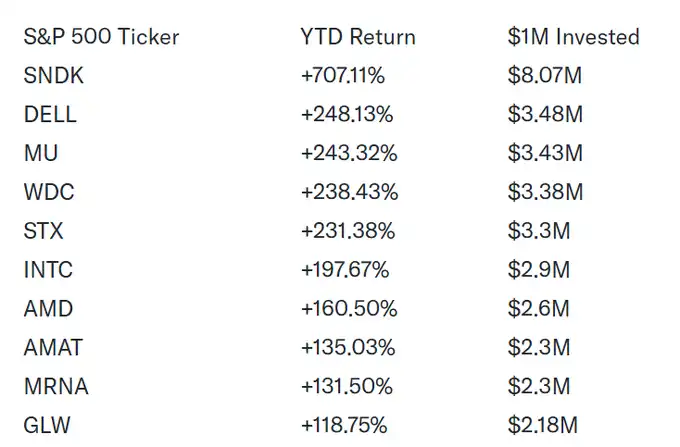
How staggering is this number? According to a report from Stocktwits, if $1 million were invested in each of the year's top 10 performing stocks in the S&P 500, the total return would be around $34 million—less than one-third of Burry's theoretical newsletter revenue.
300,000 Subscribers in 231 Days
In a post titled 'Short & Thankful: 300,' Burry disclosed that 'Cassandra Unchained' has reached 300,044 subscribers and 346,680 followers. Subscribers come from all 50 U.S. states and 212 countries, with 52% located outside the United States.
Data shows that the 'Cassandra Unchained' newsletter had about 218,000 followers in January of this year, growing to nearly 347,000 by July, indicating a consistently upward growth trajectory.
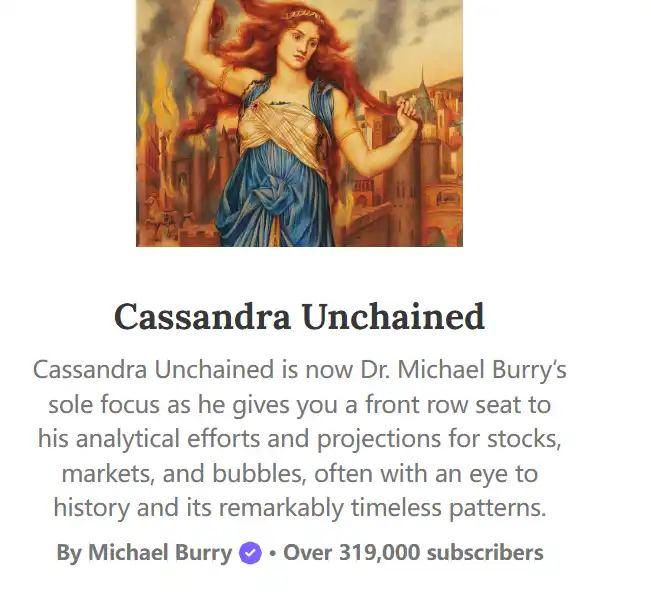
The newsletter is priced at $39 per month or $379 per year, with a free tier also available. Burry has not disclosed the specific proportion of paid subscribers. Substack's subscriber count includes both free and paid readers, and the aforementioned calculation does not deduct Substack's platform fees. Therefore, the $113.7 million figure represents a theoretical maximum, not actual net income.
Burry launched the newsletter in November 2025, shortly after deregistering his hedge fund with the SEC, returning to social media, and resuming his criticism of the AI frenzy. The newsletter attracted over 60,000 subscribers at launch and has gradually evolved into his primary platform for publishing real-time portfolio updates, valuation analyses, and detailed trading records.
Long Value Stocks: PayPal, Lululemon, Alibaba
In the newsletter, Burry continuously discloses specific trades.
In April, he made his first large-scale public disclosure of holdings, initiating a position in PayPal Holdings (PYPL) at around $49, making it 3.5% of his portfolio and naming it his top pick in the software and payments sector, ahead of Fiserv (FI) and Adobe (ADBE). He subsequently added to his PayPal position around $45 and simultaneously bought Fiserv. That same month, he also initiated positions in Adobe, Autodesk (ADSK), and Veeva Systems (VEEV), citing that 'AI disruption fears have compressed software valuations below intrinsic value.'
In April, he also reaffirmed his confidence in Molina Healthcare (MOH), stating that market expectations had 'bottomed out' and that he would continue adding to the position, as the investment thesis is based on normalized earnings over the coming years.
In June, Burry turned his attention to Lululemon Athletica (LULU), adding to the position multiple times. He stated bluntly: 'Terrible management is a value investor's best friend.' He believes Wall Street is overly focused on management missteps, tariffs, and slowing growth, while neglecting its long-term value.
Regarding Chinese assets, Burry disclosed in April that he held over 6% of Alibaba's stock and continued adding to his position in JD.com (JD). Last week, he stated that JD.com is one of his top three holdings and predicted that 'as the enthusiasm for AI and memory chips wanes, capital will rotate toward Hong Kong and Chinese stocks.'
Shorting AI Stocks: NVIDIA, Micron, Palantir
Simultaneously, Burry has been consistently expanding his short positions in AI and semiconductor stocks.
In April, he disclosed holding additional put options on NVIDIA (NVDA), including contracts expiring in January 2027 with a strike price of $115, while maintaining his previous $100 puts. On June 30th, he escalated the trade to directly shorting NVIDIA, entering at a price of $198.09. The same update also disclosed new short positions in Applied Materials (AMAT), the iShares Semiconductor ETF (SOXX), Tesla (TSLA), and Caterpillar (CAT). He compared the current semiconductor frenzy to the dot-com bubble.
'The immediate trigger for today's rally is Korea's announced massive spending. I think this is the beginning of the end,' Burry said.
Earlier this month, he disclosed directly shorting Micron Technology (MU), stating that the memory chipmaker's deviation from its 200-day moving average exceeded any point since 1984.
Regarding Palantir Technologies (PLTR), Burry has maintained one of Wall Street's most closely watched bearish stances since first disclosing the short last November. Although he partially covered the position, in June he reiterated that 'there's still no sign of seller capitulation or exhaustion.'
The Cost of Being Short: Getting 'Slapped' by the Market
However, reality has not been on Burry's side.
This year, many of the stocks he has shorted have significantly outperformed the broader market. The S&P 500 ETF (SPY) is up 22% year-to-date, the Nasdaq 100 ETF (QQQ) is up 31%, while NVIDIA has gained 29%, AMAT has skyrocketed 206%, and Micron has surged a staggering 697%.
Shorting these stocks means Burry has incurred substantial paper losses on these positions.
This is precisely why his newsletter revenue appears particularly striking—while under pressure on the trading front, the 'Big Short's' other business venture may quietly be becoming his biggest source of profit this year.