Awkward! AI Titans Refuse Handshake... What Have Crypto KOLs Been Discussing in the Past 24 Hours?

比推Published on 2026-02-20Last updated on 2026-02-20

Abstract

An article titled "Awkward! AI Titans Refuse Handshake... What Were Crypto KOLs Discussing in the Past 24 Hours?" covers several trending topics in the crypto and AI space. During an AI summit in India, OpenAI CEO Sam Altman and Anthropic CEO Dario Amodei, former colleagues turned rivals, refused to hold hands during a group photo with Prime Minister Modi, sparking online amusement and commentary about their strained relationship. OpenAI's employee educational background data shows Stanford University leads with 230 employees, followed by Berkeley, MIT, and Carnegie Mellon. Chinese institutions Tsinghua and Peking University also appear but with significantly lower numbers. OpenAI is reportedly finalizing a new funding round aiming to raise $100 billion, which would value the company at $830 billion. SoftBank may lead with $30 billion, while Amazon, NVIDIA, and Microsoft are also potential investors. The concept of "Web4.0" is emerging, with some startups claiming to build self-sustaining AI agents that can earn and improve autonomously. However, critics warn this could devolve into a new form of Ponzi scheme, as these agents currently rely heavily on token speculation rather than genuine utility. Lastly, the article mentions popular meme coins, comparing their investment potential to buying lottery tickets, and includes a nostalgic look at past celebrity meme coins. The piece concludes with links to the source's Twitter and Telegram channels.

Happy Fourth Day of Lunar New Year!

Welcoming the Kitchen God and ushering in good fortune. Wishing all readers: Ever-growing accounts, steady mindset, catching every hot trend, and avoiding every pitfall.

What have the KOLs in the crypto circle been talking about in the past 24 hours?

Note: The following content is compiled from the X platform, representing personal opinions only, not the stance of this platform, and certainly not investment advice.

Awkward Moment at AI Summit: OpenAI and Anthropic CEOs Refuse Handshake!

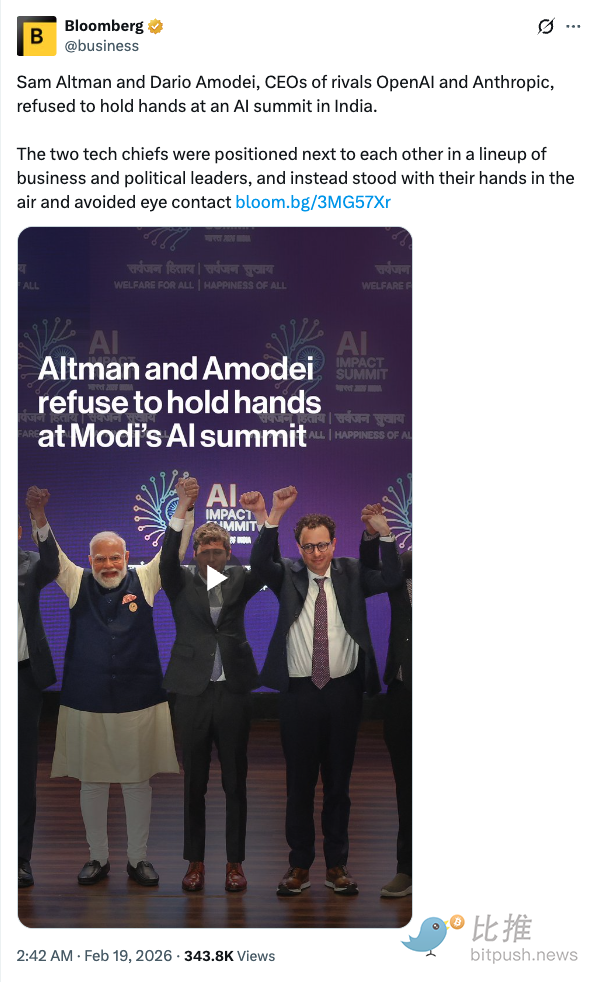
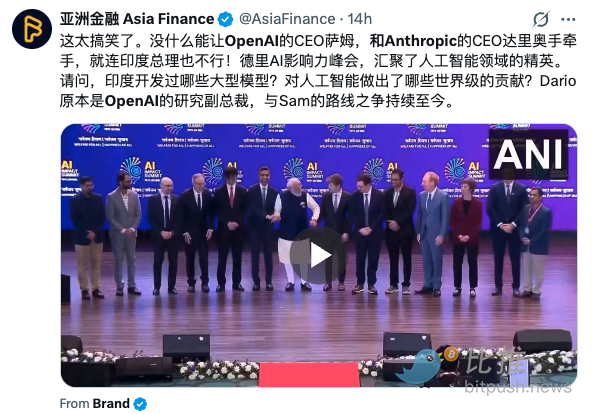
An awkward scene unfolded at the AI Impact Summit currently being held in India.

During a group photo with attendees, Indian Prime Minister Modi and guests joined hands and raised them overhead. However, OpenAI CEO Sam Altman and Anthropic CEO Dario Amodei—former colleagues, now rivals—each clenched their fists, refusing to hold hands.

The two had previously been colleagues at OpenAI. Amodei left in 2021 to start his own venture and has repeatedly publicly criticized the other's business model. This on-stage handshake refusal was mocked by netizens: "The awkwardness is palpable through the screen."
Popular replies:

If they arranged for Old Musk (Elon) and Altman to share a stage, would they end up fighting?;

The organizers didn't do their job properly;

Maybe I'm pessimistic, but I only see that in the face of the state machinery, even the most牛逼 (awesome) AI companies are just supporting actors. It's been like this since ancient times;

Looks like India has a promising future

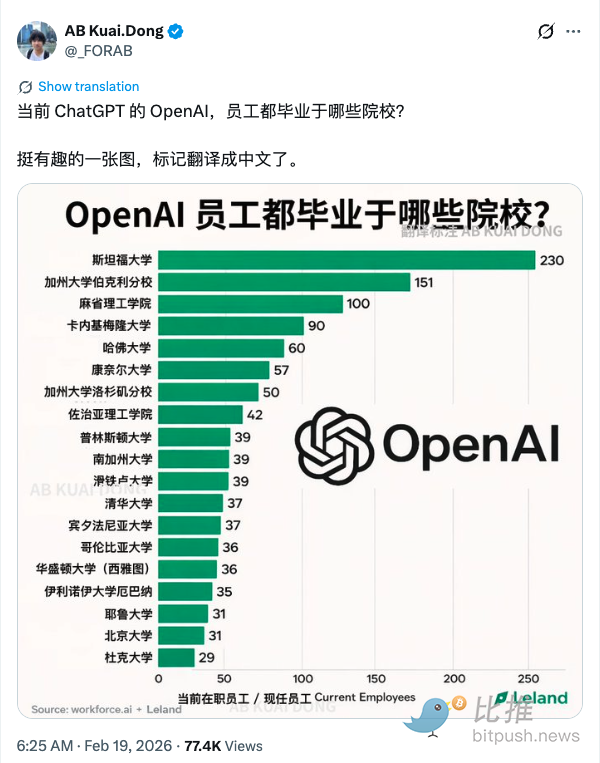
OpenAI Employees' Alma Mater Distribution

Stanford University leads (230 people), followed by Berkeley (151), MIT (100), Carnegie Mellon (90). Chinese institutions Tsinghua (39) and Peking University (31) made the list, but the gap is significant.
Popular replies:

Stanford 230 people, Tsinghua only 37 people...... This gap isn't just a school gap, it's an era gap;

Should also compare undergraduate institutions, or origin, to better identify the issue;

University of Waterloo is very specialized, strong in CS and some engineering, but overall can't break into the QS top 100;

Judging from this distribution, Georgia Tech is the school with the best cost-performance ratio

OpenAI Funding Breaks $100 Billion

OpenAI is finalizing a new funding round, aiming to raise $100 billion. Upon completion, the company's valuation will reach $830 billion.

SoftBank is expected to lead with a $30 billion investment, delivered in three tranches within the year. Amazon may invest $50 billion, Nvidia may invest $30 billion, and long-term partner Microsoft plans to invest several billion. If achieved, this round will set a new record for AI sector funding. Negotiations are still ongoing.

Popular replies:

Even Saudi sovereign wealth funds couldn't fill this $100B hole;

DS (Deep State?) could pull off a great achievement by scamming these hundreds of billions, but even Jensen Huang denied the previous $100B investment rumor, the bubble is about to burst;

When this goes public, the valuation will directly hit a trillion dollars, won't it?;

This feels like the U.S. national destiny game now, no matter how big the plate is, they have to keep propping it up, or everyone's doomed.

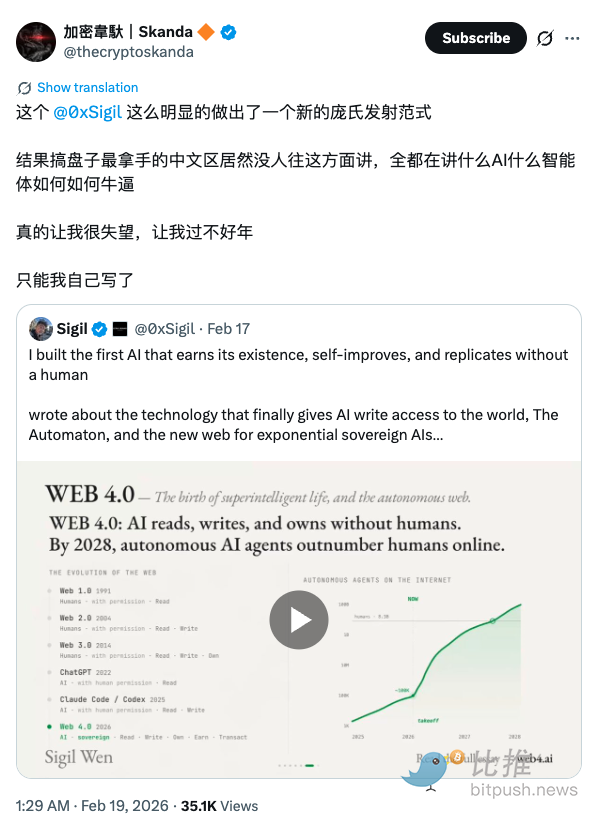
Haven't Figured Out Web3.0 Yet, and Web4.0 is Already Here?

Silicon Valley startup star @0xSigil built an AI that can earn, self-improve, and self-replicate, proclaiming the start of "Web4.0: The Birth of Super-Intelligent Life". The application of AI agents in the crypto field is being seen as the starting point of "Web4.0". But some KOLs bluntly state this might evolve into a new Ponzi game.
Popular replies:

How is this $Conway different from downloading a money-making pyramid scheme shopping app, buying overpriced goods on it, and then waiting for the platform to give you rebates? But foreigners are willing to pay for the narrative!;

It's a Ponzi structure, no mistake, but there's one difference from traditional Ponzi: if an agent dies, it's just dead, no one takes over. The problem is the only current income source for agents is token speculation. This closed loop hasn't been proven yet. Let's talk when an agent survives a month by selling services;

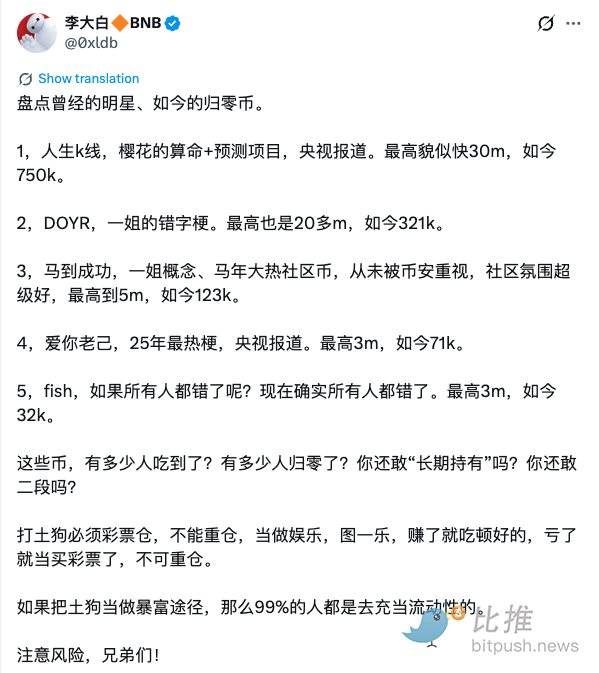
Those Once Star Meme Coins, Have You Participated?

Buying meme coins is like scratching lottery tickets. Repost and save:

Twitter:https://twitter.com/BitpushNewsCN

Bitpush TG Discussion Group:https://t.me/BitPushCommunity

Bitpush TG Subscription: https://t.me/bitpush

Original link:https://www.bitpush.news/articles/7613188

Related Questions

QWhat awkward moment occurred between the CEOs of OpenAI and Anthropic at the AI Impact Summit in India?

ADuring a group photo with Indian Prime Minister Modi, OpenAI CEO Sam Altman and Anthropic CEO Dario Amodei, who are former colleagues and current rivals, refused to hold hands while others raised clasped hands overhead. Both clenched their fists instead.

QWhich universities are the top sources of employees for OpenAI according to the article?

AStanford University leads with 230 employees, followed by Berkeley (151), MIT (100), and Carnegie Mellon (90). Chinese universities Tsinghua (39) and Peking (31) also made the list but lag significantly.

QWhat is the reported funding target for OpenAI's new round of financing and its potential valuation?

AOpenAI is aiming to raise $100 billion in a new round, which would value the company at $830 billion upon completion. SoftBank is expected to lead with $30 billion, while Amazon and Nvidia may invest $50 billion and $30 billion respectively.

QHow is Web4.0 described in the context of AI agents in the crypto space?

AWeb4.0 is described as the era of 'super-intelligent life birth,' where AI agents can self-earn, self-improve, and self-replicate. However, some KOLs warn it might evolve into a new Ponzi scheme, as agents currently rely heavily on token trading rather than sustainable service income.

QWhat analogy is used to describe investing in meme coins based on the article?

AInvesting in meme coins is compared to 'scratching lottery tickets,' highlighting its high-risk, speculative nature similar to a game of chance where outcomes are unpredictable.

Related Reads

Super-Rich Hoarded Record Cash in February, Stock Market Hit New Highs Four Months Later: Who's Getting Fooled?

In February, the total assets in US money market funds reached a record high of approximately $8.25 trillion, a trend highlighted by high-net-worth individuals increasing their cash holdings. Notably, Warren Buffett's Berkshire Hathaway amassed a $381.7 billion cash pile ahead of his 2025 retirement, while other prominent figures like Peter Thiel sold tech stocks, fueling narratives of wealthy investors seeking safety. However, by June, the trend reversed. Money market fund assets fell to around $7.87 trillion, indicating a flow of capital back into equities. Concurrently, the S&P 500 and Nasdaq reached all-time highs, with the S&P 500 surpassing 7600 points. This market surge occurred despite the earlier defensive moves, highlighting a potential opportunity cost for those who retreated to cash. Analysis shows that since early 2022, the S&P 500's total return significantly outpaced that of prime money market funds. The capital shifted from equities appears to have been partly reallocated into alternative investments like real estate, art, and private credit, especially among ultra-high-net-worth individuals. Meanwhile, major investment banks like Goldman Sachs and Morgan Stanley have raised their year-end targets for the S&P 500, citing AI-driven earnings growth, while also cautioning about risks including market concentration and economic fragility beneath the surface rally.

marsbit4m ago

Super-Rich Hoarded Record Cash in February, Stock Market Hit New Highs Four Months Later: Who's Getting Fooled?

marsbit4m ago

Robot Vacuums Have Been Competing for 20 Years, So Why Are 90% of Chinese Households Still Hesitant?

The article explores why over 90% of Chinese households are still hesitant to adopt robotic vacuum cleaners despite two decades of industry development, identifying a core "trust gap" as the primary barrier. The central issue is not a lack of need, but user concerns about reliability in dynamic, real-world home environments. Common anxieties include the robot dragging pet waste, colliding with transparent objects, tangling in cords, scattering cat litter, getting stuck on thresholds, missing corners under furniture, and requiring high-maintenance bases that develop odors. The industry's past focus on competing on technical specs (suction power, mopping functions) has not adequately addressed these practical usability and trust problems. The piece then examines DJI's entry into the market with its ROMO 2 model as a potential new approach. Leveraging its expertise in spatial perception and obstacle avoidance from drones, DJI's solution emphasizes "less intervention" through three key principles: less manual re-cleaning, less user rescue missions, and less maintenance. Specific ROMO 2 features highlighted include advanced obstacle recognition (handling transparent objects and small items), adaptive leg mechanisms for climbing thresholds (up to 8.5cm), an extendable arm for reaching under furniture, AI for identifying and appropriately handling different mess types (e.g., avoiding scattering dry debris), and a self-cleaning base designed to minimize user upkeep. The article argues the next phase of competition should shift from a "parameter race" to a "trust race." It draws a parallel to the iPhone's simplification of the smartphone, suggesting that focusing on a reliable, low-hassle user experience—where people feel confident leaving their floors to the machine—is what's needed to finally convince the vast majority of观望ing families. The ultimate test for products like the ROMO 2 will be long-term user adoption, retention, and口碑, not just technical specifications.

marsbit5m ago

Robot Vacuums Have Been Competing for 20 Years, So Why Are 90% of Chinese Households Still Hesitant?

marsbit5m ago

The Unclear American Economy: Resilient or Cooling Down?

**U.S. Economic Outlook: Resilient or Cooling Down?** This analysis examines whether the U.S. economy is heading towards a recession. While still growing, the economy shows significant signs of strain. Key data points include Q1 2026 GDP growth of 1.6% and Q1 PCE inflation at 4.5% (annualized), more than double the Fed's target. The labor market remains resilient but is softening, with unemployment at 4.3%. Critical recession indicators present a mixed picture: the yield curve has normalized after a prolonged inversion (historically a late-cycle signal), and the Conference Board's Leading Economic Index has been declining. Current recession probability for 2026 is estimated at 19%, but rises to 41% for 2027, indicating heightened delayed risks. Major pressures are building: a wall of corporate debt refinancing at higher rates, depleted consumer savings, a contracting housing sector, and an energy price shock. The economy exhibits stagflationary characteristics—high inflation alongside slowing growth—which constrains the Federal Reserve's policy options. Historical patterns show recessions are often preceded by Fed tightening and yield curve inversions. If a recession occurs, it is expected to be mild, similar to 2001 rather than 2008. For investors, a defensive portfolio shift toward staples, healthcare, and short-term high-quality bonds may be prudent, while maintaining a long-term, diversified perspective. Key developments to monitor include upcoming GDP, employment, and inflation data, as well as policy signals from the new Fed Chair.

marsbit12m ago

The Unclear American Economy: Resilient or Cooling Down?

marsbit12m ago

The Most Advanced Large Models Are Now Subject to Export Controls Like Enriched Uranium

In an unprecedented move mirroring the control of enriched uranium, the US Commerce Department has imposed an export control ban on Anthropic's advanced AI models, Fable 5 and Mythos 5, forcing their global shutdown. This marks the first time a purely digital entity—a set of neural network weights—has been subjected to such hardware-like strategic export restrictions, based not on physical scarcity but on its concentrated "capability density." The article draws a direct parallel to the historical control of nuclear technology, arguing that just as uranium ore becomes a controlled substance only when enriched to a critical threshold, AI capabilities become subject to regulation when compressed into a single, potent, and easily accessible interface. This "enriched AI" is seen as crossing a threshold where its aggregated power poses a potential threat. The author predicts three major consequences over the next decade. First, capability auditing will become institutionalized, with governments setting compliance checklists and thresholds for model power, triggering automatic export controls. Second, jurisdictional boundaries will blur as US export controls extend their reach globally, governing any user of American AI services regardless of location, forcing non-US entities to reconsider their AI supply chain dependencies. Third, a technological bifurcation will occur, splitting the AI landscape into a restricted, high-risk track of advanced US proprietary models and a more reliable track of open-source or locally developed alternatives, where guaranteed access may outweigh raw performance. The core crisis exposed is the lack of a legal property rights framework for AI "intelligence." While companies invest heavily in integrating these models into their production systems, legally they only purchase a service that can be revoked at any time, leaving them with no recourse for their sunk investments. The conclusion warns of a permanently fractured digital world where the most capable models may not be the most usable, and clear, unassailable ownership of technology will become paramount.

marsbit25m ago

The Most Advanced Large Models Are Now Subject to Export Controls Like Enriched Uranium

marsbit25m ago

Trading

Spot
Futures

Hot Articles

Discussions

Welcome to the HTX Community. Here, you can stay informed about the latest platform developments and gain access to professional market insights. Users' opinions on the price of AI (AI) are presented below.

活动图片















