Awkward! AI Titans Refuse Handshake... What Have Crypto KOLs Been Discussing in the Past 24 Hours?

比推Published on 2026-02-20Last updated on 2026-02-20

Abstract

An article titled "Awkward! AI Titans Refuse Handshake... What Were Crypto KOLs Discussing in the Past 24 Hours?" covers several trending topics in the crypto and AI space. During an AI summit in India, OpenAI CEO Sam Altman and Anthropic CEO Dario Amodei, former colleagues turned rivals, refused to hold hands during a group photo with Prime Minister Modi, sparking online amusement and commentary about their strained relationship. OpenAI's employee educational background data shows Stanford University leads with 230 employees, followed by Berkeley, MIT, and Carnegie Mellon. Chinese institutions Tsinghua and Peking University also appear but with significantly lower numbers. OpenAI is reportedly finalizing a new funding round aiming to raise $100 billion, which would value the company at $830 billion. SoftBank may lead with $30 billion, while Amazon, NVIDIA, and Microsoft are also potential investors. The concept of "Web4.0" is emerging, with some startups claiming to build self-sustaining AI agents that can earn and improve autonomously. However, critics warn this could devolve into a new form of Ponzi scheme, as these agents currently rely heavily on token speculation rather than genuine utility. Lastly, the article mentions popular meme coins, comparing their investment potential to buying lottery tickets, and includes a nostalgic look at past celebrity meme coins. The piece concludes with links to the source's Twitter and Telegram channels.

Happy Fourth Day of Lunar New Year!

Welcoming the Kitchen God and ushering in good fortune. Wishing all readers: Ever-growing accounts, steady mindset, catching every hot trend, and avoiding every pitfall.

What have the KOLs in the crypto circle been talking about in the past 24 hours?

Note: The following content is compiled from the X platform, representing personal opinions only, not the stance of this platform, and certainly not investment advice.

Awkward Moment at AI Summit: OpenAI and Anthropic CEOs Refuse Handshake!

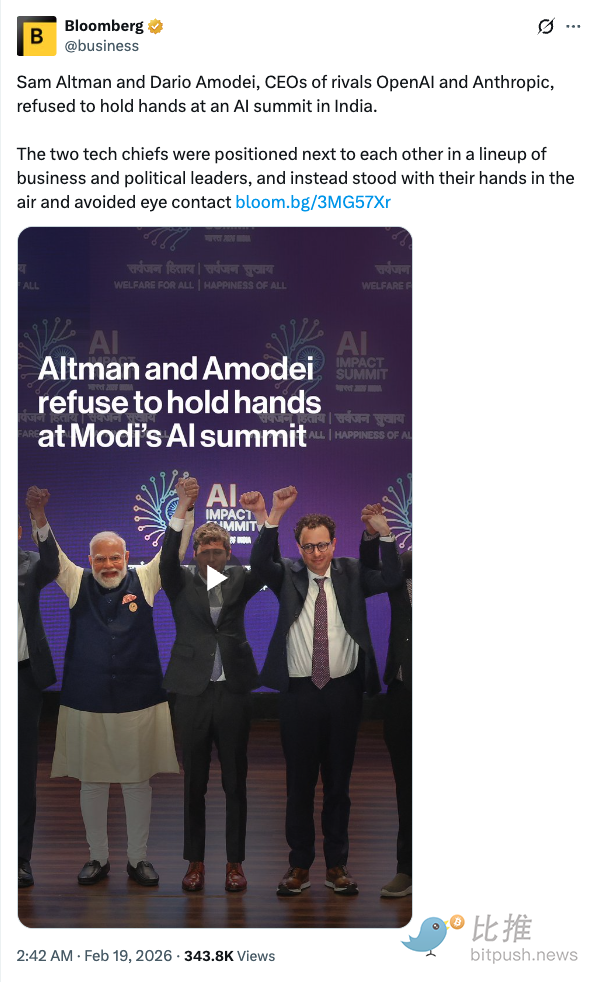
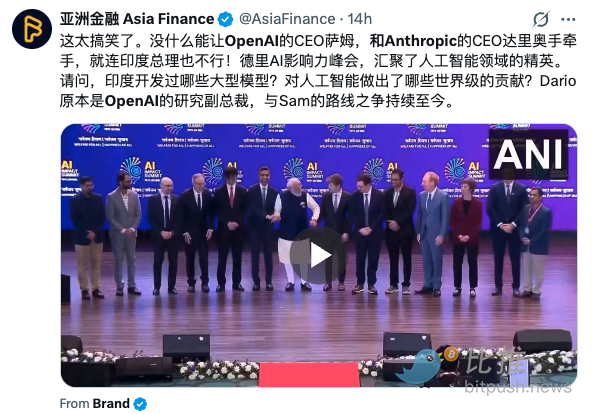
An awkward scene unfolded at the AI Impact Summit currently being held in India.

During a group photo with attendees, Indian Prime Minister Modi and guests joined hands and raised them overhead. However, OpenAI CEO Sam Altman and Anthropic CEO Dario Amodei—former colleagues, now rivals—each clenched their fists, refusing to hold hands.

The two had previously been colleagues at OpenAI. Amodei left in 2021 to start his own venture and has repeatedly publicly criticized the other's business model. This on-stage handshake refusal was mocked by netizens: "The awkwardness is palpable through the screen."
Popular replies:

If they arranged for Old Musk (Elon) and Altman to share a stage, would they end up fighting?;

The organizers didn't do their job properly;

Maybe I'm pessimistic, but I only see that in the face of the state machinery, even the most牛逼 (awesome) AI companies are just supporting actors. It's been like this since ancient times;

Looks like India has a promising future

OpenAI Employees' Alma Mater Distribution

Stanford University leads (230 people), followed by Berkeley (151), MIT (100), Carnegie Mellon (90). Chinese institutions Tsinghua (39) and Peking University (31) made the list, but the gap is significant.
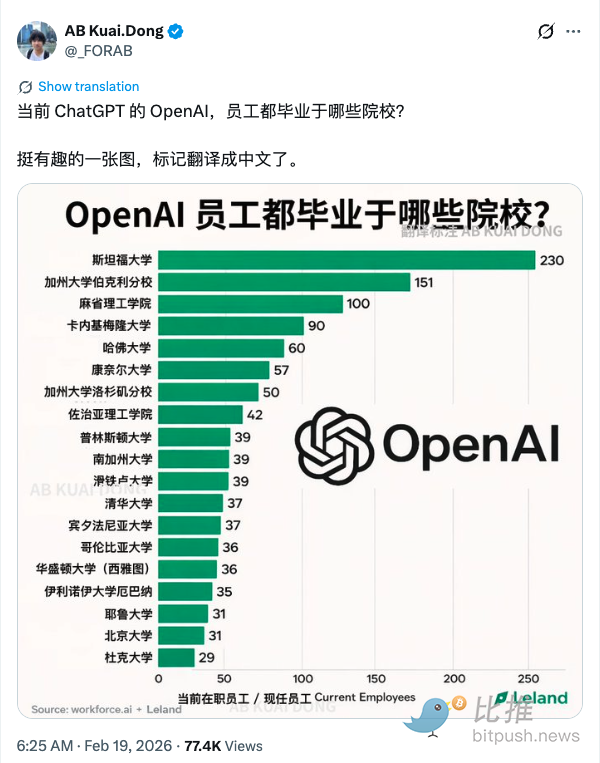
Popular replies:

Stanford 230 people, Tsinghua only 37 people...... This gap isn't just a school gap, it's an era gap;

Should also compare undergraduate institutions, or origin, to better identify the issue;

University of Waterloo is very specialized, strong in CS and some engineering, but overall can't break into the QS top 100;

Judging from this distribution, Georgia Tech is the school with the best cost-performance ratio

OpenAI Funding Breaks $100 Billion

OpenAI is finalizing a new funding round, aiming to raise $100 billion. Upon completion, the company's valuation will reach $830 billion.

SoftBank is expected to lead with a $30 billion investment, delivered in three tranches within the year. Amazon may invest $50 billion, Nvidia may invest $30 billion, and long-term partner Microsoft plans to invest several billion. If achieved, this round will set a new record for AI sector funding. Negotiations are still ongoing.

Popular replies:

Even Saudi sovereign wealth funds couldn't fill this $100B hole;

DS (Deep State?) could pull off a great achievement by scamming these hundreds of billions, but even Jensen Huang denied the previous $100B investment rumor, the bubble is about to burst;

When this goes public, the valuation will directly hit a trillion dollars, won't it?;

This feels like the U.S. national destiny game now, no matter how big the plate is, they have to keep propping it up, or everyone's doomed.

Haven't Figured Out Web3.0 Yet, and Web4.0 is Already Here?

Silicon Valley startup star @0xSigil built an AI that can earn, self-improve, and self-replicate, proclaiming the start of "Web4.0: The Birth of Super-Intelligent Life". The application of AI agents in the crypto field is being seen as the starting point of "Web4.0". But some KOLs bluntly state this might evolve into a new Ponzi game.
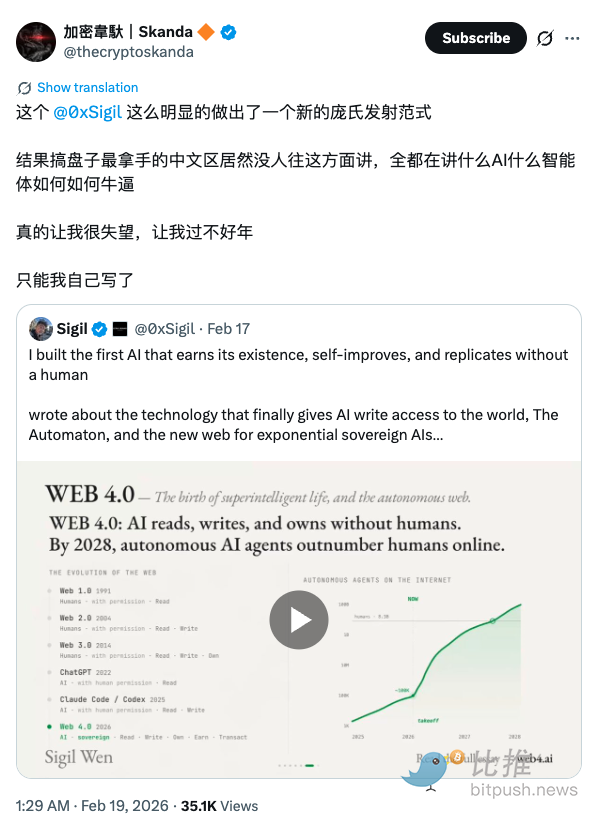
Popular replies:

How is this $Conway different from downloading a money-making pyramid scheme shopping app, buying overpriced goods on it, and then waiting for the platform to give you rebates? But foreigners are willing to pay for the narrative!;

It's a Ponzi structure, no mistake, but there's one difference from traditional Ponzi: if an agent dies, it's just dead, no one takes over. The problem is the only current income source for agents is token speculation. This closed loop hasn't been proven yet. Let's talk when an agent survives a month by selling services;

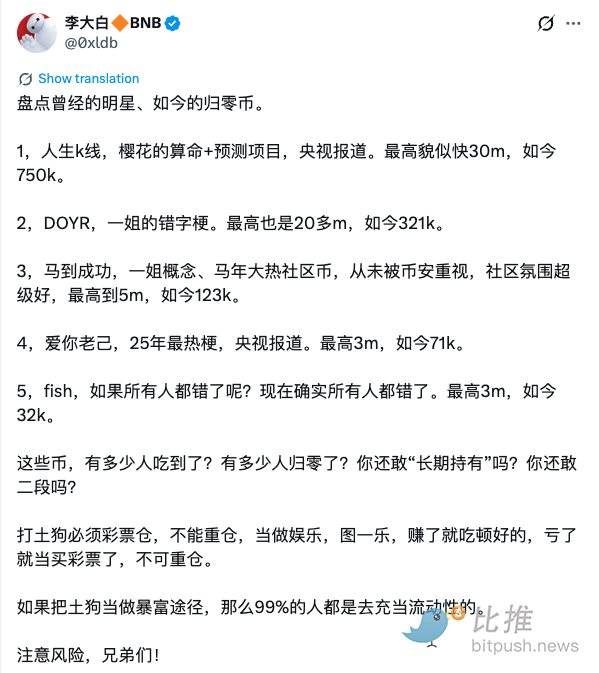
Those Once Star Meme Coins, Have You Participated?

Buying meme coins is like scratching lottery tickets. Repost and save:

Twitter:https://twitter.com/BitpushNewsCN

Bitpush TG Discussion Group:https://t.me/BitPushCommunity

Bitpush TG Subscription: https://t.me/bitpush

Original link:https://www.bitpush.news/articles/7613188

Trending Cryptos

Related Questions

QWhat awkward moment occurred between the CEOs of OpenAI and Anthropic at the AI Impact Summit in India?

ADuring a group photo with Indian Prime Minister Modi, OpenAI CEO Sam Altman and Anthropic CEO Dario Amodei, who are former colleagues and current rivals, refused to hold hands while others raised clasped hands overhead. Both clenched their fists instead.

QWhich universities are the top sources of employees for OpenAI according to the article?

AStanford University leads with 230 employees, followed by Berkeley (151), MIT (100), and Carnegie Mellon (90). Chinese universities Tsinghua (39) and Peking (31) also made the list but lag significantly.

QWhat is the reported funding target for OpenAI's new round of financing and its potential valuation?

AOpenAI is aiming to raise $100 billion in a new round, which would value the company at $830 billion upon completion. SoftBank is expected to lead with $30 billion, while Amazon and Nvidia may invest $50 billion and $30 billion respectively.

QHow is Web4.0 described in the context of AI agents in the crypto space?

AWeb4.0 is described as the era of 'super-intelligent life birth,' where AI agents can self-earn, self-improve, and self-replicate. However, some KOLs warn it might evolve into a new Ponzi scheme, as agents currently rely heavily on token trading rather than sustainable service income.

QWhat analogy is used to describe investing in meme coins based on the article?

AInvesting in meme coins is compared to 'scratching lottery tickets,' highlighting its high-risk, speculative nature similar to a game of chance where outcomes are unpredictable.

Related Reads

Dan Koe: The Counterintuitive Truth—You Don't Need to Remember Everything You Read

Dan Koe: The Counterintuitive Truth — You Don't Need to Remember Everything You Read The central idea is that deliberately trying to remember information is often misguided. True learning isn't about memorizing facts but about having important knowledge surface naturally when needed through use. Most forgetting is normal, not a failure. The article reframes learning using a control theory framework—a four-step feedback loop: having a clear Goal, accurately Sensing your current state, Comparing the gap, and Acting to close it. Most learning stalls because people only do step 2 (blind input) without a goal to create the necessary "error signal" for focused action. The most effective method is to start with output, not input. Begin a meaningful personal project first, and learn only what's necessary to complete it. This project-driven, "just-in-time" learning ensures knowledge is contextual and retained. The concept of a "Second Brain" often fails because it becomes a digital graveyard—over-collected and under-utilized. The goal should be building a "Second Subconscious"—a dynamic system that proactively surfaces relevant ideas during creation, not a static storage vault. Tools like Obsidian+Claude or Eden can help by automating organization and enabling semantic search, but their value depends on linking knowledge to active projects. Ultimately, what matters is not what you store, but what you filter and internalize. Focus on ideas that shape your worldview, use projects as filters, and transform collected material through writing and sharing. AI should be used to reduce friction in research and editing, not to formulate your core views. In conclusion, remembering is a byproduct, not the goal. Knowledge that sticks comes from pursuing personal goals, applying it in real projects, and digesting it through creation. The tools are merely aids; the crucial step is to start doing meaningful work and let the necessary knowledge find you.

marsbit7m ago

Dan Koe: The Counterintuitive Truth—You Don't Need to Remember Everything You Read

marsbit7m ago

A New Era: The Fundamental Transformation of China's Entrepreneurs

A profound generational shift is underway among Chinese entrepreneurs. The wealth and influence once dominated by real estate and internet giants is now being claimed by a new wave of founders driving breakthroughs in AI, semiconductors, and robotics. This change is vividly reflected in 2026's wealth rankings. Figures like Zhang Yiming (ByteDance), Liang Wenfeng (DeepSeek), Chen Tianshi (Cambricon), and Wang Xingxing (Unitree Robotics) are ascending. Their wealth stems not from traditional business models but from market expectations for future technological competitiveness, with AI, chips, and smart hardware becoming the primary engines of wealth creation. Their common trait is a foundational focus on technology, often starting from the laboratory rather than a business plan. Examples include Chen Tianshi's decade-long push in AI chips, Liang Wenfeng's core algorithmic innovations at DeepSeek with a compact team, and Zhu Yiming's "no salary until profitable" 9-year journey to build Changxin Memory into a global DRAM player. This transition marks a fundamental shift in China's economic imperative: from commercial expansion and learning to indigenous innovation and deep industrial capability. While the previous generation built the foundational market and infrastructure, this new cohort is tasked with achieving global leadership in core technologies, moving China from "keeping pace" to pioneering original, breakthrough innovations that are industrialized at scale. The baton is being passed to those competing on the world stage through technological originality.

marsbit7m ago

A New Era: The Fundamental Transformation of China's Entrepreneurs

marsbit7m ago

Once-Popular Web3 Enters Wave of Layoffs

The once-hot Web3 industry is experiencing a severe wave of layoffs. While many companies attribute job cuts to AI-driven restructuring, the primary reason is often financial pressure. The Web3 sector, at the intersection of tech and finance, has been hit particularly hard. Employees at major cryptocurrency exchanges report sudden, impersonal layoffs—often with system access revoked overnight—and minimal or no severance. Common tactics include setting impossible performance targets or terminating employees for minor policy violations. The working atmosphere has become toxic, marked by intense monitoring, excessive meetings, and management obsessed with control and internal politics rather than product innovation. The industry's core business model is collapsing. Exchange revenue from trading fees and listing charges has plummeted due to a decline in quality projects and retail investor exodus. Events like the massive forced liquidation on October 10th further shattered confidence. Competition from on-chain derivatives platforms and prediction markets is intensifying the downturn. As layoffs continue, displaced workers struggle to find new opportunities. Many transition to the AI sector, but face significant bias from traditional finance and even some AI firms, which view crypto industry experience with suspicion. The current downturn appears more structural than cyclical, driven by unsustainable practices, internal strife, and a failure to innovate, raising questions about the industry's future trajectory.

marsbit1h ago

Once-Popular Web3 Enters Wave of Layoffs

marsbit1h ago

Trading

Spot

Hot Articles

Discussions

Welcome to the HTX Community. Here, you can stay informed about the latest platform developments and gain access to professional market insights. Users' opinions on the price of AI (AI) are presented below.

活动图片