Where to think next? The new bottleneck in the AI race has arrived at the construction site.
In the early morning fields of Saline, Michigan, hundreds of electricians and construction workers arrive on time and work ten hours a day, repeating this schedule seven days a week.
What they are building is the latest campus for OpenAI's "Stargate" project, a massive data center costing $16 billion.
According to McKinsey's workforce forecast, just for AI infrastructure expansion, the US will need to train an additional 130,000 electricians, 240,000 construction workers, and 150,000 construction supervisors between 2023 and 2030.
Meanwhile, the U.S. Bureau of Labor Statistics predicts that between 2024 and 2034, about 80,000 electrician positions will go unfilled each year.

However, compared to traditional sectors like housing, healthcare, and energy, AI companies are very willing to pay a high premium.
For instance, the salary for a short-term maintenance position at an AI data center can be 42% higher than in traditional fields, and an excellent electrician can earn an annual salary of $240,000 - $280,000.
However, this amount of money is nothing compared to the project losses these AI giants are incurring online.
After all, electrical system construction accounts for 45%-70% of the total cost of an entire data center. For a single 60-megawatt project, monthly delivery delays caused by labor shortages directly result in $14.2 million in revenue loss.
To this end, Microsoft President Brad Smith publicly stated: "Electrician shortages have become the number one obstacle to our data center expansion in the United States."
Why Do AI Companies Need So Many Skilled Tradespeople?
Such an intense work pace might be inevitable for building AI data centers.
AI companies don't just "need more construction workers"; they need more "technically proficient experts who can endure high-intensity work."
The difficulty of constructing AI data centers is beyond imagination. Their construction complexity has virtually no comparable precedent.
This complexity manifests primarily at three levels.
The foremost is the massive power demand of AI data centers. A single GPU rack already consumes 120-140 kilowatts, a tenfold increase compared to standard server racks from a decade ago.
A typical hyperscale AI data center might deploy tens of thousands or even a hundred thousand GPUs, with the entire facility's power consumption easily reaching hundreds of megawatts, equivalent to simultaneously powering hundreds of thousands of households.
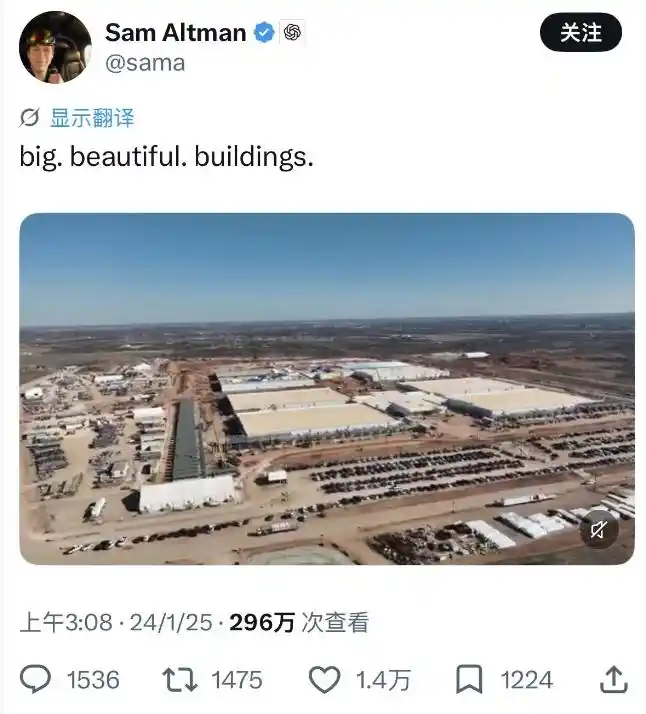
Sam Altman once posted, picture shows Stargate Base 1
Next is the extremely complex power distribution system.
Such enormous power consumption means the entire distribution system must be designed from scratch, including switchgear, transformers, uninterruptible power supply systems, busways, cooling loops, etc. Moreover, subsequent installation and debugging require certified professionals; no software can replace them.
Furthermore, high power consumption leads to heat dissipation issues: The thermal density of AI facilities has exceeded the limits of air cooling, necessitating a shift to direct liquid cooling and immersion cooling, whose design and installation also rely on certified plumbers and HVAC engineers.
Therefore, it's not just electricians; between 2022 and 2026, HVAC engineer job openings in the US also grew by 78%.
Giants Are Competing for Talent Again, Starting Electricians from a Young Age
Young, skilled electricians have become targets for poaching by the giants.
These electricians have each been poached 3 times within just 18 months, like "a professional league draft."
In 2026, Alphabet and Meta announced investments totaling $265 million in tradesperson training (despite combined total capital expenditures reaching $335 billion).
Faced with the skilled labor shortage, it's better to train people yourself than to just hire them. These speed-oriented AI companies cannot afford to wait; they have already taken action.
For example, Meta allocated $115 million to fund a long-term construction worker training school, with the first batch of 5,000 students receiving tuition, flights, and accommodation all free, plus a living stipend. After the four-week training period, graduates will immediately start working.
Meta flooded Facebook and Instagram with ads about this program, eagerly and urgently inviting young people to enroll.
Meta Technical School Ad
Meanwhile, in March of this year, OpenAI partnered with the North American Building Trades Unions, promising in advance to hire union workers to secure more experienced and thoroughly trained construction tradespeople.
This skilled trades "gold rush" has reached high schools. These AI companies are impatiently approaching graduating high school students, promising them a chance to make big money.
Kid, you should become an electrician. This is real money. Come on, hurry up!
The results are undoubtedly very significant.
Data shows that between 2017 and 2025, the enrollment rate for Gen Z in trade schools increased by 1421% (this high growth may come from a low statistical base). A 2025 survey found that 42% of Gen Z is willing to consider skipping college and directly entering trades training. According to this year's data, 60% of Gen Z is already planning to work in technical trades.
How Much Electricity Will AI Training Use in the Future?
The electricity issue remains a constant concern on the desks of AI tech company executives.
Today, AI data centers are consuming electricity at a staggering rate.
Data from June 2026 shows that global data center electricity consumption this year will reach 565 terawatt-hours, a year-on-year increase of 26.4%. This growth rate is almost entirely driven by AI servers, which account for a small portion of total installed capacity but consume 31% of the electricity, a figure growing at an annual rate of 84.2%.
International Energy Agency (IEA) data is even more revealing: In 2025, the growth rate of electricity consumption by AI data centers was 16 times that of global overall power consumption growth. Some institutions predict that by 2028, data center electricity use will account for 6.7% to 12% of total U.S. electricity consumption.
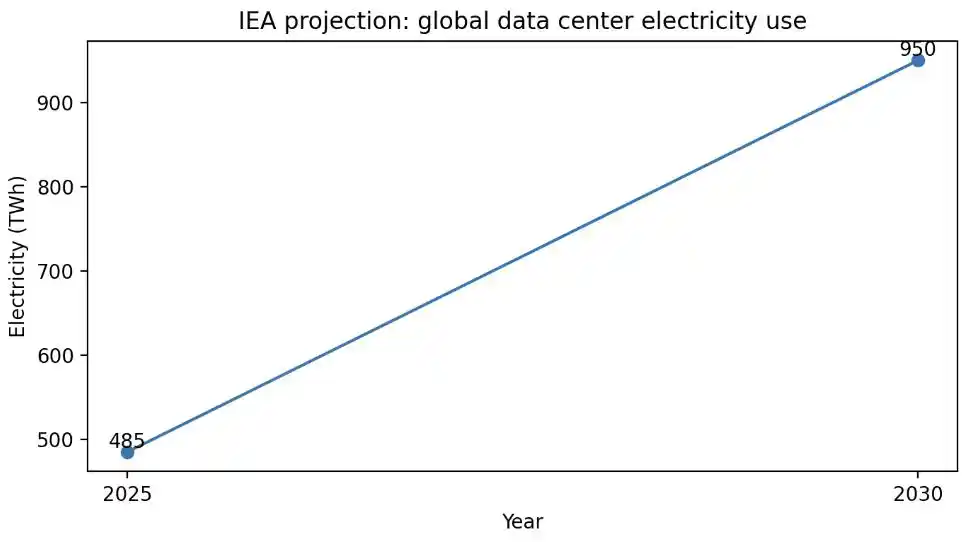
International Energy Agency forecast for global data center electricity demand
And these electricity costs are already being passed on to American bills. Analysis found that in areas dense with data centers, electricity prices are up to 267% more expensive than five years ago. The independent market monitor for PJM, the largest U.S. grid, calculated that from June 2024 onward over a 12-month period, data centers added over $9.3 billion in extra electricity costs for consumers between Illinois and Washington D.C.
So, who will build the infrastructure to carry this electricity? Are there enough electricians?
Moreover, data center construction jobs are project-based. This means the number of workers needed for construction projects is disproportionate to those needed for operation and maintenance.
The Stargate data center in Texas, with a power consumption of 1000 megawatts, roughly equals the output of a nuclear reactor. During its construction, it required 6,400 workers simultaneously, but its permanent workforce only needs 100-1,000 people.
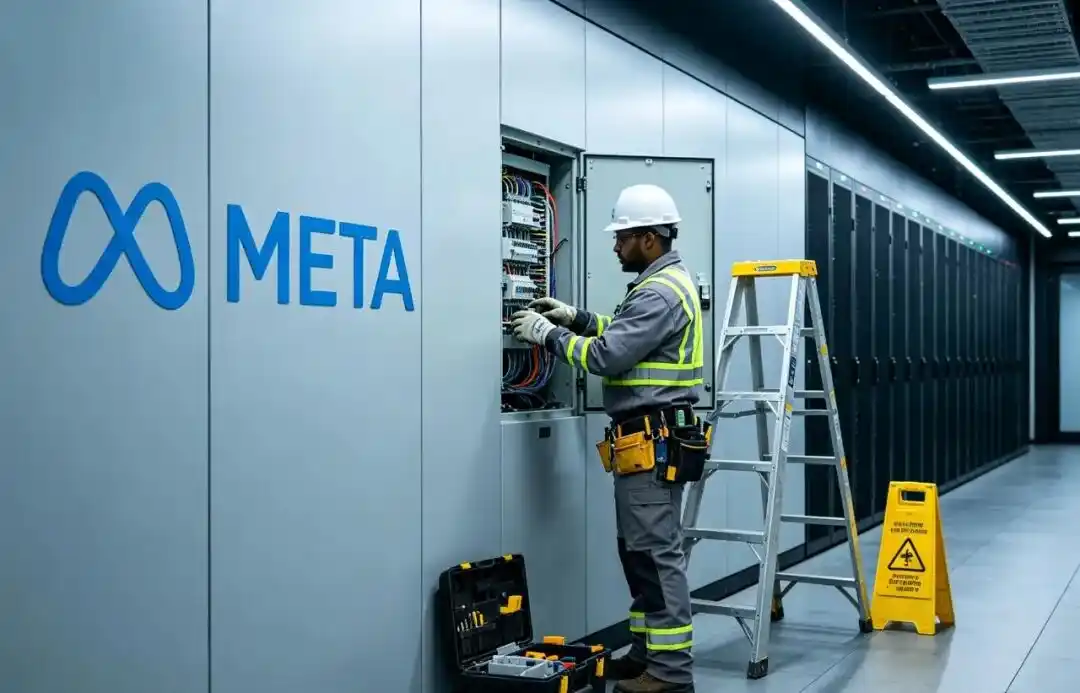
Picture generated by AI
Therefore, afterwards, hundreds of thousands of specially trained, skilled union workers will successively flood into other sectors, thereby suppressing the general wage level in the industry.
The best-case scenario is: When these data centers are completed and operational, they just happen to coincide with a real estate boom.
But the question is, is this even possible?
Reference Links:
[1]https://www.nytimes.com/2026/07/29/business/economy/data-center-electricians-training.html
[2]https://qz.com/ai-data-center-electricians-carpenters-meta-google-1851690612
[3]https://www.techtimes.com/articles/310086/20260622/ai-boom-needs-130-000-more-electricians.htm
[4]https://www.irecruit.co/insights/data-center-construction-labor-market-report
[5]https://qz.com/ai-electricians-data-center-boom-gen-z-trades-1851685432
[6]https://therinvio.com/electrician-shortage-data-center-boom/
[7]https://axis-intelligence.com/ai-data-center-energy-consumption-statistics/
This article is from the WeChat public account "QbitAI" (ID: QbitAI), author: Cheng Qian