An AI-Generated 'Whistleblower Post': How Did It Make Two CEOs Write Self-Defense Essays at Midnight?

比推Published on 2026-01-07Last updated on 2026-01-07

Abstract

An anonymous post on Reddit, allegedly written by a drunken backend engineer from a major food delivery platform, went viral with 87,000 upvotes and 36 million views on X. The post accused the company of using algorithms to exploit drivers—assigning “desperation scores” to prioritize orders for more financially vulnerable drivers, delaying regular orders despite promised priority delivery, and misusing driver welfare funds for lobbying against unions. The viral allegations prompted immediate public denials from the CEOs of DoorDash and Uber, who issued statements and social media posts in the middle of the night to refute the claims. DoorDash published a detailed rebuttal on its website. The post was later exposed as an AI-generated hoax by a Platformer reporter. The “whistleblower” provided a fake 18-page technical document and an AI-generated employee ID, which was detected using Google’s SynthID watermarking tool. The account was deleted when further verification was requested. The incident highlights how AI can cheaply and convincingly fabricate content that aligns with public skepticism toward tech platforms. Past real controversies, such as DoorDash’s tip policy and Uber’s Greyball tool, made the false narrative feel plausible. The case underscores growing public anxiety over the difficulty of distinguishing real from AI-generated content and the power of emotionally resonant misinformation—even when debunked—to shape perception.

Written by: Curry, Deep Tide TechFlow

Original Title: The People Need a Bad Capitalist, AI Created a Food Delivery Rumor


Last week, something quite surreal happened.

The CEOs of two major American food delivery giants, one worth $2.7 billion and the other running the world's largest ride-hailing platform, were both awake at midnight on Saturday, writing self-defense essays online.

The cause was an anonymous post on Reddit.

The poster claimed to be a backend engineer at a major food delivery platform, who got drunk and went to a library to use public WiFi to leak information.

The content roughly was:

The company analyzes ride-hailing drivers' situations and assigns them a "desperation score." The more financially strained the driver, the fewer good orders they receive; the so-called priority delivery for food orders is fake, as regular orders are deliberately delayed; various "driver welfare fees" are not given to drivers at all but are used to lobby Congress against unions...

The post ended in a very convincing manner: I'm drunk, I'm angry, so I'm leaking this.

It perfectly portrayed itself as a whistleblower role of "big companies using algorithms to exploit drivers."
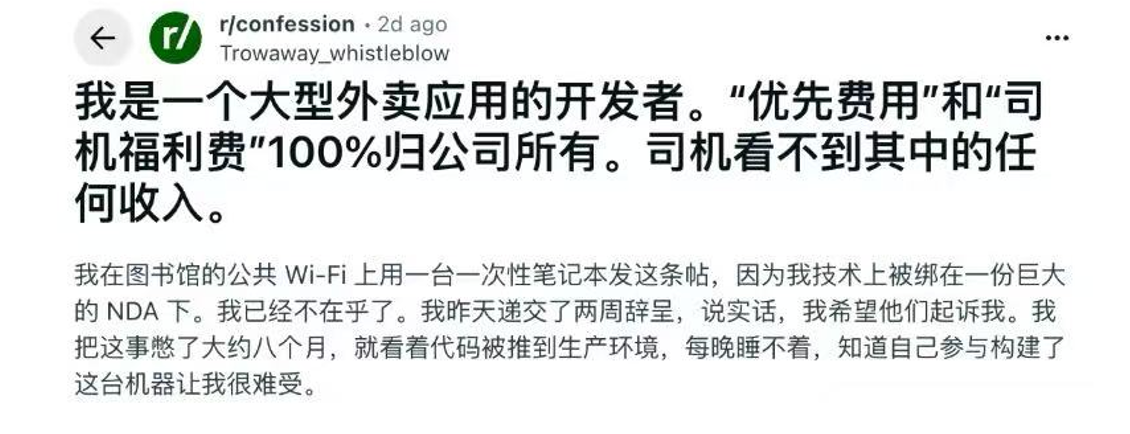
The post received 87,000 upvotes in three days, reaching the front page of Reddit. Some also screenshotted and posted it on X, where it gained 36 million exposures.

Keep in mind, the American food delivery market has only a few major players. The post didn’t name names, but everyone was guessing who it was.

DoorDash's CEO Tony Xu was the first to react, tweeting that this wasn’t them and that he would fire anyone who did such a thing. Uber’s COO also jumped in to respond, "Don’t believe everything you see online."
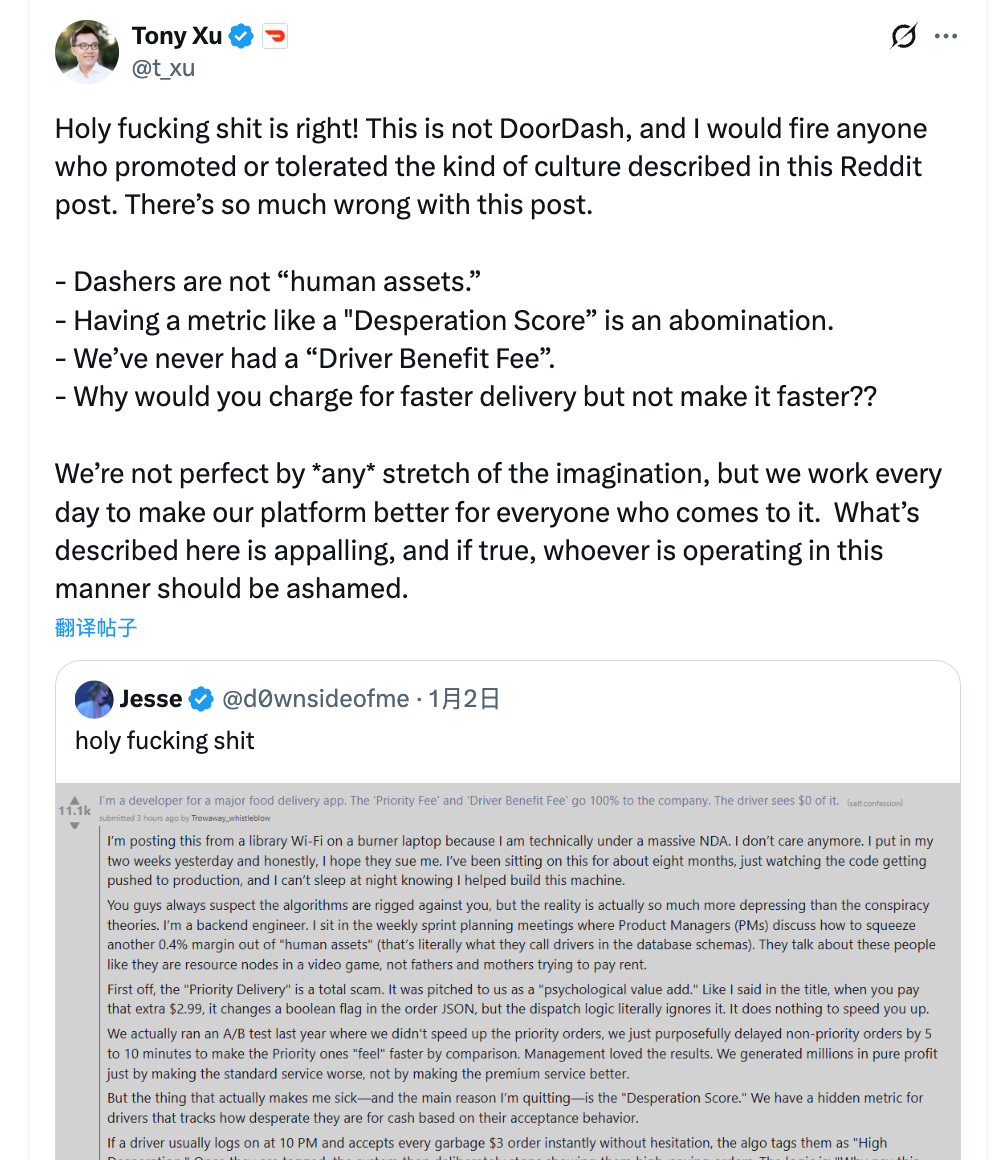
DoorDash even published a five-point statement on its official website, refuting each point in the leak. These two companies, with a combined market cap of over $80 billion, were forced into overnight PR clarifications by an anonymous post.

Then, the post was proven to be fabricated.

It was debunked by Platformer reporter Casey Newton.

He contacted the poster, who immediately sent over an 18-page "internal technical document" titled "AllocNet-T: High-Dimensional Temporal Supply State Modeling."

Every page was watermarked "Confidential," attributed to Uber’s "Market Dynamics Group · Behavioral Economics Department."

The content explained the model mentioned in the Reddit post that calculates the "desperation score" for drivers. It included architecture diagrams, mathematical formulas, data flow charts...
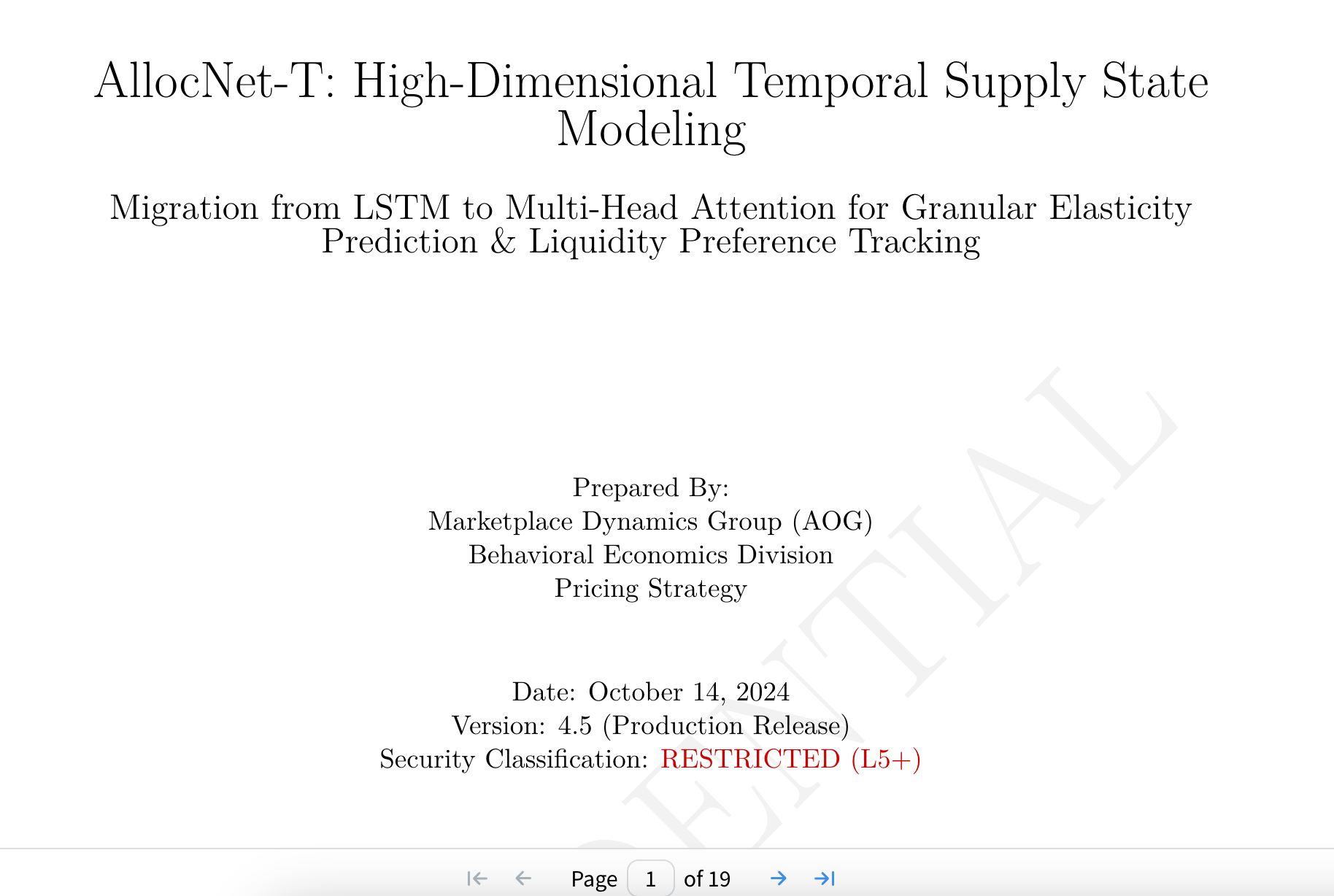
(Fake paper screenshot, at first glance, it looked very real)

Newton said the document initially fooled him. Who would go to the trouble of forging an 18-page technical document to bait a journalist?

But now it’s different.

An 18-page document like this can be generated by AI in minutes.

Additionally, the leaker sent the reporter a blurred photo of their Uber employee ID to prove they worked there.

Out of curiosity, Newton ran the ID photo through Google Gemini for verification. Gemini said the image was AI-generated.

It could be identified because Google embeds an invisible watermark called SynthID in its AI-generated content, undetectable to the human eye but recognizable by machines.

Even more absurdly, the employee ID featured the "Uber Eats" logo.

An Uber spokesperson confirmed: They do not have Uber Eats-branded employee IDs; all badges only say Uber.
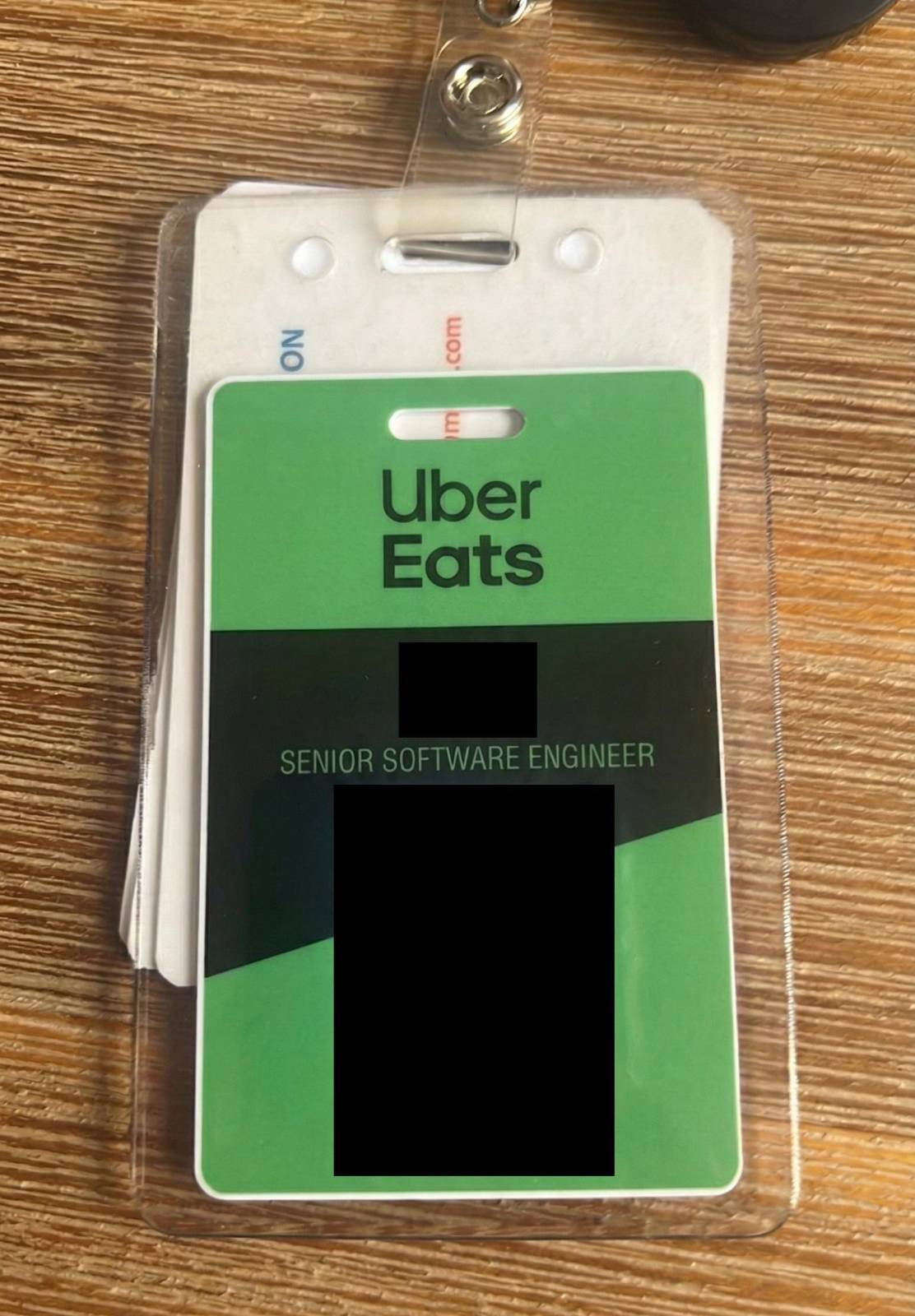
Clearly, this fake "whistleblower" didn’t even know who they were trying to target. When the reporter requested LinkedIn or other social media accounts for further verification,

The leaker deleted their account and vanished.

Actually, we don’t want to talk about AI’s ability to fake things; that’s not new.

We’d rather discuss: Why were tens of millions of people willing to believe an anonymous leak post?

In 2020, DoorDash was sued for using tips to offset drivers' base pay and settled for $16.75 million. Uber had a tool called Greyball to evade regulators. These are real events.

It’s easy to find a subconscious agreement: Platforms are not good guys, and this judgment is definitely correct.

So when someone says "food delivery platforms use algorithms to exploit drivers," the first reaction isn’t "Is this true?" but "I knew it."

Fake news spreads because it resembles what people already believe in their hearts.

What AI does is reduce the cost of creating this "resemblance" to almost zero.

There’s another detail in this story.

The deception was uncovered using Google’s watermark detection. Google develops AI, and Google also creates AI detection tools.

But SynthID can only detect Google’s own AI. This time, they caught it because the forger happened to use Gemini. With another model, they might not have been so lucky.

So solving this case was less a technical victory and more about:

The other party made a rookie mistake.

Previously, a Reuters survey found that 59% of people worry they can’t distinguish truth from falsehood online.

The food delivery CEOs’ clarification tweets were seen by hundreds of thousands, but how many firmly believe it’s just PR, just lies? Even though the fake leak post has been deleted, people are still criticizing the platforms in the comments.

The lie has run halfway around the world while the truth is still tying its shoes.

Now think, what if this post wasn’t about Uber but Meituan or Ele.me?

Things like "desperation score," "using algorithms to exploit riders," "welfare fees not given to riders at all." When you see these accusations, is your first reaction emotional agreement?

"Delivery Riders, Trapped in the System"—do you remember that article?

So the issue isn’t whether AI can fake things. The issue is, when a lie looks like what everyone already believes, does truth even matter?

What that account-deleting fugitive wanted, we don’t know.

We only know they found an emotional outlet and poured a bucket of AI-generated fuel into it.

The fire started. As for whether it’s real or fake firewood, who cares?

In fairy tales, Pinocchio’s nose grows when he lies.

AI has no nose.

Original link:https://www.bitpush.news/articles/7600729

Trending Cryptos

Related Questions

QWhat was the main reason the anonymous Reddit post about food delivery platforms gained so much traction and led to CEOs responding?

AThe post gained traction because it tapped into pre-existing public skepticism and negative sentiment towards large food delivery platforms, with many people already believing that such companies exploit drivers through algorithms. The allegations, though fabricated, aligned with common perceptions, making them easily believable.

QHow was the anonymous Reddit post eventually exposed as being AI-generated?

AThe post was exposed as AI-generated when a journalist, Casey Newton, investigated and found that the 'internal technical document' provided by the whistleblower was likely created by AI in minutes. Additionally, a fake employee ID photo included in the evidence was identified as AI-generated by Google's SynthID watermark detection tool, and Uber confirmed they do not issue Uber Eats-branded employee cards.

QWhat specific allegations did the AI-generated Reddit post make against the food delivery companies?

AThe post alleged that the company analyzed ride-hailing drivers' situations and assigned them a 'desperation score,' where drivers in greater financial need received worse orders; that priority delivery for food orders was fake and regular orders were delayed; and that various 'driver welfare fees' were not given to drivers but used to lobby Congress against unions.

QWhy did the CEOs of DoorDash and Uber feel compelled to respond to the anonymous post?

AThe CEOs felt compelled to respond because the post went viral with 87,000 likes on Reddit and 36 million views on X, creating significant public pressure and potential damage to their reputations. They issued denials and clarifications to protect their companies' images and reassure the public and stakeholders.

QWhat broader concern does this incident raise about AI and misinformation?

AThe incident highlights how AI can easily generate convincing misinformation that aligns with existing public biases, making it difficult to distinguish truth from falsehood. It underscores the challenge of combating AI-generated content, especially when it reinforces preconceived notions, and raises concerns about the potential for widespread deception in the digital age.

Related Reads

Must-Watch Events Next Week|CLARITY Act Could Face Senate Vote; SpaceX, Circle to Report Earnings (8.3-8.9)

**Summary: Key Events and Developments to Watch (August 3-9)** The upcoming week is marked by significant financial disclosures, key legislative deadlines, and notable product updates. **Major Financial Events:** Several companies are scheduled to release their Q2 2026 earnings. American Bitcoin (ABTC) will report on August 3, followed by SpaceX and Hut 8 Mining Corp. on August 4, and Circle on August 5. Notably, a significant portion of SpaceX shares (up to 12% of total shares) will be unlocked on August 6 following their earnings release. **Key Legislative Deadline:** The U.S. Senate faces an August 7 deadline to secure 60 votes for the CLARITY Act, a bipartisan bill aiming to establish a federal regulatory framework for cryptocurrencies. The Senate may hold a full vote on the bill during the week. **Economic Data:** The U.S. July Non-Farm Payrolls report will be released on August 7, providing crucial labor market data. **Technology & Product Updates:** * **Shutdowns:** DeFi portfolio tracker Zapper and wallet app Ctrl Wallet will cease operations on August 3. * **Upgrades:** LayerZero will deprecate its v1 relayers on August 3. XRP Ledger's new version 3.3.0, featuring five new functions, is expected next week. * **AI:** Elon Musk announced that the advanced Grok 4.6 AI model is set for release around August 7. * **Bitcoin:** The BIP-110 forced signaling for a potential Bitcoin network change is scheduled to begin around August 8. **Other Notable Events:** Chinese robotics firm Unitree Tech has set its preliminary price inquiry for its IPO for August 5. South Korean exchange Upbit will delist AQT and AERGO tokens on August 3.

marsbit1h ago

Must-Watch Events Next Week|CLARITY Act Could Face Senate Vote; SpaceX, Circle to Report Earnings (8.3-8.9)

marsbit1h ago

Stocks Are Plummeting More Sharply Than Cryptocurrencies. Where Has the Money Gone?

Stock Markets Plunge Deeper Than Cryptocurrencies: Where Did the Money Go? In late July, Seoul's Kospi index triggered circuit breakers for two consecutive days, plummeting over 40% from its June high. The collapse was led by heavyweight stocks like SK Hynix, whose record profits still disappointed investors, and devastating leveraged ETFs, with one major product losing over 83% of its value. This signaled a global, forced deleveraging targeting the most crowded trades. Interestingly, while stocks exhibited extreme volatility akin to crypto markets, Bitcoin rose nearly 15% in July after a prior steep drop. Analysis shows the money fleeing equities did not flow into Bitcoin. Instead, Bitcoin had already absorbed its sell-off in May-June, when U.S. spot Bitcoin ETFs saw historic outflows. The true safe-haven beneficiary was gold, whose price rose over 20% year-on-year, highlighting a decoupling between Bitcoin and gold as "digital gold." The sell-off was a targeted unwinding of leveraged positions in tech and semiconductors, accelerated by broker-dealer risk management and shifts in the AI narrative, including new competition from Chinese memory chipmakers. The retreat path was clear: from high-valuation tech stocks to cash and U.S. Treasuries, then to gold. For Bitcoin to attract sustained institutional inflows, conditions like eased global liquidity pressure, a "soft-landing" Fed rate cut, and U.S. regulatory clarity via legislation like the stalled CLARITY Act are needed. Currently, Bitcoin is not a safe haven but an already-cleared asset. Its low correlation with tech stocks, however, makes it a potential diversification play for institutional portfolios once the storm passes. The money isn't here yet, but the positioning is underway.

marsbit1h ago

Stocks Are Plummeting More Sharply Than Cryptocurrencies. Where Has the Money Gone?

marsbit1h ago

In Conversation with Ray Dalio: We Are Currently in an AI Bubble, with 1% of My Portfolio in Bitcoin

Ray Dalio, founder of Bridgewater Associates, warns in an interview that the current AI boom shows classic bubble characteristics, which could lead to significant economic downturns as seen in past cycles like 1929 or 2000. He explains that speculative enthusiasm, fueled by debt and overvaluation, often precedes a crash when rising rates or taxation force asset sales, causing widespread losses and recession. Dalio also outlines his "Big Cycle" theory, describing an approximate 80-year pattern where widening wealth gaps, massive government deficits, and shifting geopolitical power (like China's rise) create internal conflict and global instability. He emphasizes that we are in a late-cycle, transitional phase where traditional powers like the US and UK face decline. For personal wealth protection, Dalio advises diversification beyond cash into assets like stocks, bonds, real estate, and particularly gold, which he prefers over Bitcoin. While he holds about 1% of his portfolio in Bitcoin as a non-printable hard asset, he views gold as more secure from technological or governmental threats. Regarding AI's impact, Dalio believes it will disproportionately benefit capital owners, worsening inequality by replacing both physical and cognitive labor. He suggests that human intuition and emotional intelligence, combined with AI, will be key for future workers. On taxation, Dalio argues that wealth taxes are impractical and risk triggering asset sell-offs, reducing productive investment. He points to the UK as a cautionary example of debt, low productivity, and political strife. Geopolitically, Dalio foresees a more regionalized world, with the US showing weakness in prolonged conflicts like with Iran, akin to past imperial declines. The ideal outcome, he suggests, is coexisting powerful blocs (e.g., Americas, China-Asia Pacific) without major war.

marsbit5h ago

In Conversation with Ray Dalio: We Are Currently in an AI Bubble, with 1% of My Portfolio in Bitcoin

marsbit5h ago

Trading

Spot

Hot Articles

Discussions

Welcome to the HTX Community. Here, you can stay informed about the latest platform developments and gain access to professional market insights. Users' opinions on the price of AI (AI) are presented below.

活动图片















