AI Within the Range of Artillery

marsbitPublished on 2026-03-03Last updated on 2026-03-03

Abstract

"AI in the Range of Cannons" discusses the vulnerability of AI infrastructure in the context of modern warfare, triggered by a real-world incident. On March 1, an Iranian missile struck an Amazon data center in the UAE, causing a fire, power outage, and disruption of about 60 cloud services. This led to a global outage of Claude, a major AI service running on Amazon's cloud. Although officially attributed to surging user demand, the incident is linked to a U.S.-Israel airstrike on Iran that used Claude for intelligence analysis, despite a recent U.S. ban on Anthropic (Claude's developer) for refusing unrestricted military use. The article highlights that this marks the first physical destruction of a commercial data center in war, emphasizing that AI, though virtual, relies on physical infrastructure located in geopolitically unstable regions like the Middle East. Silicon Valley has heavily invested in AI infrastructure in the Gulf due to cheap electricity, wealthy sovereign funds, and data localization laws, with projects from Amazon, Microsoft, and OpenAI. However, security frameworks like the Pax Silica agreement focus on chip controls and political alignment, ignoring physical security risks. The piece raises critical questions: When data centers serve both civilian and military purposes, are they legitimate targets? International law lacks clarity. The incident shifts focus from AI replacing jobs to its fragility—over 1,300 large data centers worldwide are protecte...

Author: David, Deep Tide TechFlow

On March 1, Iranian missiles and drones struck the Gulf region, with one landing on an Amazon data center in the UAE.

The data center caught fire, lost power, and approximately 60 cloud services were interrupted.

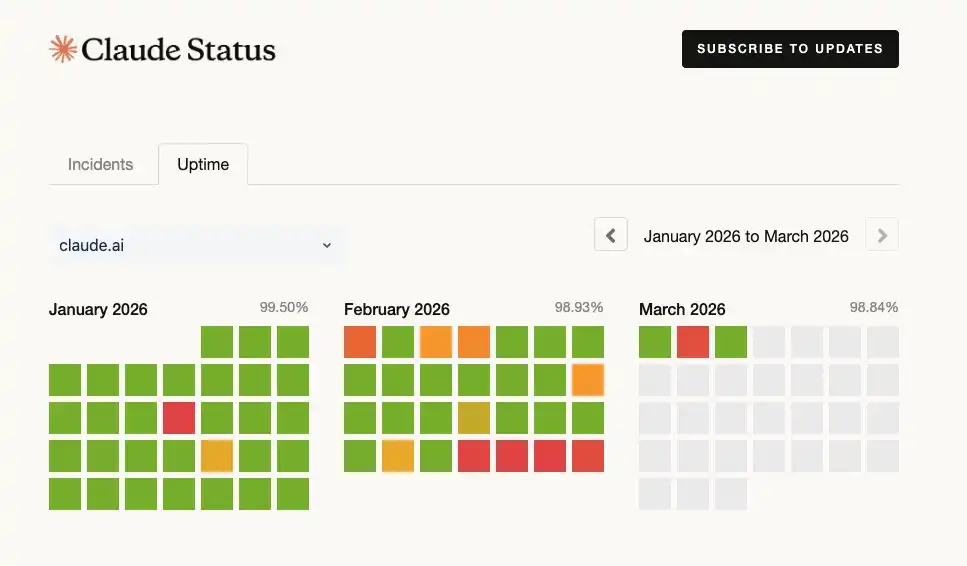
Claude, one of the world's most widely used AIs, runs on Amazon's cloud. On the same day, Claude experienced a global outage.

Anthropic's official statement was that a surge in users overwhelmed the servers.

As of the time of writing, complaints about Claude's service being unavailable are still circulating on social media; the well-known prediction market Polymarket has already launched a prediction topic: "How many more times will Claude be down in March?".
If it is ultimately confirmed that Iran was responsible, this would be the first time in human history:

A commercial data center was physically destroyed in war.

But why would a civilian data center be bombed?

Rewind two days. On February 28, the US and Israel jointly launched an airstrike on Iran, killing Supreme Leader Khamenei and a number of senior officials.

A significant portion of the intelligence analysis, target identification, and battlefield simulation for this airstrike was done with the help of Claude. Through cooperation between the military and data analytics company Palantir, Claude had long been integrated into the US military's intelligence system.

Ironically, just hours before the airstrike, Trump ordered a comprehensive ban on Anthropic because Anthropic refused to hand over its AI to the Pentagon without restrictions. But despite the ban, the war had to be fought.

Publicly, it was said that it would take at least six months to remove Claude from the military system.

So before the ink on the ban was dry, the US military took Claude to bomb Iran. Then Iran retaliated, and a missile landed on the data center running Claude AI.

Image source: Bloomberg

The data center was most likely not targeted, merely caught in the crossfire. But regardless of whether the missile was aimed at the data center or not, one thing is certain:

Truth is within the range of the cannon, and AI is within the range of artillery. This applies to both the side firing the artillery and the side being shelled.

The Great AI Infrastructure, Built on the Middle East Powder Keg

Over the past three years, Silicon Valley has moved half of the AI industry to the Middle East Gulf.

The reason is simple. The UAE and Saudi Arabia have the world's wealthiest sovereign wealth funds, cheap electricity, and one regulation:

If you want to serve my customers, the data must be stored in my territory.

So Amazon opened data centers in the UAE and Bahrain each, and invested $5.3 billion in Saudi Arabia to build another; Microsoft has nodes in the UAE and Qatar, and its Saudi facility is also ready.

OpenAI, in collaboration with Nvidia and SoftBank, is building a $30 billion+ AI park in the UAE, touted as the largest computing base outside the US mainland.

In January this year, the US just signed an agreement with the UAE and Qatar called "Pax Silica". Translated, it means "Silicon Peace", which sounds beautiful.

The core content of the agreement is to control the flow of chips, ensuring that advanced chips do not fall into Chinese hands.

In exchange, the UAE obtained a license to import hundreds of thousands of Nvidia's most advanced processors annually. Abu Dhabi's G42 cut ties with Huawei, Saudi AI companies promised not to buy Huawei equipment...

The entire Gulf's AI infrastructure, from chips to data centers to models, has comprehensively leaned towards the US.

These agreements considered everything, from chip export controls, data sovereignty, investment reciprocity, to technology leakage risks.

But none considered that someone would use a missile to bomb a data center.

An international security scholar at Qatar University said something quite fitting after seeing the Amazon data center fire:

"These security frameworks were designed for supply chain control and political alignment; physical security was never on the agenda."

Cloud computing has been telling a story for ten years about elasticity, redundancy, and decentralization. But data centers are buildings with addresses, with walls, roofs, and coordinates. No matter how advanced your chips are, if the data center is bombed, it's bombed.

"Cloud" is a metaphor; data centers are not.

AI seems virtual, running in code, floating in the cloud. But code runs on chips, chips are installed in data centers, and data centers are built on Earth.

Who Protects AI?

This Amazon data center can be said to have been affected, or optimistically, collateral damage.

But what about next time?

In the context of escalating global geopolitical conflicts, if your data center is running AI models that help an opponent with target identification, the opponent has every reason to treat your data center as a military facility to strike.

International law has no answer to this question either.

Existing laws of war have provisions for "dual-use facilities," but those clauses were written for factories and bridges; no one thought about data centers.

Is a data center that helps banks process transactions during the day and runs intelligence analysis for the military at night considered civilian or military?

In peacetime, data center选址 considers latency, electricity prices, policy incentives... When war comes, none of this matters. What matters is how far your data center is from the nearest military base.

So, this bombing has started to shift everyone's attention.

Previously, everyone was discussing the same anxiety: will AI replace my job? But no one discussed another question:

Before AI replaces you, how vulnerable is it itself?

A regional conflict paralyzed the Middle East node of the world's largest cloud service provider for a full day; and this was just one data center.

There are now nearly 1,300 hyperscale data centers worldwide, with another 770 under construction. These centers are consuming more and more electricity, water, and money, and承载着越来越多的事物——your deposits, your medical records, your food delivery orders, even a country's military intelligence...

But the方案 for protecting these data centers, to this day, is probably still fire suppression systems and backup generators.

When AI becomes a country's infrastructure, its security is no longer the responsibility of a single company. Who protects AI? Cloud providers? The US Pentagon? Or the UAE's air defense system?

This question was theoretical three days ago. Not anymore.

AI is within the range of artillery. Actually, it's not just AI. In this era, what isn't within the range of artillery?


Related Questions

QWhat was the significance of the missile strike on Amazon's data center in the UAE on March 1st?

AIt was potentially the first time in history that a commercial data center was physically destroyed in a war, marking a new reality where digital infrastructure is vulnerable to physical conflict.

QWhy was the Claude AI service disrupted globally on the same day?

AThe official reason from Anthropic was a surge in users overwhelming its servers, but the disruption coincided with the missile strike on the Amazon data center in the UAE, where Claude's servers were hosted, suggesting a possible connection.

QWhat geopolitical agreement, signed in January, is mentioned as a reason for the concentration of AI infrastructure in the Middle East?

AThe 'Pax Silica' (Silicon Peace) agreement, where the U.S. secured commitments from the UAE and Qatar to control chip flows and prevent advanced chips from reaching China, in exchange for access to advanced Nvidia processors.

QAccording to the article, what critical consideration was missing from the security frameworks and agreements governing AI infrastructure in the region?

APhysical security. The frameworks were designed for supply chain control and political alignment, but they completely overlooked the risk of physical attacks, such as a missile strike on a data center.

QWhat new question does the article suggest we should be asking about AI, beyond the fear of it taking our jobs?

AHow vulnerable is AI itself? The incident demonstrates that the global AI infrastructure is fragile and can be disrupted by regional conflicts, raising the question of who is responsible for protecting it.

Related Reads

Anthropic Starts Poaching Scientists? $27K Weekly Onsite Stipend to Fix Claude's Expert-Level Errors

Anthropic has launched a new STEM Fellow program, offering $3,800 per week for a three-month, in-person residency in San Francisco. The role targets experts from science, technology, engineering, and mathematics (STEM) fields—machine learning experience is helpful but not required. Instead, Anthropic values scientific judgment and a willingness to learn quickly. Fellows will work with Claude models and internal tools under the guidance of an Anthropic researcher. Example projects include a materials scientist identifying errors in Claude’s reasoning or a climate scientist integrating atmospheric modeling software with Claude. The goal is to have experts "tell Claude where it's wrong" and improve its scientific capabilities. This initiative is part of Anthropic’s broader strategy to strengthen its scientific ecosystem, following earlier programs like the AI Safety Fellows and AI for Science programs. The company acknowledges that current AI models, while powerful, still produce high-confidence errors and lack end-to-end research autonomy. The program aims to embed domain expertise directly into model development, turning scientists into "high-level reviewers" for AI. Anthropic CEO Dario Amodei has previously emphasized AI’s potential to accelerate scientific breakthroughs, particularly in biology and healthcare. The company believes that the next phase of AI competition will depend not on scaling parameters, but on integrating human expertise to refine model accuracy and reliability.

marsbit45m ago

Anthropic Starts Poaching Scientists? $27K Weekly Onsite Stipend to Fix Claude's Expert-Level Errors

marsbit45m ago

On the Eve of X Money's Launch, Musk Dismantles the Referee First

"X Money Launches After Dismantling Regulator: Musk's 9-Day Power Play" In February 2025, a team from the "Department of Government Efficiency" (DOGE), led by Elon Musk, entered the Consumer Financial Protection Bureau (CFPB) headquarters. Shortly after, the CFPB was effectively dismantled—its funding frozen, activities suspended, and nearly 90% of staff laid off. This move came just nine days after X announced a partnership with Visa and as X Money prepared to launch. The article contrasts this with the decade-long regulatory battles faced by companies like Coinbase and PayPal. Coinbase spent over $75 million in political contributions and endured a major SEC lawsuit to operate legally. PayPal complied with strict state and federal rules for its stablecoin PYUSD, including 100% reserve requirements and monthly audits. However, Musk’s approach was different. After the CFPB introduced a rule placing large digital payment apps under federal oversight, Musk tweeted "Delete CFPB." Within months, the rule was revoked by Congress. Meanwhile, DOGE operatives gained "god-tier" access to CFPB databases, potentially obtaining sensitive competitive information from rivals like Apple, Google, and PayPal. The article also highlights a "suspicious exemption clause" in the GENIUS Act, which allows private companies like X to issue stablecoins with fewer restrictions. Senator Elizabeth Warren questioned whether Musk, who was a senior presidential advisor during the Act’s drafting, influenced this clause. X Money offers a 6% APY on deposits, despite FDIC warnings that stablecoin users are not insured. As X Money launches to 600 million monthly users, the article questions the fairness of a system where Musk can bypass regulations that others spent years and millions to comply with. The dismantling of the CFPB and the alleged regulatory advantages raise concerns about the future of equitable rule-making in the U.S. financial system.

marsbit53m ago

On the Eve of X Money's Launch, Musk Dismantles the Referee First

marsbit53m ago

Trading

Spot
Futures

Hot Articles

Discussions

Welcome to the HTX Community. Here, you can stay informed about the latest platform developments and gain access to professional market insights. Users' opinions on the price of AI (AI) are presented below.

活动图片