AI is Red-Hot, Crypto is Left in the Cold

marsbitPublished on 2026-02-12Last updated on 2026-02-12

Abstract

The article discusses the significant shift of venture capital investments from the crypto sector to AI, as observed in the strategies of major firms like Sequoia, a16z, Lightspeed, and Y Combinator. Many early Web3 adopters are now leaving for AI or prediction markets. The author argues against two extreme reactions: dismissing departures as a lack of faith or abandoning crypto for AI. Instead, he asserts that blockchain-driven finance is inevitable, citing cryptocurrencies' potential to serve as a superior, trust-minimized, and cost-effective global monetary system. He highlights the efficiency of decentralized systems like Uniswap, which operates with drastically lower overhead than traditional exchanges, and emphasizes the importance of censorship-resistant financial infrastructure, particularly for underserved regions. While acknowledging AI's value as a tool, the author believes crypto represents a larger, transformative opportunity for building equitable and efficient financial systems globally.

Written by: Patrick Collins

Compiled by: Chopper, Foresight News

In 2025, venture capital firms like Sequoia, A16z, Lightspeed, and Y Combinator are heavily investing in AI companies, with funds flowing from the crypto sector to AI, not to mention the recent sharp decline in overall cryptocurrency prices.
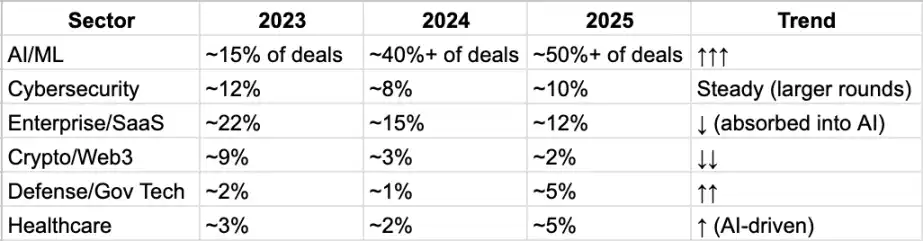
Sequoia Capital's investment trends over the past three years
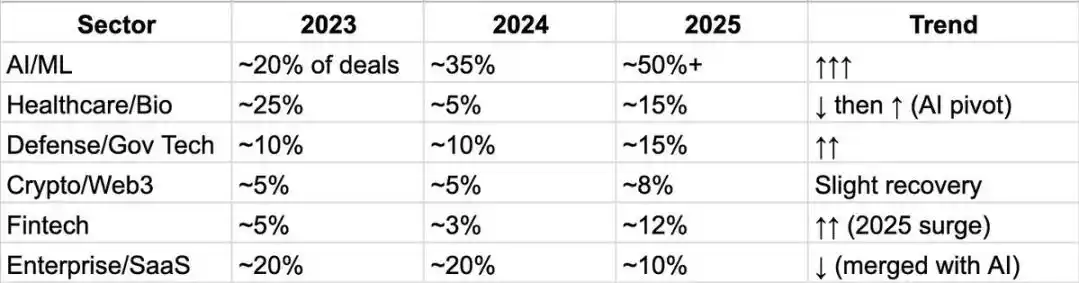
a16z's investment trends over the past three years
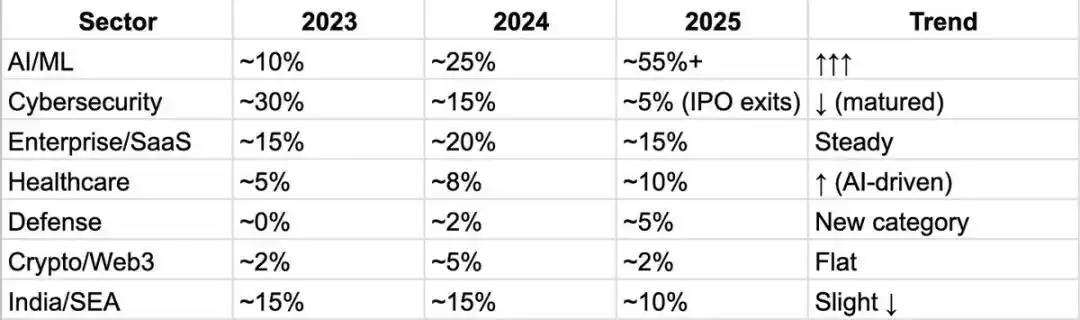
Lightspeed's investment trends over the past three years
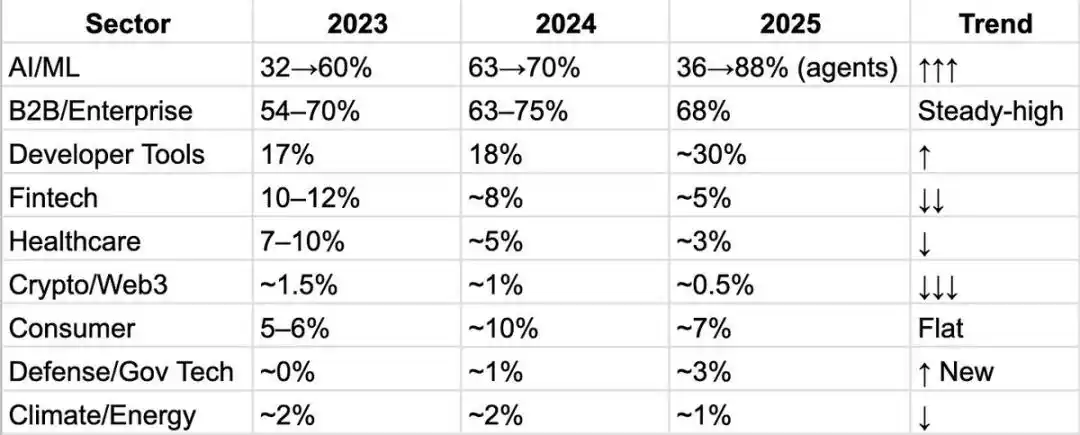
Y Combinator's investment trends over the past three years

I've seen many people who entered Web3 with me in 2019/2020 starting to leave, joining AI companies or prediction markets. As someone fully committed to the blockchain and decentralized finance space, I believe there are a few different mindsets one can have in the face of this situation.

Good Riddance, They Never Had Faith Anyway

It's a bit like a bad breakup—you say a few harsh words when they're gone. "Now only the true builders remain, and everything will be better." I don't think this mindset or approach is right. We need talent in this industry, even if they don't fully subscribe to our underlying philosophy.

As long as we have the vision, we will always need people to turn that vision into reality. Many people just want to live a good life and don't necessarily want to change the world, and I think that's perfectly fine.

Both types of people are great in the world: those with extreme passion, and those with less intense passion but who are willing to work hard, improve themselves, and do the right thing. To me, this is a bit like the difference between "rock stars" and "superstars."

Crypto is Dead, Hurry Up and Switch to AI

This is the topic I want to focus on, and it's a sentence I want to engrave in your heart: It is inevitable that the world's finance will ultimately be entirely powered by cryptocurrency.

Let that sink in. Once you accept this, switching to AI seems utterly nonsensical.

Yes, AI is exploding, AI is amazing, but AI is just a tool to build other things. And among those "other things" is the future of finance.

Of course, you can do what's best for you. There might be a fast-moving bandwagon in AI beckoning you, go ahead and hop on. But I believe you will miss a much bigger opportunity.

Why is Blockchain Inevitable?

The reason is the same reason gold has a market cap of $35 trillion today. I've talked about "what is money" countless times, especially in my explanations of stablecoins. Money has three functions: a store of value, a medium of exchange, and a unit of account.

Throughout human history, finding a currency that is credibly neutral and convenient has been nearly impossible, until recently. Gold is recognized as a "credibly neutral" currency, but it's very non-portable and inconvenient. Cryptocurrency is the solution.

Blockchain's Overwhelming Advantages

This alone is compelling enough, but when combined with smart contracts, the explosive potential is astronomical. Take the stock market as an example: the NYSE has a daily trading volume of about $80 billion, while Uniswap might only have $20 billion—a 40-fold difference. But then look at the operating costs: the parent company of the NYSE has about 12,000 employees; Uniswap, in theory, can operate with just liquidity providers and has only about 200 employees.

Operating costs are directly reduced by 60 times! From a cost perspective alone, the advantage of running a decentralized exchange is overwhelming.

Not to mention censorship resistance and credible neutrality, which are the core meaning of this technology. I won't elaborate here on why credibly neutral financial products are the future; just look at the data: DeFi has extremely low operating costs and is more fair.

Many people dismiss the logic of "credible neutrality." I'll skip that part in this article. Most of these people are from developed countries and will never understand how important this technology is for less developed nations. But I still believe this is the core reason for the inevitable success of crypto technology.

Many people, once they see the enormous costs of the existing financial system, will start asking: "Why am I paying such high fees and waiting two days for stock settlement?"

Conclusion

It's fine if you want to leave, but I believe you will miss the massive adoption that is happening, and the opportunity here is bigger than ever.

Many so-called "opportunities" in the history of the crypto space were, to some extent, scams. NFTs, yield farming, meme coins—these products exploited people's ignorance of new technology to harvest attention. We've moved past that stage; we all know those things were silly.

Now, we can have institutions and ordinary users actually using products that improve their lives: Aave, Uniswap, zero-knowledge privacy protocols, stablecoins... They provide financial services to the world with extremely low costs and lower barriers to access.

The entire world will eventually run on this infrastructure. And I will continue to do everything I can to make that day come sooner.


Trending Cryptos

Related Questions

QAccording to the article, what is the main reason for the shift of venture capital investments from crypto to AI in 2025?

AThe article states that venture capital firms like Sequoia, A16z, Lightspeed, and Y Combinator are making large investments in AI companies, with funds flowing from the crypto sector to AI, especially as cryptocurrency prices have recently fallen significantly.

QWhat does the author believe is the inevitable future of global finance?

AThe author believes it is inevitable that the world's finance will ultimately be entirely powered by cryptocurrency.

QWhat key advantage does the author highlight when comparing a decentralized exchange like Uniswap to a traditional one like the NYSE?

AThe author highlights the massive operational cost advantage, noting that while the NYSE has about 12,000 employees, Uniswap can theoretically run with just liquidity providers and about 200 employees, representing a 60-fold reduction in operating costs.

QWhat are the three functions of money as described in the article?

AThe three functions of money are a store of value, a medium of exchange, and a unit of account.

QWhat does the author argue is the core significance of blockchain technology beyond just lower costs?

AThe author argues that the core significance of the technology is its censorship resistance and credible neutrality, which are crucial for the future of financial products.

Related Reads

As Consensus Accelerates, What Are Young Investors Betting On?

Title: As Consensus Forms Faster, What Are Young Investors Betting On? In the rapid evolution of tech investment, a new generation of young investors is navigating a landscape where AI, robotics, commercial aerospace, and quantum computing are advancing simultaneously. Traditional investment logic based on financial models is giving way to a need for deep technical understanding and the ability to act before industry consensus forms. An analysis of trends from the "WAIC FUTURE TECH" list of young investment leaders reveals key shifts in focus. The first major trend is the movement of AI from the digital screen into the physical world. Investment is shifting from large language models and chatbots towards embodied AI, robotics, AI hardware, and edge computing. While demonstrations generate excitement, the real challenge lies in achieving scalable, reliable, and cost-effective delivery in complex real-world environments like factories and logistics. Success depends not just on algorithms but on the integration of sensors, actuators, and control systems. Second, the competitive focus for large models is moving beyond raw capability toward building an "intelligence flywheel." The goal is to create self-reinforcing systems where user interaction generates data, improving the model, which in turn enhances the user experience and attracts more engagement. Companies that successfully embed AI into workflows to create these closed-loop systems can build lasting value that isn't easily erased by the next model upgrade. Third, facing a potential bottleneck in high-quality human-generated data, investors are looking at new underlying technologies. Reinforcement learning and self-play, as demonstrated by AlphaGo Zero, offer paths for AI to generate its own experience. Scientific foundation models, which aim to build general AI capabilities for fields like life sciences and materials discovery, represent a non-consensus direction that could unlock new frontiers of knowledge and data. Finally, in deep-tech areas like quantum computing, commercial aerospace, and space-based infrastructure, patient capital is essential. These fields have long, uncertain development and validation cycles involving complex engineering, supply chains, and regulations. Investment here requires a long-term view, focusing on foundational team capabilities and the eventual emergence of market demand, even if commercial returns are distant. Collectively, these trends illustrate how young investors are adapting to a new era. They are learning to make earlier, technically-informed judgments, balance hype with real-world viability, and provide the patient capital needed to build the deep-tech foundations of the future.

marsbit6m ago

As Consensus Accelerates, What Are Young Investors Betting On?

marsbit6m ago

Can Japan Buy Growth with AI? Will the Bond Market Believe It?

Japan's cabinet has introduced the 2026 Basic Policy on Economic and Fiscal Management and Reform, shifting its primary fiscal target. The new framework moves away from the traditional annual primary balance goal and instead prioritizes a stable reduction of the debt-to-GDP ratio. This change is tied to a strategy of increased "responsible proactive fiscal" spending, aiming to boost long-term growth through investments in strategic sectors like AI, semiconductors, energy, and robotics. The government estimates total public and private investment in 62 key technologies could exceed 370 trillion yen by 2040. The market reaction has been mixed and cautious. While equity markets may respond to policy signals, bond markets are focused on fiscal credibility. Concerns center on whether the weakening of the clear primary balance anchor could lead to looser fiscal discipline. If investors doubt that these strategic investments will generate sufficient productivity gains, tax revenue, and nominal growth to outpace rising interest costs, they may demand higher yields on Japanese Government Bonds (JGBs). Recent volatility in the yen and JGB yields, with the 10-year yield briefly reaching 2.9%, reflects this skepticism. The success of this new framework hinges on two factors: whether Japan can achieve a nominal growth rate consistently higher than its long-term interest rates, and whether future budgets demonstrate disciplined control over bond issuance. The government's narrative is that strategic investment is essential to break Japan's cycle of low growth, aging, and labor shortages. However, the bond market will continuously assess the credibility of this plan, pricing the risk that it may represent fiscal expansion rather than a viable growth strategy.

marsbit43m ago

Can Japan Buy Growth with AI? Will the Bond Market Believe It?

marsbit43m ago

Misjudged A-Shares: Resilience, Expectations, and Confidence

China's A-share market recently faced selling pressure, especially in tech sectors, initially triggered by a global tech sell-off that began in South Korea. However, the article argues this is a case of "mistaken injury" and highlights the market's underlying resilience. This resilience stems from three main pillars: **1) Tech Sector Fundamentals:** Unlike Korea's market dominated by a few memory chip stocks, China's tech sector is diversified across computing, communications, electronics, and semiconductors, supported by dual narratives of global AI supply chains and domestic substitution. Core areas like optical modules and fiber optics continue to show strong earnings growth. **2) "National Team" Support:** State-backed institutions and large corporations have made significant market purchases and announced buybacks, providing liquidity and signaling confidence. This is seen as a stabilizing policy signal, often associated with market bottoms. **3) Broader Market Pillars:** Other major sectors are showing endogenous recovery momentum. Consumer stocks benefit from stabilizing CPI and signs of sector recovery (e.g., liquor price hikes). Cyclical sectors like aluminum have high earnings, potential price increases due to tight supply, and low valuations. The financial sector offers stable dividends and low valuations. The conclusion is that the sell-off was driven by external contagion, not a collapse in fundamentals. With strong policy support and recovering momentum across key sectors, the A-share market possesses the toughness to regain stability.

marsbit1h ago

Misjudged A-Shares: Resilience, Expectations, and Confidence

marsbit1h ago

Trading

Spot

Hot Articles

Discussions

Welcome to the HTX Community. Here, you can stay informed about the latest platform developments and gain access to professional market insights. Users' opinions on the price of AI (AI) are presented below.

活动图片














