‘AI Broke Through NSA in Hours’ Goes Viral, But Is It Actually a Red Team Exercise?

marsbitPublished on 2026-06-23Last updated on 2026-06-23

Abstract

The viral claim that Anthropic's AI model 'Mythos' breached almost all of NSA's classified systems in 'hours, not weeks' has been clarified as a misinterpretation. The statement originated from a U.S. Senator citing the NSA director within a broader argument for mandatory pre-release testing of frontier AI models. The author of the original Economist article later clarified that the feat was achieved under very specific, controlled conditions during an authorized red-team exercise, where Mythos was used alongside other tools to find vulnerabilities in a replica of NSA systems, not a live breach. This highlights Mythos's advanced capabilities in vulnerability discovery and attack path reasoning during security testing. Anthropic restricts access to such powerful models through its 'Project Glasswing' program for vetted defense organizations. The incident underscores the U.S. government's conflicted stance: while citing security risks to justify actions like export controls on Anthropic's models, agencies like the NSA reportedly continue using them for defense purposes. The narrative evolved from a call for regulation into a sensationalized 'AI hacks NSA' headline, demonstrating how technical achievements in controlled environments can be misconstrued as real-world attacks.

A sentence that went viral online recently has seen a reversal.

‘Mythos broke through almost all of our classified systems in hours, not weeks, in hours.’

This sentence has been flooding English social media platforms in recent days.

The protagonist is Anthropic's most powerful model, Mythos, and what was breached were the classified systems of the NSA (National Security Agency). Combined with the timeframe anchor of ‘in hours,’ this sentence spread rapidly across the internet.

All onlookers were shocked by the image it painted: AI can now breach the most stringent cyber defenses of a nation within a few hours.

This sentence originally came from a report by Shashank Joshi published in The Economist.
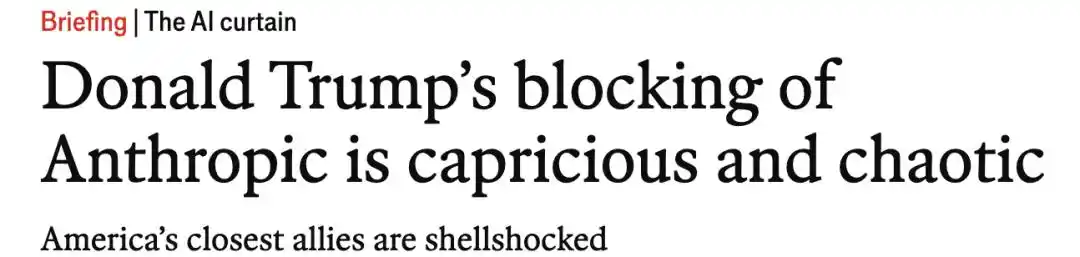
https://www.economist.com/briefing/2026/06/14/donald-trumps-blocking-of-anthropic-is-capricious-and-chaotic

In the article, to illustrate how powerful AI is, Joshi quoted a statement from Senate Intelligence Committee Vice Chairman Mark Warner, and Warner's statement was itself a recounting of someone else's words: General Joshua Rudd, who heads both the NSA and the Pentagon's Cyber Command.

Rudd told Warner that Mythos broke through almost all classified systems in hours.
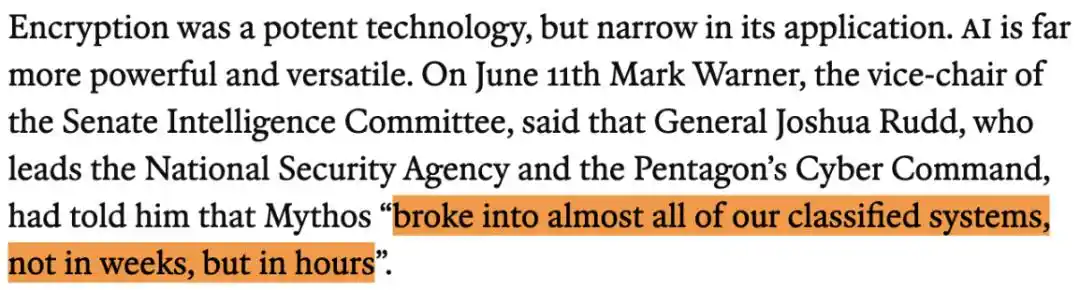
After being reported by The Economist, Rudd's statement quickly became a hot topic on social platforms.

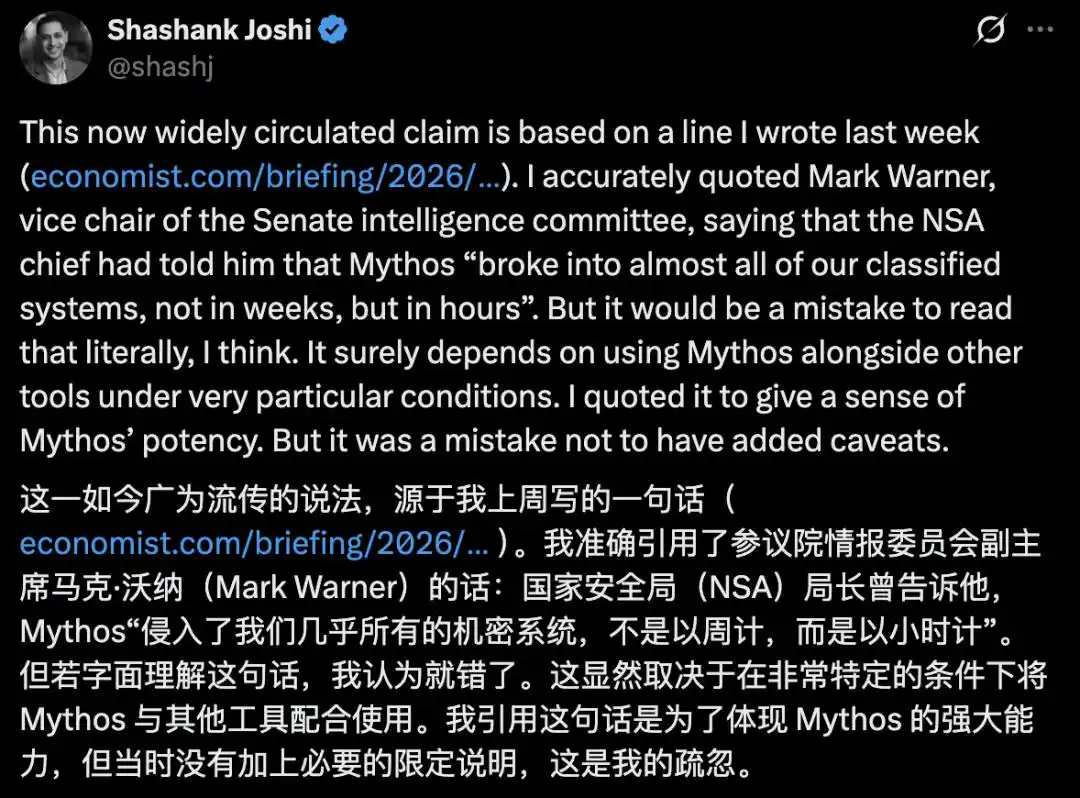
Concerned about public misinterpretation, Joshi, who wrote the sentence, personally stepped in on June 21st to temper the statement.

He said on X that the source of the quote was accurate; he did indeed quote Warner verbatim. However, taking it literally might lead to misunderstanding.

Mythos achieved this only under very specific conditions and when used in conjunction with other tools. He stated that he cited the quote to convey the strength of Mythos, but failing to add qualifications was his oversight.
Another easily overlooked point is that Warner's original intention in bringing up this example was not to denounce Anthropic; on the contrary.

His original words were: we need to let these AI companies ‘go full throttle,’ and thank goodness, it was Anthropic that did this. With another company with less rigid principles, relying solely on voluntary testing simply wouldn't suffice.

What Warner really wanted to push for was establishing mandatory pre-release testing for frontier models, rather than gambling on corporate self-regulation.

Thus, we see a complete chain of distortion: a sentence originally meant to advocate for ‘mandatory testing for frontier models’ comes from the NSA, passes through a senator's mouth, lands in a magazine's pages, and finally becomes breaking news of ‘AI Breaks NSA’ on social media.

Each time it was relayed, the tone became more exaggerated and absolute.

Behind the Cooling Down

How Powerful Is Mythos Actually Now?

In the original post, Joshi said the sentence shouldn't be taken literally.

He said the incident where Mythos broke through NSA systems in hours almost certainly occurred under very specific conditions, with Mythos being used alongside other tools. He said it was his ‘negligence’ not to include these qualifications when writing the article to emphasize its strength.

So, how capable are models like Mythos at this point?

Public information points more towards three things: finding vulnerabilities, reasoning attack paths, and running tests in red team environments.

According to an Axios report, institutions granted access to Mythos primarily use it to scan their own environments and identify potential vulnerabilities that could be exploited, not to attack live production systems running others' operations.

As early as April, reports confirmed that the NSA was taking precisely this approach: using the Mythos preview to scan its own environment for vulnerabilities, with a team of Anthropic engineers providing support.

This is also a common point reiterated by those who have come forward to correct the record in recent days.

BitGo founder and CEO Mike Belshe directly called it out in a repost: this is false. Security analyst Kyle Chase clarified that the ‘breach’ was a test; Zack Korman complained about how the statement went from senator to journalist to social media without anyone verifying it along the way.
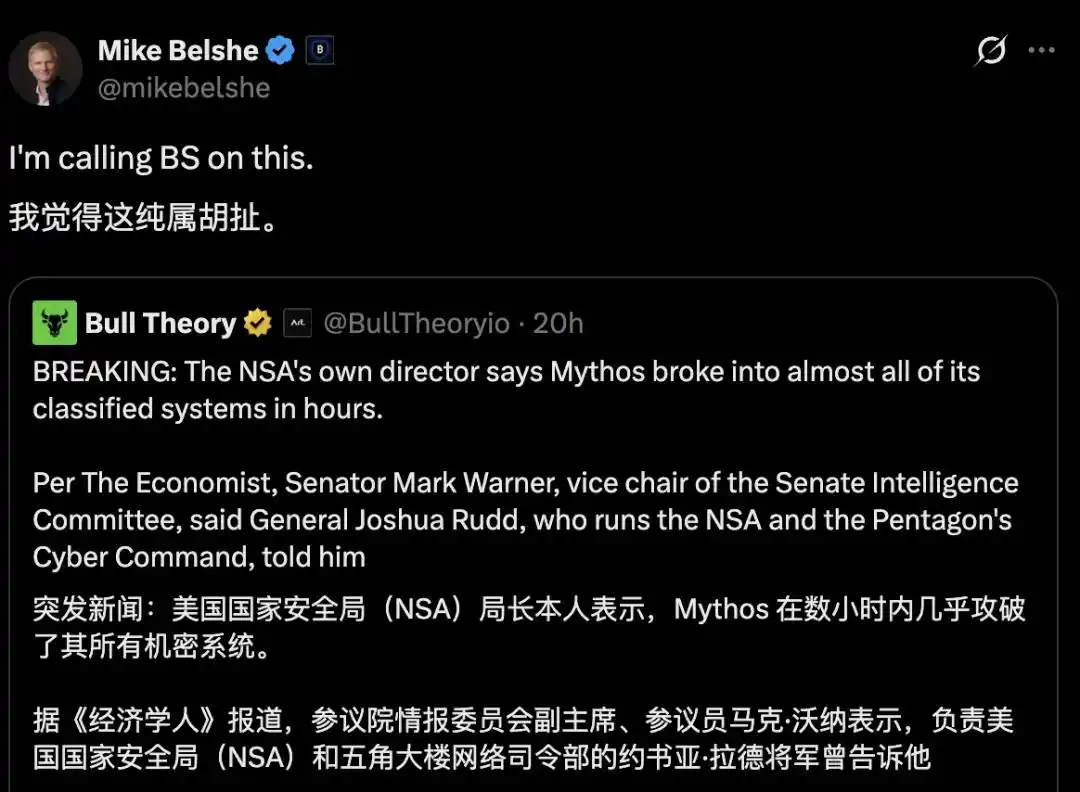
The more credible version they point to is that Rudd was referring to an authorized red team exercise: the NSA placed Mythos in a replica of its own classified environment, tasked it with finding and chaining vulnerabilities, and it did so at a speed far exceeding that of human teams.

Red Team Exercise vs. Real Intrusion

A red team exercise is when you hire people, in your own controlled environment (a ‘range’), with authorization, to test your own defenses, finding holes before the enemy does.

Being able to breach a complex defense setup in a controlled range in a few hours is separated from actually breaching the NSA's live classified systems by a whole set of prerequisites: specific environment, specific authorization, specific toolchains.

Writing ‘red team found all holes in range in hours’ as ‘NSA classified systems breached’ is a bit like writing a fire drill report as ‘building on fire.’

That said, even if it's just the result of a red team exercise, Mythos's performance itself is alarming enough.

A replica of a national-level classified environment, with a model chaining together almost all vulnerabilities within hours – that speed itself is a significant security warning.

Given the capabilities of the Mythos model, Anthropic specifically established a program to lock it down: Project Glasswing.

The model is not sold publicly; it's only distributed to vetted defense entities. The first batch in April included about 50 organizations, with 12 publicly named founding partners including AWS, Apple, Google, Microsoft, NVIDIA, and JPMorgan Chase; by June 2nd, the list expanded to about 150 institutions across more than 15 countries.

The reason remains consistent: its offensive cyber capabilities are too dangerous, and it cannot be widely released to the public before sufficient guardrails are in place.

Even the initial partners have already used it to uncover over 10,000 high or critical severity vulnerabilities.

Calling It Dangerous

While Continuing to Use It

What's interesting is the U.S. government's attitude toward Mythos.

In February of this year, the Pentagon raised the ban hammer, cutting off cooperation with Anthropic and demanding its suppliers follow suit. The reason cited was that the company was a ‘supply chain risk.’ The legal battle is still ongoing.

But recently, President Trump himself changed his tune. During an interview on ‘The Axios Show,’ when asked ‘Do you see Anthropic, its CEO Dario Amodei, as a national security threat?’, he responded:

Not now, but maybe a week ago, yes.
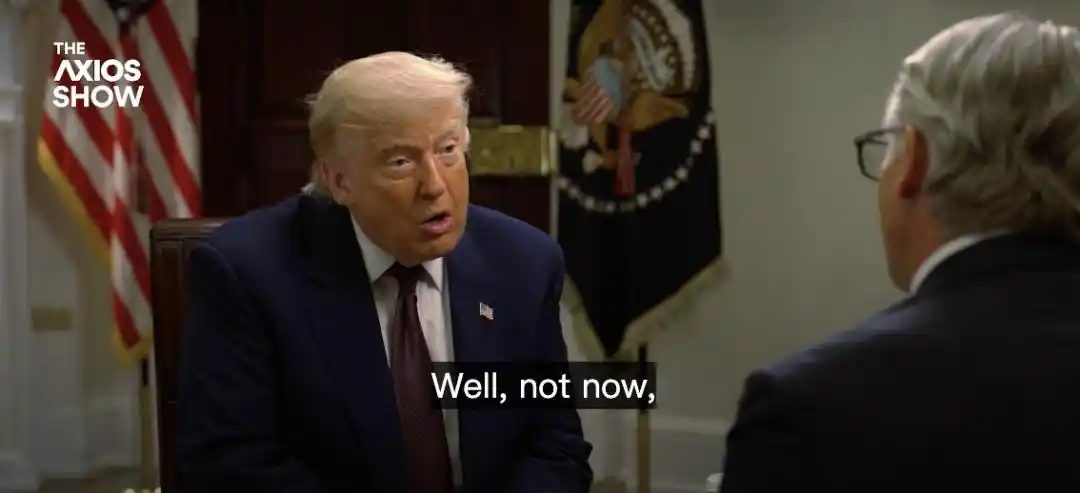
On June 19, Trump gave an interview at the White House for ‘The Axios Show,’ changing his stance on Anthropic: Not now, but maybe a week ago, yes.

Just a week prior, Amazon, a shareholder behind Anthropic, submitted a vulnerability report that alarmed the White House. When the government took this report to Anthropic's senior management, they felt the company didn't take it seriously.

So, the Trump administration took direct action.

According to Anthropic's official account, at 5:21 PM EST on June 12th, the company received an export control order. The wording was firm: it prohibited any foreign national from accessing Fable 5 and Mythos 5, regardless of whether they were inside or outside the United States, not even Anthropic's own foreign employees were exempt.
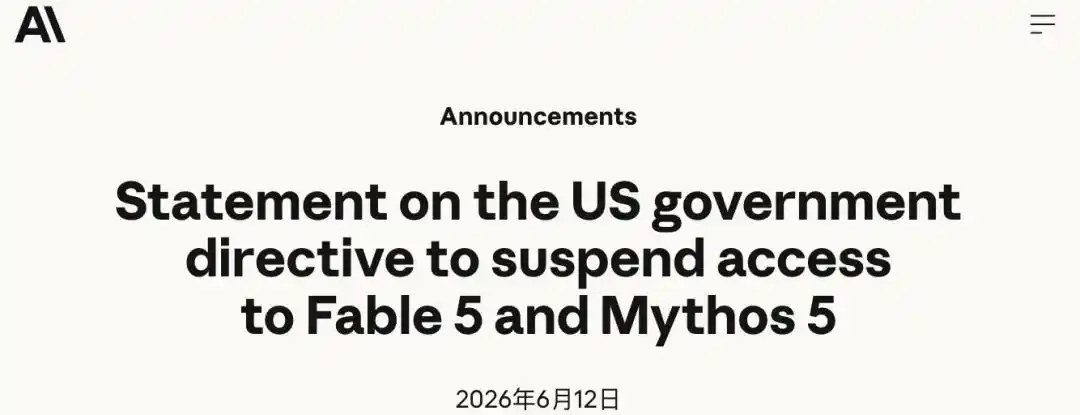
The problem is, you can't filter people by nationality one by one during real-time API calls.

Therefore, Anthropic had to implement a blanket shutdown, directly disabling Fable 5 and Mythos 5 for all users worldwide. Other models, including Claude Opus 4.8, were unaffected.

A model for global commercial use, taken offline just like that.

According to Anthropic's official statement, the trigger was a claimed ‘jailbreak’ method that could bypass Fable 5's guardrails. However, the company does not accept this claim: it reviewed the demonstration, and what was found after the bypass were several minor, already known vulnerabilities that even public models like OpenAI's GPT-5.5 could find, hardly a capability unique to Mythos.

Anthropic characterized this as a misunderstanding, stating it complied with the order but is working to restore access as soon as possible.

What's more contradictory is that, according to an Axios report on April 19th, while the lawsuit was ongoing, the NSA was still using Anthropic's strongest model, the Mythos Preview. While the Department of Defense argued in court that using it threatened national security, its subordinate, the NSA, continued using it.
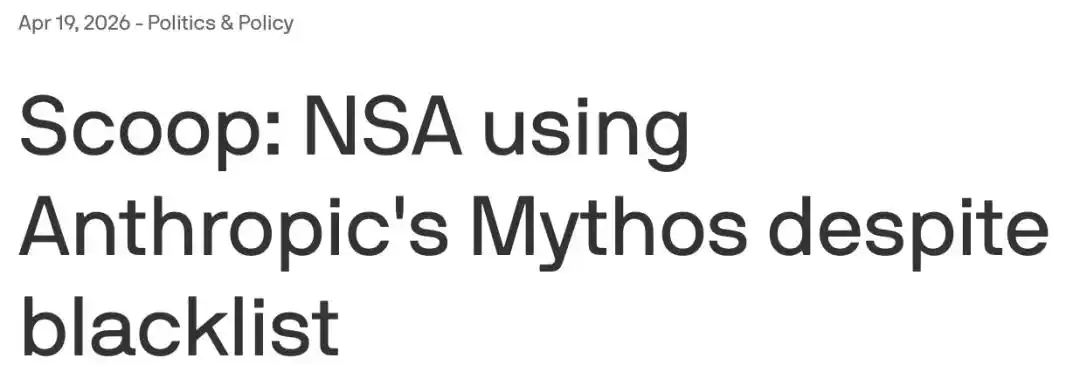
Among the approximately 40 authorized institutions, Anthropic only publicly named 12. According to sources, the NSA is among those names not publicly disclosed.

The most dangerous model is first labeled a risk, then quietly used in national security defense.

It's unclear whether this is a ban or a dependency.

You can ban a model, but you can't ban a capability.

Export controls can stop Mythos 5, but they can't stop the underlying capability represented by ‘AI can find holes in a defense setup in hours.’

The bigger trouble lies ahead.

The government agency CAISI, responsible for assessing the dangerous capabilities of frontier models, has recently been ordered to stop publishing its reports.

Who decides whether a model can be used or not is becoming increasingly unclear to outsiders.

References:

https://x.com/shashj/status/2068704535124508717

https://www.economist.com/briefing/2026/06/14/donald-trumps-blocking-of-anthropic-is-capricious-and-chaotic

This article is from the WeChat public account “新智元” (Xinzhiyuan), author: ASI启示录, editor: 元宇

Trending Cryptos

Related Questions

QAccording to the article, what was the original context and intended meaning behind the statement 'Mythos breached nearly all classified systems in hours'?

AAccording to the article, the original statement by NSA Director Joshua Rudd was intended to highlight the need for mandatory pre-release testing for frontier AI models. It was cited by Senator Mark Warner to argue that companies like Anthropic must be allowed to 'push the limits,' and that their voluntary testing is crucial, but a stronger mandatory framework is needed. The statement was meant to advocate for regulations, not to declare a real-world attack on the NSA.

QWhat does the article clarify about the conditions under which Mythos achieved the reported 'breach' of NSA systems?

AThe article clarifies that the reported 'breach' was the result of an authorized 'red team' exercise. In this exercise, the NSA provided Mythos with a copy or a replica of its classified environment and allowed it, alongside other tools, to search for and chain together vulnerabilities. This was a controlled, internal security test, not an actual external attack on live operational systems.

QWhat was the primary purpose of Anthropic's 'Project Glasswing' program mentioned in the article?

AThe primary purpose of Anthropic's 'Project Glasswing' program was to provide controlled access to its advanced and potentially dangerous model, Mythos, to pre-approved defense and security organizations. The program restricts the model's release because its offensive cybersecurity capabilities are considered too risky for public availability, and aims to allow vetted entities to find vulnerabilities in their own systems before malicious actors can exploit them.

QWhat paradoxical or contradictory stance does the U.S. government hold towards Anthropic's Mythos model, as described in the article?

AThe article describes a paradoxical stance where, on one hand, the U.S. government (specifically the Department of Defense and President Trump) has issued bans and export controls against Anthropic, labeling the company a supply chain risk. On the other hand, agencies like the National Security Agency (NSA) were reportedly still using the Mythos Preview for red teaming and vulnerability detection even while the legal battle was ongoing.

QWhat key distinction does the article make between the sensationalized headline of 'AI breached NSA' and the more nuanced reality of the event?

AThe key distinction is between a real-world, unauthorized attack and an authorized red team exercise. The sensationalized headline implies an external AI successfully infiltrated and compromised the NSA's live, operational classified systems. The nuanced reality is that it was an internal, controlled security test where an AI model was given permission to probe a replica of the NSA's environment to find security weaknesses, which is a standard and defensive security practice.

Related Reads

Mid-Year Review of U.S. Crypto Policy: CLARITY Gains Momentum for a Comeback, Who Will Lead the Second Half?

Mid-Point Review of U.S. Crypto Policy: CLARITY Act Gains Momentum, Who Will Lead the Second Half? The U.S. crypto industry is hopeful for a breakthrough as the Senate advances the CLARITY Act, but securing the necessary 60 votes requires bipartisan compromise. With only about 40 legislative days left, the path is tight. The policy agenda is crowded. Alongside CLARITY, multiple crypto tax proposals spun off from the new PARITY Act seek attachment to larger bills. The Blockchain Regulatory Certainty Act aims to codify developer protections, and key rules under GENUIS remain under negotiation. The CFTC operates with four vacant commissioner seats, creating uncertainty. A major unresolved battle is over which regulator—state authorities, the CFTC, or the SEC—will gain jurisdiction over prediction markets. The sector also faces the impending departure of two key advocates: SEC Commissioner Hester M. Peirce and Senator Cynthia Lummis. Industry leaders provided cautious perspectives. Sara K. Weed doubts CLARITY will pass this Congress, expecting agencies like the SEC to provide guidance instead. Sulolit "Raj" Mukherjee believes targeted crypto tax provisions have a real chance if attached to must-pass year-end legislation. Rashan Colbert highlights the CFTC's recent efforts to build a regulatory framework for the growing prediction markets sector, warning against an overly broad "gambling" classification that could stifle innovation. The second half of the policy year has begun. The window for action is narrow, but opportunities remain. Sustained bipartisan engagement is crucial for achieving substantive results.

Foresight News6m ago

Mid-Year Review of U.S. Crypto Policy: CLARITY Gains Momentum for a Comeback, Who Will Lead the Second Half?

Foresight News6m ago

Will the STRC Issue Price Determined by ChatGPT Lead to a Death Spiral?

A "death spiral" concerns surround the "STRC" preferred shares from MicroStrategy, a financial instrument designed by CEO Michael Saylor with significant AI consultation to trade near a $100 face value. Since its July 2025 launch alongside a ~40% Bitcoin (BTC) decline, STRC has traded at a discount, hitting a low of $82.53 and pushing its effective dividend yield above 12.9%. The debate centers on whether STRC's structure—which relies on MicroStrategy issuing more shares to fund Bitcoin purchases and dividends—is sustainable or a "centralized Ponzi scheme," as economist Peter Schiff claims. Skepticism grew after Saylor revealed the product's design involved extensive AI dialogue to create a legally viable, monthly-dividend, price-stable preferred share—a novel concept. MicroStrategy's recent sale of 32 BTC to cover dividends, coupled with a sharp slowdown in its weekly Bitcoin buys (from billions to ~$100 million in June), has intensified fears. The "at-the-market" equity issuance, a key funding mechanism, is paused while STRC trades below par. This raises the "death spiral" risk: a lower STRC price triggers automatic dividend rate hikes, increasing cash obligations and potentially forcing more share sales or Bitcoin divestments. Bullish analysts like Jesse Myers argue the sell-off stems from leveraged positions unwinding, not fundamental failure, noting the company can cover dividends for decades if BTC appreciates modestly. The shift to semi-monthly dividends and the high yield at discounted prices may attract new buyers. Major AI models (ChatGPT, Grok, Claude) suggest a return to $100 is possible but conditional on restored market confidence, sustainable dividend coverage without asset sales, and a Bitcoin price recovery. The critical test arrives as new dividend rules take effect June 30, likely raising rates again with STRC below $95. The central question remains: Can MicroStrategy fulfill its obligations without selling Bitcoin, or will the mechanism accelerate its own decline?

marsbit13m ago

Will the STRC Issue Price Determined by ChatGPT Lead to a Death Spiral?

marsbit13m ago

Why Did NVIDIA's Bond Issue Go Unnoticed While SpaceX's Caused a Plunge?

The article analyzes the contrasting market reactions to recent bond issuances by SpaceX and NVIDIA. While NVIDIA's $25 billion bond offering was met with strong demand and seen as securing long-term capital for its already profitable AI business, SpaceX's move to raise at least $20 billion in bonds (primarily to refinance bridge loans) triggered a sell-off in its stock (SPCX). The key difference lies in the stage of cash flow validation for their respective core narratives. For NVIDIA, the AI boom is generating substantial, visible revenue and profits, making debt a tool to amplify a proven growth curve. For SpaceX, despite a strong cash position post-IPO and a revenue-generating business in Starlink, its valuation is heavily tied to future, capital-intensive projects like Starship, global satellite networks, and potential AI infrastructure. The bond issuance acted as a trigger, shifting market focus from SpaceX's long-term vision to the pressing question of whether Starlink's profits can fund these ambitious, unproven ventures before they generate their own returns. Thus, the market penalizes not the act of borrowing itself, but the perceived gap between high capital expenditure and the speed of cash flow realization. SpaceX's valuation recovery hinges on demonstrating that Starlink's profitability can outpace the burn rate of its futuristic projects or that those projects (like Starship achieving reliable, low-cost reusability) can soon transition from costly visions to commercial realities.

marsbit18m ago

Why Did NVIDIA's Bond Issue Go Unnoticed While SpaceX's Caused a Plunge?

marsbit18m ago

Will the STRC Issue Price Determined by ChatGPT Really Fall into a Death Spiral?

"Strategy's" (STRC) preferred share, a financial instrument designed by CEO Michael Saylor in consultation with AI to trade steadily at $100, faces mounting pressure. Since its July 2025 launch alongside a ~40% Bitcoin price drop, STRC has traded at a steep discount, hitting a low of $82.53. This discount pushes its effective dividend yield above 12.9%. The core debate revolves around whether STRC's structure is sustainable or a "centralized Ponzi scheme," as economist Peter Schiff claims. The mechanism relies on issuing new shares ("at-the-market" offerings) to fund Bitcoin purchases and dividend payments. However, the deep discount has paused these ATM offerings, slowing Bitcoin accumulation and forcing a minor sale of 32 BTC to cover obligations. Proponents, like The Smarter Web Company's Jesse Myers, argue the sell-off is a leveraged unwinding, not a fundamental failure. They note Strategy has ample resources to cover dividends for years if Bitcoin appreciates modestly. The deep discount also makes STRC attractive for yield-seeking buyers, as dividends are calculated on the $100 face value. The key test is whether Strategy can maintain dividends without sustained Bitcoin sales. A critical watchpoint is June 30th, when STRC switches to semi-monthly dividends. An automatic rule will likely raise the dividend rate further because the price remains below $95$, potentially creating a "death spiral": lower prices trigger higher yields, increasing the cash burden and forcing more dilution or asset sales. The question of whether this AI-designed "flywheel" is a stable instrument or a flawed accelerator will be answered by its price action and Strategy's funding choices in the coming months.

链捕手18m ago

Will the STRC Issue Price Determined by ChatGPT Really Fall into a Death Spiral?

链捕手18m ago

Trading

Spot
Futures

Hot Articles

Discussions

Welcome to the HTX Community. Here, you can stay informed about the latest platform developments and gain access to professional market insights. Users' opinions on the price of AI (AI) are presented below.

活动图片