If artificial general intelligence (AGI) were achieved tomorrow, what would the next phase of AI look like?
Google DeepMind's team and its collaborators propose in a latest research report that AGI is likely not the endpoint. In their view, AI will not plateau at a level close to humans but will continue to become more powerful, surpassing the most top-tier teams of human experts and ultimately moving towards artificial superintelligence (ASI).
As Alan Turing wrote in 1950: “We can only see a short distance ahead, but we can see plenty there that needs to be done.”
In this report, the research team outlines four potential pathways for AI's transition from AGI to ASI, possible key bottlenecks, and the most pressing research questions to advance.
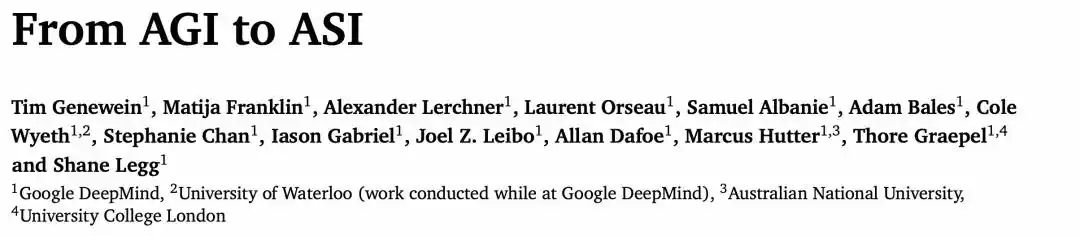
Paper Link: https://arxiv.org/abs/2606.12683
The research team stated that due to the considerable uncertainty in predicting ASI progress, the possibility of AI continuing to accelerate its development in the coming years cannot be ruled out. This may mean that the notion of a “single transformative leap” triggered by introducing human-level AGI into society might be inaccurate.
A more fitting prospect might be that AI-driven progress and breakthroughs will emerge successively across numerous fields of science and technology, thereby triggering a series of transformative societal changes.
To address this prospect, a large-scale, interdisciplinary project with a global vision and broad concern is needed.
After AGI, Comes ASI
Before discussing how AI might continue to become stronger, the research team first distinguishes three easily confused concepts: AGI, ASI, and UAI.
AGI (Artificial General Intelligence): A general intelligent system that reaches the median human level in most cognitive tasks. This corresponds to the general cognitive ability of an average person, not the level of top experts. The research team also notes that the first generation of AGI might already surpass humans in some tasks, just not yet possessing sufficiently broad generality.
ASI (Artificial Super Intelligence): It does not surpass humans in only a few tasks but overall exceeds humans in nearly all fields of human concern; the reference is not a single expert but large-scale, well-coordinated collectives of human experts.
UAI (Universal Artificial Intelligence): The theoretical upper bound of machine intelligence, formally described by the AIXI framework. AIXI corresponds to a theoretically optimal universal agent. Real-world AI can only gradually approach this upper bound, not directly achieve it.
Simultaneously, the research team points out that the transition from AGI to ASI might not have only one path. They propose four potentially parallel advancing pathways, detailed as follows:
Path One: Continue Scaling Computation, Models, and Data
This path continues the basic logic of AI progress over the past decade, including more powerful hardware, larger training runs, higher algorithmic efficiency, larger models, and more data. The research team notes that recent “effective compute” has roughly grown tenfold annually. Following this path, AI's improvement comes not only from individual models becoming stronger but also potentially from collective capability expansion due to more instances, faster inference, and larger-scale collaboration.
Path Two: Continued Algorithmic Evolution, Even New Paradigm Shifts
The research team states that longer context, continual learning, retrieval augmentation, tool use, robust decision-making in interactive environments, world models, etc., all belong to extensions of existing paradigms; whereas new architectures, training objectives, or learning mechanisms are closer to genuine paradigm shifts. The team does not specifically predict what the next paradigm shift might be but believes it could still be a crucial source of continued AI progress post-AGI.
Path Three: Recursive Self-Improvement
A stronger AI can help develop the next generation of even stronger AI, forming a positive feedback loop. The research team mentions this mechanism could manifest in algorithm and code improvement, hardware design, data generation and filtering, and efficiency gains in division of labor. For example, AlphaZero's approach of first using search to improve outputs, then distilling results back into the model, is a relevant case. More importantly is the question of how far this positive feedback can develop in reality.
Path Four: Multi-Agent Coordination and Collective Intelligence
This path focuses not on how strong a single model becomes, but on numerous AGI systems forming collective intelligence exceeding individual limits through division of labor and collaboration. The research team views automated companies, research organizations, and virtual economic systems as possible manifestations of this path. According to this path, ASI might not necessarily be an extremely powerful individual model but could be a highly coordinated AI collective.
The research team also cautions that the move from AGI to ASI may not simply be about more compute being better. Compute expansion is certainly important but will soon hit resource ceilings, requiring new algorithmic ideas, even new paradigms. More notably, even if a single AGI is only near human-level, once many AGIs can efficiently divide labor and collaborate, their collective capability might exceed humanity's.
Where Do the Real Challenges Lie?
After discussing the four potential paths, the research team also summarizes six categories of key bottlenecks that could affect AI's continued strengthening. Details as follows:
1. Data Wall
The research team points out that high-quality human-generated data is finite; human text data suitable for large-scale pre-training may approach its limit within this decade. Whether synthetic data, simulated environment data, and data generated from AI interacting with the real world can fill this gap fast enough is not concluded by the team but listed as a core uncertainty.
2. Economic and Natural Resource Pressures
If AI progress continues to rely primarily on scaling, then energy, chips, data centers, supply chains, and capital investments must grow in sync. The research team sees this as a real-world constraint but also notes that AI itself might increase economic output and improve algorithmic and hardware efficiency, thereby alleviating these pressures.
3. Current Neural Network Paradigms Might Be Inadequate
The research team does not rule out the possibility of the current path leading to ASI but also cautions that this path may still have fundamental limitations in areas like continual learning, stable reasoning, interactive decision-making, uncertainty representation, as well as issues like hallucinations and prompt injection.
4. Research Itself Will Become Increasingly Difficult
The research team notes that as a field matures, further progress often requires greater investment; whether AI can offset this trend through automated research remains to be studied.
5. Abstraction Barrier
The research team believes that if today's AI primarily learns from concepts and symbolic systems humans have already formed, it might excel at recombining existing concepts but not necessarily at autonomously extracting new conceptual primitives from the raw world. For example, if a modern large model were trained solely on pre-Newtonian knowledge, it would be almost impossible for it to derive general relativity or quantum mechanics from that material alone.
6. Regulation, Governance, and Societal Backlash
The research team argues that regulatory thresholds, licensing regimes, incident reporting requirements, and societal reactions to accidents will all influence the pace of AI capability expansion. This involves not just technical issues but also policy, institutions, markets, and public risk perception.
Shortcomings and Future Developments
Finally, the research team raises a very practical question: If AI already surpasses humans, how should we continue to assess its capabilities?
Today, many benchmarks use human-level as a reference. Once AI approaches or surpasses top humans in exams, programming, mathematics, Q&A, and professional knowledge tests, the original evaluation metrics may lose meaning. Therefore, future needs include establishing new evaluation and forecasting systems for the post-AGI era, encompassing tasks like multi-agent competition and cooperation, automated test generation, universal compression tasks, economic productivity and other indirect indicators, along with assessment mechanisms that can be continuously updated and do not saturate prematurely.
However, in terms of content, this is not an experimental paper but more like a technical report centered on the post-AGI era. The research team points out that future directions worthy of attention include: continuing to scale existing AGI systems, exploring new AI paradigms, achieving recursive self-improvement of systems, and forming stronger overall capabilities through large-scale multi-agent collaboration.
Finally, the research team notes that ASI is also not an omniscient, omnipotent “magic system”; it remains constrained by physical laws, computational complexity, data, resources, experimentation time, and the speed of real-world feedback. Which path AI will advance along and at what speed remains highly uncertain. In the future, there is still a need to establish continuously updated benchmarks, predictions, and research mechanisms to reduce uncertainty in judgment.
This article is from the WeChat public account "Academic Headlines" (ID: SciTouTiao), author: Academic Headlines




















