After Nine Months of Shorting, a Full Turn to Long: Renowned Trader Opens Bitcoin Positions Around 64K, Crypto Market Long-Short Divergence Intensifies

marsbitPublished on 2026-07-20Last updated on 2026-07-20

Abstract

After nine months of being short, prominent crypto trader Doctor Profit has closed all his bearish positions and started buying Bitcoin near $64,000, signaling a complete bullish reversal. He argues that structural market changes—such as impending U.S. regulation (CLARITY Act) and institutional adoption via securities tokenization—are rewriting the traditional four-year cycle script, potentially bringing the market bottom forward from the widely expected September/October timeframe. This view finds some technical support from on-chain analyst gumsays, who notes a bullish divergence on Bitcoin's weekly chart has persisted for 147 days, nearing the 161-day duration seen before the 2022 cycle low. However, cycle researcher Jake Pahor presents a counter-argument based on historical data. Analyzing patterns since 2014, he identifies three common features of past bear market bottoms: a ~12-month duration from peak to trough, a sustained period of extreme fear (with a proprietary risk score below 20), and the price falling below Bitcoin's realized price (~$53,000 currently). The current cycle, only nine months from its October 2025 peak, meets none of these conditions. The debate highlights a market torn between "front-running" a potential early bottom driven by new fundamentals and waiting for confirmation through traditional on-chain and sentiment metrics. While Doctor Profit opts for aggressive buying, Pahor maintains a disciplined, tiered accumulation strategy, continuing wee...

Author: Claude, Shenchao TechFlow

Shenchao Insights: Bitcoin has fallen from its October high of 126K to the 60K range, a drop exceeding 50%. Doctor Profit, the well-known trader who accurately shorted this decline, has announced fully closing all short positions and entering long at 64,000 USD, claiming structural variables have rewritten the four-year cycle script. On-chain analyst gumsays points out that a weekly bullish divergence has persisted for 147 days, close to the 161 days before the 2022 bottom. However, cycle researcher Jake Pahor, examining common features of every bear market bottom since 2014, finds that this cycle has met zero out of three conditions regarding time span, extreme fear days, and price falling below the realized price. The market is torn between "positioning early" and "waiting for confirmation signals".
Bitcoin has dropped from its historical high of around 126K last October to the 60K range, with a maximum drawdown exceeding 54%. This bear market has lasted nine months, and the debate is shifting from "how much further will it fall" to "has the bottom been reached".

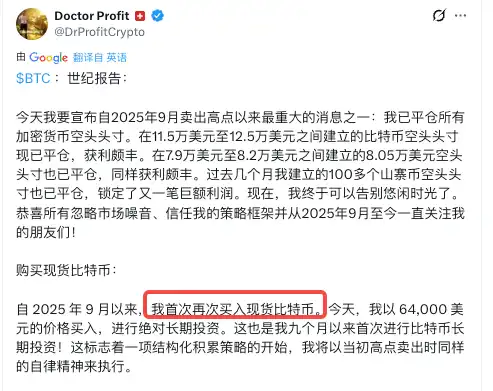
On July 19th, the renowned crypto trader Doctor Profit, who accurately shorted this decline, posted a lengthy thread on platform X, announcing the full closure of all short positions and starting to buy Bitcoin spot at 64,000 USD. This post garnered over 2.13 million views, quickly becoming a focal topic in the crypto community. On the same day, cycle researcher Jake Pahor provided a completely opposite judgment in his Substack column CryptoSuperHub: reviewing 5279 days of data since 2012, he found that every bear market bottom since 2014 met three specific conditions, none of which have been met in this cycle.

Doctor Profit Fully Closes Shorts, Claims Four-Year Cycle Bottom Will Arrive Early

Doctor Profit called this his "Century Report". He disclosed that all short positions established since September 2025 have been closed: Bitcoin shorts in the 115K-125K range, shorts in the 79K-82K range, and over 100 altcoin short positions, all locking in profits.

He entered long buying Bitcoin spot at 64,000 USD, with a strategy of structured accumulation: as long as Bitcoin is in the 54,000 to 64,000 USD range, invest 5% of allocated funds daily to buy spot. Buy at 58,000, continue buying at 56,000, increase buying intensity if it falls below 54,000.

The core logic for turning bullish is not technical but fundamental. Doctor Profit believes the market mainstream is still waiting for a "four-year cycle bottom" in September or October, but this consensus itself is a danger signal. "The market doesn't reward those who memorize calendars. When everyone is waiting for the same date, the bottom tends to arrive early."

He listed several variables changing Bitcoin's market structure: The CLARITY Act may pass the Senate before August 10th; BlackRock, Vanguard, JPMorgan, Goldman Sachs, and the New York Stock Exchange have joined DTCC's security tokenization pilot, with Microsoft stock, SPY, QQQ, and US Treasuries being tested as tokenized securities, official launch scheduled for October; Citadel just invested 400 million USD in Crypto.com, valuing it at 20 billion USD.

His judgment is: Trillions in institutional capital are waiting on the sidelines to enter, the tokenization revolution and regulatory legislation are advancing simultaneously. Retail investors on X are shouting about waiting for 40K-50K to build positions, but the largest capital is already in motion. "I won't stand behind the herd, begging the market for chips at the same price as everyone else. I'll run ahead."

Doctor Profit simultaneously maintains all S&P 500 short positions unchanged. He believes the crypto bear market started in October 2025, months ahead of the stock market, and has already undergone repricing. If a stock market crash triggers capital flow from overvalued assets to the already undervalued crypto market, it could serve as a catalyst.

gumsays: Weekly Bullish Divergence Has Lasted 147 Days, Nearing Last Cycle Bottom Level

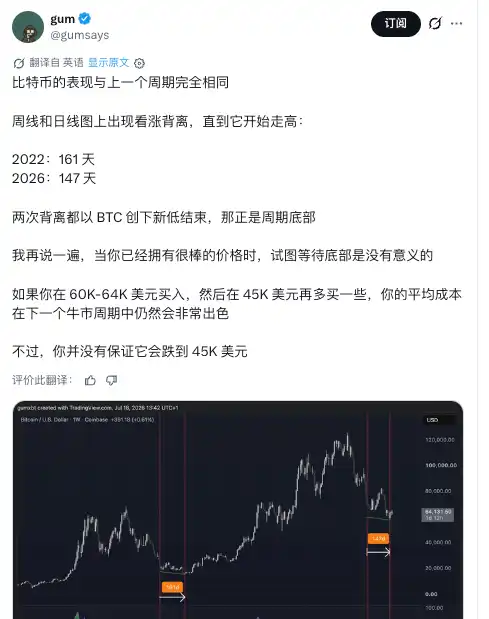
On-chain analyst gumsays posted on the same day, providing supporting technical arguments.

His observation is: Bitcoin's weekly chart shows high similarity to the 2022 cycle bottom. In the 2022 cycle, the weekly bullish divergence lasted 161 days before Bitcoin made a new low and confirmed the cycle bottom; in the 2026 cycle, this divergence has lasted 147 days, only about two weeks short of the 2022 duration.

gumsays' conclusion is moderate but clear: "Trying to wait for the absolute bottom when you already have a good price makes no sense. If you buy between 60K-64K and then add at 45K, your average price will still be excellent in the next bull run." But he added a risk note: "You have no guarantee it will drop to 45K."
Three Bottoming Conditions, None Met This Cycle

Jake Pahor provided the most systematic counter-argument in his July 19th CryptoSuperHub weekly report.

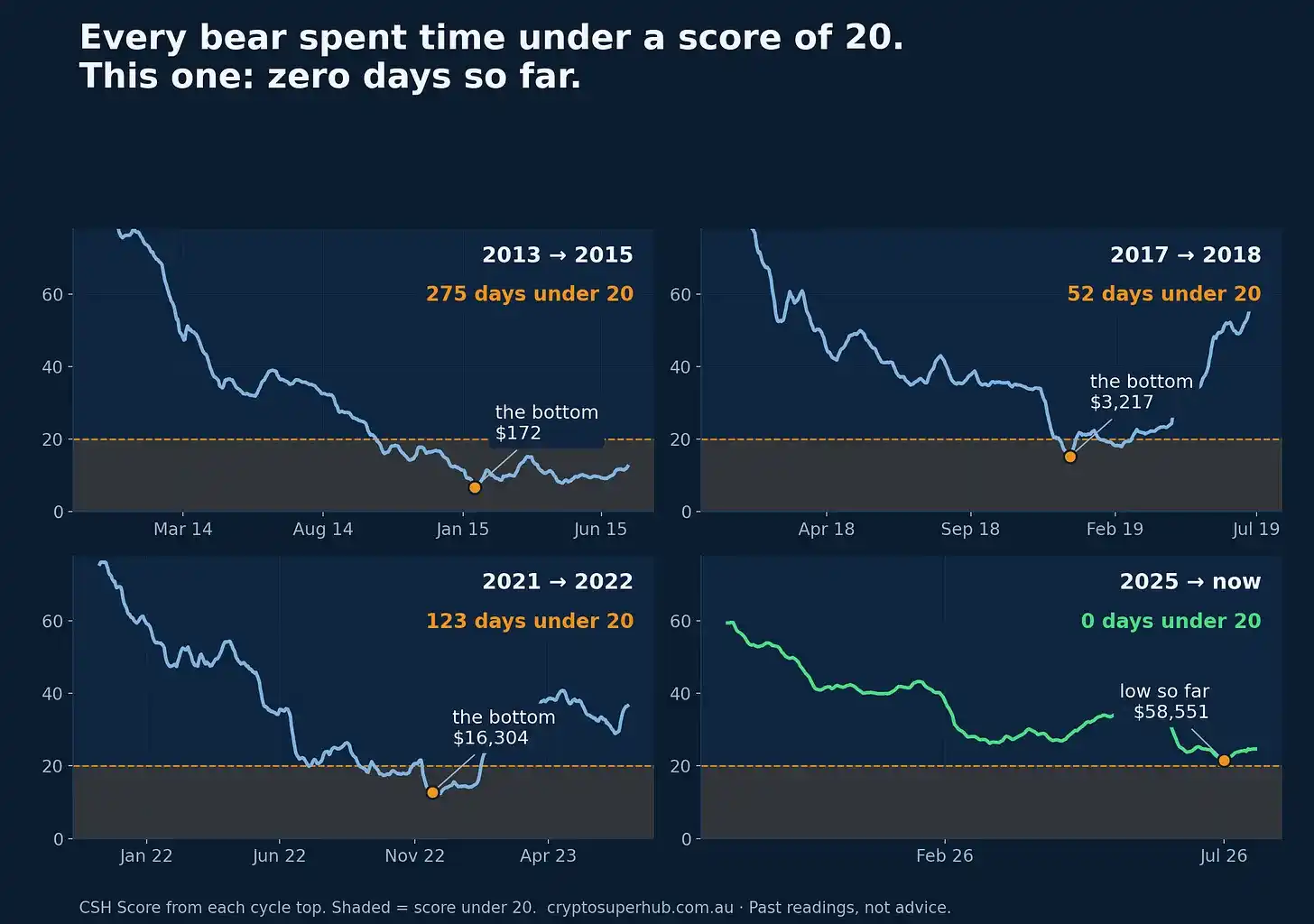
Reviewing 5279 days of CSH Risk Score data since February 2012, he outlined three common features of every bear market bottom since 2014:

First, time span. Bear market cycles since 2014 took about 12 months from peak to trough. This cycle's peak was October 2025, with the 12-month window pointing to Q4 this year. Only 9 months have passed so far.

Second, duration of extreme fear. The CSH Risk Score fell below 20 before every bear market bottom and remained there for a considerable time. The 2014-2015 bear spent 275 days below 20, 2018 spent 52 days, 2022 spent 123 days. This cycle has not had a single day below 20, with the lowest point being 21.5 on July 1st.

Third, price falling below realized price. The realized price is the weighted average price of all Bitcoins at their last on-chain move, representing the market's collective cost basis, currently around 53,000 USD. In previous bear market bottoms, price fell below this level. The June low of 57,000 USD was close but didn't breach it.

Zero out of three conditions met. This is why Jake Pahor refuses to join the "bottom is in" camp.
However, he is not purely bearish.

He acknowledges the bull camp's rationale in his article: This cycle's drawdown is shallower than at similar past stages; ETFs, a non-existent buying force in 2018 and 2022, may provide higher bottom support this cycle; at the June low, over half of Bitcoin was in loss (a condition historically correlating highly with bottoming zones).

Jake Pahor's operation reflects his stance: Weekly DCA continues as usual (in the Score 20-30 range, current location), but larger buy orders are placed to trigger only if the score falls below 20. "If the bottom is in, my DCA at scores in the 20s will perform well. If the bottom isn't in, my larger buy orders below 20 are waiting, funds ready. The plan covers both outcomes, prediction only covers one."

He also provided a set of historical backtest data: Buying Bitcoin in the CSH Score 20-30 range (current location) yielded a median return of +132% after 12 months, with only 6% of trading days recording losses; buying at scores above 60 yielded negative median returns.

Two Key Time Windows and One Data Anchor

From the views of multiple traders and analysts, the core divergence between the two camps boils down to one question: Are the two structural variables—ETF buying and regulatory legislation—sufficient to make this cycle deviate from the historical template?

Doctor Profit believes the answer is yes, betting on an early bottom, going all-in long. Jake Pahor believes the evidence isn't enough to overturn historical patterns, opting for systematic accumulation while reserving larger positions for more extreme signals.

As of July 19th, Bitcoin is quoted around 64,800 USD, with the 200-week moving average near 63,000 USD, price sitting right above this long-term support line. The Fear & Greed Index is at 25 (Extreme Fear).


Trending Cryptos

Related Questions

QWhat are the main reasons why trader Doctor Profit decided to switch from a short to a long position on Bitcoin?

ADoctor Profit cites several fundamental structural changes as reasons for his pivot to long: 1) The potential passage of the CLARITY Act by the Senate. 2) Major institutions (BlackRock, Vanguard, JPMorgan, etc.) joining the DTCC's tokenization pilot for traditional assets. 3) Significant institutional capital waiting on the sidelines, and 4) His belief that the anticipated four-year cycle bottom will arrive earlier than the market consensus (Sept/Oct) because 'markets don't reward those who memorize calendars.'

QAccording to Jake Pahor's historical analysis, what three key conditions have characterized previous Bitcoin bear market bottoms since 2014?

AAccording to Jake Pahor's analysis of CSH Risk Score data, the three common conditions for bear market bottoms since 2014 are: 1) A time span of roughly 12 months from cycle top to bottom. 2) The CSH Risk Score spending a significant period below 20 (indicating extreme fear). 3) The price falling below the Realized Price (the aggregate cost basis of the market, currently around $53,000). He notes the current cycle has met zero of these three conditions.

QWhat technical pattern does chain analyst gumsays observe that suggests similarities to the 2022 market bottom?

AChain analyst gumsays points out that a bullish divergence on the Bitcoin weekly chart has persisted for 147 days in the current cycle. This is similar to the 161-day duration of a bullish divergence that preceded the cycle bottom in 2022. He suggests that being only about two weeks away from the 2022 duration is a notable technical similarity.

QHow do the opposing views of Doctor Profit and Jake Pahor differ in their overall approach to the current market?

ADoctor Profit is taking a decisive, forward-looking bet that structural changes (ETF inflows, regulation, institutional adoption) have fundamentally altered the market cycle, leading him to fully exit shorts and begin aggressive spot buying. Jake Pahor, in contrast, adheres to a systematic, historically-grounded approach. He acknowledges potential bullish arguments but continues his plan of DCA (Dollar-Cost Averaging) now while reserving larger capital for deployment only if/when his historical bottom indicators (CSH Score

QWhat is Jake Pahor's investment strategy based on the CSH Risk Score, and what are the potential outcomes he is preparing for?

AJake Pahor employs a two-tiered investment strategy based on the CSH Risk Score. He continues with regular weekly DCA investments while the score is in the 20-30 range (where it currently is). Simultaneously, he has placed larger pending buy orders that will only execute if the score drops below 20. This strategy prepares him for two outcomes: If the bottom is already in, his DCA buys at scores in the 20s will perform well. If the bottom is not in and fear deepens (score

Related Reads

Trading

Spot

Hot Articles

What is $BITCOIN

DIGITAL GOLD ($BITCOIN): A Comprehensive Analysis Introduction to DIGITAL GOLD ($BITCOIN) DIGITAL GOLD ($BITCOIN) is a blockchain-based project operating on the Solana network, which aims to combine the characteristics of traditional precious metals with the innovation of decentralized technologies. While it shares a name with Bitcoin, often referred to as “digital gold” due to its perception as a store of value, DIGITAL GOLD is a separate token designed to create a unique ecosystem within the Web3 landscape. Its goal is to position itself as a viable alternative digital asset, although specifics regarding its applications and functionalities are still developing. What is DIGITAL GOLD ($BITCOIN)? DIGITAL GOLD ($BITCOIN) is a cryptocurrency token explicitly designed for use on the Solana blockchain. In contrast to Bitcoin, which provides a widely recognized value storage role, this token appears to focus on broader applications and characteristics. Notable aspects include: Blockchain Infrastructure: The token is built on the Solana blockchain, known for its capacity to handle high-speed and low-cost transactions. Supply Dynamics: DIGITAL GOLD has a maximum supply capped at 100 quadrillion tokens (100P $BITCOIN), although details regarding its circulating supply are currently undisclosed. Utility: While precise functionalities are not explicitly outlined, there are indications that the token could be utilized for various applications, potentially involving decentralized applications (dApps) or asset tokenization strategies. Who is the Creator of DIGITAL GOLD ($BITCOIN)? At present, the identity of the creators and development team behind DIGITAL GOLD ($BITCOIN) remains unknown. This situation is typical among many innovative projects within the blockchain space, particularly those aligning with decentralized finance and meme coin phenomena. While such anonymity may foster a community-driven culture, it intensifies concerns about governance and accountability. Who are the Investors of DIGITAL GOLD ($BITCOIN)? The available information indicates that DIGITAL GOLD ($BITCOIN) does not have any known institutional backers or prominent venture capital investments. The project seems to operate on a peer-to-peer model focused on community support and adoption rather than traditional funding routes. Its activity and liquidity are primarily situated on decentralized exchanges (DEXs), such as PumpSwap, rather than established centralized trading platforms, further highlighting its grassroots approach. How DIGITAL GOLD ($BITCOIN) Works The operational mechanics of DIGITAL GOLD ($BITCOIN) can be elaborated on based on its blockchain design and network attributes: Consensus Mechanism: By leveraging Solana’s unique proof-of-history (PoH) combined with a proof-of-stake (PoS) model, the project ensures efficient transaction validation contributing to the network's high performance. Tokenomics: While specific deflationary mechanisms have not been extensively detailed, the vast maximum token supply implies that it may cater to microtransactions or niche use cases that are still to be defined. Interoperability: There exists the potential for integration with Solana’s broader ecosystem, including various decentralized finance (DeFi) platforms. However, the details regarding specific integrations remain unspecified. Timeline of Key Events Here is a timeline that highlights significant milestones concerning DIGITAL GOLD ($BITCOIN): 2023: The initial deployment of the token occurs on the Solana blockchain, marked by its contract address. 2024: DIGITAL GOLD gains visibility as it becomes available for trading on decentralized exchanges like PumpSwap, allowing users to trade it against SOL. 2025: The project witnesses sporadic trading activity and potential interest in community-led engagements, although no noteworthy partnerships or technical advancements have been documented as of yet. Critical Analysis Strengths Scalability: The underlying Solana infrastructure supports high transaction volumes, which could enhance the utility of $BITCOIN in various transaction scenarios. Accessibility: The potential low trading price per token could attract retail investors, facilitating wider participation due to fractional ownership opportunities. Risks Lack of Transparency: The absence of publicly known backers, developers, or an audit process may yield skepticism regarding the project's sustainability and trustworthiness. Market Volatility: The trading activity is heavily reliant on speculative behavior, which can result in significant price volatility and uncertainty for investors. Conclusion DIGITAL GOLD ($BITCOIN) emerges as an intriguing yet ambiguous project within the rapidly evolving Solana ecosystem. While it attempts to leverage the “digital gold” narrative, its departure from Bitcoin's established role as a store of value underscores the need for a clearer differentiation of its intended utility and governance structure. Future acceptance and adoption will likely depend on addressing the current opacity and defining its operational and economic strategies more explicitly. Note: This report encompasses synthesised information available as of October 2023, and developments may have transpired beyond the research period.

951 Total ViewsPublished 2025.05.13Updated 2025.05.13

What is $BITCOIN

Discussions

Welcome to the HTX Community. Here, you can stay informed about the latest platform developments and gain access to professional market insights. Users' opinions on the price of BTC (BTC) are presented below.

活动图片