After 10 Years, Altman Finally Has the Person He Wanted

marsbitPublished on 2026-06-18Last updated on 2026-06-18

Abstract

After a decade of waiting, OpenAI CEO Sam Altman has finally secured his desired collaborator: Noam Shazeer, a legendary AI researcher and co-author of the seminal "Attention Is All You Need" paper that introduced the Transformer architecture. Shazeer has announced his departure from Google to join OpenAI as Head of Architectural Research. Shazeer, a crucial early Google employee who returned to Google DeepMind in a high-profile $2.7 billion deal two years ago, confirmed his move on social media platform X. Altman expressed his long-standing desire to work with Shazeer, stating the 10-year wait would be worth it. OpenAI's research lead, Mark Chen, welcomed Shazeer, highlighting his foundational work on Transformer, Mixture-of-Experts (MoE) models, and efficient decoding, which have profoundly shaped modern AI. His departure is seen as a significant blow to Google's Gemini project, where he served as a technical co-lead. Industry observers note this move represents a major win for OpenAI in the ongoing AI talent war, with some quipping that OpenAI acquired his expertise "for free" after Google's massive investment.

Noam Shazeer, the legendary AI figure whom Google brought back two years ago with a $2.7 billion deal, announced his departure from Google to join OpenAI.

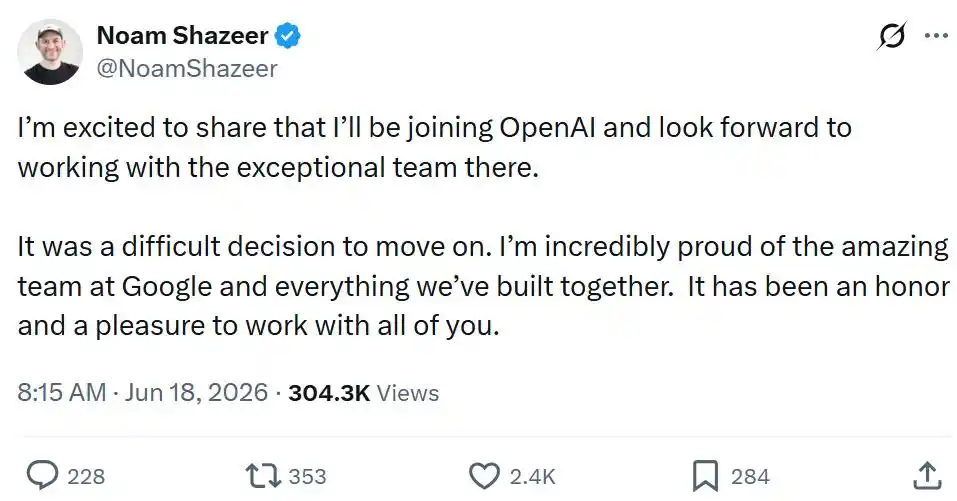
Just now, Noam Shazeer confirmed this news on X. He stated that he is joining OpenAI and looks forward to working with the excellent team there. He also expressed that leaving Google was not an easy decision; he is immensely proud of the Google team and everything they have built together, and it has been an honor and a pleasure to work alongside these colleagues.
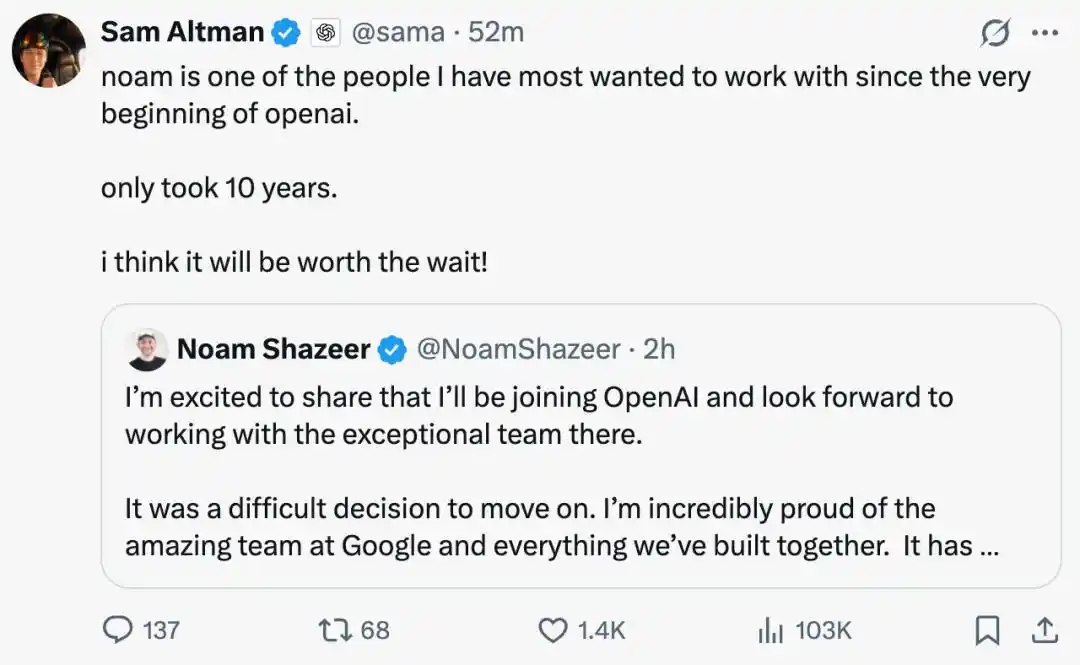
Subsequently, Sam Altman said, "From the very beginning of OpenAI's founding, Noam has been one of the people I most wanted to work with. It just took 10 years to finally get the chance. I believe the wait will be worth it!"
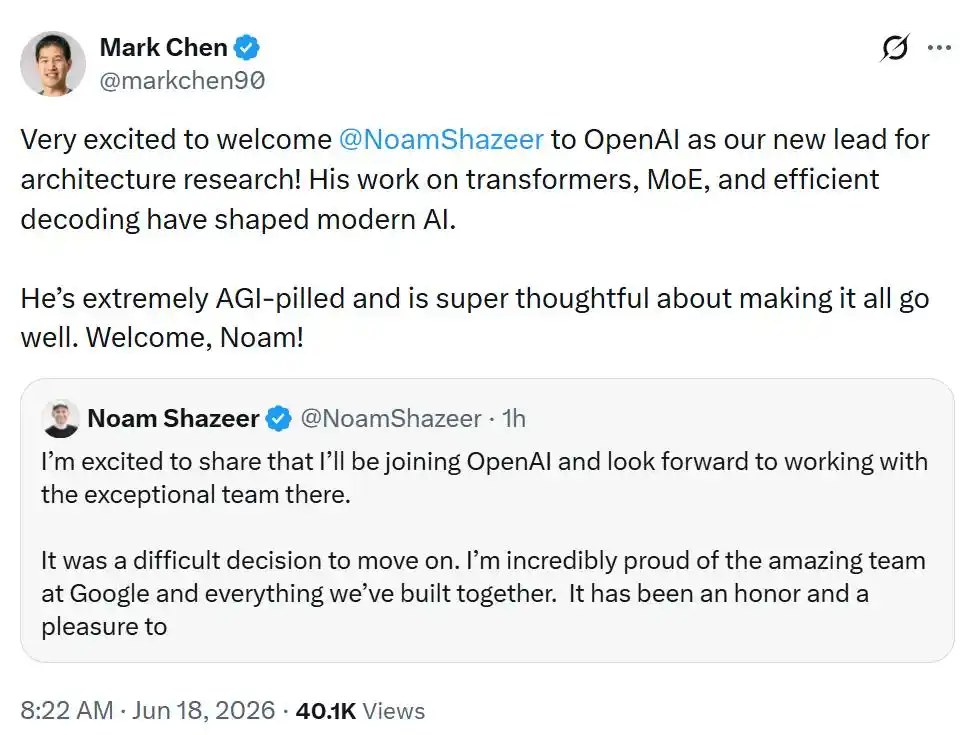
OpenAI research lead Mark Chen and others also responded on X: "A huge welcome to Noam Shazeer joining OpenAI as Head of Architecture Research! His research contributions in Transformer, MoE (Mixture of Experts), and efficient decoding have profoundly shaped the development of modern AI.

He not only holds a strong belief in achieving AGI but also has deeply considered insights on how to ensure its smooth development. Welcome, Noam!"
Noam Shazeer

Noam Shazeer is one of Google's most important early employees. He joined Google at the end of 2000, serving as a Principal Software Engineer responsible for early advertising systems.

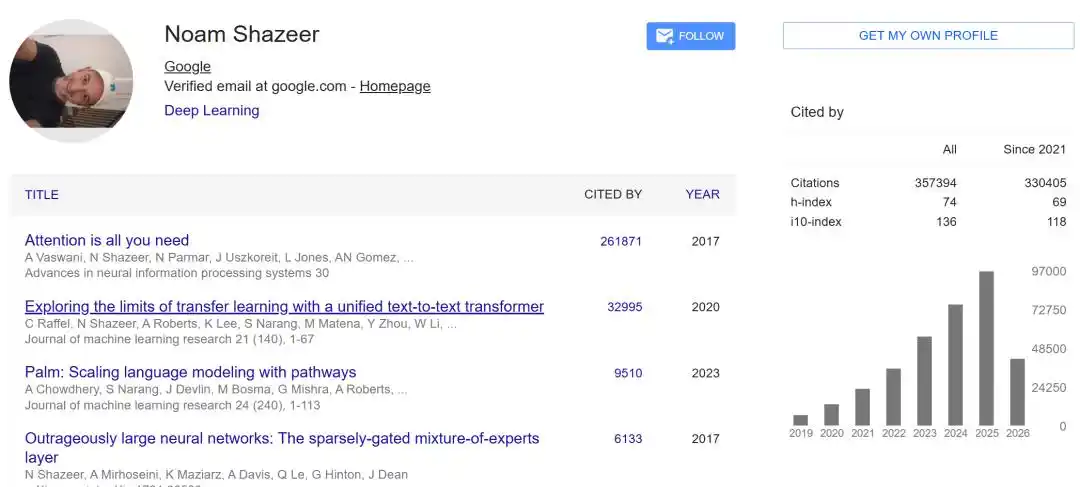
Noam Shazeer is no ordinary researcher. He is one of the co-authors of the seminal 2017 paper "Attention Is All You Need." The Transformer architecture proposed in this paper later became the most crucial technical foundation of the large language model era. From GPT and Gemini to Claude, and nearly all mainstream large models today, they all rely on the Transformer technical lineage.

More importantly, Shazeer's contributions extend beyond Transformer itself.

Long before large models truly entered the phase of scale competition, he had been focused on model scaling, sparse computation, and training of massive models. He co-proposed Sparsely-Gated Mixture-of-Experts, an important early foundation for the later MoE approach; Switch Transformer further pushed sparse expert models to the trillion-parameter scale. Today, MoE has become one of the key approaches for frontier models to increase parameter scale while controlling inference costs.
In 2021, Noam Shazeer left Google, disappointed by the bureaucracy at the search giant, and co-founded Character.AI with Daniel De Freitas. That company once became one of the most watched AI startups.

In 2024, Google reached a technology licensing deal with Character.AI and brought Shazeer and others back to Google DeepMind. Subsequently, he was appointed as co-head of Gemini technology, involved in Google's core large model project.
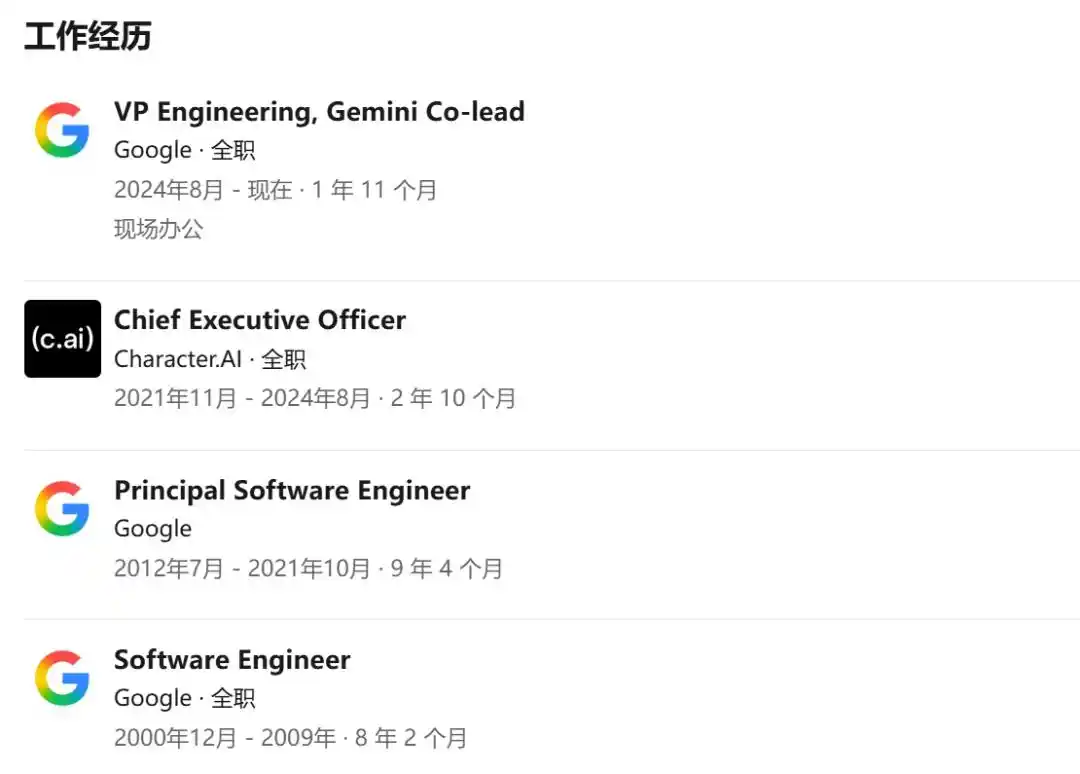
Now, in less than two years, he has turned to join OpenAI. This is truly harsh news for Gemini's development.

Many netizens believe that during the critical stage where Gemini still needs to continuously strengthen model capabilities and engineering systems, losing a figure like Shazeer will be a significant talent drain.

Others were more blunt in their jokes: Gemini wasn't that great to begin with; now with a core figure leaving, it's completely finished.
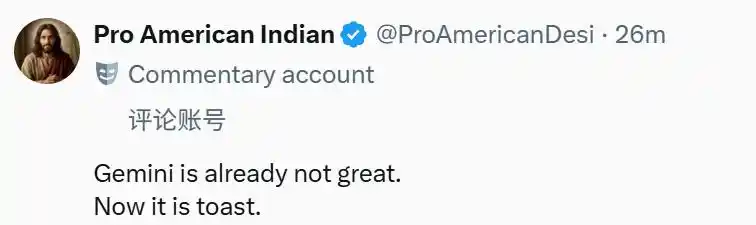
Another netizen joked: Google paid $2.7 billion for Shazeer's intellectual property. And OpenAI got these patents for free. This is the most favorable acquisition price in tech history.

In this AI talent war, Shazeer's addition is undoubtedly a significant victory for OpenAI.

This article is from the WeChat public account "Machine Heart" (ID: almosthuman2014), author: Focus on AI Big Shots.


Trending Cryptos

Related Questions

QWho is Noam Shazeer and what are his key contributions to AI?

ANoam Shazeer is a prominent AI researcher and a co-author of the seminal 2017 paper "Attention Is All You Need," which introduced the Transformer architecture. He is also known for his foundational work on Sparsely-Gated Mixture-of-Experts (MoE) and efficient decoding, technologies that are critical to modern large language models.

QWhy did Sam Altman say it took 10 years to get Noam Shazeer to join OpenAI?

ASam Altman stated that Noam Shazeer had been one of the people he most wanted to work with since OpenAI's founding. The wait of 10 years refers to the period from OpenAI's establishment to finally securing Shazeer's collaboration.

QWhat position did Noam Shazeer hold at Google before joining OpenAI, and why is his departure significant?

ABefore joining OpenAI, Noam Shazeer was a co-technical lead for the Gemini project at Google DeepMind. His departure is seen as a significant talent loss for Google, potentially impacting the Gemini project's development during a critical phase of strengthening its capabilities.

QWhat was the reported financial deal between Google and Character.AI involving Noam Shazeer?

AAccording to the article, Google reportedly struck a $2.7 billion deal for a technology license with Character.AI, the company co-founded by Shazeer, which also led to his return to Google in 2024.

QHow did the AI community react to Noam Shazeer's move to OpenAI?

AReactions were mixed. Some viewed it as a major win for OpenAI in the AI talent war. Others expressed concern for Google's Gemini project, with some joking that OpenAI got Shazeer's expertise 'for free' while Google had paid billions, and some even suggesting it was a devastating blow for Gemini.

Related Reads

Global Stock Market's Storm Center: South Korea's Stock Market De-leveraging Is Largely Complete

Storm's Eye: South Korean Market De-leveraging Nears Completion The recent sharp correction in South Korean equities, with the KOSPI index dropping 32% from its June high, has been a key trigger for global tech stock volatility. The core driver was not a fundamental shift but a forced de-leveraging process within the market's unique structure, which is now largely complete. Two main leverage channels amplified the sell-off: 1. **Leveraged ETFs:** Their size, proportionally four times larger than in the U.S., peaked near $50 billion. Their mandatory daily rebalancing mechanism created a vicious cycle of "price drop → forced selling → further drop." Approximately 75% of this excess has been unwound, shrinking to $26 billion, with regulatory curbs now blocking new inflows. 2. **Hedge Fund Leverage:** Using swaps to magnify exposure, hedge funds saw their net long positioning fall by over 50% from peak levels. The most intense phase of this institutional de-leveraging is over. In contrast, **retail margin debt** poses minimal systemic risk. At 0.5% of market cap, it is far lower than in the U.S. or China, lacks automatic triggers, and is concentrated in smaller stocks. The conclusion: the high-leverage structures most prone to "chain-reaction selling" have been substantially cleared. The market is transitioning from a liquidity-driven crash to one priced more on fundamentals. The article argues that the AI trend—centered on Korean memory chips—remains intact. This episode represents a painful but necessary clearing of crowded trades, not the end of the AI revolution. For investors, the key question is conviction in the long-term AI direction; if the trend is real, current volatility is a cost of entry, not a terminal risk.

链捕手1h ago

Global Stock Market's Storm Center: South Korea's Stock Market De-leveraging Is Largely Complete

链捕手1h ago

Trading

Spot

Hot Articles

Discussions

Welcome to the HTX Community. Here, you can stay informed about the latest platform developments and gain access to professional market insights. Users' opinions on the price of AI (AI) are presented below.

活动图片














