A Quick Look at the Latest Moves of the 24-Year-Old 'AI Stock God': Sixty Percent of the Portfolio Hedging Against Semiconductor Downturn

marsbitPublished on 2026-05-18Last updated on 2026-05-18

Abstract

24-year-old AI investing prodigy Leopold Aschenbrenner's fund, Situational Awareness LP, has disclosed its Q1 2026 13F holdings. The fund's total portfolio nominal value surged 148% to $13.7 billion, driven by both investment gains and significant new capital inflows. The most striking move was the establishment of massive short-term hedges against potential volatility in the AI semiconductor sector. Over 60% of the fund's nominal exposure is now in put options (bets on declines) targeting major AI hardware stocks like NVIDIA (NVDA), VanEck Semiconductor ETF (SMH), Broadcom (AVGO), and AMD. Notably, the fund also holds call options (bets on rises) on some names like Micron (MU) and TSMC, indicating it expects extreme price swings in these stocks. Alongside these hedges, the fund remains a long-term bull on AI infrastructure. It significantly increased its equity stakes in companies like GPU cloud provider CoreWeave (CRWV) and added to positions in power/energy infrastructure firms like Bloom Energy (BE), albeit after taking substantial profits on the latter. The fund also exited positions in optical communication hardware (LITE, COHR) and reduced leverage by clearing out large call option positions on Intel and CoreWeave. In essence, the portfolio reflects a dual strategy: cautious on near-term semiconductor valuations and potential over-extension, while maintaining a conviction that the true long-term bottlenecks and value will be in the underlying infrastructure powering...

Original | Odaily Planet Daily (@OdailyChina)

Author | Azuma (@azuma_eth)
No Confidential Treatment Requested! No Complete Sell-Off! The 13F filing for Situational Awareness LP, the fund run by the new "AI Stock God" Leopold Aschenbrenner, was officially published this evening.

  • Odaily Note: For details about Leopold Aschenbrenner's personal story, see 'SBF's Junior, Turned $225 Million into $5.5 Billion in One Year'.

This means the first assumption in our morning article 'Fastest Reveal Expected Today, the Entire Internet Awaits the 24-Year-Old 'AI Stock God's' Version of the Answer' was accurate. Situational Awareness LP indeed submitted its filing quite late on the May 15th deadline, causing the SEC to be unable to publish the document on its website that day. The market had to wait through another weekend until the SEC resumed work on Monday to see the fund's holdings disclosure.
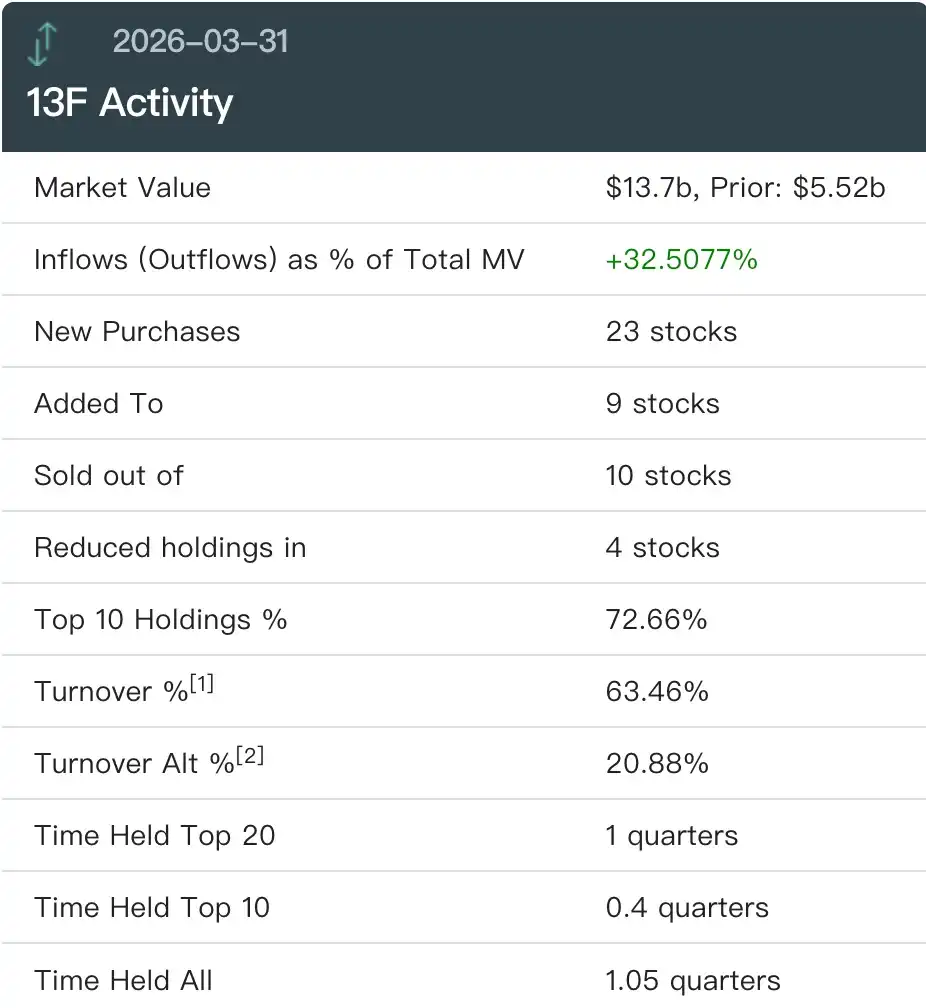
According to this latest 13F filing, as of March 31, 2026, the nominal total value of Situational Awareness LP's holdings has increased to $13.7 billion, more than doubling (up 148%) from $5.52 billion as of December 31 last year.

  • Odaily Note: It's important to note that in the statistical methodology of US stock 13F filings, the market value of option assets is typically shown as the "Notional Value" of the underlying stock, not the actual premium cost paid by the fund. This means that although the fund has built a semiconductor hedge wall with hundreds of billions in nominal asset value, its actual cash cost consumed (maximum potential loss) is much smaller, representing a typical high-leverage macro hedge.

Additionally, this quarter, net inflows accounted for 32.51% of the fund's total holdings value. This indicates the fund's explosive growth isn't solely due to portfolio appreciation but also includes very substantial external new capital subscriptions (i.e., new capital injection).

Frenetic Portfolio Adjustment

The filing also shows that Situational Awareness LP executed drastic portfolio adjustments in Q1.

  • New Purchases: 23 stocks (including options);
  • Added To: 9 stocks;
  • Sold Out Of: 10 stocks (including options);
  • Reduced Holdings In: 4 stocks (including options).

New Purchases: Sixty Percent of Portfolio Hedging Semiconductor Downturn
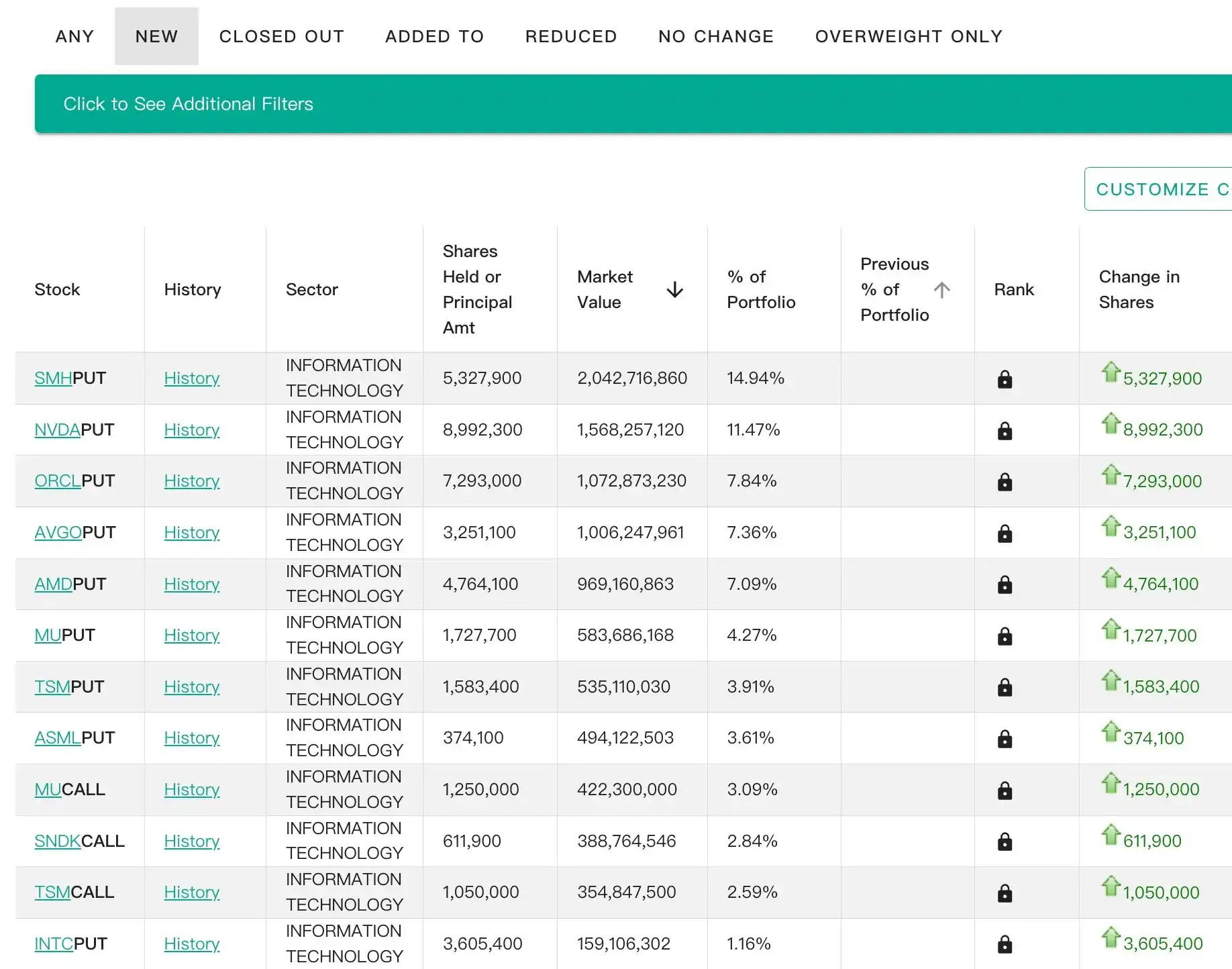
  • Odaily Note: The chart above only covers new stock purchases valued over $100 million. For all 23 new stock purchases, click the "portal" to view.

First, let's look at the new purchase activity, which is the most shocking piece of information in Situational Awareness LP's entire 13F report — in Q1, the fund conducted systematic risk hedging on the AI semiconductor and computing hardware sector through large-scale Put option positions.

Let's look at the data directly:

  • SMH PUT (VanEck Semiconductor Core ETF Put Option): 14.94% weighting (market value $2.04 billion) — Largest new position;
  • NVDA PUT (NVIDIA Put Option): 11.47% weighting (market value $1.56 billion) — Second largest new position;
  • ORCL PUT (Oracle Put Option): 7.84% weighting;
  • AVGO PUT (Broadcom Put Option): 7.36% weighting;
  • AMD PUT (AMD Put Option): 7.09% weighting;

Just the above top five Put option holdings account for 48.7% of Situational Awareness LP's $13.7 billion nominal total holdings value. Adding the subsequent Put options on Micron (MU), TSMC (TSM), ASML (ASML), and Intel (INTC), over 60% of the fund's nominal portfolio is betting on or hedging against a decline or severe volatility in core AI hardware stocks.

It's also noteworthy that Situational Awareness LP simultaneously bought both Call and Put options on the same stock. For example, while buying Micron Puts (MU PUT, 4.27%), it also bought MU CALLs (3.09%); while buying TSMC Puts (TSM PUT, 3.91%), it also bought TSM CALLs (2.59%).

This is a two-way bet strategy commonly used by hedge funds. It suggests the fund believes Micron (memory chips) and TSMC (foundry) may experience stock price movements far exceeding market expectations in upcoming 2026 earnings reports or industry cycles due to geopolitics or extreme supply-demand imbalances — significant one-way volatility large enough can generate profits on both sides.

Added To: Still Favors SanDisk, CRWV in Common Stock
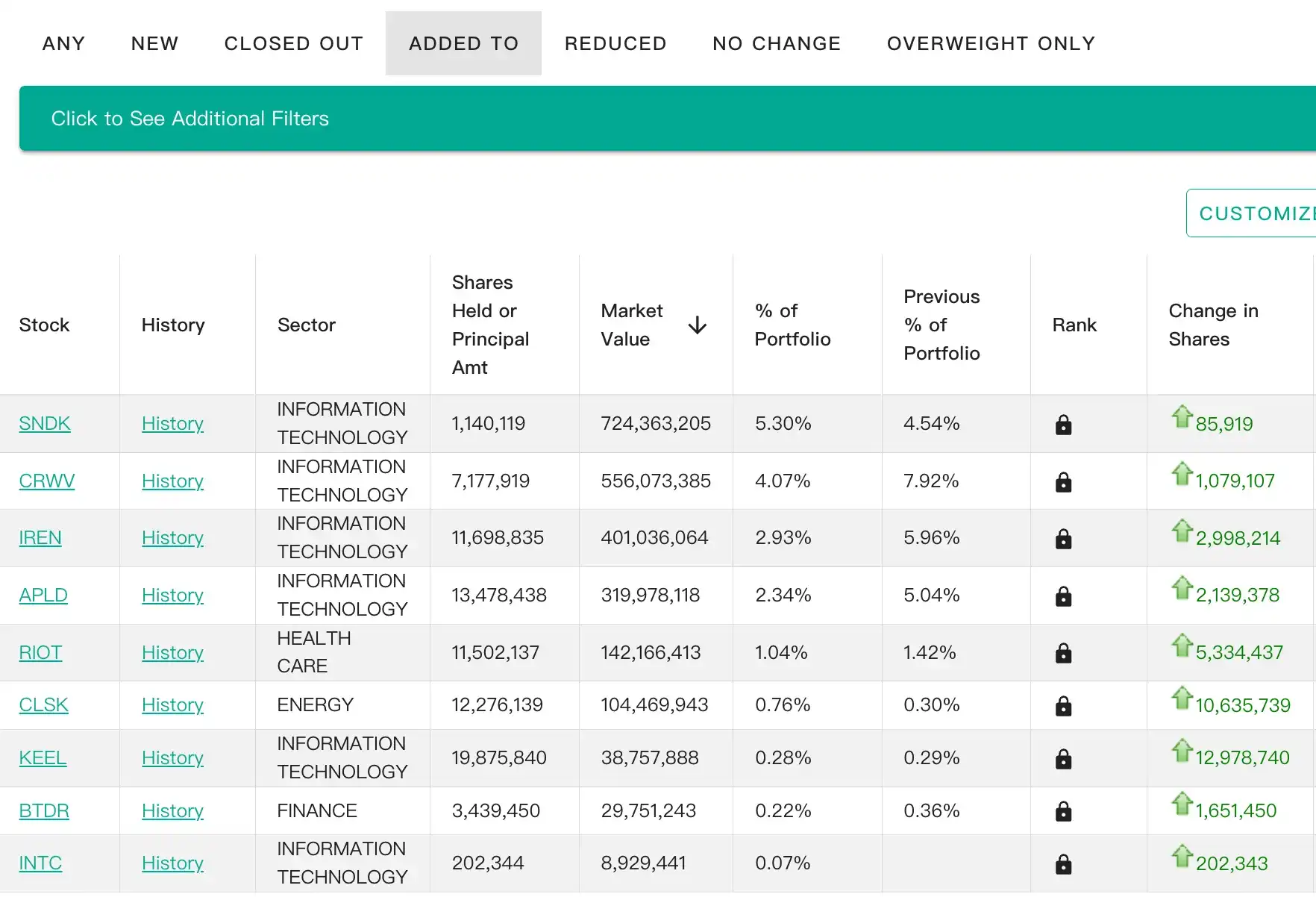
Regarding additions, Situational Awareness LP opted for common stock rather than options, increasing holdings in 9 stocks.

In Q1, Situational Awareness LP added a small amount of 85,000 shares of SanDisk (SNDK), bringing total holdings to 1.14 million shares, with a holding value as high as $724 million, accounting for 5.30% of the entire investment portfolio. This is one of the very few super-heavyweight positions in Situational Awareness LP's portfolio held entirely in common stock form.

Another noteworthy action is that Situational Awareness LP significantly increased its holdings by over 1.07 million shares of CoreWeave (CRWV) in Q1, pushing the holding value to $556 million, a 4.07% weighting. CoreWeave is one of the most closely watched AI GPU cloud service infrastructure companies currently, and an important partner in NVIDIA's ecosystem. After its IPO, Situational Awareness LP swiftly incorporated it into its core portfolio and aggressively increased its position. This indicates that while the fund is shorting NVIDIA's short-term valuation (via PUTs), it remains extremely bullish on cloud giants that directly convert GPUs into computing power for renting to various models.

Furthermore, Situational Awareness LP also added to positions in KEEL, IREN, APLD, RIOT, CLSK, BTDR, and other computing or power infrastructure companies, continuing the logic championed by Leopold Aschenbrenner that "electricity is the new oil."

Sold Out Of: Unwinding Intel Call Leverage, Exiting Optical Communications
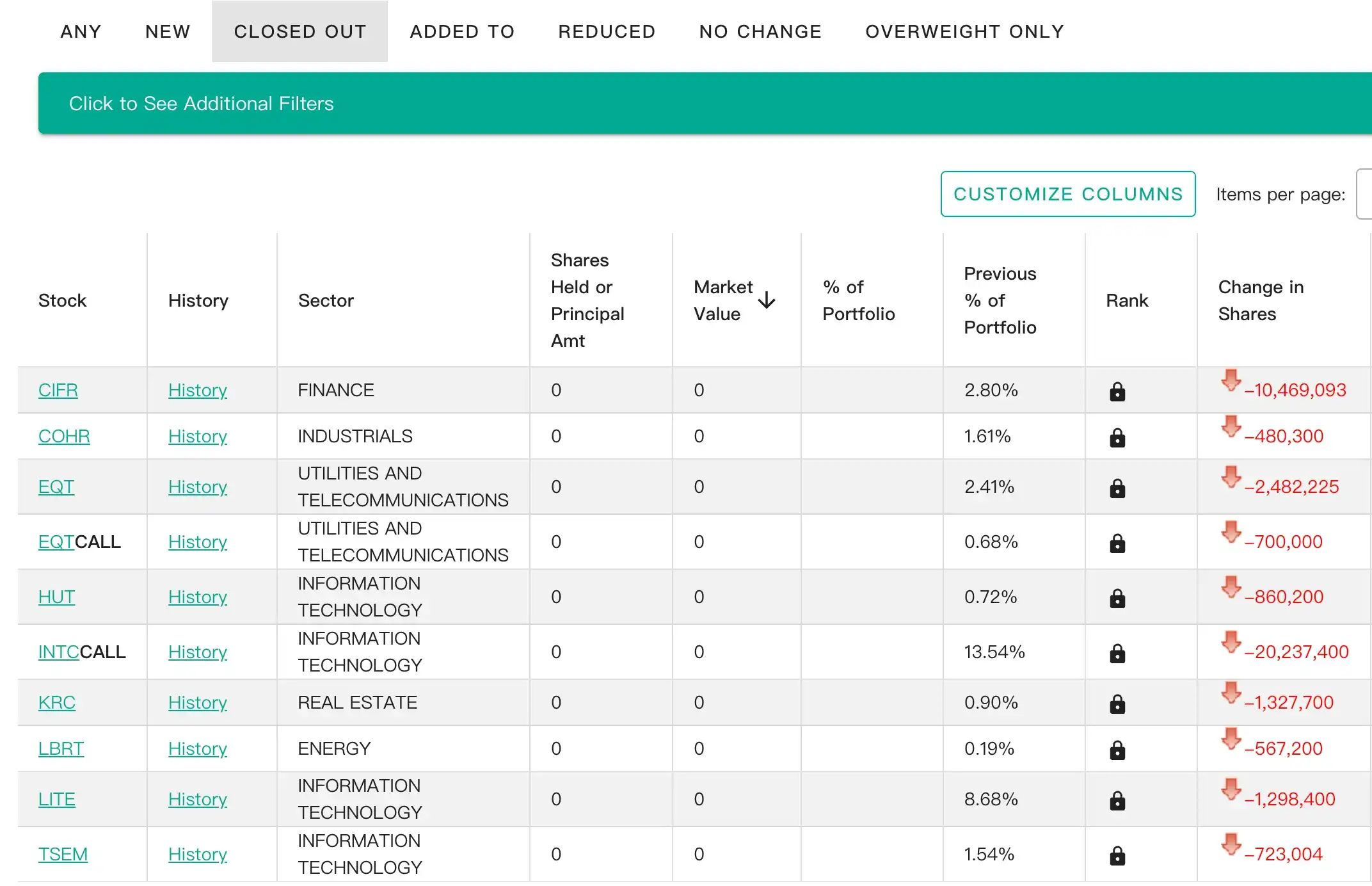
Regarding complete sell-offs, Situational Awareness LP's biggest move was completely unwinding its leverage from Intel Call options (INTC CALL). In the previous disclosure period, Situational Awareness LP had bet over 13% of its portfolio on Intel Call options (a staggering 20.23 million option contracts), a highly leveraged directional bet. This quarter, it completely sold out, shifting to holding a small common stock position (0.07% weighting).

Additionally, Situational Awareness LP completely exited LITE (8.68% weighting last period) and COHR (1.61% weighting last quarter) in Q1. LITE and COHR are both global top-tier optical communication chip and optical module (Optical Transceivers) giants. This exit indicates Situational Awareness LP is withdrawing from the AI optical module/network hardware sector.

Situational Awareness LP also sold out of CIFR (2.80% weighting last period) and HUT (0.72% weighting last period) in Q1. Both are cryptocurrency mining companies (including CORZ, which was reduced in the next section). Considering the additions to similar companies like RIOT, CLSK, BTDR, this is likely routine portfolio adjustment.

Reduced Holdings: Substantial Profit-Taking on BE
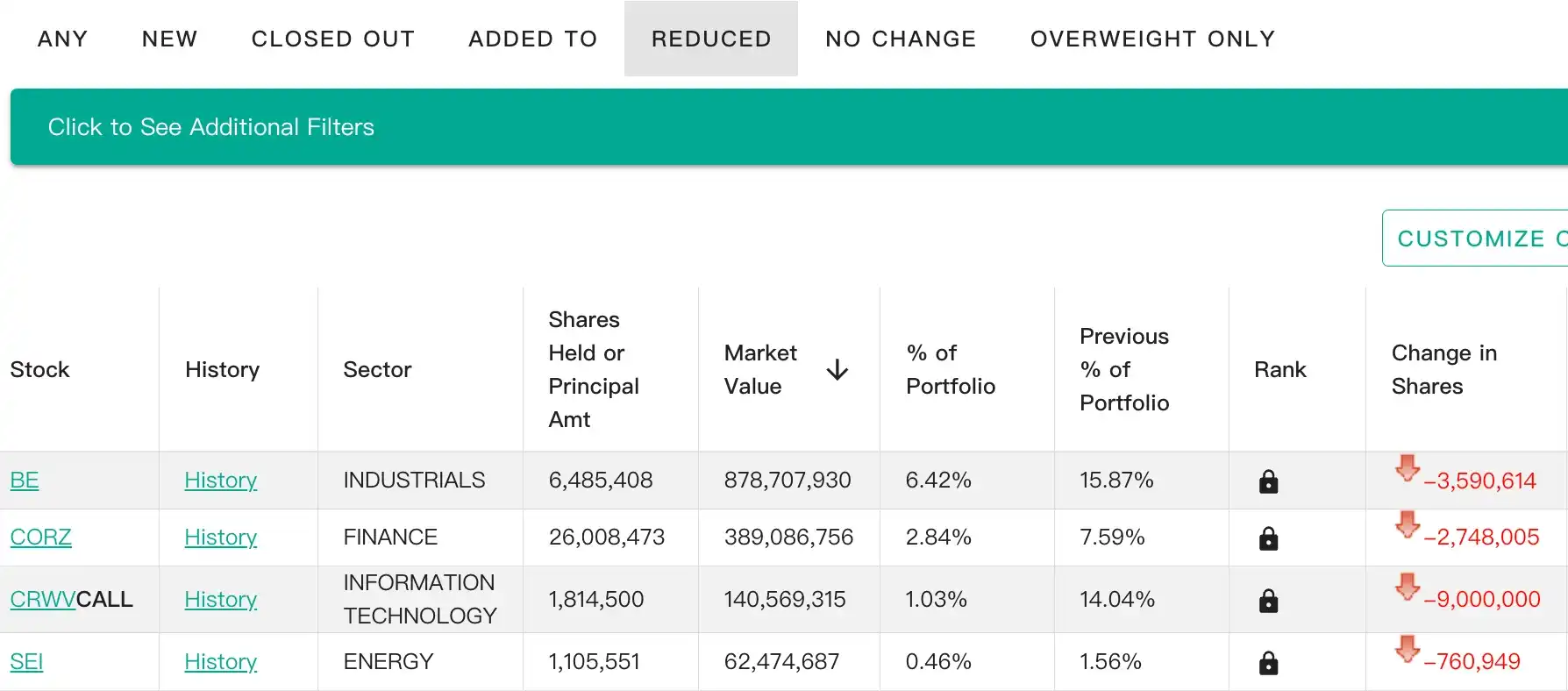
Finally, looking at the reductions, Bloom Energy (BE) was the largest holding disclosed in Situational Awareness LP's previous 13F filing. In Q1, the fund reduced its position by 3.59 million shares, causing its weighting to plummet from 15.87% last quarter to 6.42%.

Bloom Energy focuses on solid oxide fuel cell technology and is a core target for data center "on-site power" that bypasses traditional grids. Considering the remaining position is still significant, the reduction likely doesn't mean Situational Awareness LP is no longer bullish on the company, but more likely routine profit-taking.

CoreWeave Call options (CRWV CALL) were Situational Awareness LP's second-largest reduction (weighting plummeted from 14.04% to 1.03%). As mentioned earlier, the fund has shifted to holding CRWV in common stock form, so this is more about reducing leverage.

Situational Awareness LP also reduced its holdings in Core Scientific (CORZ) by 2.74 million shares, lowering its weighting from 7.59% to 2.84%. CORZ is a leading Bitcoin miner transitioning to AI computing power hosting. However, considering Situational Awareness LP added other miners still in transition with potentially more attractive valuations this quarter, reducing CORZ seems more like partial profit-taking.

What Is the 'AI Stock God' Really Thinking?

If looking only at the surface data of this 13F, many might draw a simple, crude conclusion — Leopold Aschenbrenner, who once proclaimed "AGI by 2027," has turned bearish on AI.

But the reality is clearly not that simple. In Situational Awareness LP's portfolio structure, there are actually two seemingly contradictory, yet highly unified, main themes.

  • On one side, there is extreme vigilance towards short-term valuation bubbles in the 'chip sector.' Situational Awareness LP has used Put option positions of staggering nominal size to essentially "buy crash insurance" for almost the entire AI semiconductor industry chain, including NVIDIA and Broadcom;
  • On the other side, there is a near-fanatical optimism about long-term AI infrastructure demand. Whether it's CoreWeave, Bloom Energy, or a series of power, transformer, and data center-related companies, they all essentially point to the same deterministic logic — AI's computing power war has entered the deep end.

This is perhaps Situational Awareness LP's core judgment at present. What will truly be scarce in the future may not be GPU chips themselves, but the energy, power systems, and data center infrastructure supporting these GPUs' continuous operation. GPU production can keep expanding, and advanced processes will eventually ramp up, but megawatt-level power supply capacity, transformers, transmission systems, and large-scale data center construction cycles are difficult to replicate simultaneously in a short time. Compared to the 'selling picks and shovels' logic already fully priced by the market, Leopold Aschenbrenner seems more focused on where the real bottlenecks might emerge in the next phase of the AI industry.

This also explains why Situational Awareness LP is simultaneously buying massive semiconductor Put options to hedge against severe volatility risks in the AI hardware sector, while continuing to heavily invest in GPU cloud services, power, and computing infrastructure assets.

In a sense, this 13F is less a simple holdings disclosure and more like Leopold Aschenbrenner's roadmap judgment for the next phase of evolution in the AI industry chain.

When a genius investor who rose to fame rapidly by All-in on AI starts deploying billions in nominal positions to buy insurance for the AI sector, it at least indicates one thing — even the most steadfast AI bulls of this era have begun to take volatility seriously.


Related Questions

QAccording to the article, what is the most significant new position taken by Situational Awareness LP in Q1 2026, and what does it represent?

AThe most significant new position is a $2.04 billion notional value in SMH (VanEck Semiconductor ETF) put options, accounting for 14.94% of the fund's portfolio. It represents a large-scale hedge against a potential downturn or high volatility in the AI semiconductor and hardware sector.

QWhy did Situational Awareness LP simultaneously buy both call and put options for stocks like Micron (MU) and TSMC (TSM)?

AThe fund used a dual-option strategy (straddle/strangle) for these stocks, indicating a belief that their prices could experience extreme volatility in either direction due to factors like geopolitical tensions or severe supply-demand imbalances. This strategy profits if the stock price makes a large move up or down, regardless of the direction.

QWhat is the apparent contradiction in Situational Awareness LP's investment strategy as described in the article, and how is it explained?

AThe apparent contradiction is the fund's massive bearish bets (put options) on AI semiconductor stocks alongside substantial bullish investments in AI infrastructure companies like CoreWeave and Bloom Energy. This is explained by the fund's core thesis: it is hedging against short-term valuation bubbles in the 'chip makers' while remaining bullish on the long-term, structurally scarce necessities for AI—specifically, the energy, power, and data center infrastructure needed to run the chips.

QWhat major sector did Situational Awareness LP exit in Q1 2026, as indicated by its sell-outs?

AThe fund exited the AI optical modules/network hardware sector by completely selling out its positions in LITE and COHR, which are leading companies in optical communication chips and transceivers.

QWhat was the primary reason suggested for the fund's large reduction in its Bloom Energy (BE) position?

AThe primary reason suggested for the large reduction in the Bloom Energy position was likely routine profit-taking. The fund still maintains a significant holding (6.42%), indicating it likely remains positive on the company's long-term prospects related to on-site power generation for data centers.

Related Reads

Musk Posted a Recruitment Ad for SpaceX, and After Reading the Comments Section, I Understood

On May 20th, SpaceX filed for a landmark IPO with a $1.75 trillion valuation. Shortly after, Elon Musk posted a recruitment call on X, seeking "world-class engineers and physicists" for SpaceX. The application process was starkly simple: email with three bullet points proving "exceptional ability," with real, complex projects as a plus. Musk promised to review qualifying emails himself. The post garnered millions of views and thousands of replies, revealing a spectrum of responses. Most comments, including a highly-upvoted humorous one listing absurd "skills," merely listed credentials or experiences in a conventional, non-differentiating way. This highlighted a key insight: a traditional resume listing degrees and skills often fails to demonstrate true exceptionalism. Effective self-presentation requires "performance efficiency." A standout reply came from an OpenAI engineering lead, who simply stated "codex." This demonstrated that for those who have built significant, recognized products, the product itself becomes the ultimate resume. The article argues that in the AI era, any tangible, shareable output—a tool, research, or online project—serves as a living, self-evident credential more powerful than a list of attributes. However, a twist emerged when applicants found the provided email address non-functional, leading to speculation that the post might also serve as an IPO publicity stunt, projecting an image of aggressive talent acquisition to investors. Ultimately, the episode served as a microcosm: some participate through performance, others through proof of work, while some question the reality of the stage itself. It underscores the enduring challenge of defining and demonstrating value in an age of abundant, yet often superficial, content.

marsbit7m ago

Musk Posted a Recruitment Ad for SpaceX, and After Reading the Comments Section, I Understood

marsbit7m ago

Cutting Off OpenAI, Anthropic Acquires the Tool Provider Used by a Quarter of Global Developers

Anthropic has acquired Stainless, a developer tool company that automatically generated official SDKs (Software Development Kits) for AI giants including OpenAI, Anthropic, Meta, and Cloudflare. The deal, reportedly valued at around $300 million, marks a strategic shift for Anthropic as it builds its "AI agent" infrastructure. Stainless acted as a "translator," converting complex API specifications into ready-to-use code libraries for developers. Its tools indirectly reached about a quarter of professional software developers globally. Following the acquisition, Stainless will shut down its public products and its team will join Anthropic to focus on internal platform development, notably for the Claude Platform. Existing SDKs remain with their respective client companies but will no longer receive updates from Stainless. This move is part of Anthropic's broader 18-month strategy to assemble a complete "agent stack." The stack consists of the Claude model at its core, the newly acquired Stainless for standardized API interfaces, and the Model Context Protocol (MCP), an open standard for connecting agents to external tools and data. This contrasts with OpenAI's focus on model generations and consumer-scale compute. Anthropic believes an agent's ultimate utility depends on its ability to connect to external systems. By internalizing the SDK layer and promoting MCP as a connection standard, Anthropic aims to lock in long-term ecosystem advantages and create path dependency, moving beyond the transient lead provided by any single model generation.

marsbit8m ago

Cutting Off OpenAI, Anthropic Acquires the Tool Provider Used by a Quarter of Global Developers

marsbit8m ago

Bankless Founder Sells Off ETH, Collective Collapse of Ethereum Faith

Ethereum faces a "crisis of faith" as David Hoffman, co-founder of the prominent pro-Ethereum media outlet Bankless, announces he has sold all his ETH. This move, coupled with reports of major layoffs at Bankless, signals a potential retreat of Ethereum's staunchest supporters. Hoffman and co-founder Ryan Sean Adams confirm Bankless is entering a "second era," with Adams stepping back and Hoffman exploring new frontiers. Hoffman sharply criticizes the Ethereum Foundation, stating that ETH's poor price performance cannot be separated from its leadership. He has a history of public dissatisfaction, citing the Foundation's failure to drive market growth and its "endless manifestos." His frustration coincides with ETH/BTC hitting multi-month lows and a significant exodus of senior researchers and executives from the Ethereum Foundation, partly attributed to controversial "loyalty oaths." The article contrasts Ethereum's current predicament—with its Layer-2 narrative discredited and ecosystem stagnant—against what should have been a highlight year in 2026 amid tokenization trends. While a previous surge to near $5,000 was driven by corporate buybacks (DAT热潮), ETH has since fallen over 50%. The core question remains: with fading faith and intense competition, what is Ethereum's next solution? Hoffman's divestment symbolizes a growing disconnect between the community and the ecosystem's direction.

Odaily星球日报32m ago

Bankless Founder Sells Off ETH, Collective Collapse of Ethereum Faith

Odaily星球日报32m ago

a16z Invests Heavily with $356 Million in HYPE, Surpassing Paradigm to Become the Largest External Holder

On May 21st, HYPE surged past $59, reaching a new high since September 2025, with a market cap nearing $150 billion. Analysts attribute the rally to a short squeeze and significant ETF inflows. The launch of two U.S. spot ETFs for Hyperliquid has driven substantial capital, with their inflows at times surpassing those of Bitcoin and Ethereum ETFs. Major institutions are actively accumulating HYPE. Venture firm a16z has become the largest external holder with a $356 million position, surpassing Paradigm. Other firms like Goldman Sachs, Grayscale, and Galaxy Digital have also made large purchases, with Goldman reportedly selling portions of its XRP, ETH, and BTC holdings to buy HYPE. Bitwise CIO Matt Hougan calls HYPE one of the most "mispriced" assets, arguing its valuation should reflect Hyperliquid's broader platform beyond just a perpetual DEX token. The protocol generates substantial real revenue, using 97% of fees to buy back and burn HYPE. Its expansion into RWA commodities and prediction markets has driven user growth and transaction volume, now commanding about 70% of the on-chain perpetual DEX market. However, this rapid growth faces challenges. Traditional exchanges CME and ICE are pressuring the CFTC to regulate Hyperliquid, citing concerns over its impact on global commodity benchmarks. Concurrently, some major market makers have withdrawn significant liquidity from the platform. With HYPE up over 125% year-to-date, operational risks are rising. Large holders are reportedly hedging with sizable short positions. The regulatory outlook from the CFTC remains a key uncertainty, adding another layer to the ongoing battle over the future of on-chain finance.

链捕手33m ago

a16z Invests Heavily with $356 Million in HYPE, Surpassing Paradigm to Become the Largest External Holder

链捕手33m ago

Trading

Spot
Futures

Hot Articles

Discussions

Welcome to the HTX Community. Here, you can stay informed about the latest platform developments and gain access to professional market insights. Users' opinions on the price of AI (AI) are presented below.

活动图片














