Bitcoin Begins an Independent Market Move: Is This a Rebound or a Reversal?

marsbitPublished on 2026-07-07Last updated on 2026-07-07

Abstract

Bitcoin has begun to show independent price action, rebounding from around $57,742 to surpass $60,000. This move was initially triggered by comments from Federal Reserve officials downplaying inflation risks and was subsequently amplified by weaker-than-expected U.S. employment data, which reduced expectations for further interest rate hikes. The rally was further fueled by a short squeeze, with approximately $281 million in short positions being liquidated as the price climbed. This created buying pressure and accelerated the upward move. Altcoins, particularly Ethereum and Solana, have also participated in the rally, indicating a broader, though not yet euphoric, risk-on sentiment returning to the crypto market. However, several key indicators suggest caution. The recovery is not yet a confirmed trend reversal. Despite the price rebound, the options market still shows a high premium for downside protection, implying traders remain wary. The short squeeze itself provides a temporary boost but requires sustained buying from spot markets, such as ETFs, to maintain momentum. Furthermore, Bitcoin's trajectory remains sensitive to macroeconomic data; any resurgence in inflation concerns or a shift to a more hawkish Fed stance could quickly reverse recent gains.

Federal Reserve Chair Kevin Warsh did not announce an interest rate cut. Regarding inflation, he stated that inflation expectations and inflation risks have moderated over the past few weeks. He simultaneously reaffirmed that the Fed will maintain its 2% inflation target.

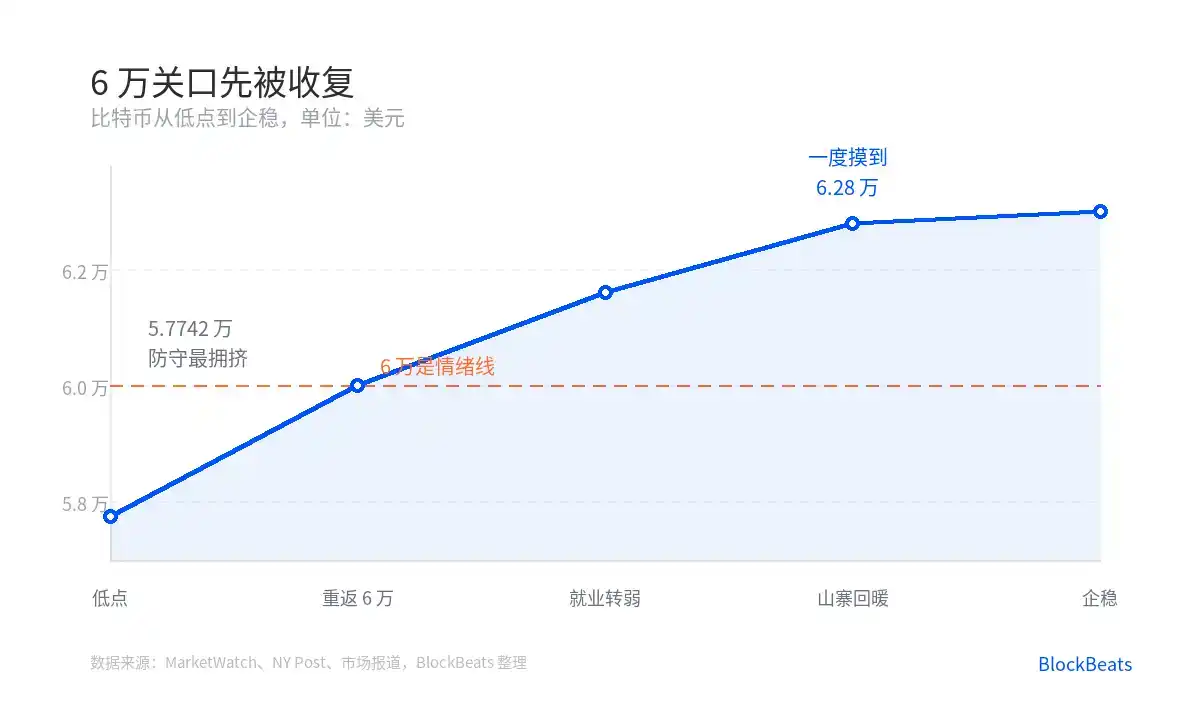
The latter part of his statement was not dovish, but the market first took the former part. Bitcoin quickly rebounded from its lows, once again approaching $60,000. Subsequently, weaker U.S. employment data continued to cool rate hike expectations, and the market movement evolved from "repair" into "relay."
Over the past few weeks, the market's greatest fear was that the Fed would continue to keep interest rates high, or even re-escalate tightening expectations. For Bitcoin, this is not an abstract macro judgment. The harder the interest rate expectations, the narrower the valuation space for risk assets, and the easier it is for leveraged positions to be liquidated first.

After Warsh downplayed inflation risks, the market first repriced "rate hike pressure." After weak employment data, this direction received another push. Bitcoin recovered from around $57,742 to above $60,000. While the price movement appears rapid, its essence is the market rolling back the previous round of panic trading.

On Deribit, traders concentrated on buying $50,000 put options. Open interest in gold perpetual futures reached a new high. A death cross also appeared on the technical charts. Several signals together indicate that the market is not simply bearish but is buying insurance against a decline.

This is different from an ordinary pullback. In an ordinary pullback, sellers simply want to exit. In a panic defense, traders simultaneously buy puts, purchase safe-haven assets, and reduce leverage. When the price touches a key level, liquidations amplify the volatility.
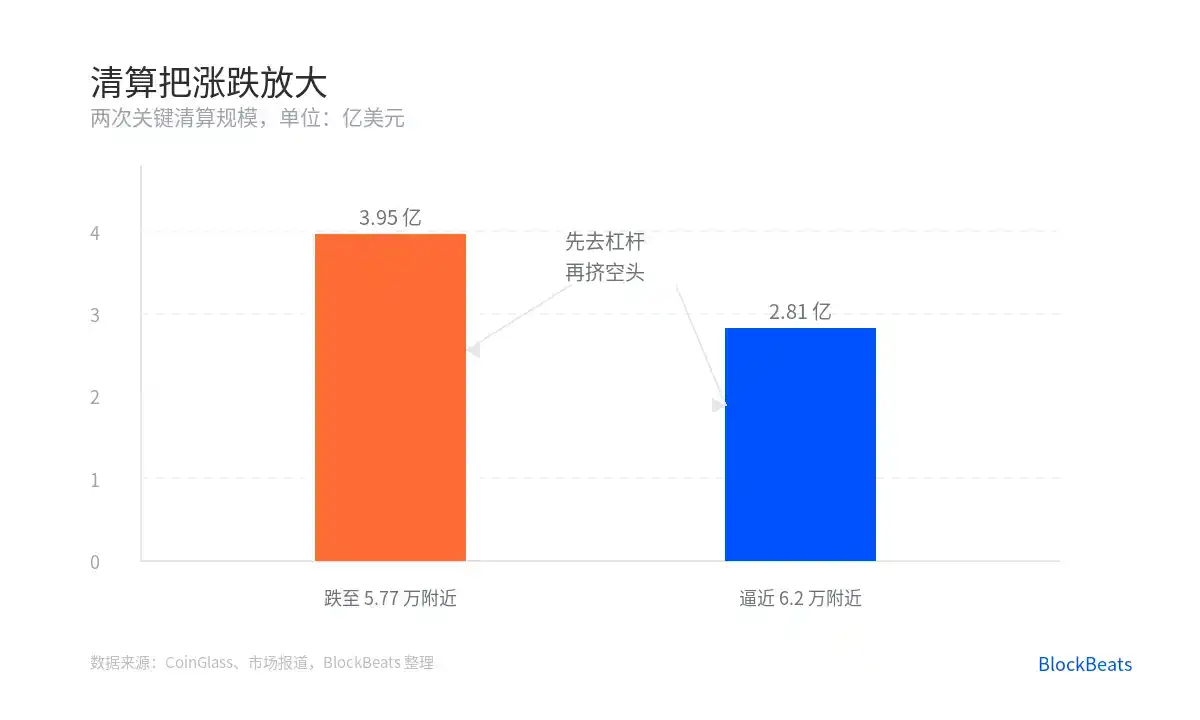
CoinGlass data shows that when Bitcoin fell near $57,700, it triggered approximately $395 million in liquidations. This figure indicates that the price decline was not solely driven by selling pressure but also by forced exits from leveraged positions.

After the forced exits, the market actually becomes more prone to a rebound.

The reason is straightforward. The previous decline liquidated some long leverage and pushed defensive sentiment to a high. When macro news marginally eased, the price only needed to return near a key level to make short sellers nervous. Short covering is essentially buying. The higher the price goes, the more it forces bearish positions to retreat.

This is the second layer of thrust. When Ethereum and Solana led the gains, Bitcoin once approached $62,000, liquidating approximately $281 million in bearish bets. This is not new-found belief but a reaction force from the position structure.

Therefore, this rebound cannot be attributed solely to one sentence from Warsh. A more accurate breakdown is into three stages.

First stage: Inflation risks were downplayed, easing market concerns about the Fed's path. Second stage: Weak employment data further pressured rate hike expectations downward. Third stage: Forced short covering pushed the spot price higher, faster.

If only looking at the first stage, the market movement can easily be interpreted as a "macro positive." If only looking at the third stage, one might mistakenly think it's a purely technical rebound. The real structure lies in both occurring within the same period. The macro provided the reason for prices to rise, while positioning provided the speed for prices to rise.

The reaction of altcoins also indicates this is not a single-coin market movement.

After Bitcoin reclaimed $60,000, Ethereum, Solana, and Dogecoin rose in sync. Ethereum subsequently led the gains among major cryptocurrencies, rising about 12% over the past week. When capital begins to spill over from Bitcoin to Ethereum and Solana, the market is no longer trading just "whether Bitcoin can hold."

The CoinMarketCap Altcoin Season Index rose to 52/100, the highest in three months. This level is微妙. It has just crossed the midpoint, indicating risk appetite has indeed returned, but it hasn't reached the stage of full altcoin frenzy.
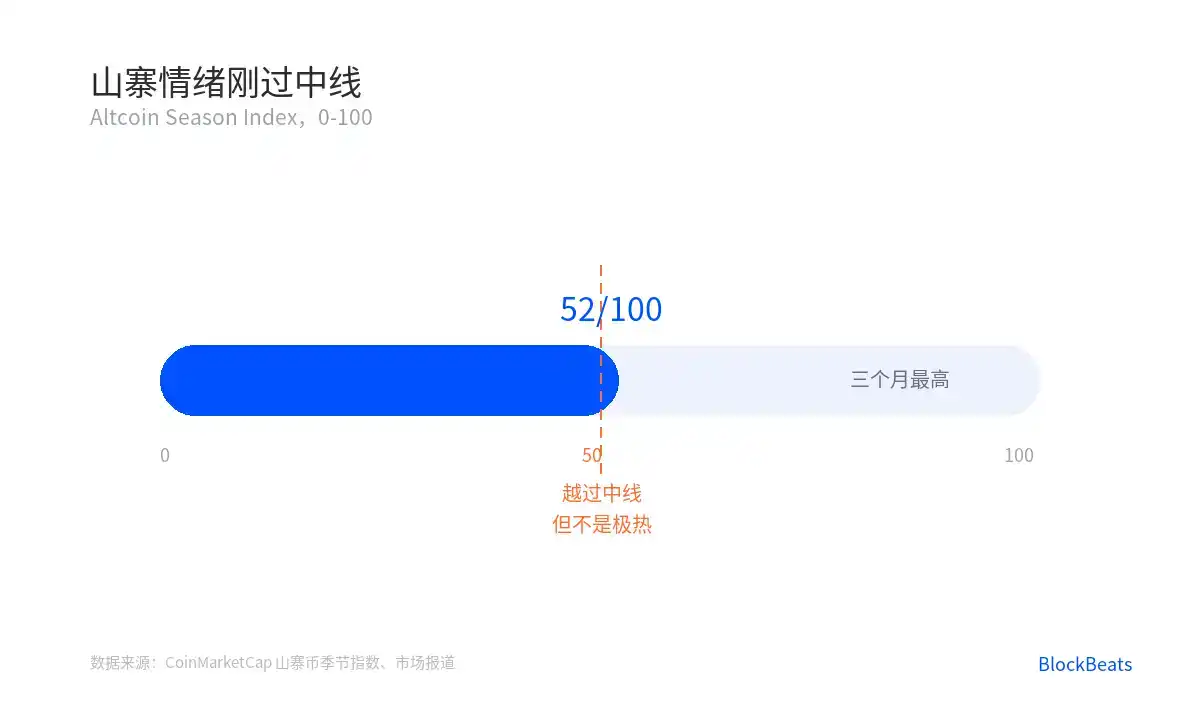
This is the first thing to note. Warming altcoin sentiment does not mean an altcoin season is confirmed.

A true altcoin season typically requires broader capital dispersion. What we're seeing now is more like the market first buying back large-cap, liquid tokens after Bitcoin stabilized. The fact that Ethereum and Solana are outperforming while some smaller coins remain weak is itself a signal.

The second thing is that the options market does not fully believe in the rebound.

The put-call skew for BTC and ETH still shows traders are willing to pay a higher price for downside protection. The price has rebounded, but insurance isn't cheap. This detail is colder than the spot price.

If traders truly believed the trend had reversed, put option premiums would typically decline faster. The current state is more like the spot market pulled the price back first, while the derivatives market hasn't put away its umbrella.

The third thing is that a short squeeze cannot continue indefinitely.

Short covering brings buying pressure, but this pressure is one-off. It can push prices up from congested lows but cannot alone sustain an entire trend. After the liquidations end, the market needs new spot buying to take over.

So what really matters next is not whether Bitcoin has breached a certain integer level, but who is still buying after it does. Spot ETF flows, stablecoin liquidity, and the strength of follow-through gains in Ethereum and Solana will be more informative than a single day's gain.

The fourth thing is that macro variables remain the same sword.

This rally benefited from declining inflation risks and weakening employment. Looked at the other way, if subsequent data points again to sticky inflation, or if Fed rhetoric turns hawkish again, the market will price it in reverse using the same logic. Bitcoin is not an asset detached from macroeconomics; it just reacts faster to changes in macro expectations.

The price has bounced back from excessive defensiveness, but true confirmation will come when the options market is willing to remove the insurance.


Trending Cryptos

Related Questions

QWhat were the three stages that led to Bitcoin's recent price rebound according to the article?

AStage 1: Fed Chair downplayed inflation risks, easing market concerns about the Fed's policy path. Stage 2: Weak U.S. employment data further pressured down interest rate hike expectations. Stage 3: Short positions were forced to cover, which amplified the upward price move.

QHow does the article describe the current state of the altcoin market, and what is a key indicator mentioned?

AThe altcoin market shows warming sentiment but is not in a confirmed altseason. The CoinMarketCap Altcoin Season Index has risen to 52/100, its highest in three months, indicating a return of risk appetite without widespread, euphoric buying across smaller altcoins. The article notes that liquidity is flowing primarily into large-cap tokens like Ethereum and Solana, while smaller coins remain weak.

QWhat does the behavior of the options market, regarding put-call skew, suggest about trader sentiment despite the price rebound?

AThe persistent put-call skew for BTC and ETH, where traders are still willing to pay a higher premium for put options (downside protection), suggests that the options market does not fully believe in the sustainability of the rebound. It indicates a cautious or defensive posture even as spot prices rise.

QWhat is the limitation of a price rally driven primarily by a short squeeze, as explained in the article?

AThe buying pressure from a short squeeze is one-time and finite. It can push the price out of a crowded low but cannot independently sustain a full trend. After the squeeze ends, the rally needs new spot buying (e.g., from ETFs, stablecoin inflows) to support it.

QWhat is the main macro variable that the article states Bitcoin's price is still sensitive to, and why?

AThe main macro variable is inflation data and the Federal Reserve's corresponding policy stance. The recent rally benefited from expectations of softer inflation and a less hawkish Fed. Conversely, the article warns that if future data points to persistent inflation or the Fed's rhetoric turns hawkish again, the market would re-price Bitcoin using the same logic in reverse. Bitcoin reacts quickly to changes in macro expectations but is not detached from them.

Related Reads

Chain Gaming Giant YGG Capitulates, Losing $15 Billion in Value Over 5 Years

The leading blockchain gaming guild Yield Guild Games (YGG) is shutting down its publishing arm, YGG Play, announced on July 6th by its official account and co-founder Gabby Dizon. The platform and its supported games will be phased out by July 31st. While YGG Play successfully validated a market for casual, crypto-native mobile games—generating over $9M in total revenue, including $876,000 in Q1 2026—Dizon stated the closure was a market-driven decision. He cited insufficient liquidity and declining user confidence in the macroeconomic environment, making the business commercially unsustainable. Founded in 2020, YGG rose to prominence during the Play-to-Earn (P2E) boom, particularly with Axie Infinity, organizing players and managing assets. Its token price soared above $10 during the 2021 bull market. However, the 2022 crypto downturn exposed the fragility of P2E economic models. YGG attempted to pivot in 2025 with the YGG Play publishing initiative, focusing on short-session casual games. The shutdown reflects broader struggles in the Web3 gaming sector. An April 2026 report highlighted a "structural mismatch" between speculative financial designs and genuine player entertainment needs, leading to an estimated $15 billion in destroyed capital. The report noted that 93% of roughly 3,200 tracked blockchain game projects are now "functionally dead," with token prices down an average of 95% from 2022 peaks. YGG itself is now pivoting its strategy entirely towards the AI Data Economy, aiming to build B2B pipelines around gaming datasets.

Foresight News5m ago

Chain Gaming Giant YGG Capitulates, Losing $15 Billion in Value Over 5 Years

Foresight News5m ago

With Mining Profits Depressed, What Kind of Mining Companies Can Survive a Bear Market?

Mining Profitability Slumps: Which Miners Can Survive the Bear Market? A comprehensive Bitcoin miner stress indicator has recently hit a historically low "extreme stress" zone, aligning with the typical market cycle pattern where industry bottoms coincide with severe miner pressure. The current situation presents a direct survival test: if hashprice (daily USD revenue per PH/s of computing power) remains weak, only the most robust mining firms will endure. Hashprice, which incorporates block rewards, transaction fees, network difficulty, and BTC price, is the core metric for mining profitability. Despite Bitcoin's price holding above previous lows, profitability is shrinking due to rising difficulty and low fees. Recent data shows hashprice around $32-33/PH/s/day, with a significant divide: newer, energy-efficient rigs (<19 J/TH) generate ~$81 per megawatt, while older, inefficient models (25-38 J/TH) make only ~$43/MW. This gap is forcing inefficient operators to shut down. The industry has a self-correcting mechanism. As high-cost miners power down, the network's total computing power (hashrate) drops. This eventually triggers a downward adjustment in mining difficulty, increasing the rewards for remaining miners. Data from Q2 2026 shows the hashrate has already fallen by 5.8%, with an estimated 252 EH/s of inefficient mining capacity idled. Firms at risk of淘汰 (elimination) are those reliant on old hardware, high electricity costs, and significant debt. Survivors will likely be miners with newer equipment, low-cost power contracts, strong cash reserves, and flexible operations. A key trend is diversification into AI and high-performance computing (HPC) hosting, though this path is only viable for miners with the necessary infrastructure, capital, and clients. The miner stress indicator serves as a warning, not a precise timing tool for a market bottom. Key signals to watch are whether hashprice stabilizes above ~$30, difficulty continues to adjust downward, hashrate finds a floor, and miner Bitcoin selling subsides. The duration of this low-profitability period will act as a solvency test, determining which miners are positioned to survive and eventually benefit from the next cycle.

Foresight News33m ago

With Mining Profits Depressed, What Kind of Mining Companies Can Survive a Bear Market?

Foresight News33m ago

Blood Loss of $55 Million Selling 3,588 BTC, Strategy Becomes a Literal Scumbag

On July 6th, Strategy (formerly MicroStrategy) disclosed in an SEC filing that it sold 3,588 Bitcoin (BTC) between June 29th and July 5th for approximately $216 million, at an average price of ~$60,200. This marked the company's largest net sale since initiating its Bitcoin strategy in 2020 and its first institutionalized reduction of its core holding. The sale resulted in a realized loss of about $54.8 million, as the selling price was below its average cost basis of ~$75,476 per BTC. The proceeds were used to pay preferred stock dividends and replenish USD reserves. This move follows a new "Digital Credit Capital Framework" approved on June 29th, authorizing the sale of up to $1.25 billion in Bitcoin. The sale consumes roughly 17% of this authorized amount in its first week. Strategy's foundational narrative, built by founder Michael Saylor, was a commitment to "never sell" Bitcoin. The recent institutionalized selling framework and these substantial sales represent a significant shift from that original promise. While the amount sold is only 0.4% of Strategy's total holdings of 843,775 BTC, the action challenges the premium at which its stock (MSTR) trades relative to its Bitcoin holdings. Investors had priced in the "never sell" narrative. The company now faces a contradiction: it sells Bitcoin at a loss to pay dividends on the preferred stock it issued to fund Bitcoin purchases. Saylor has framed selling as a tool for future strategic purchases, but each sale erodes the credibility of the original commitment, potentially threatening the premium valuation of MSTR shares.

Foresight News1h ago

Blood Loss of $55 Million Selling 3,588 BTC, Strategy Becomes a Literal Scumbag

Foresight News1h ago

Trading

Spot

Hot Articles

What is $BITCOIN

DIGITAL GOLD ($BITCOIN): A Comprehensive Analysis Introduction to DIGITAL GOLD ($BITCOIN) DIGITAL GOLD ($BITCOIN) is a blockchain-based project operating on the Solana network, which aims to combine the characteristics of traditional precious metals with the innovation of decentralized technologies. While it shares a name with Bitcoin, often referred to as “digital gold” due to its perception as a store of value, DIGITAL GOLD is a separate token designed to create a unique ecosystem within the Web3 landscape. Its goal is to position itself as a viable alternative digital asset, although specifics regarding its applications and functionalities are still developing. What is DIGITAL GOLD ($BITCOIN)? DIGITAL GOLD ($BITCOIN) is a cryptocurrency token explicitly designed for use on the Solana blockchain. In contrast to Bitcoin, which provides a widely recognized value storage role, this token appears to focus on broader applications and characteristics. Notable aspects include: Blockchain Infrastructure: The token is built on the Solana blockchain, known for its capacity to handle high-speed and low-cost transactions. Supply Dynamics: DIGITAL GOLD has a maximum supply capped at 100 quadrillion tokens (100P $BITCOIN), although details regarding its circulating supply are currently undisclosed. Utility: While precise functionalities are not explicitly outlined, there are indications that the token could be utilized for various applications, potentially involving decentralized applications (dApps) or asset tokenization strategies. Who is the Creator of DIGITAL GOLD ($BITCOIN)? At present, the identity of the creators and development team behind DIGITAL GOLD ($BITCOIN) remains unknown. This situation is typical among many innovative projects within the blockchain space, particularly those aligning with decentralized finance and meme coin phenomena. While such anonymity may foster a community-driven culture, it intensifies concerns about governance and accountability. Who are the Investors of DIGITAL GOLD ($BITCOIN)? The available information indicates that DIGITAL GOLD ($BITCOIN) does not have any known institutional backers or prominent venture capital investments. The project seems to operate on a peer-to-peer model focused on community support and adoption rather than traditional funding routes. Its activity and liquidity are primarily situated on decentralized exchanges (DEXs), such as PumpSwap, rather than established centralized trading platforms, further highlighting its grassroots approach. How DIGITAL GOLD ($BITCOIN) Works The operational mechanics of DIGITAL GOLD ($BITCOIN) can be elaborated on based on its blockchain design and network attributes: Consensus Mechanism: By leveraging Solana’s unique proof-of-history (PoH) combined with a proof-of-stake (PoS) model, the project ensures efficient transaction validation contributing to the network's high performance. Tokenomics: While specific deflationary mechanisms have not been extensively detailed, the vast maximum token supply implies that it may cater to microtransactions or niche use cases that are still to be defined. Interoperability: There exists the potential for integration with Solana’s broader ecosystem, including various decentralized finance (DeFi) platforms. However, the details regarding specific integrations remain unspecified. Timeline of Key Events Here is a timeline that highlights significant milestones concerning DIGITAL GOLD ($BITCOIN): 2023: The initial deployment of the token occurs on the Solana blockchain, marked by its contract address. 2024: DIGITAL GOLD gains visibility as it becomes available for trading on decentralized exchanges like PumpSwap, allowing users to trade it against SOL. 2025: The project witnesses sporadic trading activity and potential interest in community-led engagements, although no noteworthy partnerships or technical advancements have been documented as of yet. Critical Analysis Strengths Scalability: The underlying Solana infrastructure supports high transaction volumes, which could enhance the utility of $BITCOIN in various transaction scenarios. Accessibility: The potential low trading price per token could attract retail investors, facilitating wider participation due to fractional ownership opportunities. Risks Lack of Transparency: The absence of publicly known backers, developers, or an audit process may yield skepticism regarding the project's sustainability and trustworthiness. Market Volatility: The trading activity is heavily reliant on speculative behavior, which can result in significant price volatility and uncertainty for investors. Conclusion DIGITAL GOLD ($BITCOIN) emerges as an intriguing yet ambiguous project within the rapidly evolving Solana ecosystem. While it attempts to leverage the “digital gold” narrative, its departure from Bitcoin's established role as a store of value underscores the need for a clearer differentiation of its intended utility and governance structure. Future acceptance and adoption will likely depend on addressing the current opacity and defining its operational and economic strategies more explicitly. Note: This report encompasses synthesised information available as of October 2023, and developments may have transpired beyond the research period.

655 Total ViewsPublished 2025.05.13Updated 2025.05.13

What is $BITCOIN

Discussions

Welcome to the HTX Community. Here, you can stay informed about the latest platform developments and gain access to professional market insights. Users' opinions on the price of BTC (BTC) are presented below.

活动图片