Author: imToken
Over the past period, Vitalik has repeatedly mentioned a seemingly unfamiliar term: CROPS.
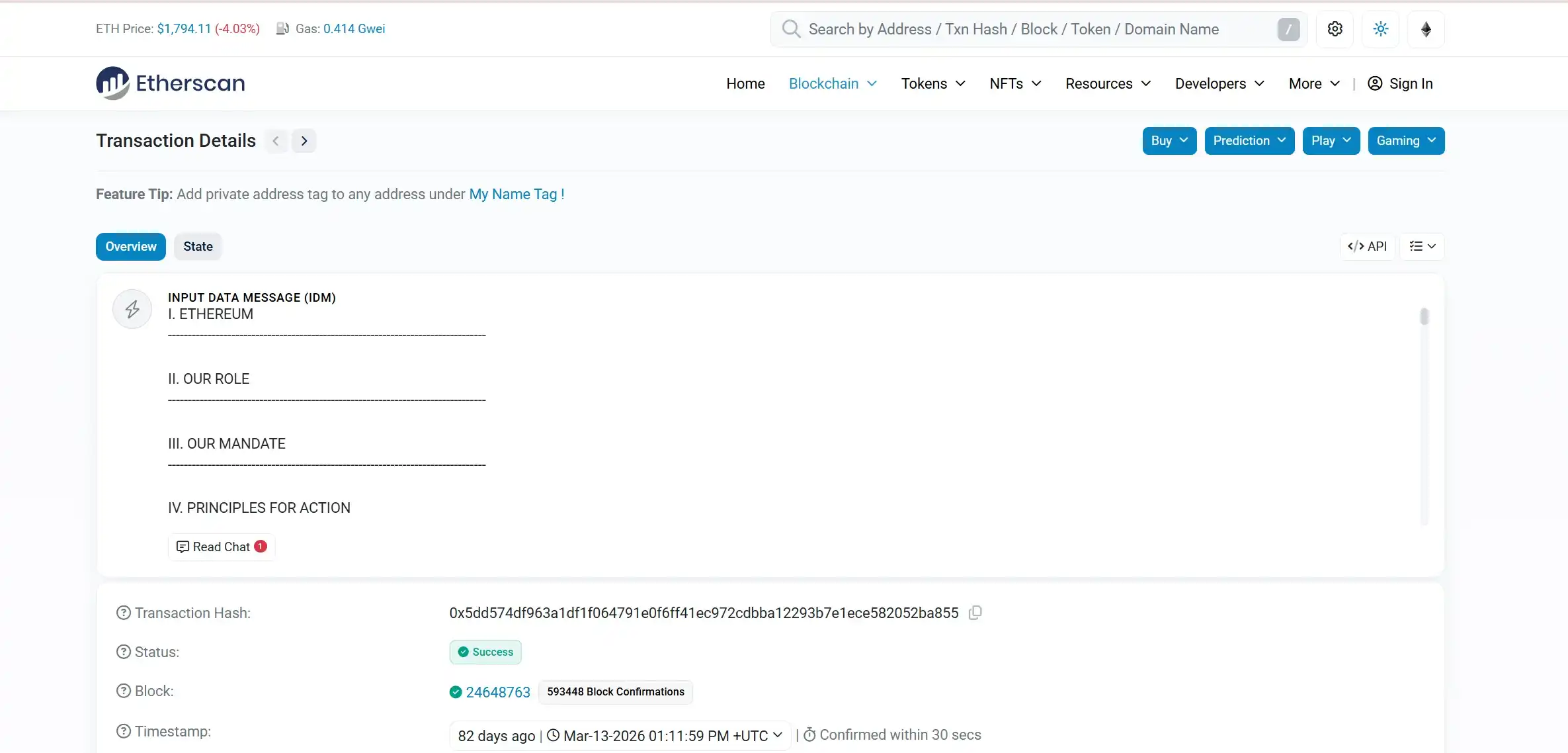
The systematic emergence of this concept can be traced back to March 13th. The Ethereum Foundation Board released the "EF Mandate" document, clearly stating its primary focus on Ethereum's censorship resistance, open source, privacy, and security—namely CROPS—to serve user self-sovereignty while maintaining anti-extraction and a more seamless user experience.
This statement is actually very important, especially as AI begins to enter wallet and automated execution scenarios, CROPS is no longer confined to Ethereum's value questions but could potentially become an issue of whether users can continue to control their digital lives in the AI era.
一、What Exactly is CROPS?
To understand CROPS, one must first step out of a common misconception: while Ethereum certainly needs to improve performance and reduce costs, it is not just competing with other public chains on who is faster or who has lower fees.
Although speed and cost are the most intuitive aspects of short-term user experience, looking at the longer term, Ethereum's stance over the past two years has become increasingly clear: what it truly aims to provide is a set of more foundational capabilities: users can hold assets, express identity, sign transactions, and participate in coordination without relying on a single platform, without surrendering ultimate control, and without being arbitrarily blocked by a centralized service.
This is the significance of CROPS.
In the context of the EF Mandate, CROPS primarily points to five directions, which are also the abbreviations of their keywords: Censorship Resistance, Capture Resistance (this was actually added later by Vitalik), Open Source, Privacy, Security:
- C - Censorship Resistance: Ensuring the immutability of transactions and smart contracts, not being terminated due to any external political or centralized entity pressure;
- R - Capture Resistance: Preventing Ethereum's governance, development roadmap, and key entry points from being controlled long-term by a few vested interests;
- O - Open Source / Openness: Insisting on completely open-source code and maintaining absolute freedom of access for the ecosystem;
- P - Privacy: Preserving the user's right to not be spied on through cryptographic technology on top of a transparent ledger;
- S - Security: Adhering to fundamental bottom lines, providing ultimate settlement security that is unbreakable;
Looking at these items together, it's actually a set of selection and guiding principles with a clear orientation, which aligns well with Ethereum's consistent value route.
For example, at the protocol layer, it means Ethereum needs to continuously improve censorship resistance, client diversity, validator decentralization, formal verification, etc.; at the application layer, wallets, RPCs, browsers, signature interfaces, and account systems also need to reduce reliance on centralized entry points; at the user experience layer, security cannot rely solely on users understanding complex transactions themselves, but must preempt risks through clearer signature displays, more verifiable interactions, and more comprehensive risk warnings before operations occur.
This is also why the EF has recently advanced some more specific directions around security, privacy, protocol resilience, and ecosystem public goods. For instance, the Ethereum Audit Subsidy program aims to lower the threshold for Ethereum ecosystem developers to obtain high-quality security audits. Extending this view, it's not just about subsidizing costs, but about pushing "security" from a high-cost service only affordable by large projects towards more small and medium-sized developers.
In late May, Vitalik also reiterated his views on the future direction of the EF, emphasizing that the EF should become a smaller, more distinct, and more focused organization dedicated to long-term sustainability, rather than trying to cover all needs in the ecosystem. The reason is pragmatic: after all, the EF does not possess unlimited resources nor a continuous revenue stream from staking or transaction fees. Therefore, it should more effectively invest its limited resources into tasks crucial for Ethereum to realize CROPS values and that are difficult for other entities to reliably undertake.
In other words, in the current transitional historical stage Ethereum finds itself in, CROPS is not an abstract slogan of "ideology over reality," but rather a framework that externally defines and constrains what the EF should and should not do.
二、 When CROPS Meets AI: The Convergence of Two Parallel Universes
The most recent time Vitalik Buterin pushed CROPS into broader discussion was in the context of AI.
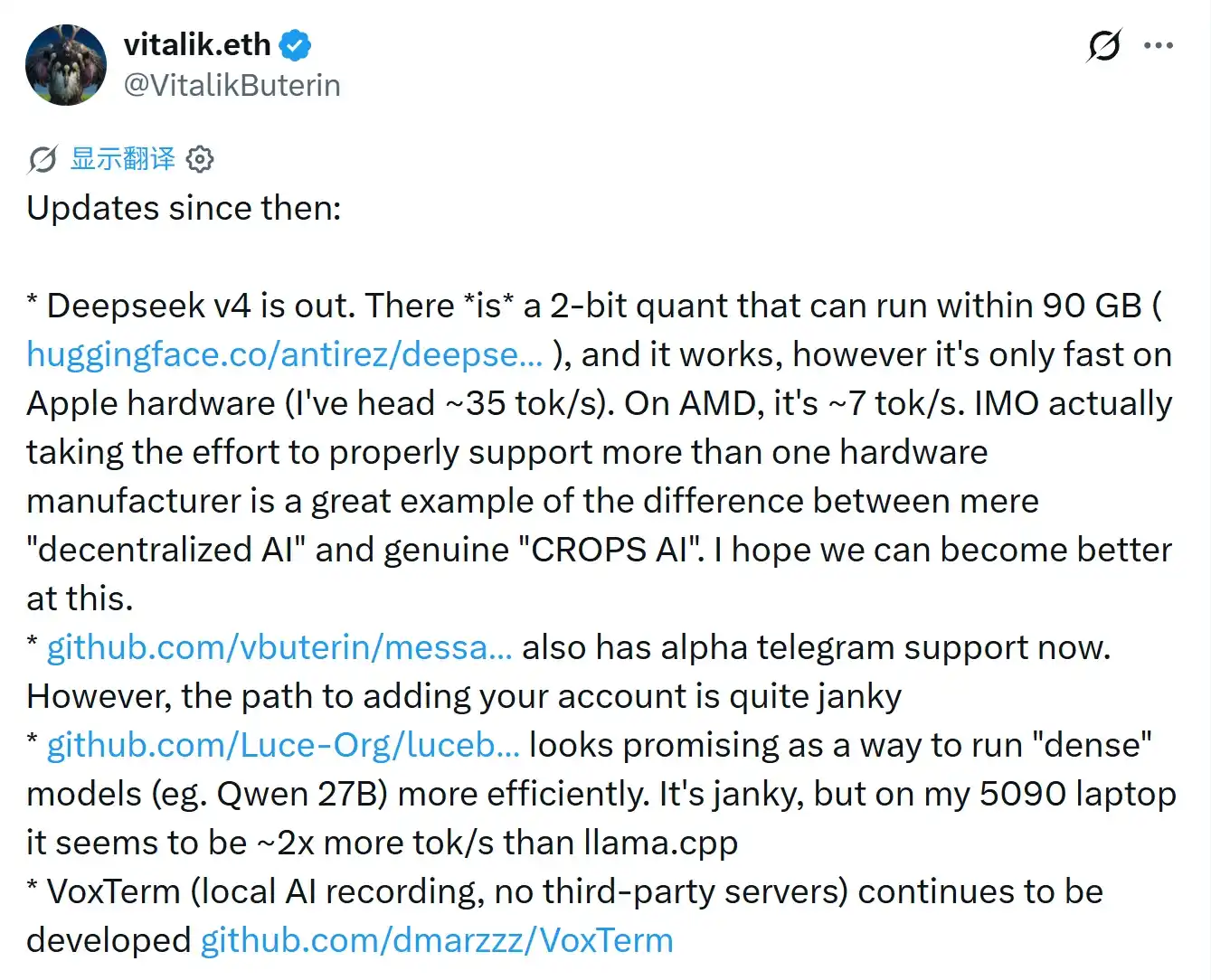
On May 28th, Vitalik Buterin posted an update on his localized AI progress, stating that DeepSeek V4 has released a 2-bit quantized version that can run within about 90 GB of VRAM, achieving speeds of about 35 tok/s on Apple hardware and about 7 tok/s on AMD hardware. He also noted that a true "CROPS AI" should support multiple hardware platforms, not just be "decentralized AI."
Simultaneously, he pointed out significant overlap between the CROPS Ethereum access layer and CROPS AI. Examples include using zero-knowledge proofs for paid remote LLM calls and private Ethereum RPC reads. In the future, there should also be more AI models fine-tuned for Ethereum scenarios to improve smart contracts, protocol code, and ecosystem security.
This actually places Ethereum and AI within the same problem framework.
When we discussed AI in the past, we often focused on model capabilities, like whether it could write code, especially whether it could perform complex tasks replacing humans. But from a user security perspective, the real change brought by AI is not just "greater capability," but that it is altering the entry point for digital operations.
Again, a familiar point: applications used to be relatively clear interfaces. We opened wallets to transfer, opened DApps to trade, opened browsers to search, opened social products to post. Each application had relatively clear boundaries. But with the emergence of AI Agents, these boundaries are becoming increasingly blurred. Users no longer click functions one by one but express intent in natural language:
Find me the optimal cross-chain route, help me make a swap, help me organize assets, help me execute a certain DeFi strategy, help me generate and send a transaction...
This sounds convenient, but it also implies a more critical question: when AI becomes your digital agent, what exactly is it signing on your behalf, and even what privacy is it exposing?
If AI runs entirely on centralized clouds, users' asset information, transaction intent, address relationships, identity preferences, and operational habits could be concentrated in the hands of a few service providers. Especially when executing on-chain operations relying on opaque APIs, centralized RPCs, black-box plugins, and unverifiable inference processes, users might become more convenient but also find it harder to know what they are truly giving away.
This is the question CROPS AI aims to answer.
An AI more aligned with CROPS is not just about being capable, but also should be as censorship-resistant, open, privacy-preserving, and secure as possible. It should ideally run locally, at least minimizing reliance on centralized cloud services in sensitive scenarios, minimizing information leakage, and allowing users to understand, confirm, and retain final control.
In other words, AI cannot just be a smarter black box, especially in Web3 scenarios. In the future, AI may not just help summarize articles, write code, or provide customer service, but directly participate in asset management and automated execution.
The closer it gets to user assets, the more important CROPS becomes.
This is also why the CROPS Ethereum access layer and CROPS AI overlap.
三、 What Web3 Incrementals Can Be Explored in This Overlap?
From this perspective, Vitalik's recent mention of overlap between the CROPS Ethereum Access Layer and CROPS AI is very natural.
Because whether it's Ethereum or AI, the core problem users face is increasingly becoming the same—how do I use AI assistance without completely handing over my privacy, identity, assets, and right to choose to centralized intermediaries?
- On the Ethereum side, this problem manifests as: How do users access on-chain data? How do they connect to RPC? How do they sign transactions? How do they confirm if DApp interactions are safe? How do they avoid having all wallet queries, balance reads, and transaction broadcasts pass through a few centralized services?
- On the AI side, this problem manifests as: How do users call models? How do they ensure prompts and personal data are not misused? How do they let local models handle sensitive tasks? How, when needing remote large model capabilities, do they avoid exposing their identity and intent as much as possible?
These two sets of problems seem different but are fundamentally similar.
For example, when Ethereum users query balances, read transaction history, or simulate transaction results, they often need to go through RPC services. While RPC might seem like just a technical interface, it could know your IP, address, query habits, asset structure, and interaction paths. If this data is centrally collected, users' on-chain privacy will be gradually pieced together.
But AI users calling remote models might also expose their preferences, financial information, and even identity clues. If users employ AI to handle wallet operations in the future, the risks amplify further.
Therefore, what Vitalik mentioned about ZK-paid remote LLM calls and private Ethereum RPC reads are essentially attempts to solve the same problem: how can one obtain services while calling remote capabilities without exposing all their information?
This is where the intersection of CROPS Ethereum and CROPS AI lies. On one side is a more private, more verifiable, and less trust-assuming on-chain access layer; on the other side is a more open, more localized, and more secure AI execution environment. Together, they might form a new entry point for users into the digital world in the future.
Extending outward along the underlying logic of CROPS, the entire Web3 ecosystem (especially the wallet layer as a traffic entry point) will undoubtedly assume more roles:
When users start expressing on-chain needs in natural language, a wallet is no longer just a signing tool but a control console for users' digital actions. It needs to help users determine: Can this DApp connect? What exactly will this transaction do? Is this AI Agent calling unnecessary data?
From this perspective, CROPS is not an abstract value but will directly influence the design direction of wallet products and drive the development shift of the next decade's integrated Web3 interaction experience and the wallet sector.
Conclusion
Although, in the current market sentiment, many people's attention to pure concepts may not be as high.
But the colder the market, the easier it is to overlook those technological variables that may not be sexy enough in the short term but truly determine the direction in the long run.
The reason CROPS deserves attention is not because it creates a new buzzword, but because it reframes the long-term problems of Ethereum and AI within the same framework: As digital systems become increasingly powerful, can users continue to retain their own control?
After all, security and privacy cannot just be afterthoughts.
From this perspective, in an era where AI is accelerating its takeover of the digital world, perhaps this is the truly positive variable that makes Ethereum continue to be worth building and using.
In an era where AI is accelerating its takeover of the digital world, being more understandable, more verifiable, more private, and more secure may be the real reasons Ethereum continues to be worth building and using.