‘AI Broke Through NSA in Hours’ Goes Viral, But Is It Actually a Red Team Exercise?

marsbitPublished on 2026-06-23Last updated on 2026-06-23

Abstract

The viral claim that Anthropic's AI model 'Mythos' breached almost all of NSA's classified systems in 'hours, not weeks' has been clarified as a misinterpretation. The statement originated from a U.S. Senator citing the NSA director within a broader argument for mandatory pre-release testing of frontier AI models. The author of the original Economist article later clarified that the feat was achieved under very specific, controlled conditions during an authorized red-team exercise, where Mythos was used alongside other tools to find vulnerabilities in a replica of NSA systems, not a live breach. This highlights Mythos's advanced capabilities in vulnerability discovery and attack path reasoning during security testing. Anthropic restricts access to such powerful models through its 'Project Glasswing' program for vetted defense organizations. The incident underscores the U.S. government's conflicted stance: while citing security risks to justify actions like export controls on Anthropic's models, agencies like the NSA reportedly continue using them for defense purposes. The narrative evolved from a call for regulation into a sensationalized 'AI hacks NSA' headline, demonstrating how technical achievements in controlled environments can be misconstrued as real-world attacks.

A sentence that went viral online recently has seen a reversal.

‘Mythos broke through almost all of our classified systems in hours, not weeks, in hours.’

This sentence has been flooding English social media platforms in recent days.
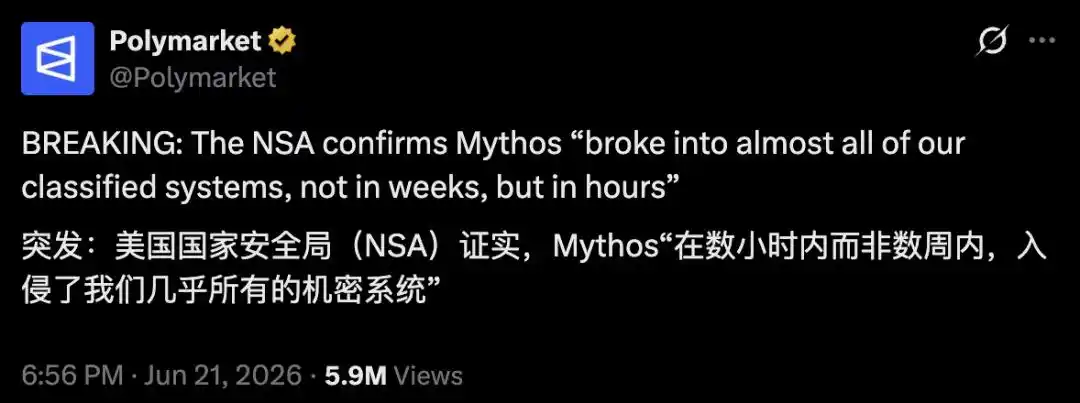
The protagonist is Anthropic's most powerful model, Mythos, and what was breached were the classified systems of the NSA (National Security Agency). Combined with the timeframe anchor of ‘in hours,’ this sentence spread rapidly across the internet.

All onlookers were shocked by the image it painted: AI can now breach the most stringent cyber defenses of a nation within a few hours.

This sentence originally came from a report by Shashank Joshi published in The Economist.
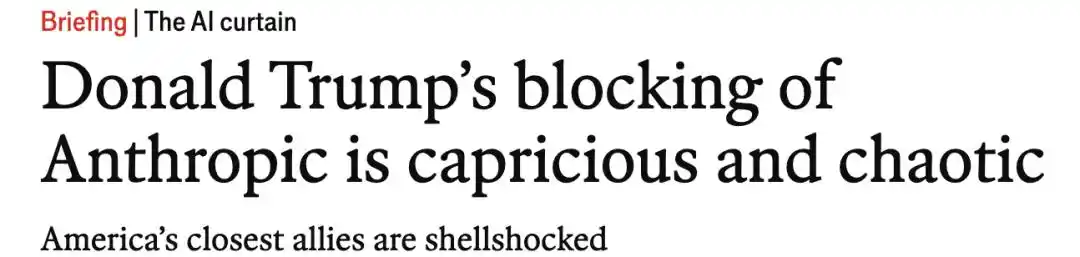
https://www.economist.com/briefing/2026/06/14/donald-trumps-blocking-of-anthropic-is-capricious-and-chaotic

In the article, to illustrate how powerful AI is, Joshi quoted a statement from Senate Intelligence Committee Vice Chairman Mark Warner, and Warner's statement was itself a recounting of someone else's words: General Joshua Rudd, who heads both the NSA and the Pentagon's Cyber Command.

Rudd told Warner that Mythos broke through almost all classified systems in hours.
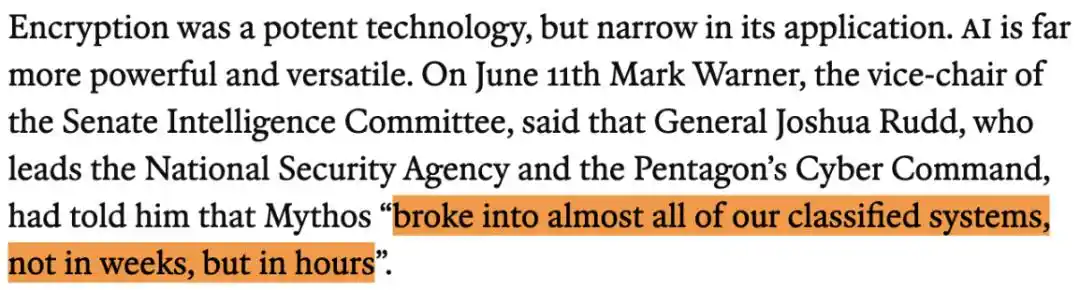
After being reported by The Economist, Rudd's statement quickly became a hot topic on social platforms.

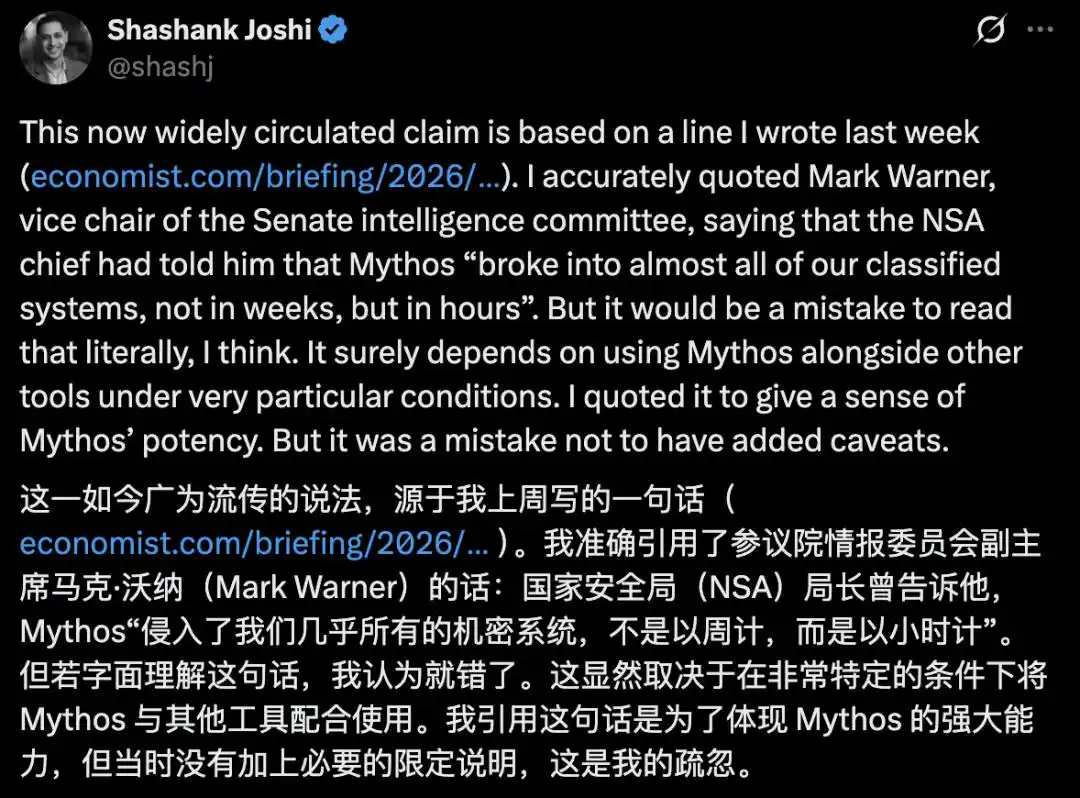
Concerned about public misinterpretation, Joshi, who wrote the sentence, personally stepped in on June 21st to temper the statement.

He said on X that the source of the quote was accurate; he did indeed quote Warner verbatim. However, taking it literally might lead to misunderstanding.

Mythos achieved this only under very specific conditions and when used in conjunction with other tools. He stated that he cited the quote to convey the strength of Mythos, but failing to add qualifications was his oversight.
Another easily overlooked point is that Warner's original intention in bringing up this example was not to denounce Anthropic; on the contrary.

His original words were: we need to let these AI companies ‘go full throttle,’ and thank goodness, it was Anthropic that did this. With another company with less rigid principles, relying solely on voluntary testing simply wouldn't suffice.

What Warner really wanted to push for was establishing mandatory pre-release testing for frontier models, rather than gambling on corporate self-regulation.

Thus, we see a complete chain of distortion: a sentence originally meant to advocate for ‘mandatory testing for frontier models’ comes from the NSA, passes through a senator's mouth, lands in a magazine's pages, and finally becomes breaking news of ‘AI Breaks NSA’ on social media.

Each time it was relayed, the tone became more exaggerated and absolute.

Behind the Cooling Down

How Powerful Is Mythos Actually Now?

In the original post, Joshi said the sentence shouldn't be taken literally.

He said the incident where Mythos broke through NSA systems in hours almost certainly occurred under very specific conditions, with Mythos being used alongside other tools. He said it was his ‘negligence’ not to include these qualifications when writing the article to emphasize its strength.

So, how capable are models like Mythos at this point?

Public information points more towards three things: finding vulnerabilities, reasoning attack paths, and running tests in red team environments.

According to an Axios report, institutions granted access to Mythos primarily use it to scan their own environments and identify potential vulnerabilities that could be exploited, not to attack live production systems running others' operations.

As early as April, reports confirmed that the NSA was taking precisely this approach: using the Mythos preview to scan its own environment for vulnerabilities, with a team of Anthropic engineers providing support.

This is also a common point reiterated by those who have come forward to correct the record in recent days.

BitGo founder and CEO Mike Belshe directly called it out in a repost: this is false. Security analyst Kyle Chase clarified that the ‘breach’ was a test; Zack Korman complained about how the statement went from senator to journalist to social media without anyone verifying it along the way.
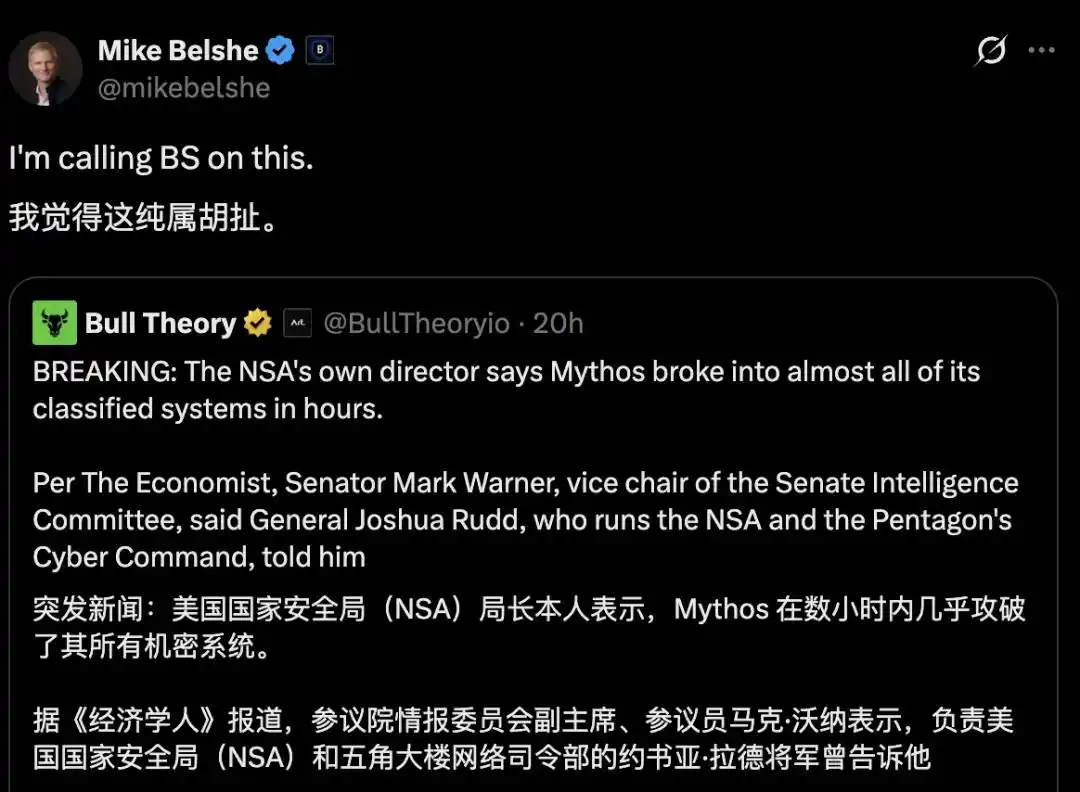
The more credible version they point to is that Rudd was referring to an authorized red team exercise: the NSA placed Mythos in a replica of its own classified environment, tasked it with finding and chaining vulnerabilities, and it did so at a speed far exceeding that of human teams.

Red Team Exercise vs. Real Intrusion

A red team exercise is when you hire people, in your own controlled environment (a ‘range’), with authorization, to test your own defenses, finding holes before the enemy does.

Being able to breach a complex defense setup in a controlled range in a few hours is separated from actually breaching the NSA's live classified systems by a whole set of prerequisites: specific environment, specific authorization, specific toolchains.

Writing ‘red team found all holes in range in hours’ as ‘NSA classified systems breached’ is a bit like writing a fire drill report as ‘building on fire.’

That said, even if it's just the result of a red team exercise, Mythos's performance itself is alarming enough.

A replica of a national-level classified environment, with a model chaining together almost all vulnerabilities within hours – that speed itself is a significant security warning.

Given the capabilities of the Mythos model, Anthropic specifically established a program to lock it down: Project Glasswing.

The model is not sold publicly; it's only distributed to vetted defense entities. The first batch in April included about 50 organizations, with 12 publicly named founding partners including AWS, Apple, Google, Microsoft, NVIDIA, and JPMorgan Chase; by June 2nd, the list expanded to about 150 institutions across more than 15 countries.

The reason remains consistent: its offensive cyber capabilities are too dangerous, and it cannot be widely released to the public before sufficient guardrails are in place.

Even the initial partners have already used it to uncover over 10,000 high or critical severity vulnerabilities.

Calling It Dangerous

While Continuing to Use It

What's interesting is the U.S. government's attitude toward Mythos.

In February of this year, the Pentagon raised the ban hammer, cutting off cooperation with Anthropic and demanding its suppliers follow suit. The reason cited was that the company was a ‘supply chain risk.’ The legal battle is still ongoing.

But recently, President Trump himself changed his tune. During an interview on ‘The Axios Show,’ when asked ‘Do you see Anthropic, its CEO Dario Amodei, as a national security threat?’, he responded:

Not now, but maybe a week ago, yes.

On June 19, Trump gave an interview at the White House for ‘The Axios Show,’ changing his stance on Anthropic: Not now, but maybe a week ago, yes.

Just a week prior, Amazon, a shareholder behind Anthropic, submitted a vulnerability report that alarmed the White House. When the government took this report to Anthropic's senior management, they felt the company didn't take it seriously.

So, the Trump administration took direct action.

According to Anthropic's official account, at 5:21 PM EST on June 12th, the company received an export control order. The wording was firm: it prohibited any foreign national from accessing Fable 5 and Mythos 5, regardless of whether they were inside or outside the United States, not even Anthropic's own foreign employees were exempt.
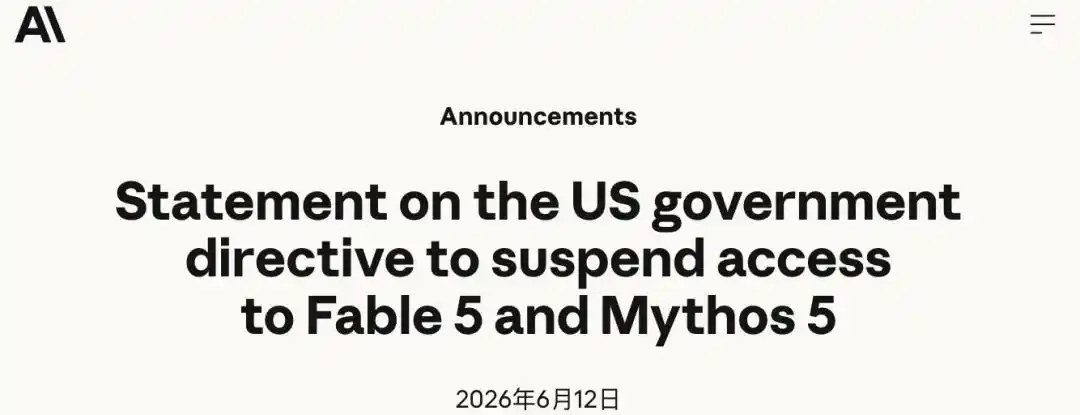
The problem is, you can't filter people by nationality one by one during real-time API calls.

Therefore, Anthropic had to implement a blanket shutdown, directly disabling Fable 5 and Mythos 5 for all users worldwide. Other models, including Claude Opus 4.8, were unaffected.

A model for global commercial use, taken offline just like that.

According to Anthropic's official statement, the trigger was a claimed ‘jailbreak’ method that could bypass Fable 5's guardrails. However, the company does not accept this claim: it reviewed the demonstration, and what was found after the bypass were several minor, already known vulnerabilities that even public models like OpenAI's GPT-5.5 could find, hardly a capability unique to Mythos.

Anthropic characterized this as a misunderstanding, stating it complied with the order but is working to restore access as soon as possible.

What's more contradictory is that, according to an Axios report on April 19th, while the lawsuit was ongoing, the NSA was still using Anthropic's strongest model, the Mythos Preview. While the Department of Defense argued in court that using it threatened national security, its subordinate, the NSA, continued using it.
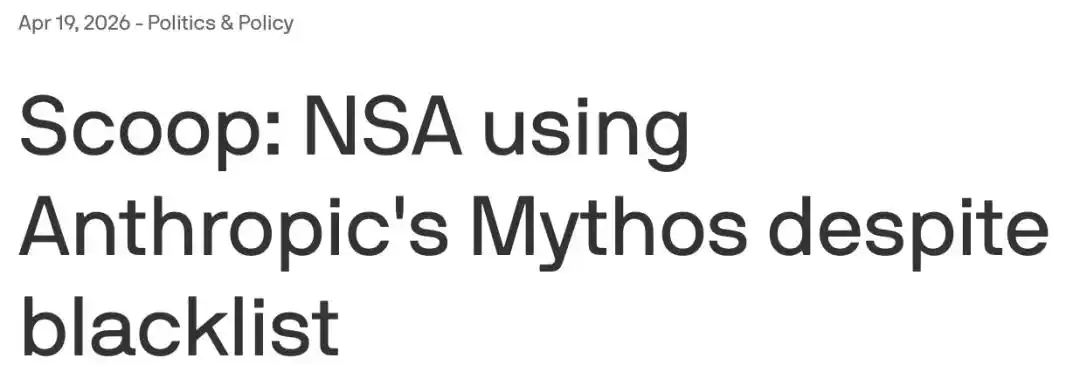
Among the approximately 40 authorized institutions, Anthropic only publicly named 12. According to sources, the NSA is among those names not publicly disclosed.

The most dangerous model is first labeled a risk, then quietly used in national security defense.

It's unclear whether this is a ban or a dependency.

You can ban a model, but you can't ban a capability.

Export controls can stop Mythos 5, but they can't stop the underlying capability represented by ‘AI can find holes in a defense setup in hours.’

The bigger trouble lies ahead.

The government agency CAISI, responsible for assessing the dangerous capabilities of frontier models, has recently been ordered to stop publishing its reports.

Who decides whether a model can be used or not is becoming increasingly unclear to outsiders.

References:

https://x.com/shashj/status/2068704535124508717

https://www.economist.com/briefing/2026/06/14/donald-trumps-blocking-of-anthropic-is-capricious-and-chaotic

This article is from the WeChat public account “新智元” (Xinzhiyuan), author: ASI启示录, editor: 元宇

Trending Cryptos

Related Questions

QAccording to the article, what was the original context and intended meaning behind the statement 'Mythos breached nearly all classified systems in hours'?

AAccording to the article, the original statement by NSA Director Joshua Rudd was intended to highlight the need for mandatory pre-release testing for frontier AI models. It was cited by Senator Mark Warner to argue that companies like Anthropic must be allowed to 'push the limits,' and that their voluntary testing is crucial, but a stronger mandatory framework is needed. The statement was meant to advocate for regulations, not to declare a real-world attack on the NSA.

QWhat does the article clarify about the conditions under which Mythos achieved the reported 'breach' of NSA systems?

AThe article clarifies that the reported 'breach' was the result of an authorized 'red team' exercise. In this exercise, the NSA provided Mythos with a copy or a replica of its classified environment and allowed it, alongside other tools, to search for and chain together vulnerabilities. This was a controlled, internal security test, not an actual external attack on live operational systems.

QWhat was the primary purpose of Anthropic's 'Project Glasswing' program mentioned in the article?

AThe primary purpose of Anthropic's 'Project Glasswing' program was to provide controlled access to its advanced and potentially dangerous model, Mythos, to pre-approved defense and security organizations. The program restricts the model's release because its offensive cybersecurity capabilities are considered too risky for public availability, and aims to allow vetted entities to find vulnerabilities in their own systems before malicious actors can exploit them.

QWhat paradoxical or contradictory stance does the U.S. government hold towards Anthropic's Mythos model, as described in the article?

AThe article describes a paradoxical stance where, on one hand, the U.S. government (specifically the Department of Defense and President Trump) has issued bans and export controls against Anthropic, labeling the company a supply chain risk. On the other hand, agencies like the National Security Agency (NSA) were reportedly still using the Mythos Preview for red teaming and vulnerability detection even while the legal battle was ongoing.

QWhat key distinction does the article make between the sensationalized headline of 'AI breached NSA' and the more nuanced reality of the event?

AThe key distinction is between a real-world, unauthorized attack and an authorized red team exercise. The sensationalized headline implies an external AI successfully infiltrated and compromised the NSA's live, operational classified systems. The nuanced reality is that it was an internal, controlled security test where an AI model was given permission to probe a replica of the NSA's environment to find security weaknesses, which is a standard and defensive security practice.

Related Reads

Coin Stock Barometer丨BitMine's Total Assets and Investment Reach $10.7 Billion, Exceeding ~$9.3 Billion Floating Loss; Strategy Buys Only 520 BTC, Strive Adds Positions Against the Trend (June 23)

This article provides a weekly market update on "coin-equity" trends, focusing on listed companies holding major cryptocurrencies. Key highlights include: **General Market Trends:** Global equities, particularly in the US, Japan, and South Korea, faced significant sell-offs, led by large tech and AI-related stocks. Analysts cite profit-taking and a shift from hype-driven to performance-driven valuation for AI companies. Market focus is on upcoming Micron Technology's earnings. **Cryptocurrency Treasury Updates:** * **Bitcoin (BTC):** Net weekly BTC purchases by listed companies (excluding miners) totaled approximately $86 million, down 13.97% from the prior week. Strategy (formerly MicroStrategy) purchased only 520 BTC for ~$34.9 million, while Strive Asset Management increased its holdings by 759 BTC for ~$50 million. Other notable actions include Mara Holdings adding 1,000 BTC and Capital B shareholders approving a massive financing plan (up to ~$1.2 trillion) to potentially expand its Bitcoin reserves. * **Ethereum (ETH):** BitMine emerged as the largest corporate ETH treasury, holding 5.67 million ETH (4.7% of supply). It purchased an additional 52,203 ETH ($92 million) in the past week. Sharplink completed a $75 million private placement to fund further ETH accumulation and stock buybacks. * **Solana (SOL):** The top five listed companies hold over 15.7 million SOL combined. However, Solmate Infrastructure, a SOL treasury firm, faces a lawsuit from its largest external shareholder alleging board misconduct and self-dealing. * **Other:** Updates include Canton Strategic's $50 million stock buyback plan and Lite Strategy's $1 million strategic investment in LitVM, a Layer-2 network for Litecoin. The article notes that while crypto treasury firms continue fundraising and accumulation, their stocks may struggle to rise against the broader market downturn until Q4.

marsbit4m ago

Coin Stock Barometer丨BitMine's Total Assets and Investment Reach $10.7 Billion, Exceeding ~$9.3 Billion Floating Loss; Strategy Buys Only 520 BTC, Strive Adds Positions Against the Trend (June 23)

marsbit4m ago

OpenAI Partners with PE Firms, Investing $4 Billion. Let's Talk About Silicon Valley's Hottest New Role: FDE.

The hottest new role in Silicon Valley is the Forward Deployment Engineer (FDE), a hybrid of engineer and business consultant whose core mission is to transform AI demos into native, practical workflows within client organizations. The recent surge in demand is driven by a strategic shift from leading AI companies. OpenAI, partnering with 19 private equity firms in a $4 billion investment, formed a Deployment Company and acquired Tomoro along with its 150 FDEs. Anthropic also announced a $1.5 billion joint venture with financial institutions like Blackstone. The article, based on interviews with industry experts Jove (FDE lead at Cresta) and Oliver (VP at Invisible Technologies, ex-McKinsey), explores the FDE role and the rise of deployment-focused companies. Key insights include: **The FDE Role:** Jove describes an FDE as a "Forward Deployed CTO"—a technically strong engineer who works intimately with clients to implement AI solutions, learn from the process, and feed those insights back to improve the core product. They require expertise in AI agents, client-facing experience, resilience, and the ability to handle complex, imperfect systems. While AI tools enhance their efficiency, the role's complexity makes full automation a distant prospect. **Industry Shift:** Model companies are moving beyond selling tools to ensuring real-world adoption. This blurs the line between model and application companies. Collaborations with private equity (PE) firms are key, providing access to large portfolios of traditional businesses needing AI transformation. For PE firms, these partnerships offer signal value to LPs, create tangible value in portfolio companies, and provide exposure to high-growth AI assets. **Consulting & Transformation:** AI deployment involves deep, customized workflow redesign, moving beyond simple tool augmentation. Companies like Invisible Technologies build modular platforms to create bespoke, AI-native workflows for clients. While traditional consulting will see growth in helping businesses rethink their models for AI, the real value is captured by firms that leave behind transformed, operational systems. Critical success factors include building robust data foundations and strategically deciding which workflow steps should be deterministic versus AI-driven. The ultimate goal shifts from pure cost-cutting to unlocking new revenue opportunities previously impossible without AI-scale capabilities.

marsbit16m ago

OpenAI Partners with PE Firms, Investing $4 Billion. Let's Talk About Silicon Valley's Hottest New Role: FDE.

marsbit16m ago

Why Is DeFi Insurance Unpopular?

The article explores the core reasons why DeFi insurance remains largely unutilized despite its potential to eliminate traditional insurance inefficiencies and malicious claim denials through automated smart contracts. Key points include: 1. **Low Adoption & Minimal Payouts:** Leading provider Nexus Mutual has paid only ~$18M in claims since 2019, dwarfed by single hack losses (e.g., Kelp DAO's $292M loss). 2. **High Correlation Risk:** Unlike traditional insurance (e.g., house fires), DeFi risks (oracle failures, bridge hacks) are systemic and can simultaneously impact multiple protocols, threatening to drain entire insurance pools. 3. **Prohibitive Cost vs. Reward:** For many protocols (Aave, Morpho, Compound), insurance premiums (1.5%-6%) consume a significant portion or even all of the native yield (3%-4%), leaving investors with meager returns. In some cases (Maple Finance, Ethena), premiums can even result in net-negative yields. 4. **Inadequate Capacity:** The total DeFi insurance pool (e.g., Nexus Mutual's $81.56M) is minuscule compared to the hundreds of billions in total value locked (TVL), creating a massive supply-demand gap. 5. **Structural Flaws:** The claims assessment model (e.g., Nexus Mutual's member voting) creates a conflict of interest, as voters bear the loss if a claim is paid. There is also no regulatory mandate forcing DeFi protocols to obtain insurance. The industry is adapting by focusing on preventative measures (e.g., bug bounty coverage) and seeking external capital via reinsurance. However, the fundamental issues of small pool size, correlated risk, and misaligned economic incentives persist. The article concludes that DeFi insurance, like a public lighthouse, provides shared security benefits, but if everyone relies on others to pay for it, no one will, leaving the ecosystem vulnerable.

Foresight News30m ago

Why Is DeFi Insurance Unpopular?

Foresight News30m ago

Trading

Spot
Futures

Hot Articles

Discussions

Welcome to the HTX Community. Here, you can stay informed about the latest platform developments and gain access to professional market insights. Users' opinions on the price of AI (AI) are presented below.

活动图片