Welcome to the New Crypto World: Only This Time, The Place Where You Lose Money Is Called the Stock Market

marsbitPublished on 2026-07-30Last updated on 2026-07-30

Abstract

Welcome to the New Crypto World: Only This Time, the Place to Lose Money is Called the Stock Market. The article depicts a future (2026) where global stock markets, particularly tech stocks, are exhibiting behaviors and risks reminiscent of the cryptocurrency world. The narrative centers on a sharp crash in South Korea's KOSPI index and leading stocks like SK Hynix, highlighting widespread retail losses, leverage-induced liquidations, and extreme volatility. It argues that a significant shift in market dynamics is underway: pricing is increasingly driven by narratives (like the AI boom) over fundamental valuation, amplified by high leverage and the rapid, emotion-fueled consensus formed on social media. Former crypto traders, seeking new opportunities, brought their high-risk strategies—chasing narratives, using leverage—into equity markets, focusing on sectors like AI and semiconductors. Ironically, data suggests some major tech stocks have recently shown greater volatility and faster crashes than Bitcoin, which is becoming relatively more stable and "stock-like" through institutional adoption. The piece details how leveraged ETFs in Korea, particularly those tied to single stocks, created a vicious cycle of forced selling that exacerbated the market plunge. It concludes that while stocks retain underlying fundamentals, the *trading* of them has undergone a "de-rationalization": markets now prioritize themes, social media sentiment, and leveraged bets over traditional ana...

Author: Dou Wanle

July 13, 2026, Seoul.

South Korea's benchmark KOSPI index plummeted 8.95% in a single day, triggering its 7th circuit breaker of the year. SK Hynix, the 'national destiny stock' in the eyes of Koreans, plunged 15.37%, a decline not seen in nearly two decades. Samsung Electronics also fell over 10%.

Margin calls were issued for over 1.2 million leveraged accounts. Brokerage systems automatically liquidated between 320,000 and 460,000 accounts. More heartbreaking is that 62% of those liquidated were young people aged 20 to 30. Some lost their down payment for a wedding apartment, others were trading on margin...

A young man in his 20s in Busan, who lost money following a recommendation from a stock YouTuber, went and stabbed the influencer.

In the past, these phrases would most likely have been used to describe scenes after a crypto market crash. Today, they are recurring in the South Korean, American, and Japanese markets as the tech stock tide recedes.

Sharp rallies and sell-offs are just the surface. What's truly changed is the method of valuation—narrative outweighs fundamentals, leverage amplifies emotions, and social media drives consensus to extremes with unprecedented speed.

Global stock markets, especially tech stocks, are becoming increasingly like the crypto world.

Returning to the Family Home

"Welcome back to the family home."

After the crash, crypto traders who had switched to stocks shared numerous loss stories online. Comments like the one above were ubiquitous.
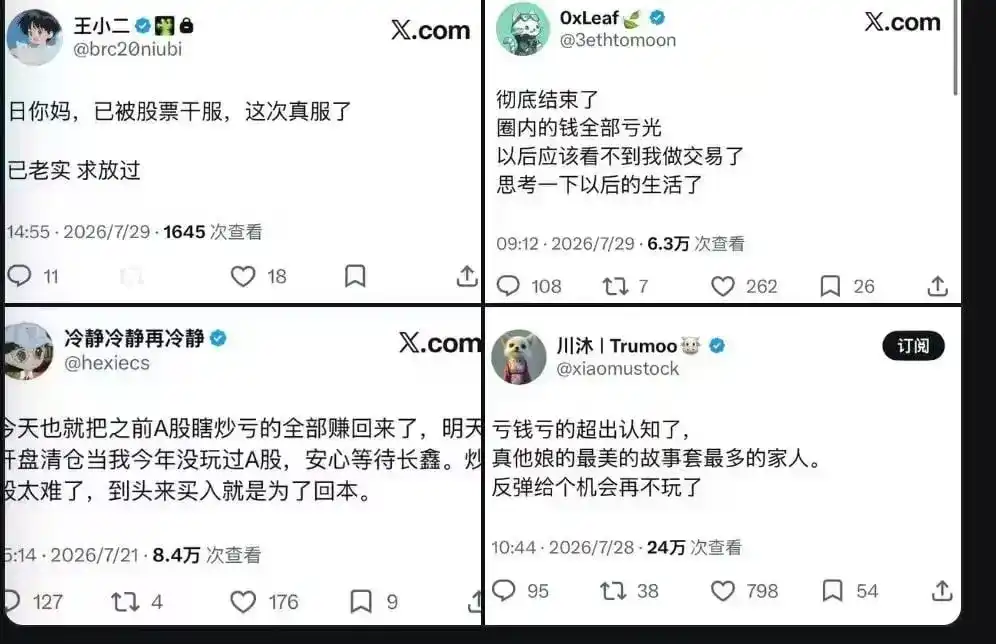
The so-called "family home" refers to the cryptocurrency world. From the second half of 2025 to early 2026, a major drama of "leaving the family home" unfolded in the crypto space.

A number of KOLs and veteran players who had been in the cryptocurrency market for years began to lose faith. Bitcoin was range-bound with tepid trading volume, meme coins kept getting shaved. Many felt "this circle is boring" and started turning their attention to US stocks.

This choice seemed very reasonable.

Stocks have revenue, profits, financial reports, and SEC oversight. Compared to crypto projects lacking cash flow and priced purely on consensus, US stocks at least appeared to be more mature and safer assets.

The crypto traders didn't just take their liquidity; they brought their trading methods along too.

In the crypto market, they were accustomed to chasing new narratives, hunting for high-volatility targets, using leverage, and swiftly switching positions based on social media sentiment. Upon entering the stock market, this approach barely changed—only the trading objects shifted from tokens to AI, memory chips, and leveraged ETFs, repeatedly achieving significant gains.

Memory stocks soon became the new collective consensus.

The logic was not complicated: AI servers require more high-bandwidth memory (HBM), leading to supply shortages and rising memory prices. Micron, Samsung Electronics, and SK Hynix naturally became the most direct 'shovel sellers.' The phrase "you can never have enough memory" became deeply ingrained.
Numerous crypto KOLs reinvented themselves, starting to talk about US stocks, memory cycles, and AI capital expenditure. Products like the 2x leveraged SK Hynix ETF were also regarded as more 'efficient' betting tools than regular stocks.

Until the market reversed in July.

Bitcoin Becomes the "Low Volatility Asset"

How long does it take to fall from the peak?

Bitcoin took 268 days to halve its value, and silver took 169 days for a similar magnitude of retracement.

In contrast, SanDisk took only 36 days to fall about 55%, and SK Hynix took only 34 days to drop about 53%.

While both experienced a 'halving,' Bitcoin took nearly nine months, while memory stocks took just over one month.
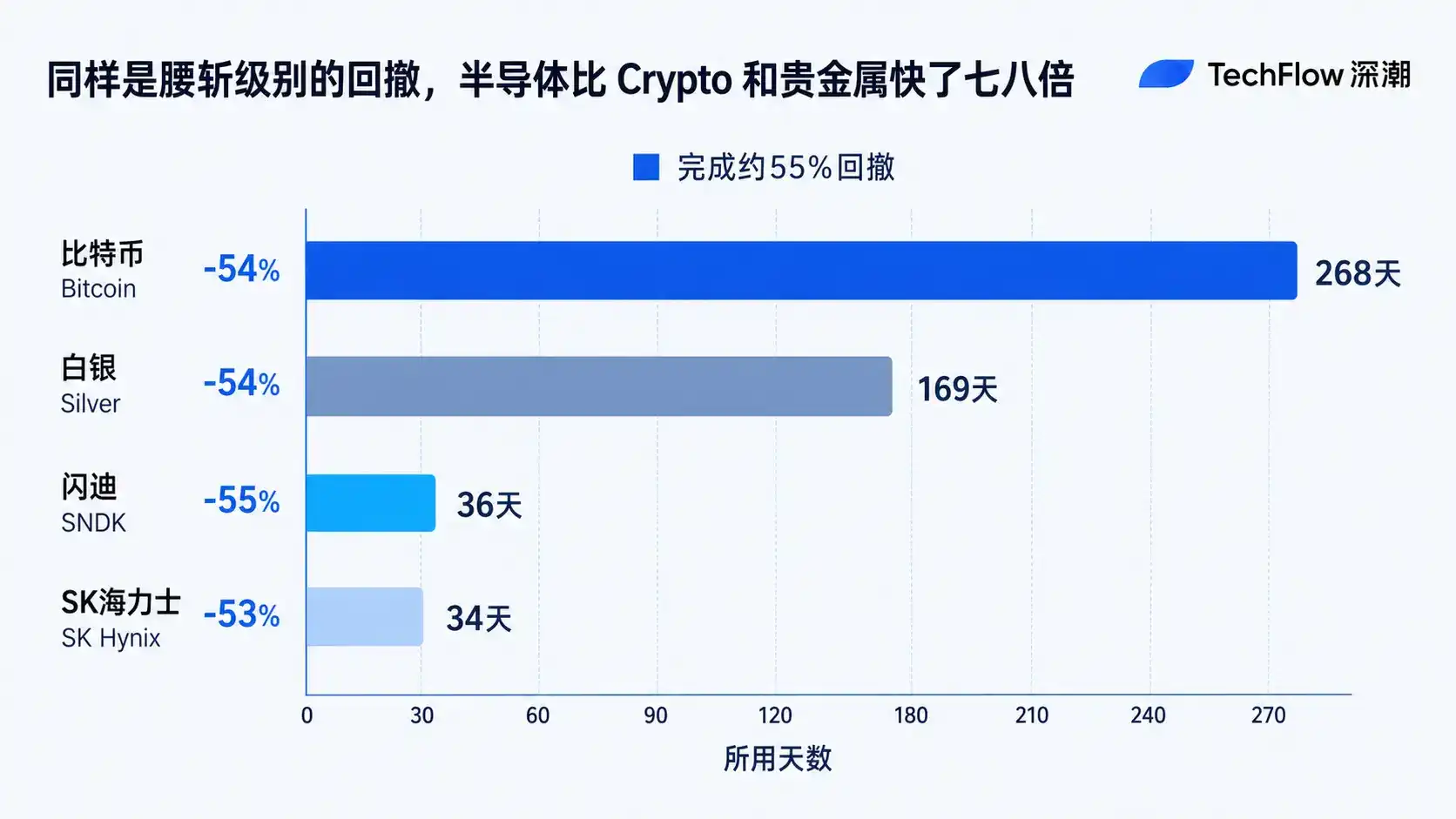
This is the ironic twist of this round of market movements. In the past, investors worried Bitcoin could surge or crash within days, while stocks adjusted slowly based on earnings and valuations. Now, some tech stocks are completing an entire bubble burst in a shorter time frame than cryptocurrencies.

It's very counter-intuitive. Compared to some tech stocks, Bitcoin is becoming relatively stable.

According to Schwab statistics, Bitcoin's historical volatility in 2025 was about 42%, with a maximum drawdown of around 32%. During the same period, Tesla's volatility was about 63% with a max drawdown of 48%, and Nvidia's volatility was about 50% with a max drawdown of 37%.

Bitcoin remains a high-risk asset, but the volatility of some major tech stocks is even greater.

Bitwise even predicted in its 2026 outlook that Bitcoin's overall volatility might continue to be lower than Nvidia's.

So the current situation is quite absurd: Bitcoin is becoming more like tech stocks, while tech stocks are becoming more like Bitcoin.

When Narrative Becomes the Valuation Anchor

There's an old saying in crypto: trading crypto is trading narratives.

In 2026, global tech stocks are turning this saying into reality.

AI is certainly not vaporware. Nvidia, Microsoft, Google, and large cloud computing companies have real revenue and are investing real capital to build data centers.

But there's a long road between "AI will indeed create value" and "any company touching AI is worth buying at any price."

At the height of the frenzy, the market simply skipped that road.

AI servers, optical modules, memory chips, data centers, power equipment, even nuclear energy companies—as long as they could be placed within the AI industrial chain, their stock prices could surge. Businesses were still in the planning stage, orders not yet secured, but the market would price them based on the best possible outcome years in advance.

The story in South Korea was "AI semiconductors are tied to national destiny." As KOSPI kept hitting new highs, more and more families began opening stock accounts for their underage children, gifting popular stocks like Samsung Electronics and SK Hynix as long-term presents.

A similar concentration occurred in the A-share market. In the first half of 2026, the TMT sector's market cap reached 41.78 trillion yuan, accounting for about 31.45% of the total A-share market value. On some trading days, turnover in the tech sector approached half of the entire market's.

The US market has long been priced around a handful of large tech companies. As index gains relied increasingly on just a few firms, and as funds, options, and retail investors flooded into the same stocks, seemingly diversified portfolios were essentially betting on the same AI story.

This is reminiscent of the old crypto world. Dogecoin's surge in 2021 wasn't due to a technological breakthrough, but because Elon Musk tweeted. The surge in tech stocks in 2026 wasn't because all companies experienced explosive earnings growth, but because ChatGPT convinced everyone that "AI will rewrite everything."

That narratives could dominate the market so rapidly is also inseparable from changes in dissemination methods.

In the past, stock information primarily came from financial reports, research notes, and institutional roadshows. Today, more and more people's investment decisions come from YouTube, X, short videos, and paid communities.

Complex company research is compressed into a few sentences: Time will prove compute and optical modules, AI compute will always be insufficient...

Social media algorithms don't reward caution either. Overnight riches are always the traffic magnet: someone doubled their money overnight with options, an office worker achieved financial freedom by heavily investing in memory stocks, someone used leveraged ETFs to earn years' worth of salary in a few months.

Charts are the best advertisement. A large number of housewives and middle-aged women began investing their private savings, and some even sold properties to buy stocks, reminiscent of students dropping out of school to all-in on Web3 a few years ago...

The Leverage Carnival

The scariest thing in crypto isn't volatility; it's the lethal combination of leverage and volatility. In 2026, global stock markets are perfectly replicating it.

On May 27, 2026, the Korea Exchange approved the listing of 16 single-stock leveraged ETFs with 2x leverage, tracking stocks like Samsung Electronics and SK Hynix.

Retail investors went wild. From approval to mid-July, Korean retail investors accumulated a net purchase of 14 trillion won (approx. 64 billion RMB) worth of single-stock leveraged ETFs. During the same period, foreign investors bought only about 2 trillion won.

These ETFs had several fatal design flaws.

These products rebalance their positions daily. The more severe the volatility, the more significant the decay in net asset value. Assume a stock falls 10%, then rises 11.1%—it returns to its original price. The corresponding 2x leveraged product would first fall 20%, then rise 22.2%, ultimately still losing about 2.2%.

The problem is even worse during rapid declines.

To maintain target leverage, the products need to passively reduce risk exposure after a decline. Selling further depresses the underlying price, triggering more position reductions, stop-losses, and margin pressure.

Goldman Sachs later pointed out that the "rapid deleveraging" of these products was the main cause of abnormal intraday volatility in KOSPI, with 62% of institutional net selling stemming from ETF-related liquidations.

Two months later, South Korean regulators urgently halted all new listings of single-stock leveraged ETFs. The minimum margin requirement was drastically raised from 10 million won to 30 million won, and only cash was recognized.

But it was too late. 2.3 trillion won in forced liquidation amounts, and the wealth of hundreds of thousands of families vanished into thin air.

Even the US stock market, the deepest in the world, is experiencing the backlash of leverage.

JPMorgan analysts recently noted that US stocks still have "deleveraging room," needing three months to return to pre-April levels.

The ratio of memory chip stock leveraged ETF assets to underlying market cap is three times the average for all stock ETFs. Even for broad leveraged stock index ETFs, the ratio is high relative to its own history.

A Regression

"Stock markets becoming like crypto" doesn't mean stocks have become completely identical to cryptocurrencies.

Stocks still have companies, assets, revenue, and cash flow behind them. They also have financial disclosures, audits, and regulation. Even when market sentiment fades, a truly profitable company still possesses a calculable value.

What's truly changed is at the trading layer.

In the past, people bought a company's future profits. Now, more and more people are trading the heat of a theme.

The crypto-fication of stock markets is essentially a revolution of de-rationalization.

Traditional stock markets look at P/E, cash flow; crypto-fied markets look at narratives, imagination. Traditional stock markets consider 20% volatility high; crypto-fied markets see individual stocks fluctuating 10-15% daily as the norm.

Traditional markets use leverage via margin trading; crypto-fied markets use ETFs, derivatives, quantitative strategies. Traditional market info comes from research reports, financial statements; crypto-fied market info comes from Twitter, YouTubers, online communities. Traditional markets have institutions rationally pricing; crypto-fied markets have institutions becoming retail-like, quant funds chasing momentum...

What's even more laughable is, now Bitcoin is striving to become like a stock, gaining mainstream financial acceptance through ETFs, institutionalization, and declining volatility.

This is an absurd point of intersection.

Those who transitioned from crypto to stocks ultimately found they hadn't left the "family home." It's the same repeating mechanism: grand narratives, crowded positions, easily accessible leverage, and everyone believing they can exit before everyone else.

The words written by a Korean retail investor on a trading forum are worth everyone remembering: I want to go back to the days before I traded stocks, and get my money back.

But the market never issues refunds.

Trending Cryptos

Related Questions

QAccording to the article, why are global stock markets, especially tech stocks, becoming more like the cryptocurrency market?

AThe article argues that stock markets, particularly tech stocks, are becoming more like the cryptocurrency market due to several converging factors. Firstly, pricing is increasingly driven by narrative and hype (like AI) rather than traditional valuation metrics like earnings. Secondly, the widespread use of leverage, especially through products like single-stock leveraged ETFs, magnifies volatility and emotions, similar to crypto trading. Finally, social media and online influencers rapidly form and spread consensus, pushing market sentiment to extremes and encouraging herd behavior among retail investors.

QWhat role did single-stock leveraged ETFs play in the South Korean market crash described in the article?

AIn South Korea, the approval of single-stock 2x leveraged ETFs (tracking stocks like Samsung and SK Hynix) in May 2026 played a catastrophic role. A massive influx of retail money into these products created concentrated, highly leveraged positions. Their daily rebalancing mechanism caused significant 'volatility decay' during swings. Most critically, during the sharp July decline, these ETFs were forced to automatically sell underlying stocks to maintain their target leverage. This created a vicious cycle of forced selling, further driving down stock prices, triggering more margin calls, and leading to a market crash. High estimated that 62% of institutional net selling during the crash was related to ETF liquidations.

QWhat paradoxical comparison does the article make between Bitcoin and certain technology stocks in 2026?

AThe article presents a paradoxical and counterintuitive comparison: while Bitcoin is notorious for its volatility, data from 2025 showed that its historical volatility (~42%) and maximum drawdown (~32%) were actually lower than those of major tech stocks like Tesla (~63% volatility, ~48% drawdown) and Nvidia (~50% volatility, ~37% drawdown). Furthermore, it took stocks like SK Hynix only about 34 days to fall roughly 53% from their peak, whereas a similar 'halving' for Bitcoin historically took about 268 days. Thus, compared to some hyper-volatile tech stocks, Bitcoin was ironically becoming a relatively 'low-volatility asset'.

QHow does the article characterize the change in information sources and decision-making for stock investors?

AThe article characterizes a fundamental shift in how stock investment information is sourced and decisions are made. Traditionally, investors relied on financial reports, analyst research, and institutional roadshows. Now, decisions are increasingly influenced by content from social media platforms like YouTube, X (Twitter), short video apps, and paid online communities. Complex company analysis is reduced to simple, viral slogans or narratives (e.g., 'AI compute will always be scarce'). Social media algorithms favor sensational, get-rich-quick stories over cautious analysis, accelerating the spread of consensus and FOMO (fear of missing out) among retail investors.

QWhat is the core irony or 'crossroads' highlighted at the end of the article regarding Bitcoin and stocks?

AThe article highlights a profound irony at the current crossroads of finance. On one hand, Bitcoin and the crypto market, originally the 'wild west' of finance, are striving to become more like traditional stocks—seeking legitimacy through ETFs, institutional adoption, and reduced volatility to gain mainstream acceptance. On the other hand, segments of the traditional stock market, especially tech stocks, are regressing to behave more like the speculative, narrative-driven, high-leverage crypto market of the past. The 'crypto natives' who moved to stocks found they never left their '原生家庭' (native home)—the same mechanisms of hype, leverage, and the greater fool theory were now dominant in equities.

Related Reads

Cardano Price Forecast for August 2026: Will ADA Triangle Breakout Happen Before or After the CLARITY Act Deadline?

Cardano (ADA) is trading at $0.1642, testing the apex of a symmetrical triangle pattern on the daily chart, which signals an impending directional move. Technical analysis identifies key resistance at the 20-day EMA ($0.1650) and the triangle's upper trendline. A breakout above could target the 50-day EMA at $0.1732, with a cup-and-handle pattern potentially forming. Support lies at the SuperTrend indicator ($0.1536) and the June low of $0.1386. Historically, August has been a weak month for ADA, with a median return of -12.8%. A weekly forecast outlines a volatile month influenced by the imminent August 8th deadline for the U.S. CLARITY Act vote, potential SEC regulatory action, and renewed geopolitical tensions following Iran's missile strike. Key bullish catalysts include the potential passage of the CLARITY Act and a major upgrade integrating Cardano's developer documentation and tools into AI coding assistants like Claude, which could significantly boost developer adoption. On-chain data also shows whale accumulation, a potential Wyckoff accumulation signal. The price forecast presents two scenarios: a bullish breakout above $0.1650 targeting $0.17-$0.1732 if the CLARITY Act passes and AI integration fuels momentum, or a bearish break below $0.1536 toward $0.1386 if the bill fails, seasonal weakness persists, and risk appetite diminishes.

cryptonews.ru14m ago

Cardano Price Forecast for August 2026: Will ADA Triangle Breakout Happen Before or After the CLARITY Act Deadline?

cryptonews.ru14m ago

Coinbase Vice President: The Wars Over Cryptocurrency Regulation Are Over

Coinbase's new Vice President, Ryan VanGrak, declared that regulatory wars in the cryptocurrency sector are over. Since taking office on July 9, 2026, he has shifted the company's approach from litigation and sanctions to focusing on growth and innovation. The industry can now concentrate on development rather than fighting for its right to exist. He highlighted that the Digital Asset Market Clarity Act (CLARITY Act), which aims to establish a clear federal regulatory framework dividing oversight between the SEC and CFTC, has gained significant momentum. This framework is intended to provide proper supervision, investor protection, and maintain U.S. leadership in digital assets. VanGrak's appointment marks a strategic shift from a "wartime" to a "peacetime" advisor, replacing former Chief Legal Officer Paul Grewal, who oversaw major litigation, including a dismissed 2023 SEC lawsuit. With his background at Citadel Securities and the SEC, VanGrak brings deep regulatory and institutional finance expertise as Coinbase expands beyond a simple exchange into a broader financial services provider, offering stocks, futures, prediction markets, and AI tools. For investors, bipartisan support for crypto legislation like the CLARITY Act represents a major shift from the enforcement-focused environment of 2023-2024. Lawmakers are now focused on *how* to regulate crypto, not *if* it should exist. However, risks remain, as the bill's passage is not yet guaranteed.

cryptonews.ru1h ago

Coinbase Vice President: The Wars Over Cryptocurrency Regulation Are Over

cryptonews.ru1h ago

Deep Dive into FWA: An Intriguing Experiment Turning NFTs into "On-Chain Gachapon"

A Deep Dive into FWA: The “On-Chain Gacha” Experiment for NFTs Fake World Assets (FWA), created by TokenWorks, introduces an innovative “NFT gacha machine” fully operating on-chain. Users can deposit eligible NFTs paired with ETH (called Backing) to create a Position, acting as a prize pool. Others can then pay a uniform Acquisition Price for a chance to win a random NFT from the pool. The core mechanism features a reverse probability system: Positions with lower Backing have a higher chance of being selected, serving as common prizes, while high-Backing Positions are rare “jackpots.” The acquisition price is calculated based on the harmonic mean of all Backings, keeping entry costs low. When a Position is won, the purchaser must choose: keep the NFT or accept the Standing Bid (85% of the Backing, claimable in ETH or $FWA tokens), returning the NFT to the original depositor. The protocol involves two main roles. Depositors provide liquidity (NFT + ETH), earning a share of fees from each draw, distributed equally per active Position, plus potential $FWA rewards. Purchasers pay to spin the gacha, receiving $FWA rewards for participation. A special “Crown” reward goes to the Position with the highest Backing. The $FWA token has a fixed supply and is initially obtainable only through protocol participation (depositing or purchasing), with external buying disabled early on to reduce sell pressure. Its value is supported by a built-in buy pressure: when purchasers opt for the $FWA settlement on a Standing Bid, the protocol uses the backing ETH to buy $FWA from the market. Revenue for the protocol comes from a 1% fee on each draw, a 1% settlement fee when an NFT is kept, and the 15% discount from Standing Bid settlements (currently allocated to the protocol). The design cleverly blends Uniswap-style liquidity provision, gacha mechanics, and tokenomics to create a novel, self-regulating marketplace for NFT liquidity and engagement.

marsbit1h ago

Deep Dive into FWA: An Intriguing Experiment Turning NFTs into "On-Chain Gachapon"

marsbit1h ago

Trading

Spot

Hot Articles

What is SONIC

Sonic: Pioneering the Future of Gaming in Web3 Introduction to Sonic In the ever-evolving landscape of Web3, the gaming industry stands out as one of the most dynamic and promising sectors. At the forefront of this revolution is Sonic, a project designed to amplify the gaming ecosystem on the Solana blockchain. Leveraging cutting-edge technology, Sonic aims to deliver an unparalleled gaming experience by efficiently processing millions of requests per second, ensuring that players enjoy seamless gameplay while maintaining low transaction costs. This article delves into the intricate details of Sonic, exploring its creators, funding sources, operational mechanics, and the timeline of significant events that have shaped its journey. What is Sonic? Sonic is an innovative layer-2 network that operates atop the Solana blockchain, specifically tailored to enhance the existing Solana gaming ecosystem. It accomplishes this through a customised, VM-agnostic game engine paired with a HyperGrid interpreter, facilitating sovereign game economies that roll up back to the Solana platform. The primary goals of Sonic include: Enhanced Gaming Experiences: Sonic is committed to offering lightning-fast on-chain gameplay, allowing players and developers to engage with games at previously unattainable speeds. Atomic Interoperability: This feature enables transactions to be executed within Sonic without the need to redeploy Solana programmes and accounts. This makes the process more efficient and directly benefits from Solana Layer1 services and liquidity. Seamless Deployment: Sonic allows developers to write for Ethereum Virtual Machine (EVM) based systems and execute them on Solana’s SVM infrastructure. This interoperability is crucial for attracting a broader range of dApps and decentralised applications to the platform. Support for Developers: By offering native composable gaming primitives and extensible data types - dining within the Entity-Component-System (ECS) framework - game creators can craft intricate business logic with ease. Overall, Sonic's unique approach not only caters to players but also provides an accessible and low-cost environment for developers to innovate and thrive. Creator of Sonic The information regarding the creator of Sonic is somewhat ambiguous. However, it is known that Sonic's SVM is owned by the company Mirror World. The absence of detailed information about the individuals behind Sonic reflects a common trend in several Web3 projects, where collective efforts and partnerships often overshadow individual contributions. Investors of Sonic Sonic has garnered considerable attention and support from various investors within the crypto and gaming sectors. Notably, the project raised an impressive $12 million during its Series A funding round. The round was led by BITKRAFT Ventures, with other notable investors including Galaxy, Okx Ventures, Interactive, Big Brain Holdings, and Mirana. This financial backing signifies the confidence that investment foundations have in Sonic’s potential to revolutionise the Web3 gaming landscape, further validating its innovative approaches and technologies. How Does Sonic Work? Sonic utilises the HyperGrid framework, a sophisticated parallel processing mechanism that enhances its scalability and customisability. Here are the core features that set Sonic apart: Lightning Speed at Low Costs: Sonic offers one of the fastest on-chain gaming experiences compared to other Layer-1 solutions, powered by the scalability of Solana’s virtual machine (SVM). Atomic Interoperability: Sonic enables transaction execution without redeployment of Solana programmes and accounts, effectively streamlining the interaction between users and the blockchain. EVM Compatibility: Developers can effortlessly migrate decentralised applications from EVM chains to the Solana environment using Sonic’s HyperGrid interpreter, increasing the accessibility and integration of various dApps. Ecosystem Support for Developers: By exposing native composable gaming primitives, Sonic facilitates a sandbox-like environment where developers can experiment and implement business logic, greatly enhancing the overall development experience. Monetisation Infrastructure: Sonic natively supports growth and monetisation efforts, providing frameworks for traffic generation, payments, and settlements, thereby ensuring that gaming projects are not only viable but also sustainable financially. Timeline of Sonic The evolution of Sonic has been marked by several key milestones. Below is a brief timeline highlighting critical events in the project's history: 2022: The Sonic cryptocurrency was officially launched, marking the beginning of its journey in the Web3 gaming arena. 2024: June: Sonic SVM successfully raised $12 million in a Series A funding round. This investment allowed Sonic to further develop its platform and expand its offerings. August: The launch of the Sonic Odyssey testnet provided users with the first opportunity to engage with the platform, offering interactive activities such as collecting rings—a nod to gaming nostalgia. October: SonicX, an innovative crypto game integrated with Solana, made its debut on TikTok, capturing the attention of over 120,000 users within a short span. This integration illustrated Sonic’s commitment to reaching a broader, global audience and showcased the potential of blockchain gaming. Key Points Sonic SVM is a revolutionary layer-2 network on Solana explicitly designed to enhance the GameFi landscape, demonstrating great potential for future development. HyperGrid Framework empowers Sonic by introducing horizontal scaling capabilities, ensuring that the network can handle the demands of Web3 gaming. Integration with Social Platforms: The successful launch of SonicX on TikTok displays Sonic’s strategy to leverage social media platforms to engage users, exponentially increasing the exposure and reach of its projects. Investment Confidence: The substantial funding from BITKRAFT Ventures, among others, emphasizes the robust backing Sonic has, paving the way for its ambitious future. In conclusion, Sonic encapsulates the essence of Web3 gaming innovation, striking a balance between cutting-edge technology, developer-centric tools, and community engagement. As the project continues to evolve, it is poised to redefine the gaming landscape, making it a notable entity for gamers and developers alike. As Sonic moves forward, it will undoubtedly attract greater interest and participation, solidifying its place within the broader narrative of blockchain gaming.

1.9k Total ViewsPublished 2024.04.04Updated 2024.12.03

What is SONIC

What is $S$

Understanding SPERO: A Comprehensive Overview Introduction to SPERO As the landscape of innovation continues to evolve, the emergence of web3 technologies and cryptocurrency projects plays a pivotal role in shaping the digital future. One project that has garnered attention in this dynamic field is SPERO, denoted as SPERO,$$s$. This article aims to gather and present detailed information about SPERO, to help enthusiasts and investors understand its foundations, objectives, and innovations within the web3 and crypto domains. What is SPERO,$$s$? SPERO,$$s$ is a unique project within the crypto space that seeks to leverage the principles of decentralisation and blockchain technology to create an ecosystem that promotes engagement, utility, and financial inclusion. The project is tailored to facilitate peer-to-peer interactions in new ways, providing users with innovative financial solutions and services. At its core, SPERO,$$s$ aims to empower individuals by providing tools and platforms that enhance user experience in the cryptocurrency space. This includes enabling more flexible transaction methods, fostering community-driven initiatives, and creating pathways for financial opportunities through decentralised applications (dApps). The underlying vision of SPERO,$$s$ revolves around inclusiveness, aiming to bridge gaps within traditional finance while harnessing the benefits of blockchain technology. Who is the Creator of SPERO,$$s$? The identity of the creator of SPERO,$$s$ remains somewhat obscure, as there are limited publicly available resources providing detailed background information on its founder(s). This lack of transparency can stem from the project's commitment to decentralisation—an ethos that many web3 projects share, prioritising collective contributions over individual recognition. By centring discussions around the community and its collective goals, SPERO,$$s$ embodies the essence of empowerment without singling out specific individuals. As such, understanding the ethos and mission of SPERO remains more important than identifying a singular creator. Who are the Investors of SPERO,$$s$? SPERO,$$s$ is supported by a diverse array of investors ranging from venture capitalists to angel investors dedicated to fostering innovation in the crypto sector. The focus of these investors generally aligns with SPERO's mission—prioritising projects that promise societal technological advancement, financial inclusivity, and decentralised governance. These investor foundations are typically interested in projects that not only offer innovative products but also contribute positively to the blockchain community and its ecosystems. The backing from these investors reinforces SPERO,$$s$ as a noteworthy contender in the rapidly evolving domain of crypto projects. How Does SPERO,$$s$ Work? SPERO,$$s$ employs a multi-faceted framework that distinguishes it from conventional cryptocurrency projects. Here are some of the key features that underline its uniqueness and innovation: Decentralised Governance: SPERO,$$s$ integrates decentralised governance models, empowering users to participate actively in decision-making processes regarding the project’s future. This approach fosters a sense of ownership and accountability among community members. Token Utility: SPERO,$$s$ utilises its own cryptocurrency token, designed to serve various functions within the ecosystem. These tokens enable transactions, rewards, and the facilitation of services offered on the platform, enhancing overall engagement and utility. Layered Architecture: The technical architecture of SPERO,$$s$ supports modularity and scalability, allowing for seamless integration of additional features and applications as the project evolves. This adaptability is paramount for sustaining relevance in the ever-changing crypto landscape. Community Engagement: The project emphasises community-driven initiatives, employing mechanisms that incentivise collaboration and feedback. By nurturing a strong community, SPERO,$$s$ can better address user needs and adapt to market trends. Focus on Inclusion: By offering low transaction fees and user-friendly interfaces, SPERO,$$s$ aims to attract a diverse user base, including individuals who may not previously have engaged in the crypto space. This commitment to inclusion aligns with its overarching mission of empowerment through accessibility. Timeline of SPERO,$$s$ Understanding a project's history provides crucial insights into its development trajectory and milestones. Below is a suggested timeline mapping significant events in the evolution of SPERO,$$s$: Conceptualisation and Ideation Phase: The initial ideas forming the basis of SPERO,$$s$ were conceived, aligning closely with the principles of decentralisation and community focus within the blockchain industry. Launch of Project Whitepaper: Following the conceptual phase, a comprehensive whitepaper detailing the vision, goals, and technological infrastructure of SPERO,$$s$ was released to garner community interest and feedback. Community Building and Early Engagements: Active outreach efforts were made to build a community of early adopters and potential investors, facilitating discussions around the project’s goals and garnering support. Token Generation Event: SPERO,$$s$ conducted a token generation event (TGE) to distribute its native tokens to early supporters and establish initial liquidity within the ecosystem. Launch of Initial dApp: The first decentralised application (dApp) associated with SPERO,$$s$ went live, allowing users to engage with the platform's core functionalities. Ongoing Development and Partnerships: Continuous updates and enhancements to the project's offerings, including strategic partnerships with other players in the blockchain space, have shaped SPERO,$$s$ into a competitive and evolving player in the crypto market. Conclusion SPERO,$$s$ stands as a testament to the potential of web3 and cryptocurrency to revolutionise financial systems and empower individuals. With a commitment to decentralised governance, community engagement, and innovatively designed functionalities, it paves the way toward a more inclusive financial landscape. As with any investment in the rapidly evolving crypto space, potential investors and users are encouraged to research thoroughly and engage thoughtfully with the ongoing developments within SPERO,$$s$. The project showcases the innovative spirit of the crypto industry, inviting further exploration into its myriad possibilities. While the journey of SPERO,$$s$ is still unfolding, its foundational principles may indeed influence the future of how we interact with technology, finance, and each other in interconnected digital ecosystems.

200 Total ViewsPublished 2024.12.17Updated 2024.12.17

What is $S$

What is AGENT S

Agent S: The Future of Autonomous Interaction in Web3 Introduction In the ever-evolving landscape of Web3 and cryptocurrency, innovations are constantly redefining how individuals interact with digital platforms. One such pioneering project, Agent S, promises to revolutionise human-computer interaction through its open agentic framework. By paving the way for autonomous interactions, Agent S aims to simplify complex tasks, offering transformative applications in artificial intelligence (AI). This detailed exploration will delve into the project's intricacies, its unique features, and the implications for the cryptocurrency domain. What is Agent S? Agent S stands as a groundbreaking open agentic framework, specifically designed to tackle three fundamental challenges in the automation of computer tasks: Acquiring Domain-Specific Knowledge: The framework intelligently learns from various external knowledge sources and internal experiences. This dual approach empowers it to build a rich repository of domain-specific knowledge, enhancing its performance in task execution. Planning Over Long Task Horizons: Agent S employs experience-augmented hierarchical planning, a strategic approach that facilitates efficient breakdown and execution of intricate tasks. This feature significantly enhances its ability to manage multiple subtasks efficiently and effectively. Handling Dynamic, Non-Uniform Interfaces: The project introduces the Agent-Computer Interface (ACI), an innovative solution that enhances the interaction between agents and users. Utilizing Multimodal Large Language Models (MLLMs), Agent S can navigate and manipulate diverse graphical user interfaces seamlessly. Through these pioneering features, Agent S provides a robust framework that addresses the complexities involved in automating human interaction with machines, setting the stage for myriad applications in AI and beyond. Who is the Creator of Agent S? While the concept of Agent S is fundamentally innovative, specific information about its creator remains elusive. The creator is currently unknown, which highlights either the nascent stage of the project or the strategic choice to keep founding members under wraps. Regardless of anonymity, the focus remains on the framework's capabilities and potential. Who are the Investors of Agent S? As Agent S is relatively new in the cryptographic ecosystem, detailed information regarding its investors and financial backers is not explicitly documented. The lack of publicly available insights into the investment foundations or organisations supporting the project raises questions about its funding structure and development roadmap. Understanding the backing is crucial for gauging the project's sustainability and potential market impact. How Does Agent S Work? At the core of Agent S lies cutting-edge technology that enables it to function effectively in diverse settings. Its operational model is built around several key features: Human-like Computer Interaction: The framework offers advanced AI planning, striving to make interactions with computers more intuitive. By mimicking human behaviour in tasks execution, it promises to elevate user experiences. Narrative Memory: Employed to leverage high-level experiences, Agent S utilises narrative memory to keep track of task histories, thereby enhancing its decision-making processes. Episodic Memory: This feature provides users with step-by-step guidance, allowing the framework to offer contextual support as tasks unfold. Support for OpenACI: With the ability to run locally, Agent S allows users to maintain control over their interactions and workflows, aligning with the decentralised ethos of Web3. Easy Integration with External APIs: Its versatility and compatibility with various AI platforms ensure that Agent S can fit seamlessly into existing technological ecosystems, making it an appealing choice for developers and organisations. These functionalities collectively contribute to Agent S's unique position within the crypto space, as it automates complex, multi-step tasks with minimal human intervention. As the project evolves, its potential applications in Web3 could redefine how digital interactions unfold. Timeline of Agent S The development and milestones of Agent S can be encapsulated in a timeline that highlights its significant events: September 27, 2024: The concept of Agent S was launched in a comprehensive research paper titled “An Open Agentic Framework that Uses Computers Like a Human,” showcasing the groundwork for the project. October 10, 2024: The research paper was made publicly available on arXiv, offering an in-depth exploration of the framework and its performance evaluation based on the OSWorld benchmark. October 12, 2024: A video presentation was released, providing a visual insight into the capabilities and features of Agent S, further engaging potential users and investors. These markers in the timeline not only illustrate the progress of Agent S but also indicate its commitment to transparency and community engagement. Key Points About Agent S As the Agent S framework continues to evolve, several key attributes stand out, underscoring its innovative nature and potential: Innovative Framework: Designed to provide an intuitive use of computers akin to human interaction, Agent S brings a novel approach to task automation. Autonomous Interaction: The ability to interact autonomously with computers through GUI signifies a leap towards more intelligent and efficient computing solutions. Complex Task Automation: With its robust methodology, it can automate complex, multi-step tasks, making processes faster and less error-prone. Continuous Improvement: The learning mechanisms enable Agent S to improve from past experiences, continually enhancing its performance and efficacy. Versatility: Its adaptability across different operating environments like OSWorld and WindowsAgentArena ensures that it can serve a broad range of applications. As Agent S positions itself in the Web3 and crypto landscape, its potential to enhance interaction capabilities and automate processes signifies a significant advancement in AI technologies. Through its innovative framework, Agent S exemplifies the future of digital interactions, promising a more seamless and efficient experience for users across various industries. Conclusion Agent S represents a bold leap forward in the marriage of AI and Web3, with the capacity to redefine how we interact with technology. While still in its early stages, the possibilities for its application are vast and compelling. Through its comprehensive framework addressing critical challenges, Agent S aims to bring autonomous interactions to the forefront of the digital experience. As we move deeper into the realms of cryptocurrency and decentralisation, projects like Agent S will undoubtedly play a crucial role in shaping the future of technology and human-computer collaboration.

869 Total ViewsPublished 2025.01.14Updated 2025.01.14

What is AGENT S

Discussions

Welcome to the HTX Community. Here, you can stay informed about the latest platform developments and gain access to professional market insights. Users' opinions on the price of S (S) are presented below.

活动图片